Wandjina Spirit Beings Myth Meaning & Symbolism
Ancestral sky beings who created the land, brought the life-giving monsoon, and left their essence in rock to watch over the living world.
The Tale of Wandjina Spirit Beings
In the Dreaming, before time was counted, the world was a parched and waiting thing. The land lay silent under a relentless sun, its bones of rock exposed, its rivers mere memories in the sand. Then, they came from beyond the Milky Way. They were the Wandjina, and their arrival was the world’s first breath.
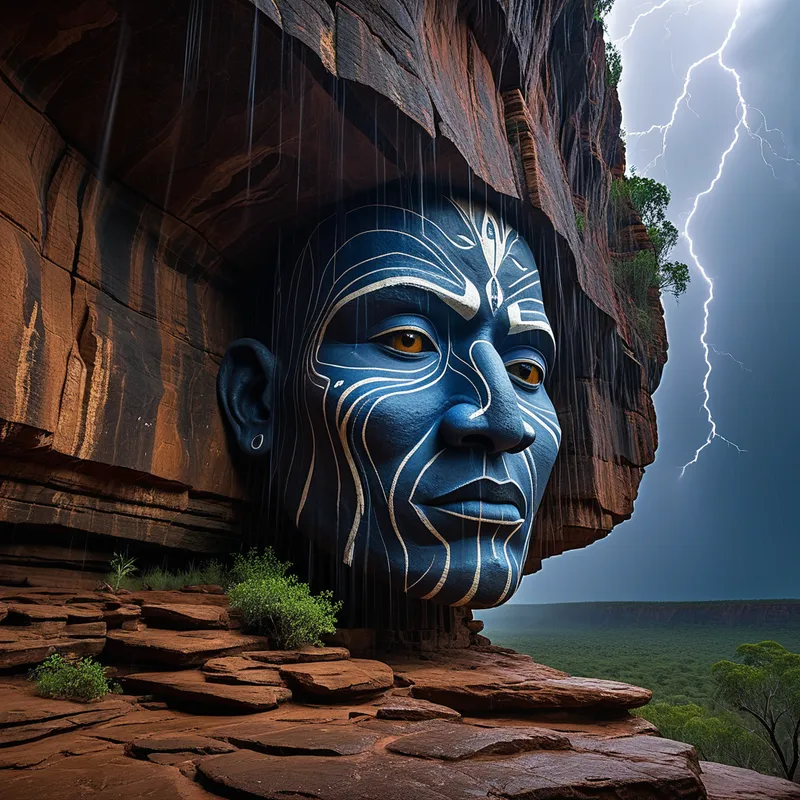
They descended not with a crash, but with a gathering, a profound pressure in the air. Their forms were like humans, yet utterly other: immense, haloed heads that held the wisdom of the stars, eyes like deep pools of night that saw into the heart of things, and where a mouth should be, only smooth, potent silence. They did not speak with words, but with the language of the elements. With them came the first great clouds, rolling in from the sea, heavy with promise.
The eldest Wandjina raised its hand, and a spear of Lightning split the sky. It was not destruction, but a call. The thunder that followed was the first drumbeat of creation. Then, they opened the sky. Rain fell—not a gentle shower, but the great, life-giving monsoon. It roared onto the plains, filled the cracked riverbeds, and carved the gorges that would become the arteries of the land. Where the Wandjina walked, water followed, and where they rested, soaks and springs bubbled forth from the stone.
They shaped the world with intention. One Wandjina dragged its fingers through the mud, and a mountain range rose. Another breathed upon a valley, and it bloomed with the first green. They placed the animals and gave them their languages, and they set the stars in their courses. But their greatest gift was The Law. They imprinted it upon the land itself, in the relationship between the water and the rock, the kangaroo and the grass, the people and the sky.
Their work complete, the Wandjina did not simply depart. They performed the final, sacred act. One by one, they entered the very rock faces of the escarpments and caves of the Kimberley. Their powerful spirits infused the stone, leaving behind their images as a covenant. Their bodies became part of the country, their eyes forever watching from the rock. They became the land, and the land became them. Now, they sleep within the stone, but their power is not dormant. When the monsoon clouds gather each year, it is the breath of the Wandjina, stirring in their sacred places, calling the rains to renew the world once more.
Cultural Origins & Context
The Wandjina tradition belongs to the Wunambal, Ngarinyin, and Worrorra peoples (often grouped as the Mowanjum community) of the Kimberley region. This is not a myth of a distant past, but a living cosmology integral to The Dreaming. The myths are not mere stories but are sung, danced, and painted, forming the core of a profound ritual and custodial relationship with country.
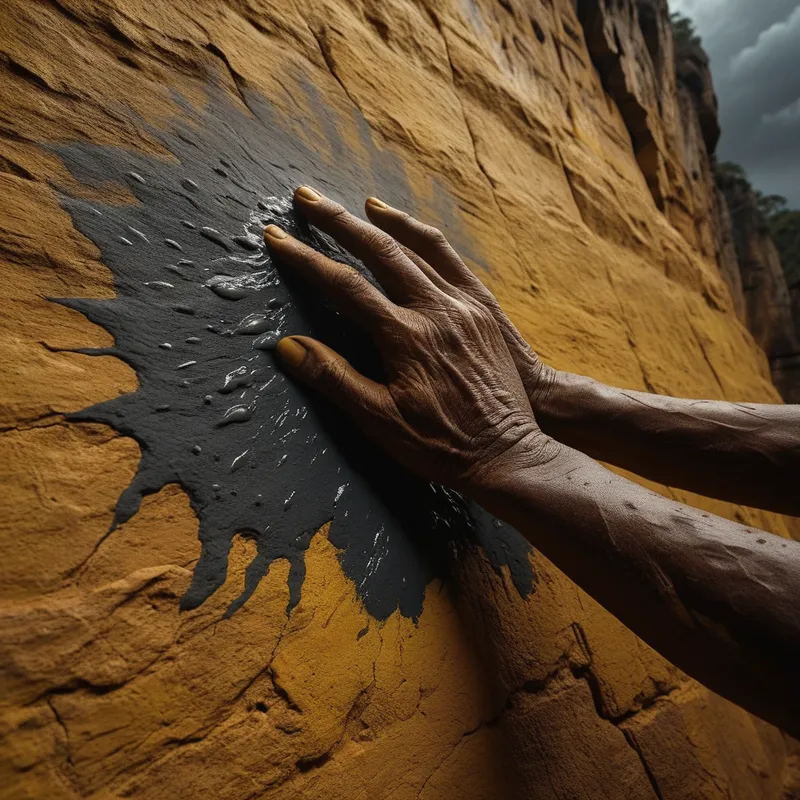
The narratives and the sacred rights to depict the Wandjina are passed down through specific family lineages. The most powerful manifestation of this tradition is the rock art—some of the most distinctive and majestic in the world. These sites are not museums; they are living temples. The act of repainting the images, a ritual conducted by senior knowledge holders, is not restoration but revitalization. It is a direct interaction with the Wandjina’s enduring power, a prayer for fertility and seasonal order, and a reaffirmation of the Law they established. The myth functions as the ultimate charter for ecological responsibility, social structure, and spiritual identity, binding the people irrevocably to their land.
Symbolic Architecture
The Wandjina presents a profound symbolic [architecture](/symbols/architecture “Symbol: Architecture in dreams often signifies structure, stability, and the framing of personal identity or life’s journey.”/) centered on creative [authority](/symbols/authority “Symbol: A symbol representing power structures, rules, and control, often reflecting one’s relationship with societal or personal governance.”/), cyclical renewal, and the [paradox](/symbols/paradox “Symbol: A contradictory yet true concept that challenges logic and perception, often representing unresolved tensions or profound truths.”/) of immanent [presence](/symbols/presence “Symbol: Presence in dreams often signifies awareness or acknowledgment of something significant in one’s life.”/).
The mouthless face speaks of a knowledge beyond words, a law written directly into the fabric of the world, communicated through the thunder and the flood.
The most striking feature—the lack of a mouth—symbolizes that their power and law are transmitted not through [human](/symbols/human “Symbol: The symbol of a human represents individuality, complexity of emotions, and social relationships.”/) speech but through natural phenomena and direct spiritual imprinting. They are the ultimate Order-givers. Their large, dark eyes represent all-seeing omniscience and a perpetual, watchful presence. The [halo](/symbols/halo “Symbol: A luminous circle or ring of light, often depicted around a head, symbolizing divinity, enlightenment, or exceptional virtue.”/) or headdress often connects them to [storm clouds](/symbols/storm-clouds “Symbol: Storm clouds represent impending conflict, emotional turmoil, or a significant change approaching in one’s life.”/) and celestial power.
They are beings of [Water](/symbols/water “Symbol: Water symbolizes the subconscious mind, emotions, and the flow of life, representing both cleansing and creation.”/) and [Lightning](/symbols/lightning “Symbol: Lightning symbolizes sudden insights or revelations, often accompanied by powerful emotions or disruptive change.”/), agents of both creation and [cataclysm](/symbols/cataclysm “Symbol: A sudden, violent upheaval or disaster of immense scale, often representing profound transformation, destruction, or the collapse of existing structures.”/) who bring [life](/symbols/life “Symbol: The symbol of ‘Life’ represents a journey of growth, interconnectedness, and existential meaning, encompassing both the joys and challenges that define human experience.”/) through the terrifying, purifying force of the [monsoon](/symbols/monsoon “Symbol: Monsoons symbolize intense emotional experiences, often bringing about renewal or upheaval, and may represent cycles of change.”/). Their final act—entering the rock—is the ultimate [symbol](/symbols/symbol “Symbol: A symbol can represent an idea, concept, or belief, serving as a powerful tool for communication and understanding.”/) of immanence. The divine does not abandon creation; it becomes it. The Cave [wall](/symbols/wall “Symbol: Walls in dreams often symbolize boundaries, protection, or obstacles in one’s life, reflecting the dreamer’s feelings of confinement or security.”/) holding their [image](/symbols/image “Symbol: An image represents perception, memories, and the visual narratives we create in our minds.”/) is thus a [Door](/symbols/door “Symbol: A door symbolizes transition, opportunity, and choices, representing thresholds between different states of being or experiences.”/) to the Dreaming, and the painted [image](/symbols/image “Symbol: An image represents perception, memories, and the visual narratives we create in our minds.”/) itself is a [Spirit Stone](/symbols/spirit-stone “Symbol: The Spirit Stone symbolizes connection to the spiritual realm, grounding, and the essence of nature’s energies.”/), a concentrated point of ancestral presence.
The Dreamer’s Resonance
To dream of a Wandjina is to encounter the archetype of foundational authority and the terrifying grace of creation. Psychologically, it often manifests during a profound re-ordering of the inner world.
The dreamer may find themselves in a vast, arid internal landscape—a state of psychic drought, spiritual exhaustion, or moral confusion. The appearance of the Wandjina, often sensed as a immense, silent pressure before it is seen, signals an impending inner monsoon. This can feel chaotic and overwhelming: a flood of repressed emotion (Water), a shocking insight that shatters old ways of thinking (Lightning), or the imposition of a stern, non-negotiable inner truth (the mouthless Law). The somatic experience can be of cleansing release or of being carved apart by a force greater than oneself.
The resolution in such a dream is not the being’s departure, but its integration. The dreamer may see their own face becoming smooth and featureless, or they may find themselves painting the image, signifying a move from being acted upon to becoming a custodian of this new, foundational order within their own psyche.
Alchemical Translation
The Wandjina myth models the alchemical process of coagulatio—the spirit becoming matter, the ideal becoming real—as the path of individuation.
True creation is not an act of whimsy, but of law; the Self is not discovered in freedom from constraint, but in the conscious embodiment of one’s own deepest, most non-negotiable principles.
The modern individual’s journey often begins in a state of psychic scarcity, a “dry season” where life feels meaningless or repetitive. The call of the Wandjina is the eruption of the creative dynamis, the terrifying urge to bring something new into being—a life path, a work, a healed self. This initial inspiration (the Lightning) is chaotic and can feel destructive to the old, parched identity.
The subsequent “rain” is the long, often difficult process of giving this inspiration form: the daily discipline, the emotional labor, the slow accumulation of skill and substance. It is the flood that fills the riverbeds of habit. The critical alchemical stage is the Wandjina’s entry into the rock. This symbolizes the point where the inspired vision (spiritus) must become ingrained structure (corpus). For the individual, this is the embodiment of their truth into consistent action, personal ethics, and tangible creation. The mouthless face reminds us that this embodied law needs no constant justification; it simply is.
Finally, the myth teaches that this achieved structure is not an end, but a sacred site that requires perpetual renewal. The ritual repainting is the act of ongoing commitment, the daily choices that reaffirm one’s sovereign creative authority, ensuring the inner monsoons continue to cycle, bringing perpetual rebirth.
Associated Symbols
Explore related symbols from the CaleaDream lexicon:
- Rain — The primary manifestation of the Wandjina’s creative and sustaining power, representing emotional and spiritual abundance, cleansing, and cyclical renewal.
- Lightning — The sudden, catalyzing force of divine inspiration or transformative insight that precedes and initiates the creative downpour.
- Spirit — The essential, ancestral power of the Wandjina, which exists beyond physical form and infuses the land, art, and living tradition.
- Cave — The sacred, womblike space of the rock shelter where the Wandjina reside, representing the unconscious, the place of mystery, and the portal to the Dreaming.
- Door — The painted image of the Wandjina itself, which serves as a threshold or access point between the mundane world and the timeless realm of the ancestral creators.
- Order — The fundamental Law (Lore) brought by the Wandjina, representing the sacred structure, rules for living, and natural balance imposed upon creation.
- Earth — The living entity into which the Wandjina merged, symbolizing the ultimate unity of creator and creation, spirit and matter.
- Stone — The enduring medium that holds the Wandjina’s essence, representing permanence, memory, and the solidified presence of ancestral power.
- Dream — The state of consciousness and the epoch of time (The Dreaming) in which the Wandjina operate, representing the foundational, mythic reality underlying visible existence.
- Rebirth — The perpetual cycle of the monsoon, initiated by the Wandjina, symbolizing the seasonal and spiritual renewal guaranteed by their enduring presence.
- Ancestral Spirit — The specific mode of the Wandjina’s existence as progenitors and perpetual, watchful guardians of the people and the land.
- Origin — The Wandjina as the foundational source-point of the world’s geography, laws, and life, representing the absolute beginning and reference point for all that follows.