
Vaitarna River Myth Meaning & Symbolism
A sacred river born from divine grief, forming the ultimate boundary between the worlds of the living and the dead in Hindu cosmology.
The Tale of Vaitarna River
Listen, and hear the story of the river that is not a river, the boundary that is a birth. In the time when the worlds were still settling into their shapes, the great goddess Parvati walked the earth. Her heart, a universe of compassion, was heavy with a sorrow not her own. She saw the souls of the departed, confused and weary, wandering the bleak plains between life and what lies beyond. They stumbled in a formless twilight, lost without a path, without a guide, without a final rite to sever the last clinging threads of their earthly sojourn.
Their silent suffering was a cold wind against her divine spirit. A great pang of empathy, sharper than any celestial weapon, pierced her. From the depths of that sacred sorrow, born of limitless love for all beings, a single tear welled in her eye. It was no ordinary tear. It held the essence of transition, the weight of release, the clarity of farewell. It fell, a diamond droplet from the face of the Mother of the World.
Where it struck the barren ground, the earth did not soak it up. Instead, the tear began to flow. It carved a channel through the very fabric of reality, drawing to itself the waters of cosmic law and the substance of mercy. It grew, shimmering with a light that was both silver and shadow, cool and profound. This was the Vaitarna, the “Swift One,” a river born not from mountain snow but from divine grief transmuted into grace.
Its waters became the ultimate threshold. On one shore lay the vibrant, tangled, sorrowful, and joyous realm of the living—Bhuloka. On the other, visible yet untouchable, lay the silent, waiting fields of the ancestors and the court of Yama. The river itself became the final test, the last purification. Its currents were said to be fierce for the wicked, pulling them into tormented depths, but for the righteous, they were a gentle, guiding flow. The mythical boatman, the silent ferryman of souls, awaited at its banks. To cross the Vaitarna was to submit to the great accounting, to have the sum of one’s life weighed against the feather of truth. It was the moment between the last breath here and the first awareness there—the sacred, terrifying, and necessary borderland of the soul.

Cultural Origins & Context
The Vaitarna River flows primarily through the tributaries of post-Vedic Puranic literature and the vast epic of the Mahabharata. It is not a geographical river one can easily map, though some traditions later identified it with physical waterways. Its true home is in the cartography of the afterlife, a central feature in the Yamaloka or Pitriloka.
This myth was perpetuated by storytellers, priests, and philosophers serving a critical societal function: it gave tangible, narrative form to the abstract concepts of death, judgment, and the journey of the atman. In a culture where the rites for the deceased (antyeshti) are of paramount importance, the Vaitarna provided a vivid destination for those rites. The offerings made to ancestors were believed to sustain them on their journey and help them cross this formidable boundary. Thus, the myth enforced dharma (righteous living) by illustrating the consequences of one’s actions, while also offering comfort—the river was a structured path, not an abyss. It answered the human need to imagine what happens after, providing a landscape for the unknown and reinforcing the cultural importance of ritual in navigating life’s ultimate transition.
Symbolic Architecture
The Vaitarna is the ultimate symbol of the liminal. It is not life, nor is it death; it is the process of becoming from one state to the other. Psychologically, it represents every critical threshold we cross: the end of a chapter, the death of an old identity, the profound transition after loss, or the moment before a life-altering decision.
The river is not an obstacle, but the very process of transformation. One does not cross it unchanged; one is changed by the crossing.
Its birth from Parvati’s tear is profoundly significant. It means this necessary, feared boundary is forged from compassion, not punishment. The mother goddess, in her aspect as the one who cannot bear the suffering of her children, provides the means for their passage. This frames death not as a cold cessation, but as an act of divine mercy, a reintegration facilitated by maternal love. The varying nature of its currents—turbulent for the wicked, calm for the virtuous—externalizes the internal state of the soul. The journey across is a mirror; we meet the consequences of our own accumulated nature (karma).
The Dreamer’s Resonance
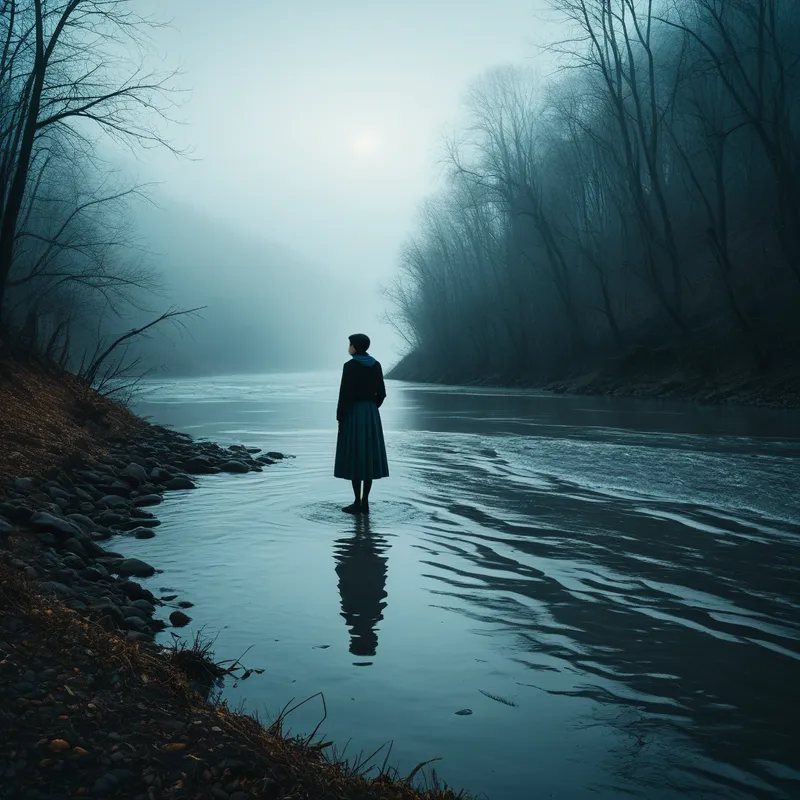
When the pattern of the Vaitarna surfaces in modern dreams, it rarely appears as a literal Hindu myth. Instead, the dreamer finds themselves at a formidable boundary: a wide, dark river they must cross, a bridge that seems endless, a shoreline from which they cannot see the other side. There is often a silent, waiting vessel or a guide whose face is obscured.
This dream signals that the psyche is in a state of profound transition. The ego is being asked to let go of a solidified identity, a long-held belief, or a finished phase of life. The somatic experience can be one of anxiety, weight, or a chilling stillness—the feeling of being on the precipice. The “other shore” represents a new psychic configuration, a potential self that is still unknown and therefore frightening. The dreamer’s emotional state in the dream—whether they feel dread, peace, reluctance, or readiness—reveals their unconscious attitude toward this necessary ending. To dream of successfully crossing suggests acceptance and integration. To dream of being stuck on the bank, or of the boat capsizing, speaks to a deep resistance to this inner alchemy, a clinging to what must be released.
Alchemical Translation
For the modern individual navigating the path of individuation—the process of becoming whole—the Vaitarna myth models the essential, non-negotiable stage of solutio. This is the psychic dissolution, the “death” of outmoded complexes, personas, and dependencies that block the flow of the true self.
The alchemical work requires us to become our own ferryman, to consent to the dissolution of the shore we know, trusting that the river’s current, born of our own deepest self (the inner Parvati), carries us toward wholeness.
We are asked to approach our own inner riverbanks: the end of a career, the close of a relationship, the loss of a cherished ideal. The myth instructs us that to cross, we must first offer up our “obsequies”—the honest review and mourning of what is passing. We must confront the ledger of our personal karma, acknowledging both our virtues and our faults without flinching. This is the judgment, not by an external Yama, but by the inner voice of conscience and integrity.
The triumphant crossing is not an escape from the self, but a purification of it. The ego, stripped of its excess baggage, is reconstituted on the other side, closer to the Self. In this light, the Vaitarna is not about physical death, but about the many ego-deaths required to live authentically. It is the sacred, often painful, process of shedding to become, of ending to begin anew, guided by the compassionate, transformative waters that arise from our own capacity to feel, to grieve, and ultimately, to let go.
Associated Symbols
Explore related symbols from the CaleaDream lexicon: