Umbanda in Brazil Myth Meaning & Symbolism
A living myth of spiritual synthesis, where African Orixás, Indigenous spirits, and ancestral guides converge to heal the wounds of history and the soul.
The Tale of Umbanda in Brazil
Listen. This is not a story that begins “once upon a time.” It is a story that is happening now, in the humid air, in the beat of the drum, in the salt spray of the ocean. It begins in the wound, in the tear, in the violent sundering of a people from their soil. Across the black water, in chains, they came, their gods shackled within their hearts. The land they met was ancient, singing with spirits of river and forest—the Caboclos, proud and free. And over them all lay the heavy cloak of a new god, with saints of plaster and gold.
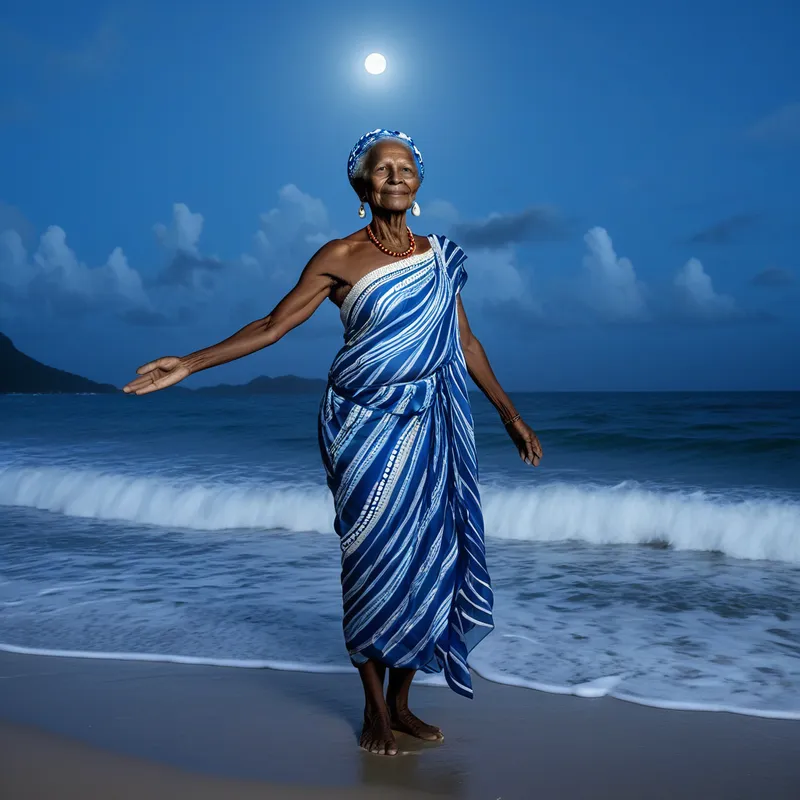
In the belly of the new world, the old gods stirred. Orixás like Xangô, whose axe cleaves falsehood, and Iemanjá, whose waves are both cradle and grave, pressed against the confines of memory. They whispered through the grief, through the work-song, through the secret gatherings in the quilombos. The spirits of the land, the Caboclos with feathers and arrows, watched. They saw not invaders, but fellow exiles of spirit. And the ancestors, the Pretos Velhos—the Old Blacks—who had endured the passage and the lash, sat in the spiritual twilight, smoking their pipes with infinite patience.
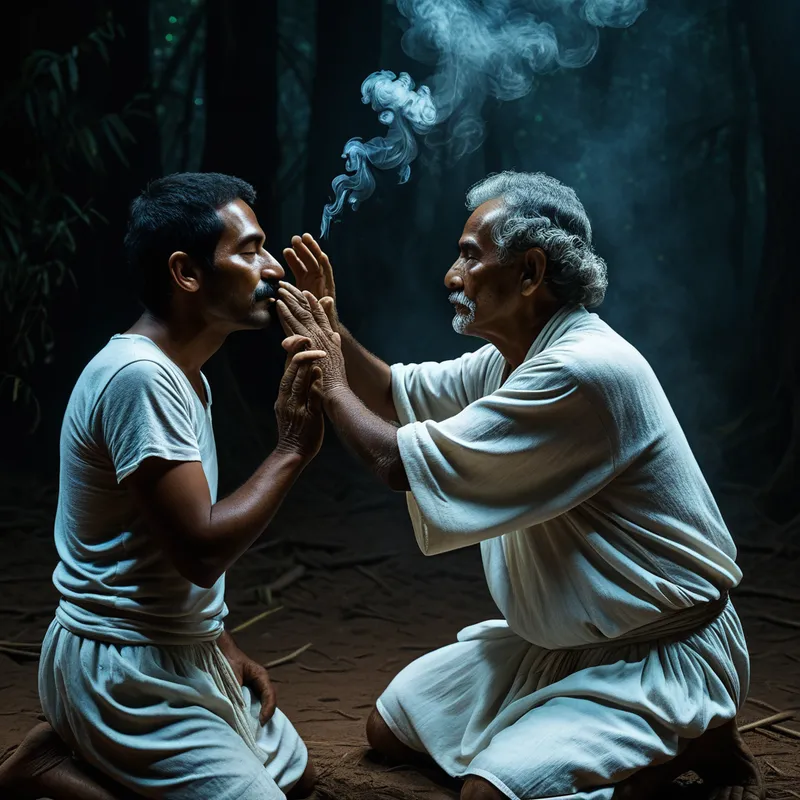
The conflict was a cacophony of souls: Yoruba prayers tangled with Latin masses, Indigenous chants muffled by plantation silence. The rising action was not a battle, but a blending—a desperate, beautiful act of psychic survival. A medium, perhaps a woman broken by toil, would feel a coolness at her brow. Not the saint she was told to pray to, but the firm, gentle presence of a Pai Velho, an old enslaved ancestor. His voice, raspy with wisdom and hardship, would speak through her, offering counsel, a healing leaf, a proverb that mended the spirit. In another, the fierce, rolling energy of a Caboclo would arrive, a spirit of the forest, dancing with untamed grace, bringing the strength of the land itself.
The resolution is the ceremony, the Gira. In a simple room, the atabaques thunder, a heartbeat calling the scattered family home. The air grows thick with sage and pipe smoke. One by one, the mediums sway, their eyes rolling back to white. They are mounted, possessed, not by demons, but by guides. The Pai Velho offers bitter herbs and sweet forgiveness. The Caboclo clears paths with his invisible blade. The Pomba Gira, a fierce feminine spirit of the crossroads, teaches of autonomy and desire. And behind them all, like great constellations, stand the Orixás, lending their elemental power: the justice of Xangô, the healing of Ossain, the transformative fire of Iansã.
The myth does not end. It turns, like a wheel. It is the story of the broken made whole through multiplicity. It is the spirit, once fractured by history, choosing to wear all its faces at once, and in that act, becoming more powerful than any single god, any single law, any single story of domination. It is the birth of a nation’s soul from the meeting of three weeping roots.
Cultural Origins & Context
The myth of Umbanda is a historical alchemy recorded in spirit. It formally crystallized in early 20th-century Rio de Janeiro, notably through the work of Zélio Fernandino de Moraes in 1908, but its components are centuries old. It is a core narrative of the African Diaspora in Brazil, born from the traumatic synthesis—the mestiçagem—forced by colonization, slavery, and cultural survival.
Its primary tellers were the enslaved Africans, primarily of Bantu and Yoruba origin, and their descendants. They carried the Orisha traditions, which were suppressed by Catholic colonizers. To preserve their gods, they engaged in a profound act of symbolic syncretism, pairing Orixás with Catholic saints (e.g., Iemanjá with Our Lady of the Immaculate Conception, Oxossi with Saint Sebastian). Simultaneously, on the ground, they encountered the robust spiritual cosmologies of Indigenous peoples, which honored the spirits of the land (caboclos). From this triple heritage—African, Indigenous, European—and infused with Kardecist Spiritism’s philosophy of moral evolution and mediumship, Umbanda emerged.
Its societal function was and remains multifaceted: a system of healing (physical, emotional, social), a court of justice for the marginalized, a means of preserving ancestral identity, and a powerful engine for community cohesion. It gave voice to the voiceless—the enslaved ancestor (Preto Velho), the displaced Indigenous guide (Caboclo)—and reintegrated them as honored, wise authorities within a new spiritual hierarchy. It transformed historical pain into a framework for spiritual agency.
Symbolic Architecture
At its core, the myth of Umbanda is a symbolic [blueprint](/symbols/blueprint “Symbol: A blueprint represents the foundational plan or design for something, often symbolizing potential, structure, and the mapping of one’s inner self or future.”/) for the [integration](/symbols/integration “Symbol: The process of unifying disparate parts of the self or experience into a cohesive whole, often representing psychological wholeness or resolution of internal conflict.”/) of the fragmented psyche. Each spiritual line represents a disowned part of the collective and individual [soul](/symbols/soul “Symbol: The soul represents the essence of a person, encompassing their spirit, identity, and connection to the universe.”/).
The forest does not ask the river why it is wet, nor the stone why it is hard. In Umbanda, the whole world is invited to the healing circle.
The Pretos Velhos symbolize the wisdom of endured suffering, the patience of the wounded [healer](/symbols/healer “Symbol: A figure representing restoration, transformation, and the integration of physical, emotional, or spiritual wounds. Often symbolizes a need for care or a latent ability to mend.”/), and the ancestral [shadow](/symbols/shadow “Symbol: The ‘shadow’ embodies the unconscious, repressed aspects of the self and often represents fears or hidden emotions.”/). They represent the part of the self that has been humiliated, aged before its time, yet has metabolized pain into profound [compassion](/symbols/compassion “Symbol: A deep feeling of empathy and concern for others’ suffering, often involving a desire to help or alleviate their pain.”/) and practical counsel. The Caboclos symbolize untamed instinct, [connection](/symbols/connection “Symbol: Connection symbolizes relationships, communication, and bonds among individuals.”/) to [nature](/symbols/nature “Symbol: Nature symbolizes growth, connectivity, and the primal forces of existence.”/), and sovereign freedom. They represent the psychic [energy](/symbols/energy “Symbol: Energy symbolizes vitality, motivation, and the drive that fuels actions and ambitions.”/) that is wild, autonomous, and in direct communion with the [life](/symbols/life “Symbol: The symbol of ‘Life’ represents a journey of growth, interconnectedness, and existential meaning, encompassing both the joys and challenges that define human experience.”/)-force of the world, often repressed in civilized society.
The Orixás represent the archetypal, impersonal forces of nature and [human](/symbols/human “Symbol: The symbol of a human represents individuality, complexity of emotions, and social relationships.”/) [character](/symbols/character “Symbol: Characters in dreams often signify different aspects of the dreamer’s personality or influences in their life.”/)—the thunderous anger of Xangô, the deep emotional currents of Iemanjá, the strategic intelligence of Exu. The practice of incorporation is the ultimate [symbol](/symbols/symbol “Symbol: A symbol can represent an idea, concept, or belief, serving as a powerful tool for communication and understanding.”/): the conscious, ritualized lowering of the ego to allow these other “selves” to speak and act. It is a model of a non-ego-centric psyche, where the “I” is a [vessel](/symbols/vessel “Symbol: A container or structure that holds, transports, or protects something essential, representing the self, emotions, or life journey.”/) for a [community](/symbols/community “Symbol: Community in dreams symbolizes connection, support, and the need for belonging.”/) of internal voices that each have their [role](/symbols/role “Symbol: The concept of ‘role’ in dreams often reflects one’s identity or how individuals perceive their place within various social structures.”/) and wisdom.
The Dreamer’s Resonance
When this mythic pattern stirs in modern dreams, it often signals a profound process of internal synthesis and the calling of forgotten “spirits” to the table of consciousness. One might dream of a vast, crowded hall where figures from different eras and cultures—a stern grandmother, a feather-clad warrior, a regal queen—all wait patiently for acknowledgment. This is the psyche assembling its own spiritual lineage.
Somatically, this can feel like a pressure at the crown of the head or solar plexus, a rhythmic pulsing, or a sensation of being “moved” by an external force. Psychologically, it manifests as conflicting impulses: a deep, patient melancholy (Preto Velho) alongside a fierce, restless desire for freedom and action (Caboclo). The dreamer may be at a crossroads in life, feeling pulled between duty and desire, tradition and innovation, grief and power. The dream is an invitation to host these contradictions, to allow the internal mediumship where each voice is given a respectful hearing, rather than being split off into shadow.

Alchemical Translation
The alchemy of Umbanda is the transmutation of historical and psychic trauma into a functional, empowered plurality. For the modern individual navigating a fragmented self—the professional persona, the inner child, the repressed wildness, the ancestral baggage—it offers a radical model of individuation.
Individuation is not about becoming a single, pure note, but about conducting the entire orchestra of one’s being.
The process begins with recognition (seeing the exiled parts: the enslaved victim, the indigenous instinct, the divine authority). It proceeds to invitation (the drumbeat of attention, the ritual space of therapy or active imagination). The critical phase is incorporation—not possession by an external demon, but the conscious, temporary granting of authority to an inner complex. Let the “Preto Velho” within speak its weary wisdom; let the “Caboclo” dance its untamed joy. Finally, there is integration and direction. The Orixás represent the mastered, archetypal energies that result from this work: the ability to wield justice (Xangô) with compassion, to navigate deep emotion (Iemanjá) without drowning, to act decisively at crossroads (Exu).
The ultimate triumph is not singularity, but a resilient, adaptive self that can call upon a full spectrum of energies appropriate to the situation. It is the healing of the colonial wound within the soul by refusing to choose one root over another, and instead, building an altar where all may sit, be fed, and contribute to the whole being’s evolution.
Associated Symbols
Explore related symbols from the CaleaDream lexicon:
- Drum — The sacred heartbeat of the Gira, calling the scattered spirits of the self and the ancestors to converge and communicate, symbolizing rhythm, call, and psychic vibration.
- Crossroads — Represented by Exu, it is the place of choice, encounter, and transformation where different worlds (human/spirit, past/present) meet.
- Ocean — The domain of Iemanjá, symbolizing the deep unconscious, the womb of origins, emotional depth, and the flow of life that both nurtures and cleanses.
- Forest — The realm of the Caboclos and Oxossi, representing the untamed psyche, instinctual wisdom, natural healing, and the place of refuge and hunting for truth.
- Ancestor — Embodied by the Pretos Velhos, symbolizing the foundation of identity, the wisdom of endured time, and the debt and dialogue between the living and the dead.
- Fire — The element of Xangô and Iansã, representing transformative justice, purification, passionate will, and the lightning-strike of sudden change or revelation.
- Herb — Sacred to Ossain, symbolizing natural healing, the knowledge of subtle energies, and the practical, earth-bound magic that minds the body and spirit.
- Mirror — Used in rituals and associated with spirit manifestation, it symbolizes reflection, the other side, the spirit world, and the act of seeing the self through the eyes of another consciousness.
- Circle — The shape of the Gira, representing wholeness, community, the cyclical nature of time and karma, and the sacred space where all forces are contained and harmonized.
- Mask — Symbolizing the ritual of incorporation, where the medium dons the “mask” of the spirit, representing the archetypal persona, sacred performance, and the fluidity of identity.
- Root — The foundational connection to Africa, to the land, and to ancestry, representing the hidden, nourishing source of strength and identity that must be tended for the tree to thrive.
- Dance — The sacred movement of the spirits through the medium, symbolizing embodied wisdom, ecstatic release, the flow of energy, and the joy of spiritual presence.