Umai Goddess of Birth Myth Meaning & Symbolism
The myth of Umai, the life-giving, protective mother goddess who guides souls into the world and safeguards the vulnerable spirit of the newborn.
The Tale of Umai Goddess of Birth
Listen, child of the eternal blue sky, to the whisper that rides the wind across the high steppe. Before the first horse was tamed, before the first hearth-fire was lit in the felt ger, there was the Great Silence. And within that silence, a longing. The earth, our mother Etugen, lay fertile and dreaming, but her dreams had no voices, no laughter to echo in the valleys. The sky, our father Tengri</abbr, watched with a million starry eyes, but his light fell upon stillness.
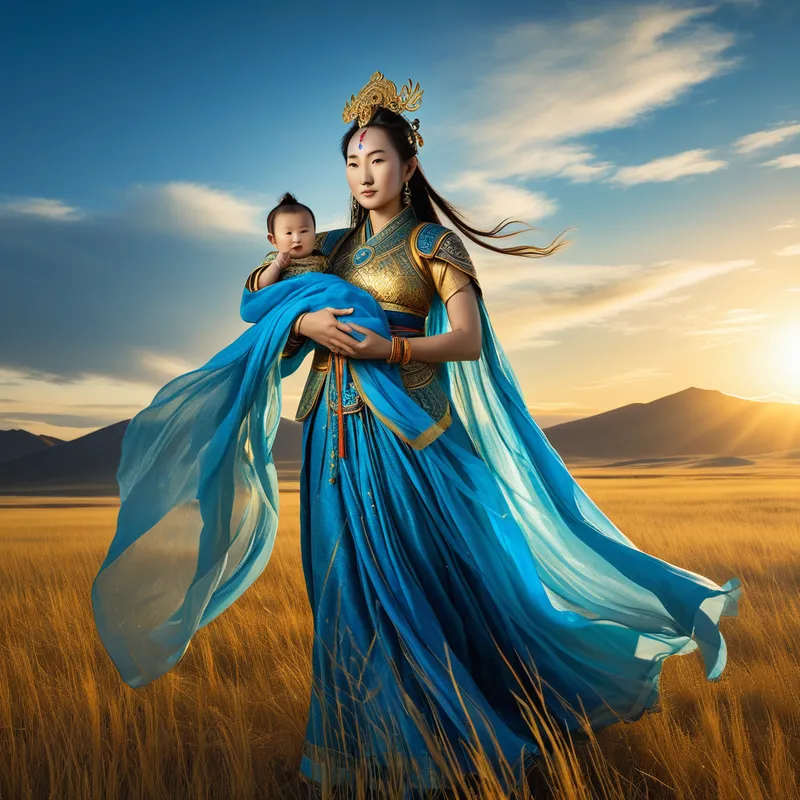
Then, from the place where the world’s breath gathers—the space between a thought and its form—she appeared. Not with thunder, but with a sigh that became the first breeze. She was Umai. Her hair was the long grass of the summer pasture, her skin the color of warm, rich soil at sunrise. In her cupped hands, she held not water, not fire, but a shimmering, restless essence—the very spark of sülde, the spirit of life and destiny.
She knelt upon the earth and breathed onto the spark. It did not ignite; it quickened. It yearned. Umai saw that this spark was a traveler, a soul on a vast and perilous journey from the starry realms of Tengri to the clay vessel of a body within a mother’s womb. The journey was long, and the steppe between worlds was haunted by shapeless, hungry shadows—the envious spirits who had no form of their own.
So Umai became the guide, the protector, the midwife of the cosmos. When a child was conceived in the warm dark of the womb, she would take that shimmering soul-spark and begin its descent. She wove for it a cord, not of wool or sinew, but of solidified moonlight and maternal intention—the khuimori, the life-force cord. Down this celestial umbilical cord she would lower the soul, singing a song older than language, a lullaby of welcome.
Her work did not end with birth. As the infant drew its first painful, glorious breath, Umai remained. She took residence in the soft spot on the baby’s head, the fontanel, a living guardian spirit. For three years (some say seven), she would shield the child’s vulnerable spirit from the clinging shadows of illness and misfortune. Mothers would hang blue silk, the color of Tengri, near the cradle, knowing it was a banner Umai recognized—a sign of a home where a soul was under her sacred guard. To offend Umai was to risk the severing of that cord, the withdrawal of her protective gaze, leaving a child listless and a soul exposed. But in her presence, there was the unshakeable safety of the mountain, the nurturing abundance of the spring, and the fierce, quiet love that turns a house into a sanctuary.

Cultural Origins & Context
The veneration of Umai is a cornerstone of the ancient Tengrist worldview that shaped Mongolian and broader Turkic cultures. Unlike myths preserved in epic poems, Umai’s story was lived daily. It was not merely a tale for the campfire but a functional, spiritual technology for survival on the harsh, beautiful steppe. This myth was passed down not by bards, but by mothers, grandmothers, and shamans (böö).
Her worship was deeply domestic and intimately feminine. Rituals were simple, profound acts: an offering of the first milk of a mare to the hearth, the careful placement of a child’s cradle in the auspicious northern part of the ger, the avoidance of loud noises or sharp objects near an infant lest they disturb Umai. She represented the sacredness of fertility and lineage—the direct, tangible connection between the cosmic order of Tengri and the continuity of the family and tribe. In a nomadic life where infant mortality was a stark reality, Umai provided a framework for understanding both the miracle of life and the tragedy of its loss. She was the personification of hope and proactive spiritual care, making the invisible forces of creation and protection tangible and approachable.
Symbolic Architecture
At its core, the myth of Umai is a profound map of the [soul](/symbols/soul “Symbol: The soul represents the essence of a person, encompassing their spirit, identity, and connection to the universe.”/)’s [journey](/symbols/journey “Symbol: A journey in dreams typically signifies adventure, growth, or a significant life transition.”/) into incarnation. She symbolizes the necessary intermediary principle—the divine function that bridges the absolute (Tengri) and the manifest ([Earth](/symbols/earth “Symbol: The symbol of Earth often represents grounding, stability, and the physical realm, embodying a connection to nature and the innate support it provides.”/)/Etugen).
The soul does not fall into matter; it is lovingly guided, tethered, and welcomed.
The khuimori is perhaps the central [symbol](/symbols/symbol “Symbol: A symbol can represent an idea, concept, or belief, serving as a powerful tool for communication and understanding.”/). It is the [connection](/symbols/connection “Symbol: Connection symbolizes relationships, communication, and bonds among individuals.”/) to [source](/symbols/source “Symbol: The origin point of something, often representing beginnings, nourishment, or the fundamental cause behind phenomena.”/), the psychic umbilical [cord](/symbols/cord “Symbol: Represents connections, bindings, lifelines, and structural support in architectural and spatial contexts.”/) that feeds our spiritual vitality. Its fragility represents the precariousness of early [life](/symbols/life “Symbol: The symbol of ‘Life’ represents a journey of growth, interconnectedness, and existential meaning, encompassing both the joys and challenges that define human experience.”/) and, by extension, the [vulnerability](/symbols/vulnerability “Symbol: A state of emotional or physical exposure, often involving risk of harm, that reveals authentic self beneath protective layers.”/) of any new, nascent [consciousness](/symbols/consciousness “Symbol: Consciousness represents the state of awareness and perception, encompassing thoughts, feelings, and experiences.”/)—a creative [idea](/symbols/idea “Symbol: An ‘Idea’ represents a spark of creativity, innovation, or realization, often emerging as a solution to a problem or a new outlook on life.”/), a budding [relationship](/symbols/relationship “Symbol: A representation of connections we have with others in our lives, often reflecting our emotional state.”/), a fledgling sense of self. Umai’s guardianship of the fontanel signifies the protection of softness, openness, and potential. The fontanel is a literal opening in the physical form, symbolizing the psychic opening required to receive grace, [intuition](/symbols/intuition “Symbol: The immediate, non-rational understanding of truth or insight, often described as a ‘gut feeling’ or inner knowing that bypasses conscious reasoning.”/), and spiritual nourishment.
Furthermore, Umai embodies a specific [aspect](/symbols/aspect “Symbol: A distinct feature, quality, or perspective of something, often representing a partial view of a larger whole.”/) of the Great [Mother](/symbols/mother “Symbol: The symbol of ‘Mother’ represents nurturing, protection, and the foundational aspect of one’s emotional being, often associated with comfort and unconditional love.”/) [archetype](/symbols/archetype “Symbol: A universal, primordial pattern or prototype in the collective unconscious that shapes human experience, behavior, and creative expression.”/): not the devouring or transformative [mother](/symbols/mother “Symbol: The symbol of ‘Mother’ represents nurturing, protection, and the foundational aspect of one’s emotional being, often associated with comfort and unconditional love.”/), but the nurturing, life-giving, and fiercely protective mother. She is the instinct to preserve, shelter, and foster growth. Psychologically, she represents the internalized [capacity](/symbols/capacity “Symbol: A measure of one’s potential, limits, or ability to contain, process, or achieve something, often reflecting self-assessment or external demands.”/) for self-care and the creation of a safe inner sanctum where the nascent, vulnerable parts of our psyche can develop without being attacked by inner “shadows” or critical voices.
The Dreamer’s Resonance
When the pattern of Umai stirs in the modern dreamer, it often signals a profound process of psychic gestation and the need for sacred protection. This is not necessarily about physical childbirth.
Dreaming of a luminous blue cord, a protected infant (which may symbolize the dreamer themselves or a new project), or a serene, maternal presence in a domestic space points to a phase where something new and vital is coming into being within the psyche. This “new life” could be a recovered sense of innocence after trauma, the integration of a forgotten talent, or the early, tender stages of self-love. The somatic feeling is often one of warmth, safety, and gentle containment.
Conversely, dreams where this protective presence is absent—where a baby is lost, a cord is severed, or a cradle is empty and cold—may indicate a “soul wound.” This reflects a feeling that some vital, nascent part of the self was never properly welcomed, guarded, or nurtured. It speaks to a deep loneliness or vulnerability, a sense that one’s fundamental life-force (khuimori) is disconnected. The psyche is highlighting a need for radical self-care, for creating internal and external boundaries (the blue silk banner), and for consciously inviting in a protective, nurturing principle to safeguard what is trying to be born.
Alchemical Translation
The alchemical journey modeled by Umai is the opus of incarnation—the sacred work of bringing spirit fully into matter, of giving form to essence. For the modern individual pursuing individuation, this is the process of making the unconscious conscious, of giving “birth” to the true, authentic Self.
Individuation begins not with a heroic conquest, but with a vulnerable descent, guided by an inner, nurturing wisdom.
The first stage is the recognition of the “soul-spark”—that call from the Self, the vague longing, the creative impulse, or the healing intention that feels both deeply personal and transpersonal. This spark feels fragile and out of place in our ordinary, defended consciousness. The Umai process requires us to become our own guide and protector. We must consciously lower this spark into the “womb” of our daily lives and commitments. This is the act of commitment: starting the therapy, writing the first page, planting the seed.
Creating the “psychic khuimori” is the practice of maintaining a living, nourishing connection to what inspires and grounds us—through ritual, meditation, nature, or creative expression. It prevents the new consciousness from being orphaned in the world. Finally, Umai’s guardianship translates to the vigilant, compassionate protection of this emerging Self. It means setting boundaries against inner and outer “shadows” (criticism, cynicism, old patterns), honoring our vulnerability (the soft fontanel), and creating a sanctuary within and around us where growth is not just possible, but sacredly guarded. The ultimate triumph is not a dramatic victory, but the sustained, protected vitality of a soul fully at home in its own life.
Associated Symbols
Explore related symbols from the CaleaDream lexicon:
- Goddess — The nurturing, life-giving aspect of the divine feminine, representing protection, fertility, and the intermediary force between heaven and earth.
- Birth — The core event Umai presides over, symbolizing not just physical emergence but any profound beginning, incarnation, or awakening of new consciousness.
- Soul — The shimmering essence or sülde that Umai guides and protects, representing our individual core of destiny and vitality on its journey into form.
- Spirit — The animating life-force, synonymous with the soul in this context, highlighting its non-material, celestial origin under Tengri’s domain.
- Mother — The archetypal embodiment of Umai’s primary function: unconditional nurturance, protection, and the creation of a safe container for growth.
- Child — The vulnerable, nascent entity—be it a physical infant, a new idea, or an emerging aspect of the Self—that requires and receives sacred guardianship.
- Sky — The realm of Tengri, the origin point of the soul’s journey, representing the vast, spiritual source from which life descends.
- Cord — The khuimori, the vital tether connecting the individual to the divine source and symbolizing dependency, nourishment, and fragile connection.
- Protection — The central action and purpose of Umai, representing the active, vigilant safeguarding of what is vulnerable, precious, and in the process of becoming.
- Light — The luminous quality of the soul-spark and Umai’s guiding presence, representing consciousness, purity, and the antithesis of the formless shadows.
- Healing — The result of Umai’s guardianship, representing the restoration and maintenance of spiritual and psychic integrity, especially for the young and vulnerable.
- Door — The fontanel, the literal and symbolic opening through which spirit enters and is protected, representing a threshold between realms and states of being.