Twi Creation Myth Myth Meaning & Symbolism
Nyame, the Sky God, descends to the primordial waters, creates the earth with Asase Yaa, and sends the trickster Anansi to deliver wisdom and mortality to humanity.
The Tale of Twi Creation Myth
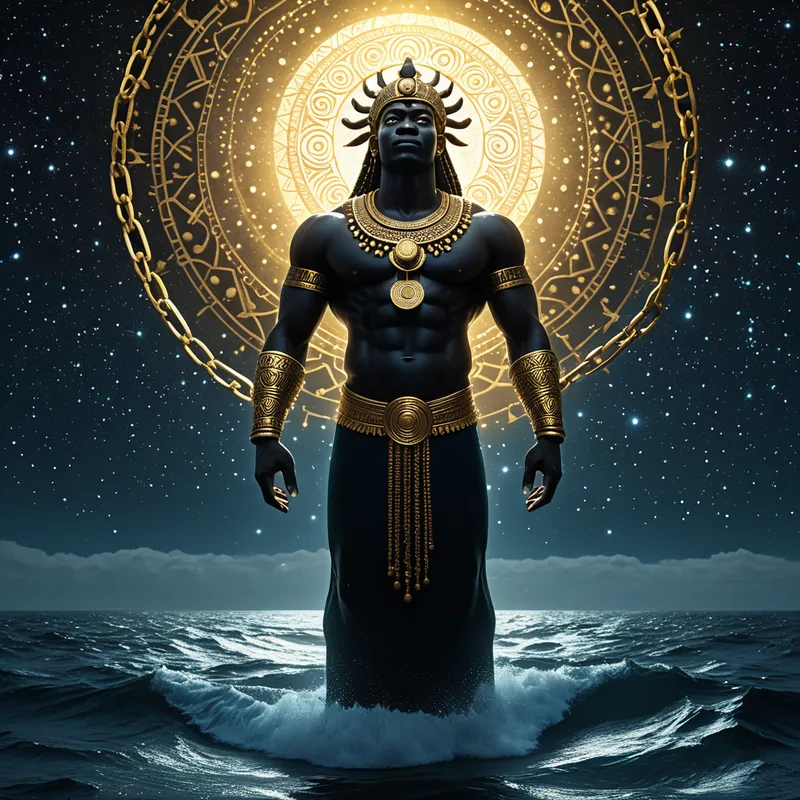
In the time before time, there was only Nyame, whose thoughts were stars and whose breath was the void. And there was the endless, silent, dark water. No land, no creature, no sound but the echo of divine solitude. Nyame gazed into the watery abyss and felt a longing—not for company, but for a place upon which to place his foot, a stage for the drama of existence.
So from the highest heaven, he began to descend. Not with a crash, but with a patient, deliberate purpose. He lowered a chain of gold, link by glowing link, from the realm of pure spirit into the formless deep. Down, down he came, a being of light approaching the primordial dark. And as he drew near the face of the waters, he summoned his companion, the one who would give form to his thought: Asase Yaa.
She rose from the deep, not as a person, but as a presence—the potential of solidity, of nurture, of foundation. Nyame spoke a word of power, a vibration that stirred the waters. Together, their essences mingled—sky and depth, spirit and substance. Where Nyame’s foot touched the churning waters, Asase Yaa responded. The waters receded, and the first earth, rich, dark, and fragrant, heaved itself upward. It was not a barren rock, but a living body, pregnant with all that would ever grow.
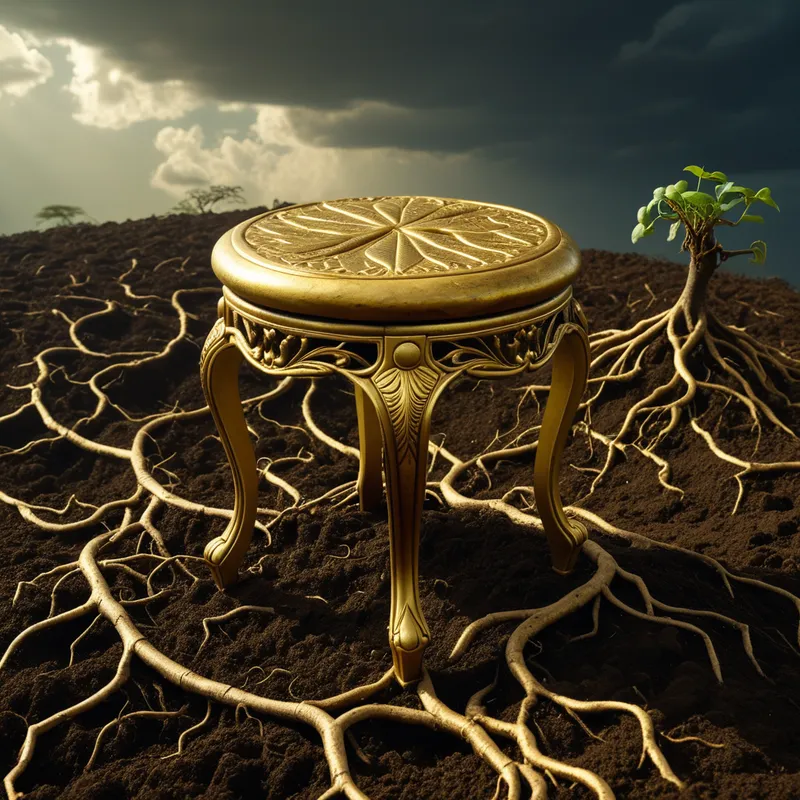
Upon this new earth, Nyame placed a Golden Stool. It descended from the heavens, containing the sunfire and the soul of the people yet to be. This was his covenant, the anchor of divine order in the material world. He then created the first humans, breathing into them the spark of life, okra, a direct fragment of his own divine essence. They were placed in a garden of profound abundance, where every need was met without toil.
But a world of perfect provision was a world without story, without growth. Nyame held in his possession the great calabash that contained all wisdom, all knowledge of things seen and unseen—including the knowledge of death. To keep this wisdom was to keep humanity as eternal children. To give it was to grant them the burden of consciousness and the shadow of mortality.
So Nyame called upon the clever one, Anansi. “Take this calabash to the humans,” Nyame commanded. Anansi, whose mind was a labyrinth of cunning, accepted the task. The journey was not easy; the calabash was heavy with the weight of the world’s truths. Anansi, in his ingenuity, tied it with a web to his back and began the descent to earth, weaving a story with every step.
He delivered the calabash. But with wisdom came the understanding of limits, of time, of ending. The garden’s innocence was forever altered. Humans now knew the names of things, the patterns of the seasons, the arts of survival and culture. And they knew, too, the finality that gave life its precious, aching urgency. Nyame and Asase Yaa watched from their realms—the sky and the soil—as the human drama, fueled by this gifted and perilous wisdom, began its eternal unfolding.
Cultural Origins & Context
This creation narrative originates from the Akan people, a major ethnic group of West Africa, primarily in present-day Ghana and Ivory Coast. The myth is part of the rich oral tradition of the Twi-speaking peoples, historically recited by Akyeame (spokespersons) and elders during significant ceremonies, festivals like the Odwira, and rites of passage.
It was never a single, fixed text but a living story, its variations echoing across different Akan states like Ashanti, Fante, and Akuapem. Its primary function was cosmological and social. It established a sacred order: Nyame as the ultimate, somewhat distant authority; Asase Yaa as the immediate, nurturing source of life; and the Golden Stool as the divine mandate for earthly kingship. The myth legitimized political structure, explained the human condition (blessed with divine essence yet subject to mortality), and encoded ethical principles about the relationship between humanity, the divine, and the natural world.
Symbolic Architecture
The myth presents a profound symbolic map of [consciousness](/symbols/consciousness “Symbol: Consciousness represents the state of awareness and perception, encompassing thoughts, feelings, and experiences.”/). Nyame represents the transcendent principle—the distant, ordering [consciousness](/symbols/consciousness “Symbol: Consciousness represents the state of awareness and perception, encompassing thoughts, feelings, and experiences.”/), the [father](/symbols/father “Symbol: The father figure in dreams often symbolizes authority, protection, guidance, and the quest for approval or validation.”/) [archetype](/symbols/archetype “Symbol: A universal, primordial pattern or prototype in the collective unconscious that shapes human experience, behavior, and creative expression.”/), and the [realm](/symbols/realm “Symbol: The symbol of ‘Realm’ often signifies the boundaries of one’s consciousness, experiences, or emotional states, suggesting aspects of reality that are either explored or ignored.”/) of pure [spirit](/symbols/spirit “Symbol: Spirit symbolizes the essence of life, vitality, and the spiritual journey of the individual.”/) and law. Asase Yaa is the immanent principle—the embodied world, the [mother](/symbols/mother “Symbol: The symbol of ‘Mother’ represents nurturing, protection, and the foundational aspect of one’s emotional being, often associated with comfort and unconditional love.”/) [archetype](/symbols/archetype “Symbol: A universal, primordial pattern or prototype in the collective unconscious that shapes human experience, behavior, and creative expression.”/), the unconscious from which all [life](/symbols/life “Symbol: The symbol of ‘Life’ represents a journey of growth, interconnectedness, and existential meaning, encompassing both the joys and challenges that define human experience.”/) emerges. Creation itself is an act of hieros gamos, the sacred [marriage](/symbols/marriage “Symbol: Marriage symbolizes commitment, partnership, and the merging of two identities, often reflecting one’s feelings about relationships and social obligations.”/) between sky and [earth](/symbols/earth “Symbol: The symbol of Earth often represents grounding, stability, and the physical realm, embodying a connection to nature and the innate support it provides.”/), [spirit](/symbols/spirit “Symbol: Spirit symbolizes the essence of life, vitality, and the spiritual journey of the individual.”/) and matter.
The Golden Stool is not merely a throne; it is the symbol of the Self in Jungian terms—the indestructible, divine center that anchors the psyche amidst the chaos of life. It is the point where the heavenly order touches and structures earthly reality.
The primordial waters symbolize the undifferentiated, chaotic state of the unconscious before the light of consciousness (Nyame) acts upon it. The [delivery](/symbols/delivery “Symbol: Delivery in dreams often symbolizes the process of bringing something new into your life, such as ideas, changes, or emotions.”/) of wisdom by Anansi is the critical twist. The [trickster](/symbols/trickster “Symbol: A boundary-crossing archetype representing chaos, transformation, and the subversion of norms through cunning and humor.”/) is the necessary agent of transformation, the psychopomp who mediates between the divine and the [human](/symbols/human “Symbol: The symbol of a human represents individuality, complexity of emotions, and social relationships.”/), delivering the painful gifts—[knowledge](/symbols/knowledge “Symbol: Knowledge symbolizes learning, understanding, and wisdom, embodying the acquisition of information and enlightenment.”/), culture, and [death](/symbols/death “Symbol: Symbolizes transformation, endings, and new beginnings; often associated with fear of the unknown.”/)—that force consciousness out of [paradise](/symbols/paradise “Symbol: A perfect, blissful place or state of being, often representing ultimate fulfillment, harmony, and transcendence beyond ordinary reality.”/) and into the complexities of [history](/symbols/history “Symbol: History in dreams often represents the dreamer’s past experiences, lessons learned, or unresolved issues that continue to influence their present.”/) and individuation.
The Dreamer’s Resonance
When this myth stirs in the modern dreamer, it often signals a profound re-ordering of the inner world. Dreaming of descending a golden chain into dark waters may reflect a necessary journey into the personal or collective unconscious to find a new foundation (Asase Yaa). The dreamer is being called to ground spiritual insights into tangible reality.
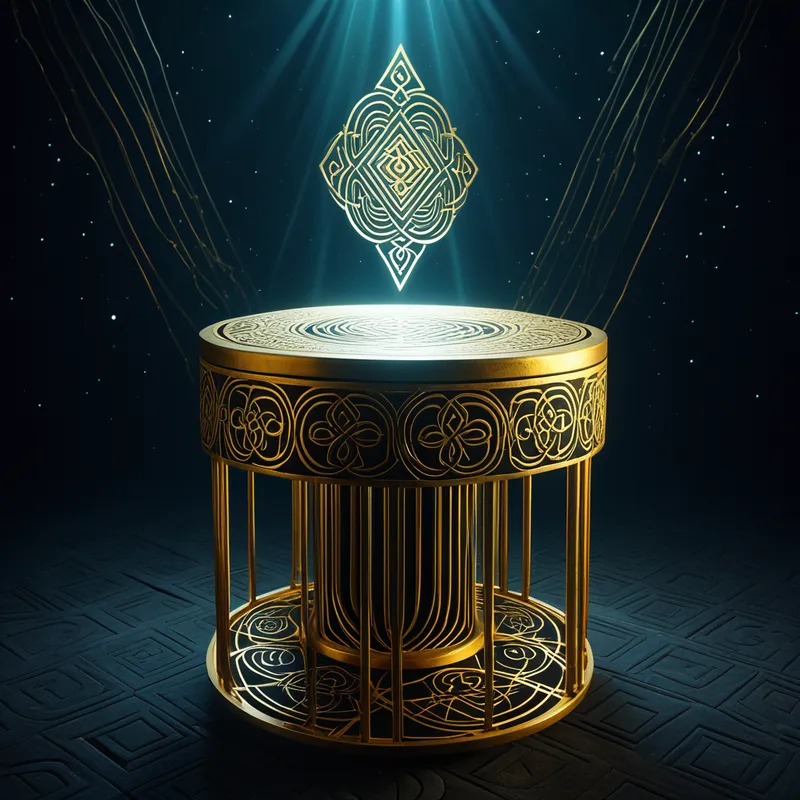
Dreams featuring a heavy, sacred vessel that must be carried (Anansi’s calabash) point to the burden of integrating hard-won wisdom or confronting a difficult truth. The somatic sensation is often one of weight, responsibility, and perhaps anxiety, as the dream-ego struggles with a new level of awareness that disrupts old comforts. A dream of a stool, especially one of luminous or immense significance, can indicate the emergence of the inner authority, the discovery of one’s own moral and psychological center amidst turmoil. The dreamer is encountering their own okra, their essential, indestructible core.

Alchemical Translation
The alchemical process modeled here is the conjunctio oppositorum—the union of opposites—leading to the creation of the lapis philosophorum, the philosopher’s stone, symbolized by the Golden Stool. For the modern individual, the myth charts the path of individuation.
First, the descent: the conscious ego (Nyame) must willingly lower itself into the chaotic, watery depths of the unconscious. This is a sacrifice of certainty. Then, the union: the ego does not conquer the unconscious but engages with it (Asase Yaa), resulting in the “creation of earth”—the solidification of a new, more authentic personality structure, a fertile inner ground from which to live.
The final, crucial stage is the trickster’s gift. Individuation is not about achieving a static, perfect state. It is about accepting the full calabash of wisdom—which includes the knowledge of one’s shadows, flaws, and mortality (Anansi’s delivery). This knowledge is what truly humanizes us, moving us from a childlike state of unconscious bliss to a mature, responsible, and creative engagement with life’s bittersweet reality.
The stool is then established within this new inner landscape. It represents the achieved, centered Self, capable of ruling the personal kingdom with wisdom drawn from both the heights of spirit and the depths of the soul. The myth teaches that our wholeness is forged not in avoiding the trickster’s difficult gifts, but in receiving them and learning to rule from the seat they ultimately help us discover.
Associated Symbols
Explore related symbols from the CaleaDream lexicon:
- Sky — Represents the transcendent realm of Nyame, the domain of pure spirit, divine law, and overarching consciousness from which creation is ordered.
- Earth — Embodies Asase Yaa, the fertile, nurturing, and foundational principle that gives solid form to celestial inspiration and sustains all life.
- Water — Symbolizes the primordial, chaotic, and undifferentiated state of existence before the divine act of creation, the formless potential from which the world emerges.
- Spider — Represents Anansi, the archetypal trickster and culture hero whose cunning and creativity mediate between gods and humans, delivering wisdom and complexity.
- Goddess — Manifest as Asase Yaa, the divine feminine principle of immanence, fertility, and the sacredness of the natural, material world.
- God — Manifest as Nyame, the supreme masculine principle of transcendence, authority, and the distant source of all being and order.
- Trickster — The essential role of Anansi, who disrupts static perfection to introduce the dynamic, challenging elements of wisdom, choice, and mortality that fuel human development.
- Order — The divine principle established by Nyame’s descent and the placement of the Golden Stool, representing the cosmic and social harmony that structures chaos.
- Soul — Corresponds to the okra, the divine spark placed within each human by Nyame, representing individual destiny and the fragment of the divine within.
- Journey — The central narrative of descent (Nyame), delivery (Anansi), and the human passage from innocent dependence to conscious, responsible existence.
- Mythos — The entire living narrative tradition of the Akan people, of which this creation story is the foundational chapter, encoding their worldview, ethics, and understanding of reality.
- Sacrifice — Implicit in Nyame’s sharing of his essence (okra) and wisdom, and in humanity’s loss of ignorant bliss to gain conscious, mortal life.