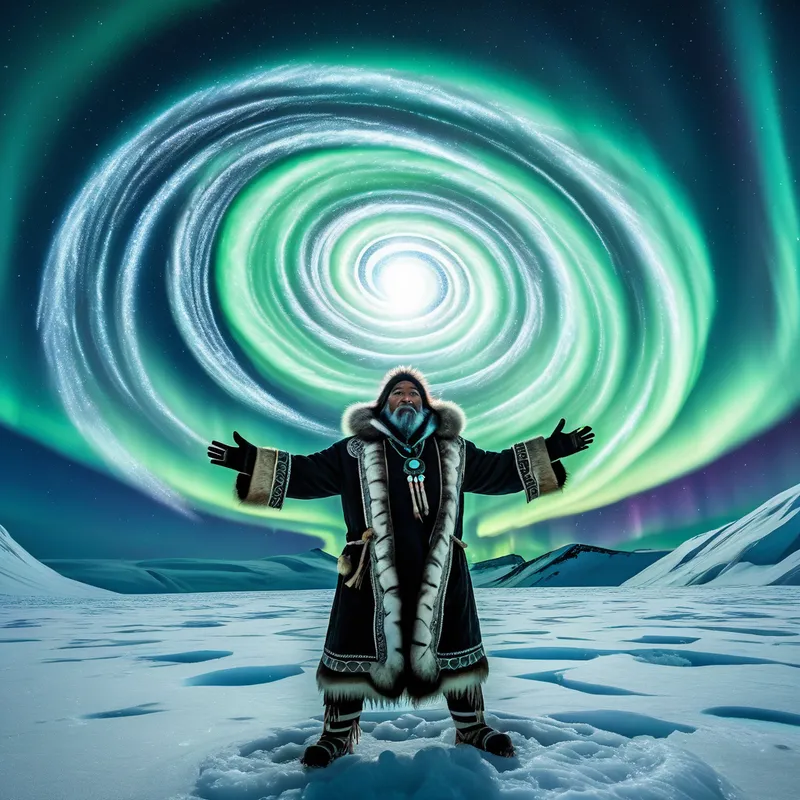
Tuurngait Myth Meaning & Symbolism
A myth of a shaman's perilous journey to the spirit world to gain a helping power, revealing the sacred pact between human need and wild spirit.
The Tale of Tuurngait
Listen. In the time when the ice was a living skin over the world and the wind had a thousand names, there was a hunger. Not in the belly—though that was often enough—but in the soul. A person could be surrounded by family, by the bounty of a good hunt, and yet feel a hollow cold that no fire could touch. They were alone against the immense, silent will of the land.
It was then they would go to the angakkuq. The angakkuq did not live in a grand house of ice, but in a humble snow-house, his true dwelling place the spaces between worlds. You would find him not by a crown, but by the weight in his eyes, which had seen things that melt the mind.
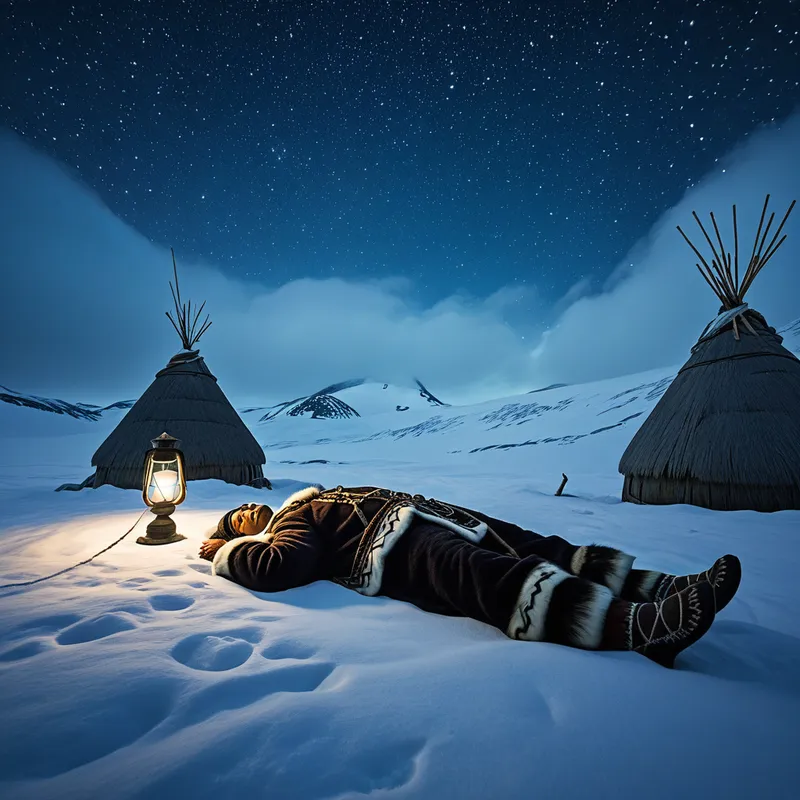
The seeker would come, shivering with a need they could not name. The angakkuq would nod, his face a landscape of old knowing. No words were needed for the pact. In the dark, close womb of the iglu, lit only by the gut-flicker of the qulliq, the ritual began. The angakkuq would be bound—sealskin thongs tight around his limbs, his head, a voluntary imprisonment. His body, the anchor. His soul, the voyager.
Then came the drum. A heartbeat older than humanity, stretched over a frame of driftwood or whalebone. Thrum-thrum-thrum. The sound was not heard with ears but felt in the marrow. The angakkuq’s breathing would slow, then stop. His body lay as one dead. But in the spirit world, a great tearing occurred—a soundless rip in the fabric of the seen. His soul, his atiq, was now loose, falling up into a sky that was not sky, crossing a bridge of breath into the land of Tuurngait.
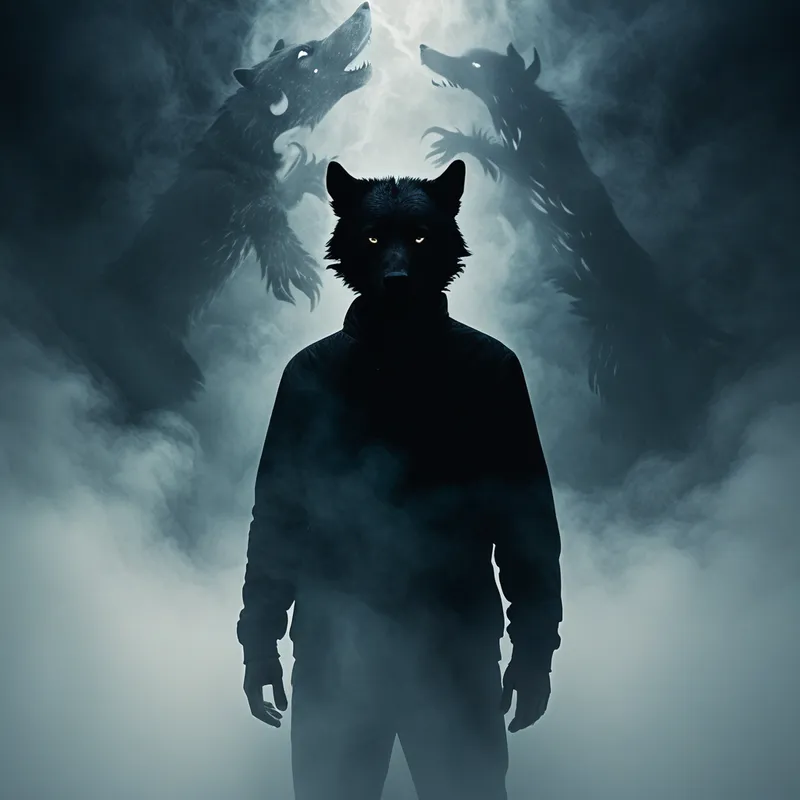
Here, the rules of flesh dissolved. Mountains were made of memory, rivers of forgotten songs. And here, the Tuurngait waited. They were not gods, not ancestors. They were the wild, raw potential of the world itself—often appearing as half-formed beasts: a bear with the eyes of a seal, a raven with the voice of the wind, a wolf carved from moonlight. They were power, untamed and ambivalent. To approach one was to risk being unmade, your soul scattered like snow in a gale.
The angakkuq’s journey was a hunt, but the prey was a fragment of this chaos that could be shaped into aid. He would sing his need, the need of his people. He would offer something of himself—a piece of his shadow, a memory of his fear, a song of his loneliness. This was the bait, the trade. A Tuurngait would be drawn. The negotiation was a battle of wills without violence, a test of emptiness. Could the angakkuq’s human purpose provide a container vast enough to hold this wild force? Could he give it a name, a task, a home in his service?
If he succeeded, a bond was forged. Not of mastery, but of sacred pact. The Tuurngait would consent to become a tornraq. It would flow into the angakkuq’s returning soul, a new weight, a new companion. Back in the iglu, the bound body would convulse. The thongs would strain, sometimes snap. The angakkuq would return with a gasp that was half his own, half the rasp of the spirit. His eyes, when they opened, held a new depth, a flicker of the other. The helping power was now his—to find game in the barren ice, to heal sickness of the spirit, to see the unseen currents of fate. The hollow cold in the seeker’s soul began, at last, to thaw.
Cultural Origins & Context
The mythos of the Tuurngait is not a single story but a living framework embedded in the shamanic complex of Inuit cultures across the Arctic. It was not entertainment but essential technology for survival in one of the planet’s most demanding environments. The myths were passed down not in books, but in the oral teachings from elder angakkuit to apprentices, and in the communal witnessing of shamanic séances.
The tellers were the angakkuit themselves, the psychologists and physicians of their world. Their authority was earned through direct, perilous experience in the spirit world, and their stories were reports from the frontier of the human psyche. The societal function was multifaceted: it explained the source of a shaman’s power (demystifying it while keeping it sacred), it provided a model for engaging with the unpredictable forces of nature (the weather, the animals), and it served as a profound moral and cosmological map. It taught that power comes with a price—sacrifice, discipline, and a perpetual balancing act between the human community and the untamed wild. The relationship with a Tuurngait was a microcosm of the Inuit relationship with the land itself: one of respect, negotiation, and never-taking-for-granted.
Symbolic Architecture
At its core, the Tuurngait myth is a [blueprint](/symbols/blueprint “Symbol: A blueprint represents the foundational plan or design for something, often symbolizing potential, structure, and the mapping of one’s inner self or future.”/) for encountering the Other—the autonomous, non-ego forces of the psyche that Jung termed the unconscious. The Tuurngait are the very [image](/symbols/image “Symbol: An image represents perception, memories, and the visual narratives we create in our minds.”/) of the psychic complexes and archetypal energies that reside outside the lighted circle of conscious [identity](/symbols/identity “Symbol: Identity represents the sense of self, encompassing personal beliefs, cultural background, and social roles.”/).
The Tuurngait are the unintegrated powers of the Self, waiting in the cold dark of the interior. They are chaos that yearns for the ordering touch of consciousness, and consciousness that withers without the raw vitality of chaos.
The bound [journey](/symbols/journey “Symbol: A journey in dreams typically signifies adventure, growth, or a significant life transition.”/) of the angakkuq symbolizes the necessary discipline and containment (the ego) required to safely navigate the [depths](/symbols/depths “Symbol: Represents the subconscious, hidden emotions, or foundational aspects of the self, often linked to primal fears or profound truths.”/). The binding is not repression, but a ritualized focus, a tether to [reality](/symbols/reality “Symbol: Reality signifies the state of existence and perception, often reflecting one’s understanding of truth and life experiences.”/). The offering—a [piece](/symbols/piece “Symbol: A ‘piece’ in dreams often symbolizes a fragment of the self or a situation that requires integration, reflection, or understanding.”/) of one’s own [shadow](/symbols/shadow “Symbol: The ‘shadow’ embodies the unconscious, repressed aspects of the self and often represents fears or hidden emotions.”/) or fear—is critical. It represents the sacrifice of a familiar, often limiting, part of the self to gain something greater. You cannot gain a new power while clutching all your old possessions. The negotiation is the [individuation process](/symbols/individuation-process “Symbol: The psychological journey toward self-realization and wholeness, integrating conscious and unconscious aspects of personality.”/) itself: the ego does not conquer the unconscious content but enters into a [relationship](/symbols/relationship “Symbol: A representation of connections we have with others in our lives, often reflecting our emotional state.”/) with it, giving it a name and a function, thereby transforming a wild, potentially destructive force (a [symptom](/symbols/symptom “Symbol: A physical or emotional sign indicating an underlying imbalance, distress, or message from the unconscious mind.”/), a rage, a compulsion) into a tornraq—a helping [spirit](/symbols/spirit “Symbol: Spirit symbolizes the essence of life, vitality, and the spiritual journey of the individual.”/), a [source](/symbols/source “Symbol: The origin point of something, often representing beginnings, nourishment, or the fundamental cause behind phenomena.”/) of [insight](/symbols/insight “Symbol: A sudden, deep understanding of a complex situation or truth, often arriving unexpectedly and illuminating hidden connections.”/) and [ability](/symbols/ability “Symbol: In dreams, ‘ability’ often denotes a recognition of skills or potential that one possesses, whether acknowledged or suppressed.”/).
The Dreamer’s Resonance
When this mythic pattern stirs in the modern dreamer, it signals a profound somatic and psychological process: the call to retrieve a lost or disowned power from the personal and collective shadow. The dreamer may not see an Inuit shaman, but they will feel the structure of the myth.
Dreams of being bound or paralyzed, followed by a sensation of flying or traversing alien landscapes, mirror the angakkuq’s ritual journey. Encounters with strange, hybrid animals—a talking fox, a bird with human hands—are direct manifestations of the Tuurngait, presenting themselves for recognition. Dreams of making a desperate trade or offering something precious (a voice, a memory, a treasured object) reflect the necessary sacrifice. The somatic experience upon waking might be one of exhaustion, as if from a great labor, or a strange, electric vitality—the feeling of a new “weight” or presence integrated.
This dream process is the psyche’s innate shamanism, attempting to broker a treaty between the civilized, adapted persona and the wild, instinctual powers it has excluded for the sake of social order. The dream is the iglu, the binding is the sleep-paralysis, and the dream-ego is the soul sent to treat with its own interior spirits.
Alchemical Translation
The alchemical operation modeled here is Solve et Coagula—to dissolve and to coagulate. The angakkuq’s conscious identity (the prima materia) is dissolved through the trance, breaking down the rigid boundaries of the ego. He enters the massa confusa, the chaotic realm of the Tuurngait, where all potentials swim formless.
The goal is not to stay dissolved in the primal soup, but to select a specific, potent element from it and bring it back, giving it new, coherent form within the structure of the self.
The negotiation is the coniunctio oppositorum, the sacred marriage of opposites: human consciousness and wild spirit, order and chaos, culture and nature. The resulting tornraq is the Philosopher’s Stone of this personal alchemy—not a stone at all, but a living, functional relationship with a once-alien part of the self. It transforms the lead of psychic fragmentation (the hollow cold) into the gold of increased wholeness and capability.
For the modern individual, the myth prescribes a path of sacred daring. It asks us to voluntarily “bind” ourselves in focused introspection (therapy, meditation, artistic practice), to courageously “journey” into our own unresolved complexes and raw emotions (the Tuurngait), and to engage them not with eradication in mind, but with the intent of negotiation. What forgotten strength lies within our rage? What keen perception hides in our fear? By offering the sacrifice of our old story about these elements (“my anger is bad,” “my fear is weak”), we can forge a pact. We can name them, give them a conscious task, and allow them to return with us as tornrait—helping spirits that grant us resilience, creativity, and a healed connection to the wild, creative root of our own being.
Associated Symbols
Explore related symbols from the CaleaDream lexicon:
- Journey — The shaman’s spirit voyage is the quintessential journey into the unknown interior, a map for any profound psychological or life passage.
- Sacrifice — The core transaction of the myth; one must offer a piece of the familiar self (a comfort, a story, a wound) to gain a new power from the spirit world.
- Spirit — The Tuurngait are pure spirit—autonomous, animating forces of the world and the psyche that exist beyond material form.
- Shadow — The Tuurngait dwell in the shadow realms, and the shaman’s offering is often a piece of his own shadow, representing the integration of denied aspects of the self.
- Dream — The entire ritual is a deliberate, waking dream-journey, modeling how dream states provide access to negotiating with unconscious contents.
- Bridge — The angakkuq’s soul crosses a bridge between worlds, symbolizing the ego’s function as a mediator between conscious reality and the unconscious.
- Mask — The Tuurngait often appear in animal forms, masks of the raw archetypal energies; integrating one is like learning to wear a new mask of capability.
- Key — The gained tornraq becomes a key that unlocks specific abilities—finding game, healing—just as integrated complexes unlock psychic potentials.
- Fear — A primary Tuurngait and a primary offering; engaging with fear transforms it from a paralyzing force into a guiding, protective spirit.
- Ritual — The binding, the drumming, the séance—the structured ritual creates the sacred container that makes the dangerous inner work possible and safe.
- Dance — The shaman’s convulsive return is a spirit-dance, the somatic expression of the new, dynamic energy now incorporated into the body and psyche.