
Tulsi Myth Meaning & Symbolism
A goddess cursed to become a plant, Tulsi's story is a sacred alchemy of love, separation, and eternal devotion, rooted in every Hindu home.
The Tale of Tulsi
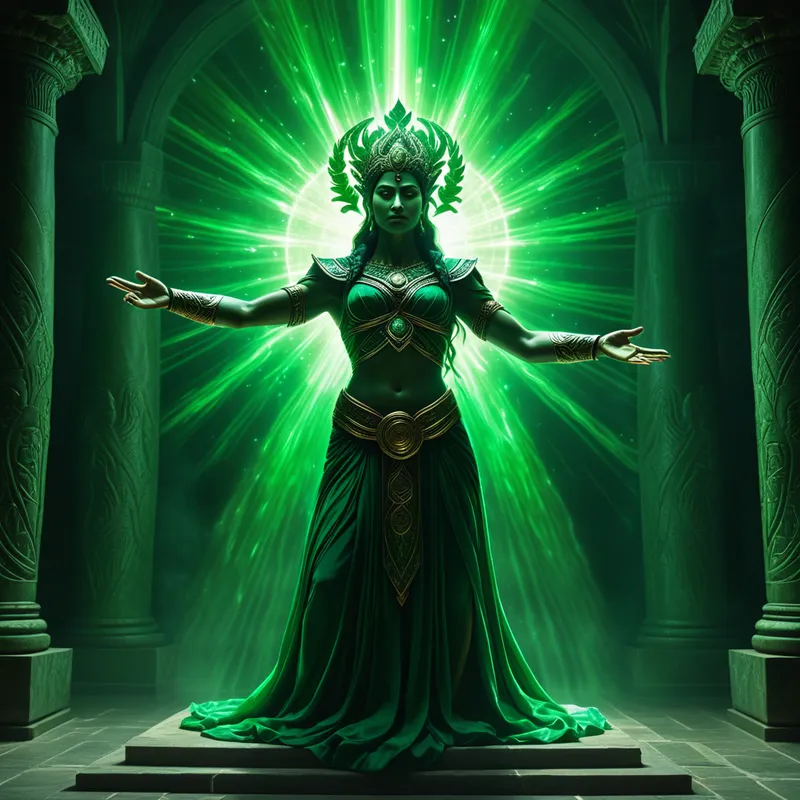
In the time before time, when the gods walked the earth and the air thrummed with the music of creation, there lived a goddess of such pure devotion that the cosmos itself bent to her will. Her name was Vrinda. She was the wife of Jalandhara, a king born from the fire of Shiva's rage. Vrinda’s love for her husband was her sacred vow, her tapas. It was a force so potent it formed an invisible, unbreakable armor around Jalandhara, making him invincible to even the Vishnu.
But destiny, woven by the three sisters of fate, had other designs. A great war raged between the gods and the demons. Jalandhara, protected by Vrinda’s unwavering fidelity, was undefeatable. The heavens trembled. In their council of desperation, the gods turned to Vishnu, the great preserver. To break the unbreakable, a profound deception was needed—a violation of the very fabric of trust that held Vrinda’s power.
Vishnu, the master of Maya, descended. He assumed the exact form of Jalandhara. The armor of fidelity, designed to keep all others out, could not deny the one it was meant to protect. In the sacred grove where Vrinda performed her prayers, her husband returned to her. But it was not her husband. In that moment of intimate betrayal, the cosmic armor shattered. The real Jalandhara, vulnerable at last, fell in battle.
Vrinda, feeling the rupture in her soul, rushed to the battlefield. There, she saw not one, but two Jalandharas. The truth, cruel and absolute, dawned upon her. The god of preservation had preserved the cosmos by breaking her heart. Her grief was not a mere cry; it was a curse that shook the foundations of heaven. She turned her fiery gaze upon Vishnu. “You who have stolen my truth,” she declared, her voice the sound of breaking worlds, “shall know the agony of separation. You shall become stone, a Shaligram, forever cold and rooted to the riverbed, longing for a touch you can never fully possess.”
Her power was such that even Vishnu had to accept this fate. But as her mortal form began to dissolve, consumed by the fire of her own sorrow and righteousness, Vishnu, filled with a profound remorse, spoke. “Your virtue, Vrinda, is the highest law. Your form may leave this world, but your essence shall never be forgotten. You will become the most sacred of herbs, Tulsi. You will be purity incarnate, planted in every courtyard, dearer to me than all jewels. And I, as the Shaligram, will find my worship incomplete without your leaves touching my form. We will be together in devotion, yet forever apart in form—a perpetual remembrance of the cost of cosmic order.”
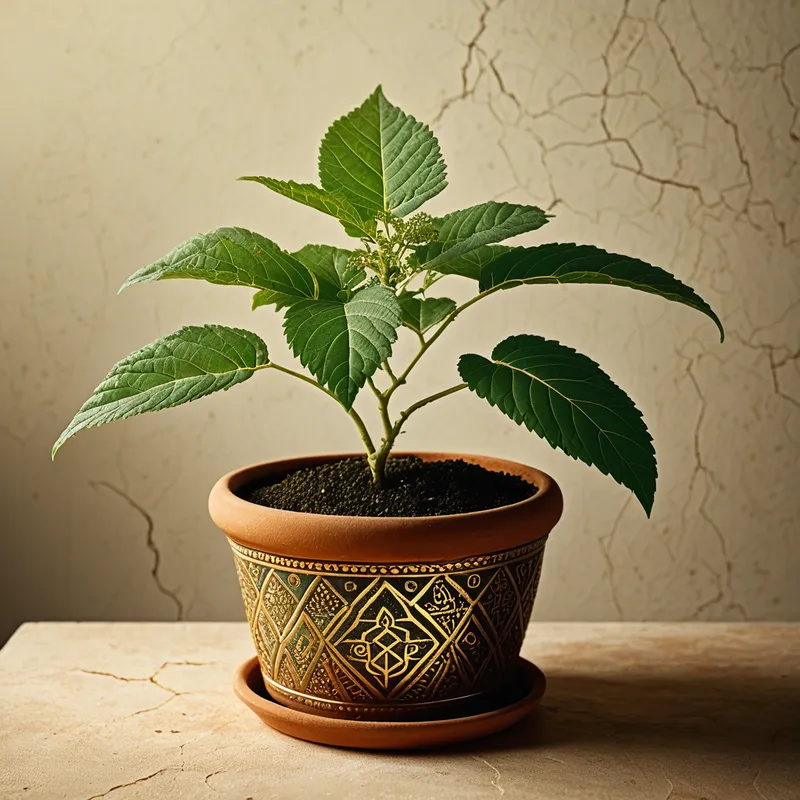
And so, Vrinda’s body dissolved into the earth. From that spot sprouted the first Tulsi plant, its leaves fragrant with her piety, its form humble yet holding the soul of a goddess. The divine lover became the beloved of the divine, in a bond redefined by sacrifice, eternal longing, and sacred grace.
Cultural Origins & Context
The myth of Tulsi is woven deeply into the Puranic tradition, particularly texts like the Bhagavata Purana and the Padma Purana. It was not merely a story for royalty but a living narrative passed down through generations of householders, primarily by women and priestly storytellers. Its societal function was multifaceted. It established the theological sanctity of the Tulsi plant, making its daily worship (puja) a non-negotiable domestic duty, especially for women. The myth served as a powerful ethical parable about the inviolable power of a wife’s fidelity (pativrata dharma), while simultaneously grappling with the complex moral landscape where divine duty (dharma) necessitates heartbreaking actions. It provided a framework to understand suffering, not as meaningless punishment, but as a transformative fire that leads to a higher, if bittersweet, state of grace. Every Tulsi plant in a courtyard is a living shrine, a daily re-enactment of this myth, connecting the mundane act of watering a plant to the epic drama of cosmic preservation and personal sacrifice.
Symbolic Architecture
At its core, the myth of Tulsi is an alchemical map of consciousness reconciling opposites: personal love and cosmic duty, betrayal and redemption, form and essence, humanity and divinity.
The greatest devotion is sometimes forged in the crucible of its own violation, creating a sacredness that transcends the personal.
Vrinda represents the archetypal power of focused consciousness—her unwavering love is a form of spiritual austerity that creates reality. Jalandhara symbolizes the empowered ego, which draws its strength from this connection to the soul (Vrinda). Vishnu’s deception is the necessary, often painful, intervention of the Self (the total, organizing principle of the psyche) to dismantle an identification that, while powerful, has become a rigid, inviolable complex blocking further growth. The shattering of Vrinda’s fidelity is the painful deconstruction of a conscious attitude, a necessary “death” of a previous way of being.
The transformation—goddess into plant—is the ultimate symbol of grounding spirit into matter. The divine is not lost; it is made accessible, daily, humble, and healing. The curse that turns Vishnu to stone (Shaligram) ensures that the divine principle is not absolved of the consequences of its actions. It must endure the state of separation, of longing. Their eternal relationship—the plant and the stone—models a sacred marriage (hieros gamos) that exists not in perfect union, but in perpetual, devotional proximity. It is a relationship based on the memory of a wound that became a gateway to a different kind of wholeness.
The Dreamer's Resonance
When this myth stirs in the modern unconscious, it often manifests in dreams of profound betrayal followed by unexpected metamorphosis. One might dream of a trusted partner whose face morphs into another’s, not necessarily leading to rage, but to a deep, silent dissolution of the dreamer’s own body into landscape—becoming a tree, a garden, or a source of water. This is the somatic signal of the Vrinda process: the ego-structure built upon a specific relationship or ideal is being dismantled.
The psychological process is one of sacralization through rupture. The dreamer is not merely processing a personal betrayal, but encountering the archetypal reality that some of our most cherished identifications must be broken by forces that seem alien to our conscious values (the Vishnu aspect) for a deeper integration to occur. The grief felt is not just personal; it is the grief of the psyche shedding a skin. Dreams of nurturing a plant that grows from one’s own chest, or of a cold, heavy stone that one feels compelled to anoint with leaves, point directly to this mythic pattern. The psyche is working to translate a personal heartbreak into an impersonal, sacred function—transforming a “why me?” into a “what for?”.

Alchemical Translation
The individuation journey modeled by the Tulsi myth is not one of heroic conquest, but of sacred surrender and alchemical grounding. It outlines the path from spiritualized emotion to embodied sanctity.
The goal is not to avoid the curse, but to become the plant that grows from its soil.
The first stage is Identification with the Vow: We, like Vrinda, build our identity and power on a specific commitment, relationship, or ideal. This gives us strength and clarity (the invincible armor).
The second is the Necessary Betrayal (Nigredo): The Self, in service of the whole psyche, orchestrates a crisis that shatters this identification. This feels like a cosmic betrayal, a dark night of the soul where all that gave us meaning is revealed as an illusion. This is the burning of Vrinda’s form.
The third is the Curse as Creative Act (Albedo): Instead of collapsing into victimhood, the conscious ego, in its moment of greatest pain, asserts its truth. It names the violation and sets a new law. Vrinda’s curse is an act of profound psychological authority—it holds the transformative agent (Vishnu/Self) accountable, forcing it into a new relationship.
The final stage is Transmutation into Sacred Substance (Rubedo): The ego-consciousness does not return to its old form. It accepts a metamorphosis into something humbler, more elemental, and more universally accessible. The personal grief becomes a general healing principle (the Tulsi plant). The “betrayer” (the complex or dynamic that caused the rupture) is not vanquished but is eternally bound in a devotional relationship to this new, grounded aspect of the self (the Shaligram wedded to Tulsi).
For the modern individual, this means that our deepest wounds, our heartbreaks and betrayals, are not failures of our story but potential seeds of our sacred purpose. The work is to consciously participate in this alchemy: to allow the old form of our devotion to be broken, to courageously speak the truth of the wound, and then to consciously choose to become the healing presence that grows from that very spot. We move from being the lover who is wronged to becoming Love itself, rooted, fragrant, and essential.
Associated Symbols
Explore related symbols from the CaleaDream lexicon: