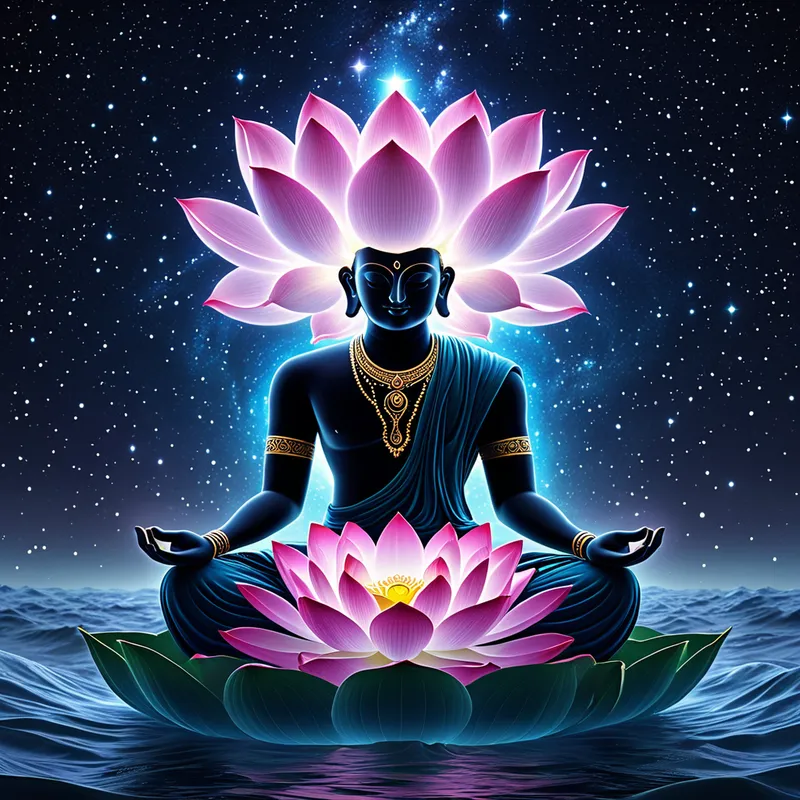
Padma Myth Meaning & Symbolism
The cosmic lotus, Padma, rises from primordial waters, symbolizing creation, spiritual purity, and the soul's journey from darkness into enlightened consciousness.
The Tale of Padma
Listen. Before the first dawn, before the first breath, there was only the One, the Brahman. And within that boundless silence, a desire stirred—a desire to become many. From this sacred longing, the waters were born. Not waters of any sea you know, but the Narayana, the cosmic ocean of potential, dark, infinite, and asleep upon the great serpent Ananta Shesha.
Upon these waters, a warmth began to glow. It was the breath of Vishnu, sleeping in yogic trance. From his navel, a light emerged, a golden, fiery stem that pierced the profound darkness of the waters. It grew, pushing upward through the thick, silent potential of the uncreated world.
Then, a sound—a soft, tearing whisper as the first form broke the surface. A bud, perfect and closed, holding within it all the laws of the universe, all the rhythms of time, all the seeds of life. It trembled for an acon, gathering the warmth of that divine breath. And then, it opened.
Petals of light unfolded, layer upon layer, radiating like a thousand suns. This was Padma. Its fragrance was the first scent in creation, a perfume of pure consciousness. And seated at its very heart, upon a throne formed of the lotus itself, was Brahma. He opened his eyes, and in his four faces, he beheld the directions. In his four hands, he held the tools of creation: the sacred scriptures, the rosary of time, the water pot of life, and the gesture of blessing.
From Padma’s radiant platform, Brahma began his work. The lotus stem was the axis of the world, connecting the murky depths of the unmanifest to the brilliant clarity of the manifest. The lotus was the first island, the first foundation, the womb and the throne. The universe blossomed from its center, and the great cycle of ages began to turn.
Cultural Origins & Context
The image of Padma is not confined to a single narrative but is woven into the very fabric of Hindu thought, appearing in the earliest Vedas and flowering fully in the later Brahmanas, Upanishads, and the great epics. It is a core symbol in Vaishnavism, where Vishnu is often called Padmanabha (lotus-naveled), and in Shaktism, where the goddess is the power that makes the lotus bloom.
This was not merely a priestly symbol but a living, breathing metaphor accessible to all. It was painted on temple walls, described by poets and bards, and held in the mind’s eye of every meditator. Its societal function was profound: it provided a cosmological map of creation, a model for spiritual aspiration, and a daily reminder that beauty and order can—and must—arise from chaos and darkness. The lotus growing from the mud became a universal teaching on resilience, purity, and the inherent potential for divinity within the material world.
Symbolic Architecture
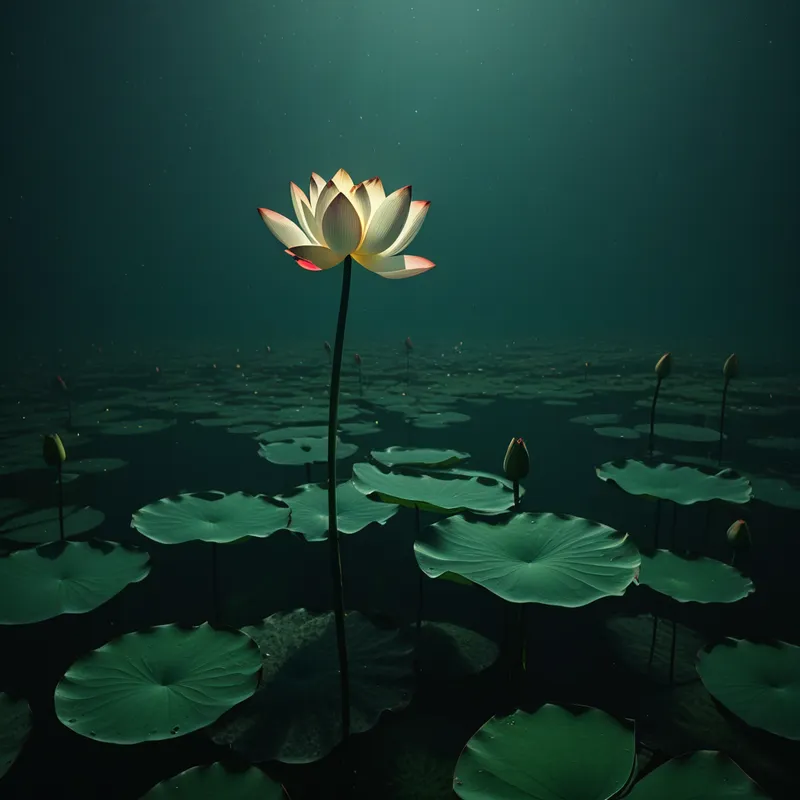
The Padma is a complete symbolic universe. Its roots in the mud represent our origins in the material, instinctual, and often murky unconscious. The long stem is the arduous path of spiritual discipline (sadhana), the journey of consciousness through the medium of life (the water). The flower blooming immaculate above the water symbolizes the enlightened mind, the awakened soul (atman), and the fully realized Self, untouched by the impurities of its origins.
The lotus does not deny the mud; it is born from it. Enlightenment is not an escape from the world, but a transformation of one's relationship to it.
Its unfolding petals mirror the unfolding of the cosmos and the layers of the human psyche. The number of petals is often sacred—eight for the cosmic directions, a thousand for the infinite. At its heart sits the deity, the Om, the point of absolute stillness and creative power. Psychologically, Padma represents the individuated Self, the central, organizing principle of the psyche that emerges only after one has consciously engaged with and integrated the contents of the personal and collective unconscious (the dark waters).
The Dreamer's Resonance
When Padma appears in a modern dream, it is a profound signal from the deep psyche. You may dream of a single lotus blooming in a murky pond, of finding yourself seated on a giant lotus pad, or of struggling to climb its slippery stem. Somatically, this can correlate with a feeling of pressure in the chest or solar plexus—the area of the heart and personal power—giving way to a sensation of expansion and lightness.
Such dreams often emerge during periods of intense inner work, crisis, or creative gestation. The murky water represents the "soup" of unresolved emotions, forgotten memories, and shadow material you are currently processing. The lotus bud is the nascent new attitude, the potential for a higher perspective or a more authentic way of being that is seeking to emerge. The struggle to break the surface mirrors the conscious effort required to bring this new psychic content into the light of awareness. To dream of a fully bloomed Padma is to experience a moment of psychic integration, a glimpse of wholeness and serene clarity achieved after navigating inner turmoil.

Alchemical Translation
The myth of Padma is a perfect map for the alchemical process of psychic transmutation, what Jung called individuation. The prima materia, the base matter for this great work, is the chaotic "water" of our unexamined life—our complexes, our traumas, our instinctual drives. This is the necessary mud. The alchemical vessel is the disciplined container of self-reflection, therapy, or spiritual practice.
The first stage, nigredo (the blackening), is immersion in these dark waters, confronting the shadow. The growing stem is the albedo (the whitening), the laborious process of purification and clarification, where we differentiate ourselves from our identifications with the mud. The blooming of the flower is the rubedo (the reddening), the culmination: the birth of the "philosophical gold," the integrated Self.
The goal is not to become the flower alone, but to be the entire plant—rooted in history, fluid in experience, and open to the transcendent.
For the modern individual, this means that our wounds, our past, and our "lowest" instincts are not obstacles to enlightenment but its very substance. The alchemical translation of Padma teaches that we must consciously descend into our own personal and collective mud, not to wallow, but to gather the nutrients for our ascent. Our highest creativity, our purest love, and our most authentic wisdom are forged in that dark, fertile depth. We are called not to reject the world, but to grow through it, until we can finally open, like Padma, to a consciousness that is in the world, yet not of it.
Associated Symbols
Explore related symbols from the CaleaDream lexicon: