Tiddalick the Frog Myth Meaning & Symbolism
A giant frog drinks all the world's water, causing a drought. The other animals must make him laugh to release the life-giving waters back into the land.
The Tale of Tiddalick the Frog
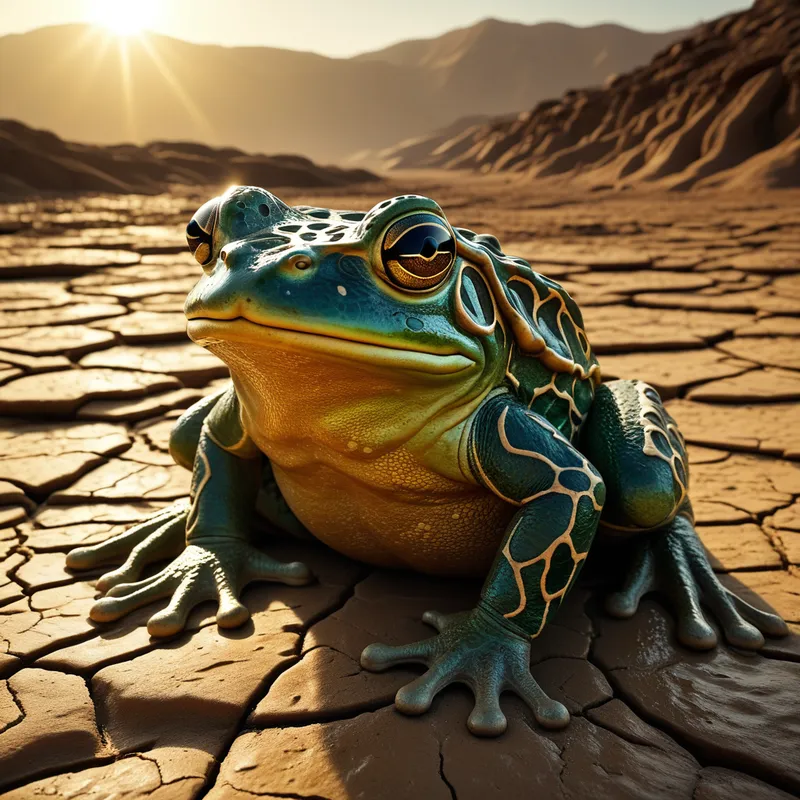
In the First Days, when the world was soft and the songs of the Dreaming still vibrated in the stones, there lived Tiddalick. He was not a small creature of the reeds, but a frog of immense proportion, with a belly that could hold thunder and eyes like still, dark pools.
On a morning when the heat began to gather its breath, a profound thirst awoke within him. It was a thirst not of the body, but of the spirit—a hollow, echoing need. He went to the great waterhole, where the lily pads lay like green shields on the surface, and he drank. He drank not just to slake his thirst, but to fill the void. He drank until the waterhole was a muddy hollow. Unsated, he moved to the river, its currents singing stories of the mountains to the sea. He placed his great mouth upon it and drank the song dry, leaving only silent, gasping stones.
On and on he went, a creature possessed by a single, devouring impulse. He drank the billabongs, the creeks, the hidden springs that wept from cliff faces. He drank the morning dew from the spiderwebs and the last dampness from the roots of the ancient gums. He drank until the world was husk-dry, and the only water left in all creation was the vast, sloshing sea inside his own swollen form.
Then Tiddalick settled, a monstrous, bloated mound in the bed of the vanished river. The land cracked like old bone. The leaves of the trees curled inward, whispering of death. The animals, their tongues thick with dust, gathered in the desperate shade. The kangaroo could not hop. The goanna could not run. The wise old wombat emerged from his burrow to find the earth turned to powder. A great silence fell, deeper than any night—the silence of a world holding its last breath.
The creatures held council, their voices rasping. Force was useless; Tiddalick was a living mountain. Pleading brought only a slow, indifferent blink. Then, from the collective despair, an idea was born: not from strength, but from cunning; not from demand, but from invitation. They would make the hoarder laugh. They would tickle the great, taut drum of his belly and release the waters not in a flood of conflict, but in a cascade of involuntary joy.
One by one, they came before him to perform. The kangaroo attempted a solemn, hopping dance, but stumbled in the dust. Tiddalick did not stir. The goanna told a winding, elaborate tale, but his dry throat made it a croak. The frog’s eyes remained lidded. The spectacle grew more absurd. The kookaburra told his raucous joke to the silent air. The platypus performed a clumsy, shuffling swim on the barren ground.
Hope began to drain away like the last memory of moisture. Then, finally, the eel—Nabunum, the wise trickster—slithered forward. With a look of profound, ridiculous seriousness, he began to twist his long, sleek body into impossible shapes. He tied himself into knots, he wobbled and stood on his tail, he contorted into a living, slithering pretzel upon the hot earth. He became a poem of pure, undignified silliness.
A tremor passed through the giant frog. A ripple under his clay-colored skin. Then, from deep within the cavern of his being, a sound began to build. It started as a low rumble, like distant thunder in a hollow log. It grew into a gurgle, a choke, and then it erupted—a vast, seismic, croaking GULP-GULP-GULP of laughter. It shook the ground. His mouth flew open, and from it burst the world.
A torrent of water, a laughing flood, poured forth. It filled the riverbed in a joyous rush, spilled over into the billabongs, soaked into the cracked earth with a sound like a great sigh. The waters returned to their courses, singing once more. Life surged back—green shoots, the chorus of frogs (small ones, now), the splash of fish. The animals drank deeply, not in greed, but in gratitude, as Tiddalick, shrunk back to a more ordinary size, sat blinking by the replenished bank, the terrible thirst within him finally, and forever, quenched by the shared laughter of the world.
Cultural Origins & Context
The myth of Tiddalick belongs to the Gunaikurnai and other Aboriginal nations of south-eastern Australia. It is a foundational Dreaming story, a narrative held in the custodianship of Elders and passed down not as mere entertainment, but as a vital, living map of law, ecology, and social order. It was and is told through oral narration, song, dance, and visual art, its performance a way of literally singing the country and its relationships into being.
Its societal function is multifaceted. On one level, it is an aetiological tale, explaining the water cycle, the existence of rivers, and the behavior of frogs. On a deeper, pedagogical level, it is a powerful lesson in community ethics. It illustrates the catastrophic consequences of unchecked individual greed (Tiddalick’s thirst) and affirms that the solution to collective crisis lies not in overwhelming force, but in communal ingenuity, humor, and the subtle power of persuasion. The story encodes the principle that life is sustained by balance and reciprocal relationship, not by hoarding.
Symbolic Architecture
Tiddalick represents the psychic force of insatiable [appetite](/symbols/appetite “Symbol: Represents desire, need, and consumption in physical, emotional, or spiritual realms. Often signals unmet needs or excessive cravings.”/), the part of the self that seeks to fill an inner [emptiness](/symbols/emptiness “Symbol: Emptiness signifies a profound sense of void or lack in one’s life, often related to existential fears, loss, or spiritual quest.”/) by consuming the external world. He is not evil, but a force of [nature](/symbols/nature “Symbol: Nature symbolizes growth, connectivity, and the primal forces of existence.”/) gone awry—the instinct of self-preservation swollen into a [monster](/symbols/monster “Symbol: Monsters in dreams often symbolize fears, anxieties, or challenges that feel overwhelming.”/) of [isolation](/symbols/isolation “Symbol: A state of physical or emotional separation from others, often representing a need for introspection or signaling distress.”/).
The hoarder does not possess the treasure; the treasure possesses the hoarder, leaving him bloated, inert, and cut off from the very flow of life he seeks to contain.
The [Water](/symbols/water “Symbol: Water symbolizes the subconscious mind, emotions, and the flow of life, representing both cleansing and creation.”/) he drinks is the [symbol](/symbols/symbol “Symbol: A symbol can represent an idea, concept, or belief, serving as a powerful tool for communication and understanding.”/) of [life](/symbols/life “Symbol: The symbol of ‘Life’ represents a journey of growth, interconnectedness, and existential meaning, encompassing both the joys and challenges that define human experience.”/), [emotion](/symbols/emotion “Symbol: Emotion symbolizes our inner feelings and responses to experiences, often guiding our actions and choices.”/), [connection](/symbols/connection “Symbol: Connection symbolizes relationships, communication, and bonds among individuals.”/), and psychic [energy](/symbols/energy “Symbol: Energy symbolizes vitality, motivation, and the drive that fuels actions and ambitions.”/) itself. His act is a profound [image](/symbols/image “Symbol: An image represents perception, memories, and the visual narratives we create in our minds.”/) of psychological [inflation](/symbols/inflation “Symbol: A dream symbol representing feelings of diminishing value, loss of control, or expansion beyond sustainable limits in one’s life or psyche.”/): the ego drinking in all libido, all vitality, leaving the inner [landscape](/symbols/landscape “Symbol: Landscapes in dreams are powerful symbols representing the dreamer’s emotional state, personal journey, and the broader context of life situations.”/)—the [community](/symbols/community “Symbol: Community in dreams symbolizes connection, support, and the need for belonging.”/) of the psyche—parched and dying. The [drought](/symbols/drought “Symbol: Drought signifies a period of emotional scarcity, lack of resources, or feelings of deprivation leading to anxiety or intense longing.”/) is the stagnation that follows when flow is arrested, when feeling is dammed up by a single, dominant complex.
The animals represent the other aspects of the self—the instincts, the talents, the voices—that are rendered powerless by this monolithic act of possession. Their [solution](/symbols/solution “Symbol: A solution symbolizes resolution, clarity, and the overcoming of obstacles, often representing a sense of accomplishment.”/), making him laugh, is the stroke of genius from the [depth](/symbols/depth “Symbol: Represents profound layers of consciousness, hidden truths, or the unknown aspects of existence, often symbolizing introspection and existential exploration.”/) of the collective psyche. Laughter is an involuntary release; it bypasses the will of the hoarder-ego. It is the [Trickster](/symbols/trickster “Symbol: A boundary-crossing archetype representing chaos, transformation, and the subversion of norms through cunning and humor.”/)‘s [weapon](/symbols/weapon “Symbol: A weapon in dreams often symbolizes power, aggression, and the need for protection or defense.”/), using absurdity to deflate pomposity and rigidity.
The Dreamer’s Resonance
When this myth pattern stirs in the modern dreamer, it often signals a state of psychological drought. One may dream of swollen containers, blocked pipes, vast deserts, or feeling oppressively full yet deeply thirsty. Somaticly, this can manifest as a sense of bloating, constipation, or emotional congestion—a feeling that something vital is trapped inside and cannot get out.
The dreamer is experiencing a Tiddalick complex: an aspect of the personality that has greedily absorbed all available energy, perhaps through over-identification with a role (the worker, the caregiver, the achiever), a trauma, or a repressed emotion like grief or rage. This complex sits like a beached leviathan in the psyche, causing a general aridity in one’s relationships, creativity, and joy. The dreaming psyche is presenting the problem in its mythic form: a life-force has been captured, and the other parts of the self are gathering, seeking the key to its release.
Alchemical Translation
The individuation process modeled here is the transmutation of hoarded libido into circulating life. The alchemical vessel is the bloated frog itself—the hardened, inflated complex that must be dissolved.
The first stage of the work is recognizing the drought—acknowledging the areas of life that have become barren, where flow has ceased. This is the painful but necessary nigredo.
The gathering of the animals is the congregation of the psyche, the conscious effort to marshal one’s inner resources, memories, talents, and even one’s foolishness. The failed attempts at dance and oration represent the ego’s initial, willful efforts to solve the problem, which only meet with more resistance.
The eel’s absurd contortions are the crucial opus contra naturam—the work against nature. It represents the intervention of the unconscious in the form of the trickster, offering a solution that is irrational, undignified, and utterly unexpected. Psychologically, this translates to the need to approach the complex not with direct confrontation, but with indirect, symbolic, or even humorous engagement. It might mean creative expression, active imagination, or simply allowing oneself to be silly and imperfect.
The laughter is the breakthrough, the solutio—the dissolving flood. It is the moment of catharsis, where the dammed-up energy (the water) is released back into the system. The complex is not destroyed, but its power is broken; Tiddalick returns to normal size. The released waters nourish the whole personality, allowing growth, feeling, and connection to flourish once more. The ego, having been forced to relinquish its hoard, is reintegrated into a flowing, balanced ecosystem of the self. The process ends not with a conquest, but with a restoration of circulation, the ultimate goal of the alchemical work.
Associated Symbols
Explore related symbols from the CaleaDream lexicon:
- Frog — The central symbol of transformative potential gone awry, representing both the capacity to hold life and the danger of swelling into stagnant, isolated inflation.
- Water — The essential substance of life, emotion, and psychic energy that is stolen, hoarded, and ultimately released back into the communal flow of existence.
- Drought — The psychological and spiritual state of aridity that results when the waters of feeling and connection are dammed up by a single, consuming complex.
- Trickster — The archetypal force of cunning and absurdity, embodied by the eel, which solves the crisis not by force but by provoking involuntary release through laughter.
- River — The natural course of life and energy that is restored at the myth’s conclusion, symbolizing the return of dynamic flow and direction to the psyche.
- Community — The assembled animals represent the collective self, whose survival depends on cooperation, ingenuity, and diverse approaches to a shared crisis.
- Laughter — The catalytic, releasing force that breaks the spell of greed and rigidity, representing the healing power of the involuntary and the absurd.
- Thirst — The insatiable, devouring drive that initiates the crisis, symbolizing a spiritual or emotional lack that seeks to fill itself by consuming the external world.
- Release — The core action and resolution of the myth, the moment when hoarded energy is surrendered back to the whole, enabling rebirth and regeneration.
- Greed — The shadow impulse of taking more than one needs, which leads to isolation and the impoverishment of the entire environment, both inner and outer.