Three Sisters agriculture Myth Meaning & Symbolism
A sacred agricultural myth of interdependence where Corn, Bean, and Squash become sisters, teaching humanity that true strength is found in community and mutual support.
The Tale of the Three Sisters
In the time before memory, when [the earth](/myths/the-earth “Myth from Hindu culture.”/) was still singing its first songs, the People walked with hunger. They knew the names of the animals and the paths of the stars, but the ground beneath their feet was a closed book. They scattered seeds upon the earth, but the seeds slept, or were taken by [the wind](/myths/the-wind “Myth from Various culture.”/), or grew lonely and weak.
Then, from the dreaming heart of the soil, a longing arose. It was not one voice, but three.
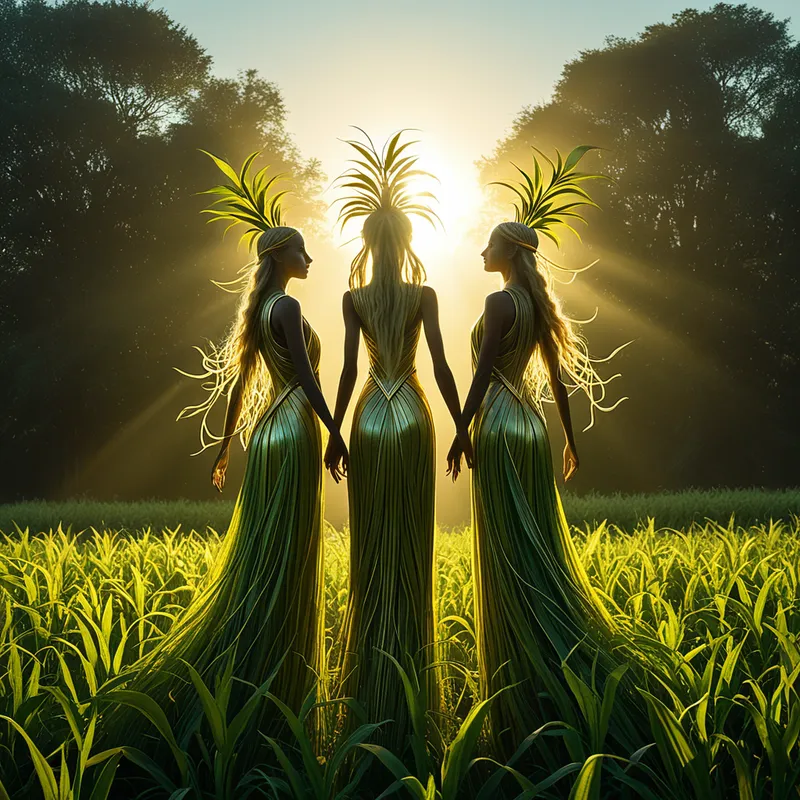
The first was a spirit of proud solitude. She stood straight and tall, reaching for the sun with all her being. Her hair was the color of summer light, and she wore a gown of rustling green. She was Corn. She offered strength, the gift of substance. But alone, the winds mocked her. They pushed her, bent her, threatened to lay her low. In her pride, she wept silent tears for a strength she could not find alone.
The second was a spirit of soft embrace. She had no hard spine of her own, but a heart full of tender, reaching tendrils. Her touch was gentle, her form slender and supple. She was Bean. She offered connection, the gift of relationship. But alone, she could only crawl in the dust, lost and directionless, her gifts of binding and nurturing untended.
The third was a spirit of quiet generosity. She did not seek the heights. She spread herself wide, her broad, soft leaves a living blanket, her body round and giving. She was Squash. She offered protection, the gift of shelter. But alone, she was vulnerable, her soft skin exposed to the burning sun and the gnawing teeth of small creatures.
Each, in her solitude, knew a profound incompleteness. Their songs were melodies without harmony.
Then came the whisper of the Great Mystery, carried on a rain that was also a question: “What do you lack?”
Corn cried, “I lack a strength that bends but does not break!” Bean sighed, “I lack a purpose for my reaching!” Squash murmured, “I lack a reason for my shelter!”
The rain seeped into the earth, and the earth spoke the answer: “Give what you alone can give. Ask for what you alone need.”
And so, in the dark womb of the soil, a pact was made. Not with words, but with the very substance of their being.
Corn, the eldest, pushed upward first, a green spear breaking the darkness. She offered her sturdy stalk, a ladder to [the sky](/myths/the-sky “Myth from Persian culture.”/). Bean, seeing this gift, did not compete. She reached out her tender tendrils and embraced the stalk, climbing not to overtake, but to adorn. In her climbing, she drew nourishment from the air and, in a secret alchemy known only to roots and stars, she gave back a gift of fertility to the soil that fed them both.
Squash, meanwhile, did not strain upward. She spread her broad, lobed leaves like a living quilt over the earth. She shaded the roots, holding the moisture close. She deterred the hungry ones with her prickly stems. She created a world beneath [the world](/myths/the-world “Myth from Tarot culture.”/), cool and safe.
Where there was one, now there were three. Where there was a single, fragile note, now there was a chord. The wind that once threatened Corn now met a united front—Bean’s network of vines binding the stalk, Squash’s leaves softening [the force](/myths/the-force “Myth from Science Fiction culture.”/) at the ground. The sun that once scorched the earth was filtered and gentled. The soil itself grew rich with their shared breath.
The People watched, and their own hearts understood. They saw not three plants, but [three sisters](/myths/three-sisters “Myth from Native American culture.”/). Corn, the sister who stands tall and gives sustenance. Bean, the sister who embraces and gives strength. Squash, the sister who shelters and gives protection. Together, they taught the first law of life: to be whole, you must be part of a whole.
Cultural Origins & Context
The myth of the Three Sisters is not a single, fixed story from one tribe, but a profound agricultural principle and its accompanying narrative spirit that flourished among numerous Haudenosaunee (Iroquois), Anishinaabe, and other Eastern Woodlands nations. It was not merely a farming technique, but a core cosmological truth enacted upon the earth.
Passed down through generations by elders, agriculturalists, and storytellers, the myth was taught to children as they helped plant. The planting ritual itself was a ceremonial re-enactment of the myth: the corn seed placed first in the mound, the bean seed placed when the corn was a few inches high, the squash seed placed at the edge. This was sacred pedagogy. The story functioned as a practical guide, an ethical framework, and a spiritual lesson. It encoded the values of community, mutual responsibility, and the understanding that different gifts, when combined respectfully, create a resilience and abundance impossible alone. It was a myth that fed the body, the community, and the soul simultaneously.
Symbolic Architecture
At its [heart](/symbols/heart “Symbol: The heart symbolizes love, emotion, and the core of one’s existence, representing deep connections with others and self.”/), [the Three Sisters](/myths/the-three-sisters “Myth from Native American culture.”/) myth is a [blueprint](/symbols/blueprint “Symbol: A blueprint represents the foundational plan or design for something, often symbolizing potential, structure, and the mapping of one’s inner self or future.”/) for a healthy [psyche](/myths/psyche “Myth from Greek culture.”/) and a healthy society. It moves beyond simple [metaphor](/symbols/metaphor “Symbol: A figure of speech where one thing represents another, often revealing hidden connections and deeper truths through symbolic comparison.”/) into the [realm](/symbols/realm “Symbol: The symbol of ‘Realm’ often signifies the boundaries of one’s consciousness, experiences, or emotional states, suggesting aspects of reality that are either explored or ignored.”/) of archetypal dynamics.
The individual, standing alone, is a hypothesis. The community, in its true, interdependent form, is the proven theorem of survival and flourishing.
Corn represents [the principle](/symbols/the-principle “Symbol: A fundamental truth, law, or doctrine that serves as a foundation for a system of belief, behavior, or reasoning, often representing moral or ethical standards.”/) of [Structure](/symbols/structure “Symbol: Structure in dreams often symbolizes stability, organization, and the framework of one’s life, reflecting how one perceives their environment and personal life.”/) and [Consciousness](/symbols/consciousness “Symbol: Consciousness represents the state of awareness and perception, encompassing thoughts, feelings, and experiences.”/). She is the erect [spine](/symbols/spine “Symbol: The spine symbolizes strength, support, and the foundational structure of one’s life and identity.”/), the striving ego, the conscious mind that seeks light and order. She is our [identity](/symbols/identity “Symbol: Identity represents the sense of self, encompassing personal beliefs, cultural background, and social roles.”/), our goals, our upright stance in the world. But pure [structure](/symbols/structure “Symbol: Structure in dreams often symbolizes stability, organization, and the framework of one’s life, reflecting how one perceives their environment and personal life.”/) is rigid and vulnerable.
Bean represents the principle of [Connection](/symbols/connection “Symbol: Connection symbolizes relationships, communication, and bonds among individuals.”/) and Unconscious Support. She is the feeling function, the relational network, the often-unseen emotional and instinctual supports that bind us. She climbs, she embraces, she fixes essential nourishment from the [atmosphere](/symbols/atmosphere “Symbol: Atmosphere can signify the emotional and sensory environment surrounding an experience or situation.”/) of the unseen. She transforms and enriches the very ground of being (the [soil](/symbols/soil “Symbol: Soil symbolizes fertility, nourishment, and the foundation of life, serving as a metaphor for growth and stability.”/)/psyche) through her symbiotic [nature](/symbols/nature “Symbol: Nature symbolizes growth, connectivity, and the primal forces of existence.”/).
Squash represents the principle of Containment and Protection. She is the mothering, nurturing [aspect](/symbols/aspect “Symbol: A distinct feature, quality, or perspective of something, often representing a partial view of a larger whole.”/) that creates a safe holding environment. She is the [shadow](/symbols/shadow “Symbol: The ‘shadow’ embodies the unconscious, repressed aspects of the self and often represents fears or hidden emotions.”/) that conserves moisture (emotional [energy](/symbols/energy “Symbol: Energy symbolizes vitality, motivation, and the drive that fuels actions and ambitions.”/)), deters pests (negative influences), and covers the vulnerable roots of our being. She is the necessary [boundary](/symbols/boundary “Symbol: A conceptual or physical limit defining separation, protection, or identity between entities, spaces, or states of being.”/) that allows growth to occur without being scorched or consumed.
The myth’s genius lies in its non-hierarchical, circular [symbiosis](/symbols/symbiosis “Symbol: A dream of mutual dependence and interconnected growth, often representing harmonious relationships or integrated aspects of the self.”/). No [sister](/symbols/sister “Symbol: The symbol of a sister in a dream often represents connection, support, and the complexities of familial relationships.”/) is the “[hero](/symbols/hero “Symbol: A hero embodies strength, courage, and the ability to overcome significant challenges.”/)”; each is a crucial part of a self-sustaining [system](/symbols/system “Symbol: A system represents structure, organization, and interrelated components functioning together, often reflecting personal or social order.”/). The [hero](/symbols/hero “Symbol: A hero embodies strength, courage, and the ability to overcome significant challenges.”/) is the [relationship](/symbols/relationship “Symbol: A representation of connections we have with others in our lives, often reflecting our emotional state.”/) itself.
The Dreamer’s Resonance
When this triad appears in modern dreams—perhaps as three women, three trees, three pillars, or three intertwined forces—it signals a profound somatic and psychological process of integration. The dreamer is likely grappling with a sense of fragmentation or one-sidedness.
Dreaming of a tall, lonely stalk battered by wind may reflect an over-reliance on conscious will (Corn) without emotional support (Bean) or self-care (Squash). Dreaming of a tangled vine crawling aimlessly may point to a life of reactive relationships without a core structure or purpose. Dreaming of a large, soft fruit rotting in the sun may indicate nurturing energies that are unprotected, unappreciated, or spilling out without direction.
The appearance of the completed triad in a dream is a powerful message from the deep psyche. It is the unconscious presenting a model of wholeness. It suggests the dreamer is ready, or is being urged, to allow these separated parts of themselves to discover their symbiotic roles. The body may feel this as a release of tension, a sense of “rightness,” or a grounding energy, as if roots are finally finding their network and leaves their purpose.
Alchemical Translation
The process of individuation—becoming an integrated, authentic Self—is perfectly modeled by the alchemy of the Three Sisters. It is the transmutation of isolated, ego-driven parts into a cooperative, self-sustaining psychic ecosystem.
The initial state is one of recognized insufficiency. The Corn-ego must admit its vulnerability. The Bean-feeling must confess its lack of direction. The Squash-nurturing must acknowledge its exposure. This is the [nigredo](/myths/nigredo “Myth from Alchemical culture.”/), the darkening, the planting in the dark soil.
The pact is the sacrifice of absolute autonomy. Each part must give up its solitary agenda. [The ego](/myths/the-ego “Myth from Jungian culture.”/) must offer its structure to be used by others. The feelings must agree to serve and strengthen, not overwhelm. The nurturing instincts must consent to operate in service of the whole, not as smothering control. This is the sacred contract, the albedo.
The growth is the emergent synergy. As the parts engage according to their true nature, a new entity arises: [the Self](/myths/the-self “Myth from Jungian culture.”/)-as-Community. The conscious mind is stabilized by emotional intelligence. Emotional intelligence is given form and purpose by consciousness. Both are protected and sustained by grounded, self-care. This creates a fertility loop where every act of self-expression nourishes the whole, and care for the whole strengthens every part.
The goal is not to become a monolithic, perfect being, but to become a sacred mound where the Sister-Spirits of your psyche can take root, embrace, and thrive together, producing a harvest that feeds your world.
This is the ultimate teaching of the Sisters. Our wholeness is not a solitary achievement, but a relational masterpiece. We are called not to be heroes standing alone against the world, but gardeners tending the sacred, interdependent life within and between us.
Associated Symbols
Explore related symbols from the CaleaDream lexicon: