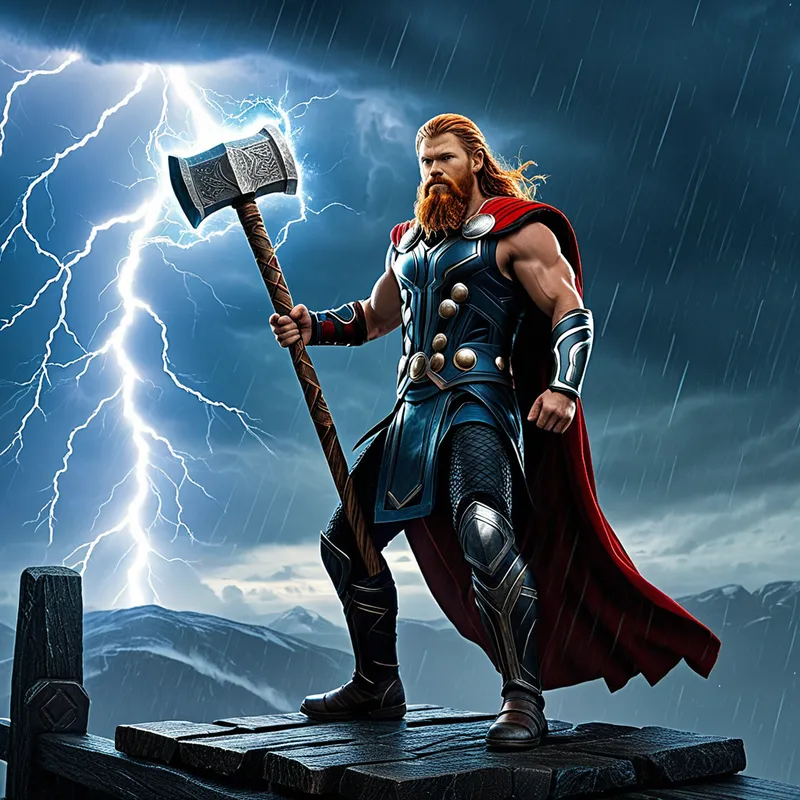
Thor's Hammer Myth Meaning & Symbolism
The theft of Thor's hammer forces the thunder god into a humiliating disguise, revealing that true power is forged in vulnerability and cunning, not just brute force.
The Tale of Thor’s Hammer
Listen, and hear the tale of the day the thunder fell silent.
In the high halls of Asgard, a dread stillness had taken root. The great protector, Thor, roared in a fury that shook the very pillars of his hall, Bilskirnir. His mighty hand grasped at empty air where a familiar, terrible weight should have been. Mjölnir was gone. Stolen. The weapon that guarded the gods from the giants, that hallowed marriages and blessed the dead, had vanished in the night. Without it, the realms were naked. The scent of fear, sharp as cold iron, hung in the mead-halls.
The culprit’s name was whispered like a curse: Thrym. From his frozen seat in Jötunheim, the giant sent a mocking message carried on a wind that stank of frost and arrogance. He had buried Mjölnir eight leagues deep in the earth. The price for its return? The fairest bride in all the worlds: the goddess Freyja.
The gods assembled, their faces grim. Freyja’s rage was a sight to behold; her necklace, Brísingamen, flashed with her fury, and her refusal was a sound that cracked like ice. Asgard was paralyzed. Then, the one-eyed All-Father, Odin, spoke, and his words were a blade of cold reason. “There is a way,” he said, his gaze settling on his thunderous son. “But it will require a sacrifice not of gold, but of pride.”
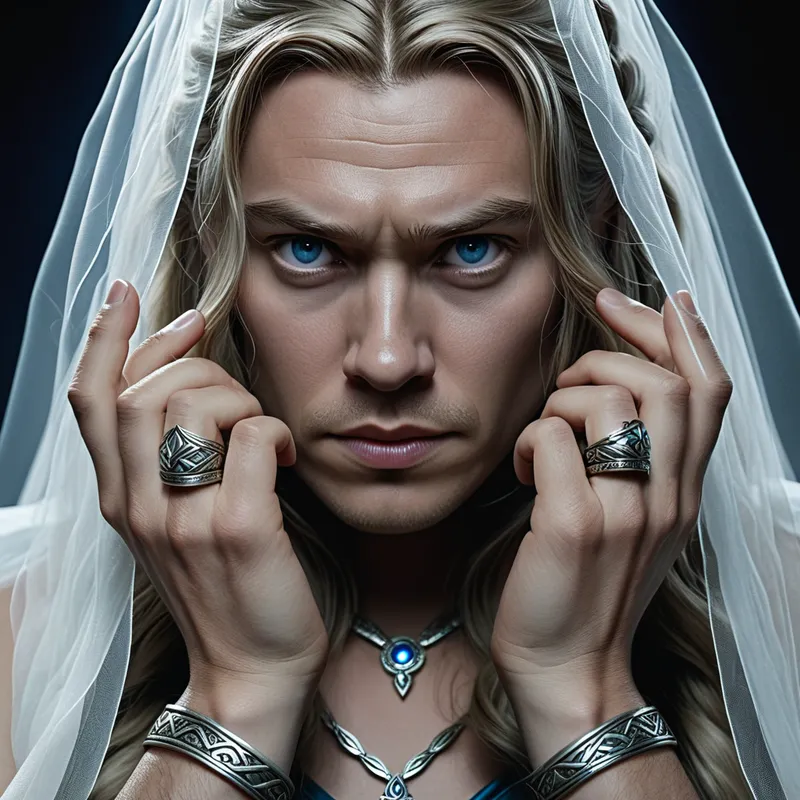
The plan was an exquisite humiliation. Thor, the embodiment of raw, unthinking force, would go to Jötunheim not as a warrior, but as a bride. He would don the linen and lace of Freyja, veil his fierce face, and let the trickster Loki, disguised as a handmaid, speak for him. To see the Thunder God, his mighty arms hidden beneath silks, his red beard tucked away, was to see the very soul of Asgard bent and shackled. The journey to Thrym’s hall was a silent torment, the chariot pulled by Thor’s goats rattling not with the joy of a wedding, but with the tension of a coiled spring.
In the giant’s hall, beneath mountains of stone and ice, the deception unfolded. Thrym, his heart swollen with greedy triumph, feasted his “bride.” But the giant’s eyes narrowed with suspicion. This Freyja ate an entire ox, eight salmon, and drained three barrels of mead in a single, terrifying draft. Her eyes burned like forge-fires behind the veil. Loki, quick as a serpent’s tongue, whispered that the goddess had not eaten for eight days, so great was her longing for Jötunheim. Convinced, Thrym lumbered forward to steal a kiss and, in doing so, lifted the bridal veil. He stumbled back, howling, for he saw not a goddess’s soft features, but the blazing, wrathful eyes of the God of Thunder.
It was the signal. The spring uncoiled. Thor’s hand, no longer restrained by pretense, shot out. There, placed in his lap as a wedding gift, was Mjölnir. His fingers closed around the familiar, rune-carved handle. In that touch, the silence ended. The hall of Thrym, once filled with gloating laughter, became the epicenter of a storm. Lightning, long pent-up, erupted from the hammer’s head. Stone melted, giants fell, and the thunder, finally unleashed, sang a song of absolute and terrible restoration.
Cultural Origins & Context
This myth, preserved primarily in the Old Norse poem Þrymskviða (The Lay of Thrym) from the 13th-century Poetic Edda, is far from a simple adventure tale. It was a story told in the long, dark winters, a narrative that held a mirror to the fears and values of the Viking Age. The skalds (poets) who recited it were not merely entertainers; they were custodians of a worldview where order (örlög) was perpetually besieged by chaos, embodied by the giants.
The theft of Mjölnir represents the ultimate societal vulnerability. Thor was not just a god; he was the divine model for the warrior-hersir (chieftain), the protector of the community (innangard) against the destructive outside forces (utangard). His hammer was the literal and symbolic tool of that protection—used to hallow, to consecrate, and to destroy threats. The myth’s function was profound: it explored what happens when the primary defense fails. It asked the community, through story, how they would respond to catastrophic loss. Would they break? Or would they, like the gods, resort to cunning (seidr), to a flexibility that their rigid warrior ethos often despised, in order to survive?
Symbolic Architecture
At its core, the myth of the stolen hammer is a profound drama of fractured identity and its necessary, humiliating restoration. Thor is not merely disarmed; he is dis-identified. His essence—the thunderous, straightforward force—is stripped from him. The hammer is more than a weapon; it is his function, his raison d’être, his connection to his own divine nature and his role in the cosmos.
To lose one’s defining tool is to confront the abyss of who one is without it.
The forced cross-dressing is the masterstroke of the myth’s symbolism. Thor must embody the very opposite of his nature: passivity, deception, the feminine archetype (in its most stereotypical, bridal form). This is not a celebration of those traits, but a brutal initiation into them. The hero must be broken open, must taste the ashes of his own powerlessness, to understand that power itself is not monolithic. True restoration requires integrating the “other”—the cunning of Loki, the transformative willingness to become what you are not.
The retrieval is not a triumphant battle from a position of strength, but a reclamation from within the belly of the beast, achieved through a performance of profound vulnerability. Mjölnir is returned not to a conqueror, but to a god who has been utterly unmade and who, in the moment of grasping it again, is remade into something more complete.
The Dreamer’s Resonance
When this myth stirs in the modern psyche, it often manifests in dreams of profound incapacity or stolen agency. You may dream of being on a critical stage but losing your voice. Of facing a threat with a weapon that turns to mist in your hands. Of being forced to wear a uniform or play a role that feels like a grotesque parody of your true self.
These are not dreams of simple anxiety; they are somatic signals of a “Thor’s Hammer” moment in the psyche. The “hammer” represents your core competency, your sense of efficacy, your will. Its theft signifies a life circumstance—a failure, a betrayal, an illness, a loss—that has severed you from that innate power. The humiliation in the dream is the psyche forcing you to confront the raw, undefended self that remains when your primary identity is stripped away. The process is one of somatic disillusionment: the body-mind is dissolving an old, rigid structure of “how I am powerful” to make way for a more complex and resilient one.
Alchemical Translation
The journey of Thor models the alchemical process of solve et coagula—dissolve and coagulate—applied to the psyche. The initial state is one of coagulated identity: “I am the Thunderer. I smash problems.” The theft of the hammer is the solve, the necessary, often catastrophic dissolution. The ego’s prized structure is broken down.
The crucible of humiliation is where the base metal of a one-dimensional self is liquefied, ready for a new alloy.
The sojourn in Jötunheim as the bride is the liminal stage, the nigredo or blackening, where the individual exists in a state of chaotic potential, containing opposites (male/female, strength/deception, god/giant). This is the shadow-work, where one must consciously engage with the despised and hidden aspects of the self—the cunning, the manipulative, the vulnerable—that the heroic persona has rejected.
The re-grasping of Mjölnir is the coagula, the rebirth. But the hammer is not merely returned; it is reclaimed by a consciousness that has been expanded. The new “Thunder” that emerges is not brute force alone, but force tempered by the experience of powerlessness, informed by cunning, and capable of strategic disguise. For the modern individual, the myth maps the path of individuation through crisis. It suggests that our deepest power is often only accessible after we have lost our primary, egoic version of it and have been forced to wander, humiliated and disguised, in the frozen lands of our own unconscious until we can reclaim that power from a place of integrated, rather than partial, being. We do not just get our hammer back. We become the smith who understands it.
Associated Symbols
Explore related symbols from the CaleaDream lexicon: