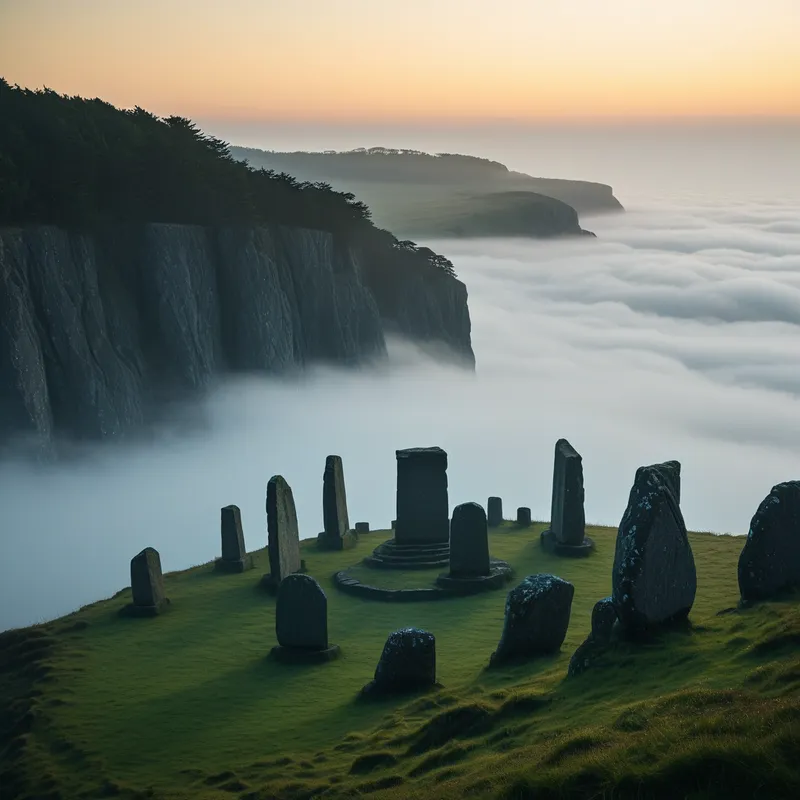
Thin Places Myth Meaning & Symbolism
A myth of sacred thresholds where the Otherworld bleeds into our own, revealing the porous nature of reality and the psyche's deepest layers.
The Tale of Thin Places
Listen. The world you know is not the only one. There are places where the fabric of An Domhain grows thin, worn soft as old linen by the breath of the other side. They are not marked on any map drawn by mortal hand. You must feel your way to them—a sudden chill in a sunlit grove, a silence deeper than sleep in a chattering stream, a pull in the marrow of your bones toward a certain standing stone on a forgotten hill.
In the time before memory, when the Tuatha Dé Danann walked the land in daylight, these places were doorways left ajar. It was at such a place, a well shaded by nine sacred hazels, that the young seer Boann dared to walk. The well belonged to Nechtan, and its waters held all knowledge. To look upon them was forbidden. But the silence of the place called to her, a humming in the air between the worlds. She walked sunwise around it once, then twice. On the third circuit, the veil tore.
Not with a crash, but with a sigh. The waters rose, not in anger, but in revelation, bursting from the well to become a river—the Boyne. In that surging flow, the wisdom of the deep earth met the light of the sun, and the boundary between the hidden and the seen was forever washed away. The place was now thin, forever.
And it is at another such place, a mist-cloaked mound on the plain of Teamhair, that a king may find his destiny. A mortal, heavy with the weight of rule, may lie down to sleep upon the grass of the Duma na nGiall. As sleep takes him, the mound opens not in stone, but in spirit. He is drawn inside, not to a tomb, but to a hall brighter than day, where a woman of terrifying beauty awaits. She is Ériu, and she offers him a cup of red ale. To drink is to bind his fate to the land itself, to see the future of his people woven into the very hills and rivers. He awakens on the dew-wet grass, the taste of Otherworldly ale still on his tongue, the world around him vibrating with a meaning it did not hold before. The mound has spoken; the thin place has transferred its truth.
These are not stories of conquest, but of encounter. A fisherman on the western sea, where the sun drowns each night, may see the ghostly islands of Tír na nÓg rise from the waves for a single, heart-stopping moment. A traveler at dusk, where three roads meet, may feel a presence beside him—a guide, a warning, a memory not his own. The thin place is always a threshold, a moment of between: between day and night, land and sea, waking and dreaming, life and what lies beyond life. To step into it is to be unmade and remade, not by force, but by seeing what was always there, just behind the curtain of the ordinary.

Cultural Origins & Context
The concept of Caol Áiteanna is woven into the very fabric of Celtic, particularly Irish and Scottish Gaelic, spiritual geography. It is less a formal "myth" with a single narrative and more a pervasive worldview—a fundamental understanding of how the cosmos is structured. This knowledge was carried by the Aos Dána, the druids, bards, and filí (seer-poets), who were the cartographers of the invisible landscape.
These ideas survived the coming of Christianity not in opposition to it, but in fusion. Early Irish monks, seeking "desert places" for solitude, often retreated to the very islands, mountain tops, and forest glades already considered thin by their ancestors. Monasteries like Sceilg Mhichíl were built on dizzying sea rocks precisely because they were perceived as edges of the world, ideal for approaching the divine. The lore was preserved in manuscripts like the Lebor Gabála Érenn and the tales of the Ulster Cycle, where heroes constantly interact with the Sídhe through mounds, lakes, and caves.
Societally, thin places functioned as anchors of the sacred within the profane. They were points of contact where the community could ritually engage with the forces of fertility, sovereignty, and ancestral wisdom. A king's legitimacy was tied to his symbolic marriage to the land at a thin place (like Tara). Seasonal festivals like Bealtaine and Samhain were times when the veil was considered especially thin, requiring specific rites to navigate the heightened permeability between worlds.
Symbolic Architecture
At its core, the myth of the thin place is a master symbol for the structure of the psyche itself. It posits that reality is not monolithic but layered, and that consciousness is not a walled city but a porous membrane.
The threshold is not a barrier, but a organ of perception. The thin place is the psyche's own capacity for revelation.
The physical locations—the well, the mound, the shore—are external mirrors of internal states. The well represents the deep, often forbidden, waters of the unconscious, where primal wisdom and creative potential (Eó Feasa) reside. The mound symbolizes the buried layers of the personal and collective past, the ancestral memory that forms the foundation of identity. The shore or mist embodies the liminal state of transition itself, the foggy, uncertain space where one reality dissolves so another can form.
The entities encountered—the goddess, the spectral guide, the vision of the otherworld—are archetypal contents of the unconscious breaking through into awareness. They are not "outside" but are profound aspects of the self that feel alien because they have been repressed, ignored, or unrealized. The encounter is always one of relationship; it demands a response, whether it be acceptance (drinking the cup), flight, or integration.
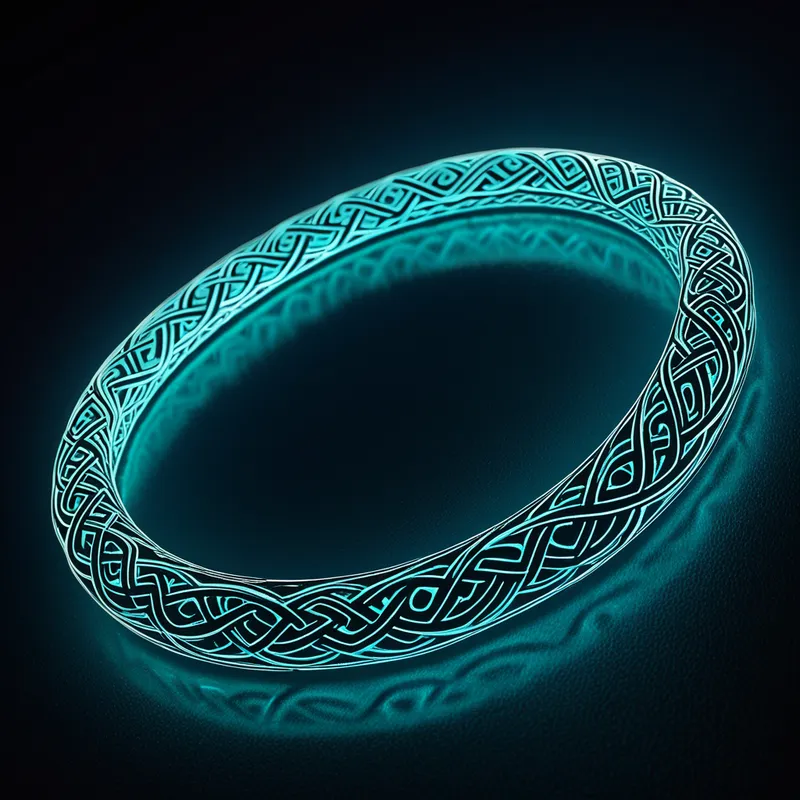
The Dreamer's Resonance
When this mythic pattern activates in the modern dreamer, it signals a psychological state of liminality. The individual is in a "thin" phase of their own life: a career change, the end of a relationship, a spiritual crisis, a creative awakening. The stable ego-structure ("An Domhain") feels permeable.
Dreams may feature:
- Literal Thresholds: Recurring dreams of doors that won't close, windows that open onto impossible landscapes, or hallways that shift and elongate.
- Permeable Environments: Walls that breathe, floors that become water, or a familiar room that extends into a vast, unknown forest.
- Archetypal Encounters: Meeting a mysterious, authoritative figure (sovereignty goddess), being offered a transformative object (cup, key, stone), or witnessing a natural element behave with uncanny intelligence (a talking river, a guiding mist).
Somatically, this process can feel like a low-grade fever of the soul—a sense of being "unwell" because one is literally un-webbed from the old reality. There is often anxiety, but also a thrilling, terrifying sense of potential. The psyche is doing the necessary work of dissolving a too-rigid ego-boundary to allow for a more complex and authentic consciousness to emerge. The dream is the thin place where this negotiation between the known self and the larger Self occurs.

Alchemical Translation
The journey to and through a thin place is a perfect map for the alchemical process of individuation—the psychic transmutation of leaden, unconscious identification into golden, conscious selfhood.
The Call (The Pull to the Place): This is the initial, often uncomfortable, stirring of the Self. A sense that the current life-myth is insufficient. It feels like nostalgia for somewhere you've never been, or a profound discontent with surface-level reality.
The Dissolution (The Veil Tears): This is the critical, often frightening phase. The old structures of identity, belief, and perception are rendered "thin." Like Boann at the well, the conscious mind's protective rules are overwhelmed by the rising waters of the unconscious. This feels like a crisis, a breakdown, or a period of intense disorientation.
The goal is not to repair the veil, but to learn to see by the light shining through it.
The Coniunctio (The Encounter): At the depth of the dissolution, in the heart of the thin place, the transformative meeting occurs. The dreamer meets the "Other"—the shadow, the anima/animus, the wise old being. This is the sacred marriage, the drinking of the cup. Psychologically, it is the moment of insight, where a previously split-off part of the psyche is acknowledged and engaged with. It is not a battle to be won, but a relationship to be formed.
The Coagulatio (Return with the Gift): The final stage is not remaining in the Otherworld, but returning to the ordinary world, forever changed. The king awakens on the mound with new sovereignty; the river now flows in the visible world. The alchemical gold is the integrated perspective. The individual now carries the thin place within. They perceive the mundane world as inherently numinous, understanding that the veil was always an illusion of a fragmented consciousness. They become, themselves, a point of permeability—where spirit meets matter, depth meets surface, and the eternal whispers into the heart of the temporal. The journey ends with the realization that all places are potentially thin, for the threshold was never in the landscape, but in the quality of one's attention.
Associated Symbols
Explore related symbols from the CaleaDream lexicon: