Theseus's Ship Myth Meaning & Symbolism
A legendary vessel, preserved plank by plank, becomes an eternal riddle: at what point does the old become new, and what remains of the original self?
The Tale of Theseus’s Ship
Hear now a riddle, not of stone or [sphinx](/myths/sphinx “Myth from Greek culture.”/), but of wood and wave. It begins not with a birth, but with a return.
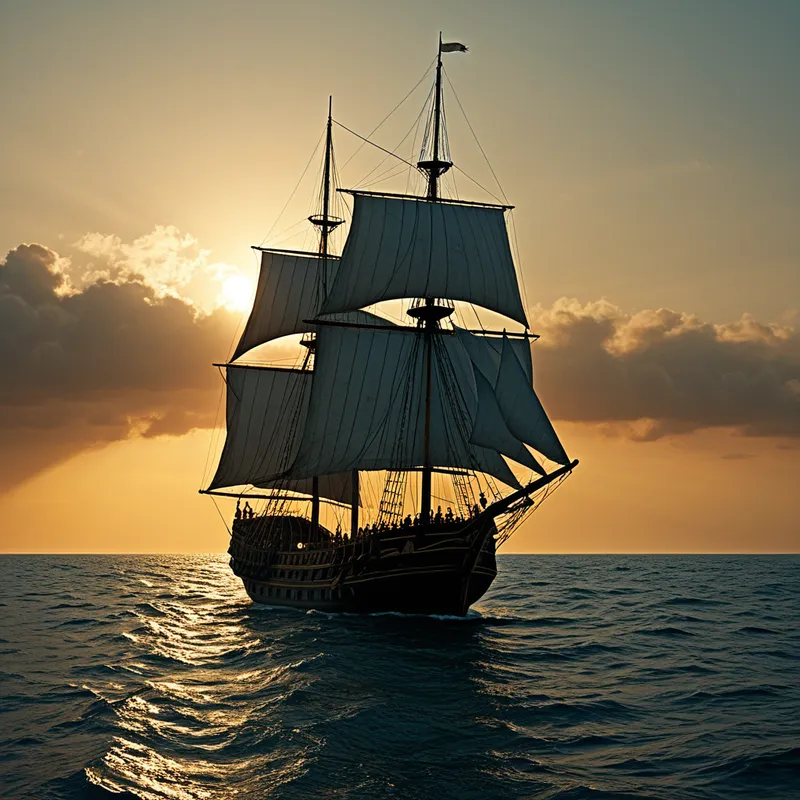
The hero [Theseus](/myths/theseus “Myth from Greek culture.”/), slayer of the [Minotaur](/myths/minotaur “Myth from Greek culture.”/), had sailed home to Athens in [triumph](/myths/triumph “Myth from Roman culture.”/). His ship, a thirty-oared trireme, was no mere vessel; it was a floating testament. Its timbers held the memory of the desperate voyage to Crete, the salt-spray of escape, the weight of liberated youths. It was a relic of salvation, and the Athenians, in their piety and pride, consecrated it. They dedicated it to [Poseidon](/myths/poseidon “Myth from Greek culture.”/) and to their own deliverer, mooring it in the harbor of Piraeus as a sacred memorial for all generations to behold.
Seasons turned. The sun beat upon its decks, and the relentless sea whispered against its hull. A plank, attacked by the hidden worm, began to soften. The sacred could not be allowed to rot, to become a monument to decay. So, the keepers of the ship—the priests and the shipwrights—made a decision. The rotten plank was carefully removed. In its place, they fitted a new one, of strong, fresh oak, sealed with pitch and reverence. The ship was whole. It was still Theseus’s Ship.
But time is a patient craftsman. The next season, another plank faltered. Then a rib. Then a bench for the oarsmen. Each time, with solemn care, the decayed piece was removed and preserved, and a new, sound piece was installed. The people still pointed to [the vessel](/myths/the-vessel “Myth from Alchemical culture.”/) and said, “Behold, [the ship of Theseus](/myths/the-ship-of-theseus “Myth from Global/Universal culture.”/)!” And so it was, for decades. For centuries.
The replaced timbers were not discarded. They were stored in a great hall, a growing archive of the sacred original. Each worn plank, each nail-pocked beam, was kept, until one day, a philosopher gazed upon that hall and saw not a collection of scraps, but a skeleton. A question took shape in the still air, heavier than any timber: If every single piece of the ship in the harbor has been replaced, is it still the Ship of Theseus? And if one were to take all the old, preserved pieces and reassemble them, which of the two—the sailing vessel or the stored relic—would hold the true essence, the true identity, of the hero’s ship?
The myth ends not with an answer, but with the question hanging over the harbor, as enduring as the ship itself.
Cultural Origins & Context
The paradox of Theseus’s Ship is not a myth in the traditional sense of gods and monsters, but a philosophical thought experiment recorded by later historians and thinkers. It is most famously attributed to Herodotus and discussed at length by Plutarch in his Life of Theseus. Plutarch uses the story not to narrate an epic, but to frame a profound inquiry into identity and change.
In the culture that gave us the Gnothi Seauton (“Know thyself”), this puzzle was a natural outgrowth. Greek philosophy, from the pre-Socratics pondering the nature of being to Plato and his theory of Forms, was obsessed with the relationship between the permanent and the changing. The Ship served as a perfect, tangible metaphor for this abstract struggle. It was a story passed down not by bards in [feasting halls](/myths/feasting-halls “Myth from Celtic culture.”/), but by philosophers in the Stoa and the Academy, a tool for sharpening the mind and examining the very foundations of what it means for a [thing](/myths/thing “Myth from Norse culture.”/)—or a person, or a city—to persist through time.
Symbolic Architecture
At its [heart](/symbols/heart “Symbol: The heart symbolizes love, emotion, and the core of one’s existence, representing deep connections with others and self.”/), the ship is a [symbol](/symbols/symbol “Symbol: A symbol can represent an idea, concept, or belief, serving as a powerful tool for communication and understanding.”/) of the Self—that complex, voyaging entity we call “I.” The [hull](/symbols/hull “Symbol: The outer shell of a vessel, representing protection, boundaries, and the separation between inner self and external world.”/) is the [body](/symbols/body “Symbol: The body in dreams often symbolizes the dreamer’s self-identity, personal health, and the relationship they have with their physical existence.”/), the visible form; the sails are the [spirit](/symbols/spirit “Symbol: Spirit symbolizes the essence of life, vitality, and the spiritual journey of the individual.”/) and aspiration; the [journey](/symbols/journey “Symbol: A journey in dreams typically signifies adventure, growth, or a significant life transition.”/) is the [life](/symbols/life “Symbol: The symbol of ‘Life’ represents a journey of growth, interconnectedness, and existential meaning, encompassing both the joys and challenges that define human experience.”/). The myth presents [the Self](/myths/the-self “Myth from Jungian culture.”/) not as a [static](/symbols/static “Symbol: Static represents interference, disruption, and the breakdown of clear communication or signal, often evoking feelings of frustration and disconnection.”/) [statue](/symbols/statue “Symbol: A statue typically represents permanence, ideals, or entities that are revered.”/), but as a living process in a sea of time.
The Self is not a monument to be preserved, but a vessel to be maintained. Its integrity lies not in the permanence of its parts, but in the continuity of its voyage.
The relentless replacement of planks symbolizes the constant, cellular renewal of the physical body and the incremental replacement of memories, beliefs, and habits that constitute our psychological [makeup](/symbols/makeup “Symbol: Cosmetics and products applied to enhance or alter one’s appearance, symbolizing identity, self-expression, and societal norms.”/). The old, stored timbers represent the past—our [history](/symbols/history “Symbol: History in dreams often represents the dreamer’s past experiences, lessons learned, or unresolved issues that continue to influence their present.”/), our [trauma](/symbols/trauma “Symbol: A deeply distressing or disturbing experience that overwhelms the psyche, often manifesting in dreams as unresolved emotional wounds or psychological injury.”/), our formative experiences. They are removed from active service, but they are not erased; they are archived, forming the [museum](/symbols/museum “Symbol: A museum symbolizes the preservation of memories, culture, and knowledge; a place for reflection and learning.”/) of our personal history. The [paradox](/symbols/paradox “Symbol: A contradictory yet true concept that challenges logic and perception, often representing unresolved tensions or profound truths.”/) forces us to ask: Are we the currently sailing [vessel](/symbols/vessel “Symbol: A container or structure that holds, transports, or protects something essential, representing the self, emotions, or life journey.”/) of present experience, or the assembled ghost of everything we have ever been?
The [hero](/symbols/hero “Symbol: A hero embodies strength, courage, and the ability to overcome significant challenges.”/) Theseus himself is the archetypal [hero](/symbols/hero “Symbol: A hero embodies strength, courage, and the ability to overcome significant challenges.”/), and his ship is the [vehicle](/symbols/vehicle “Symbol: Vehicles in dreams often symbolize the direction in life and the control one has over their journey, reflecting personal agency and decision-making.”/) of his heroic [identity](/symbols/identity “Symbol: Identity represents the sense of self, encompassing personal beliefs, cultural background, and social roles.”/). To maintain the ship is to maintain the [connection](/symbols/connection “Symbol: Connection symbolizes relationships, communication, and bonds among individuals.”/) to that heroic potential, not through [stasis](/symbols/stasis “Symbol: A state of inactivity, equilibrium, or suspension where no change or progress occurs, often representing psychological or existential paralysis.”/), but through willing [adaptation](/symbols/adaptation “Symbol: The process of adjusting to new conditions, often involving psychological or physical change to survive or thrive.”/).
The Dreamer’s Resonance
When this myth stirs in the modern unconscious, it often manifests in dreams of shifting architecture—a childhood home where rooms rearrange, a car that transforms part by part while moving, or one’s own face looking subtly different in every mirror. These are somatic dreams of identity-in-flux.
The dreamer undergoing this process is at a threshold where a foundational aspect of self is being questioned or renewed. This could be a career change, the end of a long relationship, a spiritual awakening, or recovery from illness. The somatic feeling is often one of profound disorientation—a “groundlessness” where the familiar floorboards of identity seem to be removed one by one. There is anxiety in the removal, but also a latent potential in the new space being created. The dream asks the dreamer to hold the tension: to feel the grief for the rotting plank that must go, while also sensing the necessity and strength of the new timber being fitted. It is the [psyche](/myths/psyche “Myth from Greek culture.”/)’s way of modeling its own ongoing repair and asking, “Who is the captain of this ship now?”

Alchemical Translation
The alchemical process mirrored in the myth is [solve et coagula](/myths/solve-et-coagula “Myth from Alchemical culture.”/)—dissolve and coagulate. The old, outworn elements of the personality (the rotten planks) must be dissolved, taken out of active circulation. This is a necessary decay, a death on a micro-scale. But alchemy is never mere destruction; it is always in service of transmutation.
Individuation is the continuous shipwright’s art: the conscious, careful replacement of outworn parts of the psyche with integrated ones, all while keeping the vessel seaworthy.
The “stored timbers” represent [the shadow](/myths/the-shadow “Myth from Jungian culture.”/) material—the rejected, painful, or forgotten aspects of ourselves we have removed from view. The full alchemical work is not complete until we dare to visit that storage hall. To look at those old, weathered pieces not as rubbish, but as sacred relics of our journey. The ultimate integration is realizing that both the sailing ship and the stored timbers are “Theseus’s Ship.” The conscious, present-day self and the totality of our personal history, including our wounds, are one continuous entity.
The modern individual’s “triumph” is not in finding a final answer to the paradox, but in learning to sail the ship while holding the question. It is to understand that identity is a verb, not a noun—a process of perpetual maintenance and conscious choice. We become the shipwright and the captain, tasked with the sacred duty of renewal, trusting that the essence—the daimon or soul of the voyage—is not in any single piece of wood, but in the enduring pattern, the ongoing story, and the direction we choose to sail.
Associated Symbols
Explore related symbols from the CaleaDream lexicon: