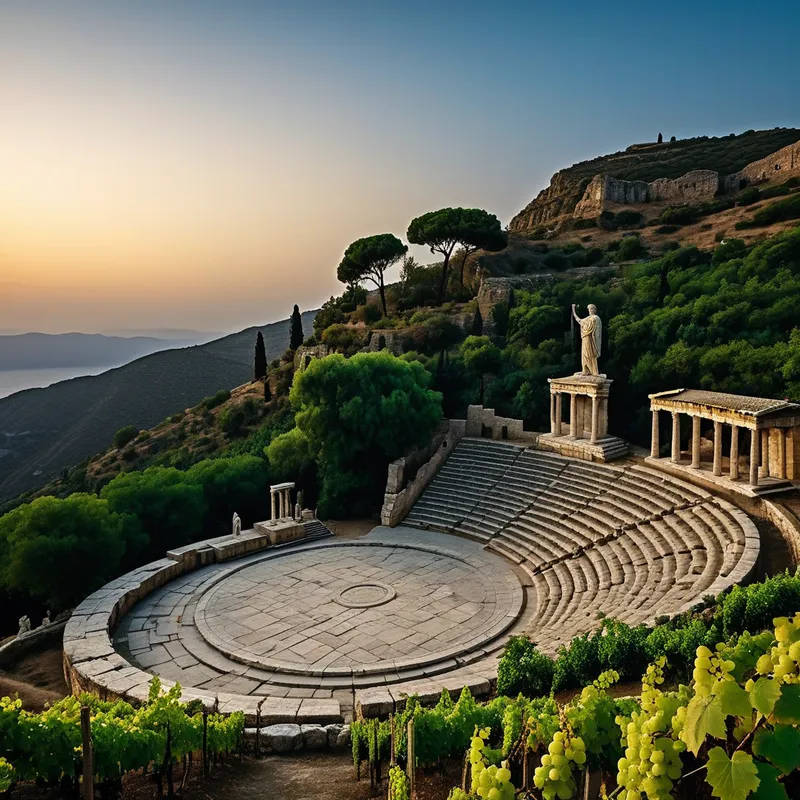
Theater of Dionysus Myth Meaning & Symbolism
The mythic origin of theater, where the god of ecstasy transforms collective frenzy into sacred performance, revealing the soul's hidden truths.
The Tale of Theater of Dionysus
Hear now the tale of the first cry that became a chorus, the first tear that became a tragedy. It begins not in a city of marble and law, but in the wild, wine-dark hills where the pines whisper secrets to the wind. There, the god walks. Dionysus, the twice-born, the stranger, the liberator. His feet are bare upon the earth, and where he treads, the soil grows soft with new vines and the air thickens with the scent of crushed grapes and impending storm.
He came not with the order of Zeus or the wisdom of Athena, but with the madness of his own birth—torn from a womb of lightning and sewn into a mortal thigh. He gathered followers not from the agora, but from the edges: women who left their looms, their husbands, their names, to become Maenads, their hair wild with ivy, their hands clutching the sacred thyrsus. Men with the legs of goats and lust in their hearts—the Satyrs—piped a chaotic, thrilling music. Together, they were the thiasos, the ecstatic band, and their worship was a tempest. They would dance until their bones ached, drink until the world blurred, and in their frenzy, tear living beasts apart with their hands, feeling the hot blood and raw flesh become one with their own pulsing life.
But the city walls saw this not as worship, but as a plague. The rulers of Thebes, of Argos, tried to bind the god, to deny his divinity, to lock away the women who heard his call. They demanded order. Dionysus answered with a deeper chaos. He would drive the doubting kings mad, have them see phantoms, make them tear at their own flesh thinking it was another’s. The Maenads, in their god-infused rage, could turn on their own sons, seeing only the beast to be sacrificed. This was the raw, untranslated power of the god: a force that could obliterate the individual in a wave of collective, destructive frenzy.
And then… a shift. A stillness in the storm’s eye. The god, witnessing the bloody aftermath of pure sparagmos (the rending apart), saw a deeper need. The ecstasy was real, the release was necessary, but the form was deadly. So, from the bloody soil of the sacred grove, he caused a new space to be born. A space not of chaotic forest, but of shaped earth—a hillside carved into a great, stone bowl facing a flat circle, the orchestra, the dancing place. He took the goat-skins of the sacrificed (tragos) and the hymns (ōdē) sung to him, and he wove them into a new ritual: the tragōidia—the goat-song.
He commanded his Satyrs to not just live their wildness, but to perform it. He asked a brave soul to step apart from the chorus, to don a mask, to become another—Thespis. One voice answering the many. A story emerged from the noise. The frenzy was channeled; the raw terror and joy of existence were given a story, a mask, a form. The rending of the beast became the catharsis of the audience. The wild cries became measured verses. The Theater was born—not as a denial of the Dionysian, but as its most sacred vessel. The god of ecstasy had become the patron of the moment when chaos finds its voice, and in finding its voice, reveals the profound, terrifying, and beautiful truth of being alive.

Cultural Origins & Context
This was not a single myth penned by one poet, but a living, cultural memory etched into the ritual life of ancient Greece. The origins are shrouded in the pre-Olympian mist of agrarian cults centered on fertility, death, and rebirth. Dionysus was always the "god who comes," an outsider force that had to be integrated, often violently, into the civic order. The historical development of theater in 6th century BCE Athens under rulers like Peisistratus formalized this integration.
The myth was enacted annually at the City Dionysia. Before the plays, a statue of the god was brought from his temple outside the city to the theater, re-enacting his arrival. The performances themselves—the tragedies, comedies, and satyr plays—were religious rituals, competitions dedicated to him. The stories told were of other myths (of the house of Atreus, of Thebes), but the container, the very fact of the performance, was the myth of Dionysus. It was passed down not just in stories, but in the collective, somatic experience of tens of thousands of citizens gathered in the theatron, experiencing pity and fear, and through them, a communal purification. Its societal function was paramount: to safely channel the disruptive, individual-dissolving energies of ecstasy and violence into a civic art form that ultimately strengthened the social fabric by confronting its deepest anxieties.
Symbolic Architecture
The Theater of Dionysus is not merely a building; it is a profound psychological model. It represents the necessary container for the raw, formless contents of the unconscious.
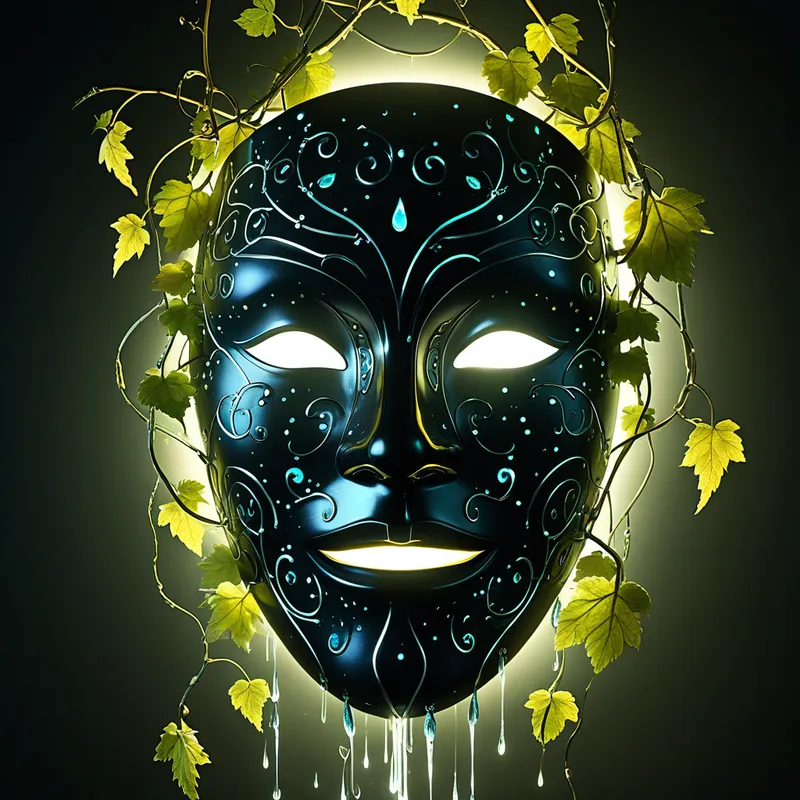
The mask does not hide the self; it reveals the Self. In putting on the face of another, we meet the stranger within.
The Wild Grove symbolizes the untamed, instinctual psyche—the realm of primal emotions, unchecked desires, and non-verbal drives. This is the sparagmos state, where the ego is torn apart by unconscious forces. The Stone Theater symbolizes the constructed ego and the super-ego—the laws, forms, and structures of consciousness and society. It is order, boundary, and perspective (the seating). The core alchemy of the myth is the transformation of the Grove into the Theater.
Dionysus himself is the archetypal force of this transformation. He is the psychopomp who leads the soul-material from chaos into form. The Mask is the central symbol: it allows for projection and identification. It protects the individual actor (the conscious ego) while giving full expression to the archetypal role (the unconscious content). The Chorus represents the collective psyche, the background hum of society and shared fate, which comments on and interacts with the individual hero's journey (the Actor). Catharsis (katharsis), the purgation of pity and terror, is the goal—the psychic release that comes when unconscious material is safely witnessed and integrated through symbolic form, rather than acted out in literal destruction.
The Dreamer's Resonance
When this myth stirs in the modern soul, it often manifests in dreams of overwhelming, chaotic emotion seeking form. One might dream of being in a frenzied crowd, feeling both terrified and ecstatically free, on the verge of violence or breakdown. This is the "Grove" state of the psyche—the sparagmos where the ego-structure is threatened by a flood of unprocessed feeling—rage, grief, or wild joy.
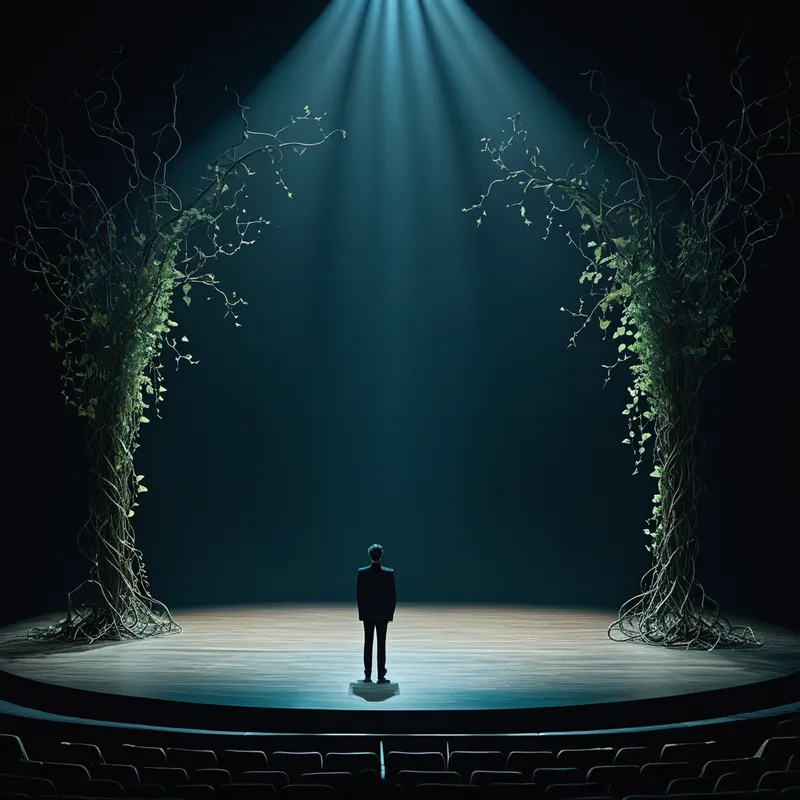
Alternatively, one may dream of being on a vast, empty stage, unable to speak or move, while a silent audience watches. This is the "Theater" without the god—a structure of judgment and exposure without the liberating ecstasy. The somatic experience is often one of constriction, stage fright, or paralysis. The dream may present masks—trying on different faces, or seeing others with shifting, unstable faces. This indicates the psyche's attempt to find a persona, a way to express a complex inner reality that feels too raw for the naked self.
The healing movement in such dreams, reflecting the myth, is the arrival of a transformative, often unsettling, energy (Dionysus) that forces the chaotic emotion into a "script" or a "performance." The dreamer may suddenly find themselves singing their grief, or dancing their rage, or speaking a truth they could not utter in waking life. This is the birth of the inner theater, where the psyche begins to dramatize its conflicts, moving them from a state of passive suffering or explosive potential into a state of active, witnessed story.
Alchemical Translation
For the modern individual navigating the path of individuation, the myth of the Theater of Dionysus models the crucial process of giving creative form to the shadow.
Individuation is not the elimination of chaos, but the development of a vessel strong enough to contain it and poetic enough to express it.
The first stage is Acknowledgment of the Grove—the often painful or frightening admission of the wild, irrational, emotional, and instinctual drives within. This is the "Dionysian invasion," where long-repressed aspects of the self break through the civilized persona. One may experience this as a crisis, a breakdown, or an overwhelming passion.
The alchemical work is the Construction of the Inner Theater. This is the conscious ego's task: not to repress the Grove, but to build a temenos (sacred space) for it. In psychological terms, this means developing the capacity for self-reflection, for symbolic thinking, for "holding" emotion without being identified with it. It is creating the orchestra—the dancing ground of the soul where these forces can be witnessed.
The Assumption of the Mask is the act of giving the unconscious content a name, a role, a story. In therapy, this is speaking the unspeakable. In journaling, it is writing the narrative. In art, it is painting the image. One "puts on" the mask of their own grief, their own anger, their own lust, not to become it, but to relate to it. The final, transformative stage is Catharsis and Communion. By safely performing the inner drama—by giving the chorus of inner voices their song and the hero (the ego) its fate—a release is achieved. The energy that was bound in conflict is liberated. The individual is no longer torn apart by the unconscious (sparagmos) but is in relationship with it. They have built their own theater, with Dionysus as both the disruptive inspiration and the divine patron of the transformative art that makes a whole life from fragmented instincts. The self becomes both the playwright and the audience of its own profound, ongoing mystery play.
Associated Symbols
Explore related symbols from the CaleaDream lexicon: