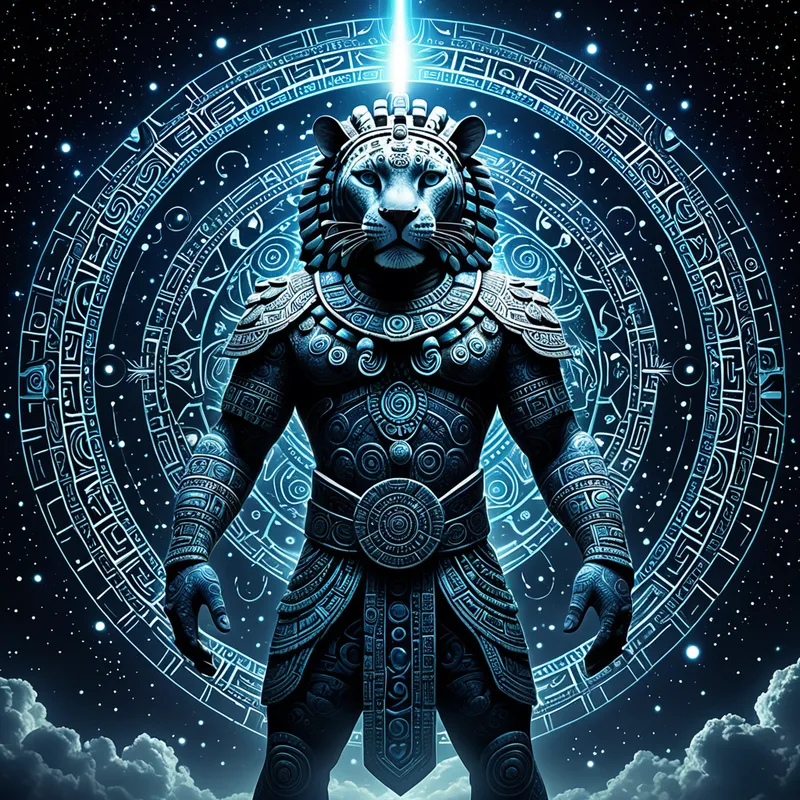
The Vigesimal System Myth Meaning & Symbolism
A myth of cosmic genesis where the gods, through sacrifice, establish the twenty sacred energies that form the foundation of all counting, time, and being.
The Tale of The Vigesimal System
In the beginning, there was only the silent, dark sea of Xibalba Be. No sun carved the sky, no moon pulled the tides. There was only the deep, dreaming water and the Heart of Sky, a presence of pure potential, humming with unsung numbers and unformed days.
The gods gathered in the blackness—Hun Hunahpu, the Lords of Xibalba in their mirrored ambiguity, and the great K'uk'ulkan. They saw the void and knew it could not be filled with mere things. It needed a structure, a skeleton of meaning upon which the flesh of the world could grow. But how to count what did not yet exist? How to measure the immeasurable?
A great tension arose. Some gods roared for infinite variation, a chaos of endless forms. Others whispered for a single, rigid law. The conflict threatened to tear the ch'ulel of the cosmos apart before it was even born. Then, from the stillness, Hun Hunahpu spoke. "To create is to sacrifice. To give a part of oneself to become the vessel for another."
He reached into his own chest, and from the place where his heart beat the rhythm of growing corn, he drew forth not blood, but five luminous seeds. Each seed glowed with a principle: Foundation, Duality, Movement, Stability, and Center. He cast them upon the dark waters. They did not sink, but floated, forming the first pentagon of light.
Seeing this, K'uk'ulkan, the plumed serpent, shed not his skin, but four scales from each of his five celestial segments. Each scale was a direction—North, South, East, West, and the sacred Center—and each direction held a quality: the cold breath of beginnings, the fiery passion of growth, the gentle rain of fruition, the silent wisdom of harvest, and the integrating spirit. Twenty scales in total, swirling around the five seeds.
The Lords of Xibalba, masters of the unseen, then made their offering. They did not give of their bodies, but of their realm. They exhaled the four hidden states of being: the potential of the seed in the earth, the struggle of the sprout in the stone, the flowering in the light, and the return to the root. These four states infused each of the twenty scales.
And so it was. The five seeds of the god, multiplied by the four directions of the serpent, activated by the four states of the underworld. Five times four is twenty. A complete set. A cosmic hand and foot. The dark sea crystallized around this matrix. The twenty luminous points became the first sacred numbers, the Uinal, each a living energy, a patron of a day. They were not just counts, but beings: Imix, Ik</ab title=", Ak'b'al... all the way to Ahau.
The conflict resolved into a humming, harmonic order. The Vigesimal System was born—not invented, but revealed through divine sacrifice. It was the loom on which the threads of time, the Tzolk'in, and the stories of all things would be woven.
Cultural Origins & Context
This myth is not a single story inscribed on a stela, but the foundational logic breathed into every aspect of Classic Maya civilization. It was passed down through the Popol Vuh and encoded in the very fabric of their world. The keepers of this knowledge were the Ah Kin, who could read the narrative of the gods in the movement of stars and the turning of the Tzolk'in.
Its societal function was total. It was a cognitive and spiritual operating system. The base-20 (vigesimal) counting system, evident in their mathematics and Long Count calendar, was seen as a divine anatomy. Twenty days made a uinal. Twenty fingers and toes mirrored the twenty day-lords. A person's destiny was calculated by the interplay of these twenty forces on their birth date. The myth provided the "why" for their sophisticated mathematics—it was sacred numerology, a way to participate consciously in the cosmic order established by the gods' sacrifice.
Symbolic Architecture
The myth presents creation not as an act of will alone, but as an act of structured sacrifice that generates a living matrix. The system is the hero.
The five seeds from Hun Hunahpu represent the quintessential human form (head, two arms, two legs) and the core phases of life. The four directions from K'uk'ulkan are the stages of any journey or process. The four states from the Lords of Xibalba are the hidden psychological or spiritual conditions necessary for transformation. Together, they create a complete mandala of existence.
The Vigesimal System is the archetype of the container. It is the sacred vessel that makes meaning possible, transforming infinite potential into navigable, knowable reality.
Psychologically, it represents the innate human need to structure chaos. The "conflict" among the gods mirrors the internal conflict between our chaotic, creative impulses and our need for order and predictability. The resolution is the birth of the conscious ego—the "I" that can count, name, and navigate the world. Each of the twenty energies can be seen as a complex within the psyche—a pattern of emotion, thought, and impulse that has its own day in the sun within the cycle of our inner life.
The Dreamer's Resonance
When this myth pattern stirs in the modern unconscious, it often manifests in dreams of intricate systems, sacred geometry, or overwhelming multiplicity seeking order. A dreamer might find themselves in a vast library with twenty doors, each leading to a different landscape of feeling. They might be trying to assemble a broken device with twenty unique parts, or counting an endless series that always resets at twenty.
Somatically, this can feel like a pressure to integrate—a sense of being pulled in too many directions, of having "too many parts" to manage. The psyche is attempting to enact its own version of the divine sacrifice: to give up the chaotic comfort of undifferentiated potential and commit to a structure. It is the labor pain of giving birth to a more complex, organized self. The dream is the soul's Tzolk'in, cycling through its twenty inner "days" to find the right alignment for a new phase of life.
Alchemical Translation
The alchemical process modeled here is the opus contra naturam—the work against nature's drift toward entropy. It is the conscious construction of the Philosopher's Stone, which is not a physical object, but a perfected, enduring psychic structure.
The first stage (Nigredo) is the dark, silent sea of Xibalba Be—the undifferentiated mass of our unlived life and unconscious content. The conflict of the gods is the Albedo, the whitening, where opposing conscious and unconscious elements clash. The sacrifice is the key. We must willingly give up a part of our familiar identity (a cherished grievance, a comfortable narrative) to generate the "seeds" of a new principle.
Individuation is the personal enactment of the Vigesimal genesis. We must take the chaos of our experiences—our joys, traumas, passions, and fears—and, through the sacrifice of old selves, arrange them into a living, breathing system of meaning.
Multiplying our core seeds (talents, values) by the four directions (exploring all aspects of life) and the four hidden states (confronting shadow, integrating lessons) leads to the Rubedo, the reddening. This is the birth of the twenty-fold self—not a single, monolithic "I," but a harmonious council of twenty inner energies, a complete psychic ecology. We become like the Tzolk'in, a self-contained system that can interact with the chaos of time and fate without losing its center. We become the vessel, the system, and the counted, all at once—a microcosm of the mythic order.
Associated Symbols
Explore related symbols from the CaleaDream lexicon: