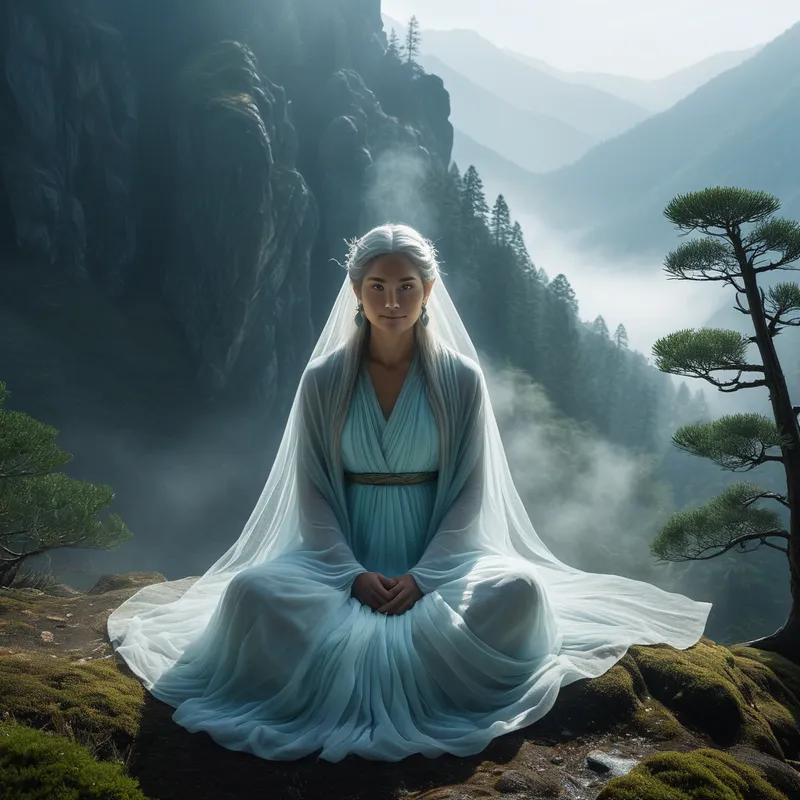
The Valley Spirit Myth Meaning & Symbolism
A myth of the eternal, receptive feminine, the Valley Spirit embodies the generative emptiness from which all life emerges and returns.
The Tale of The Valley Spirit
Before the names of things were fixed, before the ten thousand creatures learned their strife, there was the Valley. Not a place you could point to on a map drawn by human hand, but a presence in the bones of the world. A great, yawning hollow cradled between the shoulders of timeless mountains. It was never empty, this Valley, though it held nothing you could grasp. It was filled with a spirit—a breath that was not a breath, a song that was the space between notes.
They say if you walk until your mind forgets the path, until the chatter of ambition and fear falls silent like discarded leaves, you might find its mouth. The air grows cool and thick, tasting of stone and ancient water. Light falls in soft, slanting pillars through the high canopy, illuminating the eternal mist that coils and uncoils in the depths. This is the realm of the Valley Spirit.
She does not appear as a goddess on a throne. She is the valley itself. Her voice is the echo that returns your own call, changed and wiser. Her body is the dark, fertile earth that receives the seed and the fallen leaf alike without distinction. Her breath is the mist that conceals and reveals, that gives form to the shadows of deer at dawn only to take them back by noon. She is the mother who never clutches, the womb that never closes.
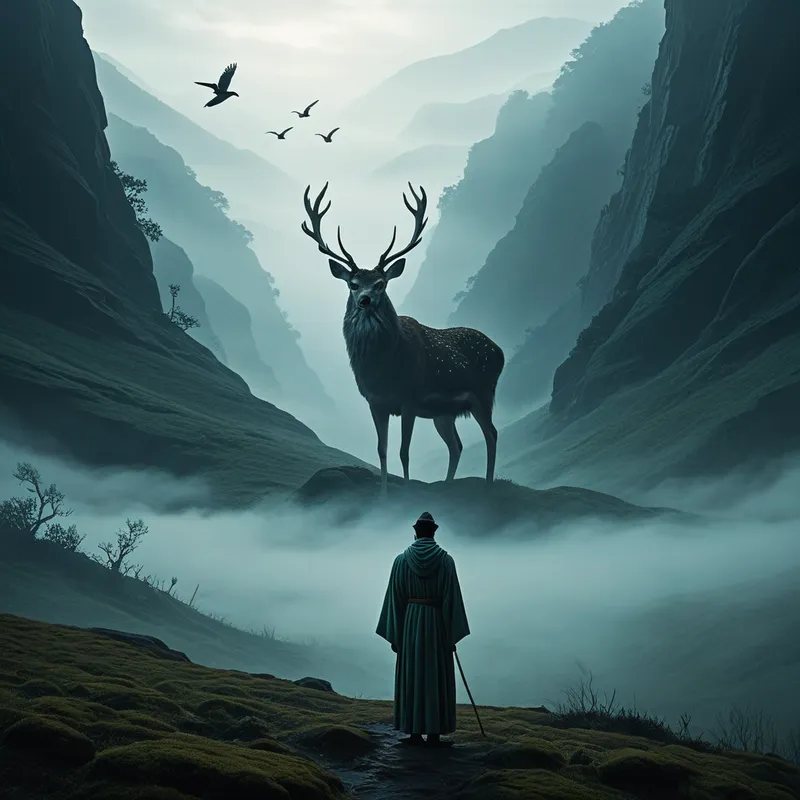
Once, it is told, a great and troubled king, his mind a battlefield of plans and regrets, sought her counsel. He climbed the highest peak, shouting his dilemmas into the abyss, demanding an answer. The mountains threw his words back in fragments. Exhausted, he descended into the Valley, his royal robes catching on thorns. He sat by a silent pool and wept his frustration until there were no tears left, only a hollow quiet.
And in that quiet, he heard it. Not a voice, but a knowing. He saw how the pool received the sky without trying to keep it. He saw how the mist embraced the empty air. He felt the immense, patient presence of the Valley, which asked nothing of him, which held his turmoil without judgment and let it settle like sediment. He did not receive a strategy or a prophecy. He received the lesson of the hollow bone: it is the empty space within that makes it useful. The king left his crown by the pool and walked out a different man, his step light, his mind clear as the water that reflected nothing but what was truly there.
Cultural Origins & Context
This is not a myth with a single author or a definitive scripture. The figure of the Valley Spirit, or Gu Shen, emerges from the primordial waters of Taoist thought, most explicitly from the Daodejing. In its sixth chapter, Laozi writes: "The Valley Spirit never dies; it is called the Mysterious Female. The gate of the Mysterious Female is the root of Heaven and Earth. It is continuous, and seems to remain. Use it, and it is never exhausted."
This was not a story told around campfires for entertainment, but a profound metaphor transmitted from master to disciple, a core component of the Taoist contemplative and alchemical tradition. Its societal function was radical: in a world increasingly structured by Confucian hierarchies and rigid roles, the myth of the Valley Spirit presented an alternative cosmology centered on wu wei, receptive power, and the foundational potency of the feminine principle. It served as a meditative map, guiding individuals away from the yang pursuit of action and acquisition toward the yin practice of stillness, emptiness, and inner observation.
Symbolic Architecture
The myth’s power lies in its utter simplicity, which contains a universe of meaning. The Valley is not a symbol of lack, but of potential. It represents the psyche’s own receptive capacity, the inner space that must be cleared for anything new to enter or be created.
The Valley Spirit teaches that true power is not in the sword, but in the scabbard; not in the note, but in the silence that frames it.
Psychologically, the Valley Spirit embodies the archetypal principle of the containing, transformative vessel. She is the unconscious itself—not as a chaotic jungle, but as a deep, fertile, and intelligent emptiness that processes, gestates, and gives birth to consciousness. The "Mysterious Female" is the root of all psychic life, the matrix from which thoughts, images, and the very sense of self emerge. The conflict in the tale is not with a dragon, but with the king’s own overfilled, yang-dominated consciousness. His triumph is his surrender to the valley’s yin nature, his allowing of the ego to be hollowed out and quieted.
The Dreamer's Resonance
When this myth stirs in the modern soul, it often manifests in dreams of profound spaces. Dreaming of vast, empty canyons, silent cathedrals, deep wells, or quiet, shadowed rooms. These are not dreams of abandonment, but of invitation. The somatic feeling is one of release—a loosening in the chest, a softening of the jaw, a deep, involuntary sigh.
To dream of the Valley is to encounter a psyche that is exhausted by doing and is initiating a process of undoing. It is the unconscious compensating for a life lived on the surface, demanding a descent into inner space. The dreamer may be going through a period where old identities, goals, or relationships have dissolved, leaving a bewildering emptiness. The myth reassures that this void is not an error or a failure, but the necessary precondition for the next, more authentic chapter. It is the psyche practicing the art of holding space for itself.

Alchemical Translation
The individuation process, the Taoist inner alchemy of becoming whole, is mirrored perfectly in the king’s journey. Our modern "kingdom" is the constructed ego—fortified with achievements, opinions, and a relentless narrative of self. The alchemical work begins not with adding another accomplishment, but with the opus contra naturam: the counter-intuitive act of descending from the peak of ego-identity into the valley of the unknown self.
The alchemical vessel is not forged; it is discovered by emptying out everything that is not it.
The king’s tears are the first dissolution, the solutio, where rigid structures are softened. His quiet sitting is the mortificatio, the death of the demanding, know-it-all ego. The Valley itself is the vas, the hermetic vessel where this dissolution occurs without loss. What is "transmuted" is the very mode of being: from active striving to receptive allowing; from knowing to not-knowing; from the hardness of the crown to the fluidity of the reflecting pool.
The ultimate "treasure" produced is not a philosopher’s stone of power, but the realization of one’s own nature as both mountain and valley—capable of action, but rooted in stillness; capable of form, but forever married to the formless spirit that animates it. One becomes, like the Valley Spirit, a continuous, inexhaustible space through which the Tao flows unimpeded.
Associated Symbols
Explore related symbols from the CaleaDream lexicon: