
The Two Sabbath Angels
A Jewish mystical tradition describes two angels who accompany believers home from synagogue on Shabbat, representing divine blessing and judgment.
The Tale of The Two Sabbath Angels
As the final prayer of the Friday evening service ascends, a hush settles over the synagogue, thicker than the twilight. It is a silence not of absence, but of arrival. For as the congregants turn to leave, stepping from the sanctified space into the ordinary world now made extraordinary, they are not alone. Two figures, luminous and immense, fall into step behind each person, one to the left and one to the right. These are the Shabbat angels, the Malachei HaSharet—the ministering angels of [the Sabbath](/myths/the-sabbath “Myth from Abrahamic culture.”/).
The angel on the right is called Tov, “Good.” His countenance is like polished silver reflecting the first gentle stars. His presence is a soft pressure, a warmth that seeps into the bones, an unspoken promise. He carries with him the scent of myrtle and baked challah, the echo of peaceful melodies. Where he passes, a subtle blessing settles: the weariness of the week begins to dissolve, replaced by a quiet joy. He is the angel of all that Shabbat is meant to be—rest, delight, sanctity, and the whispered “yes” of the divine.
The angel on the left is called Ra, “Evil.” Do not mistake this for a demon; his is a severe, necessary holiness. His form is like obsidian, absorbing the fading light. His gaze is exacting, a cool clarity that sees not with malice, but with unwavering truth. He carries the scent of extinguished lamp-wicks and old parchment. He is the angel of judgment, of measure, of the unadorned reality of the soul’s state. He witnesses what is, not what one hopes might be. He is the guardian of the boundary, the one who ensures the sacred day is not entered lightly or with hypocrisy.
Together, they escort the believer home. The walk is the myth. It is an inner procession mirrored in the outer world. If the household is prepared—the table set, the candles waiting, the home a vessel of peace and anticipation—then Angel Tov steps forward. His voice, like distant chimes, speaks the blessing: “May it be thus for another Shabbat.” Angel Ra, his judgment met, is compelled to echo, “Amen.” The blessing is sealed, and the angels depart, leaving a doubled sanctity in their wake.
But if the home is in disarray, the spirit agitated, the [Sabbath](/myths/sabbath “Myth from Judeo-Christian culture.”/) peace uninvited, then the roles reverse. Angel Ra, his assessment confirmed, steps forward. His voice, like stone on stone, pronounces the judgment: “May it be thus for another Shabbat.” And Angel Tov, bound to truth, must sorrowfully echo, “Amen.” The potential for blessing is withheld, and the angels depart into the night, leaving only the echo of what might have been.
This is the weekly drama, the celestial audit of the heart. The angels do not create the blessing or the curse; they merely announce what the human soul has already prepared through its actions and intentions. They are the divine responders, the eternal witnesses to the choice laid bare at [the threshold](/myths/the-threshold “Myth from Folklore culture.”/) of the sacred.
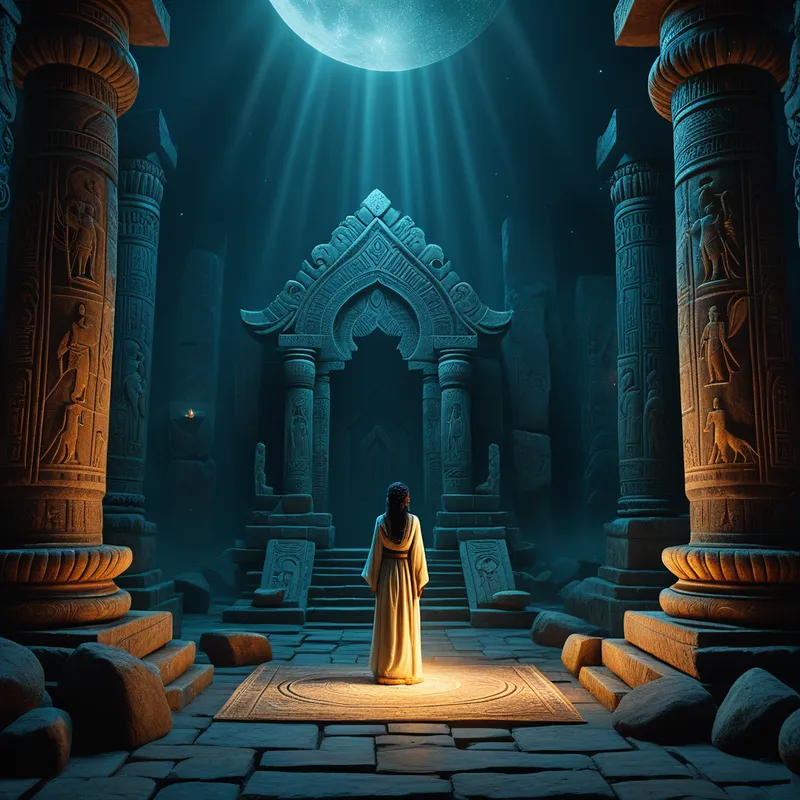
Cultural Origins & Context
The tradition of the two Shabbat angels is found in the Babylonian Talmud, in tractate Shabbat (119b). It emerges from the rich soil of rabbinic Midrash and Kabbalah, where the line between legal injunction and poetic cosmology blurs. The Talmud records the teaching in the name of Rabbi Yosé, who states that these two angels accompany a person home from synagogue.
This narrative is not a fringe folklore but a deeply integrated psychological and theological construct. It sits at the intersection of Halakha (law) and Kabbalah. Halakhically, it emphasizes the concrete actions of preparing for Shabbat—cleaning, cooking, setting the table—as acts of cosmic significance. Kabbalistically, it reflects the fundamental duality within the divine structure of creation, the Sefirot, particularly the interplay between Chesed (loving-kindness, represented by Tov) and Gevurah (judgment/strength, represented by Ra). The goal is not the victory of one over the other, but their integration into Tiferet (beauty/harmony), achieved through human intention and action.
The myth grounds the abstract concept of “receiving the Sabbath” (Kabbalat Shabbat) in a tangible, almost visceral experience. It externalizes the internal conflict every individual faces when transitioning from the profane week into sacred time: have I done enough? Am I worthy? Am I truly present? By personifying these questions as angels, the tradition makes them companions on the journey, not abstract fears.
Symbolic Architecture
The [architecture](/symbols/architecture “Symbol: Architecture in dreams often signifies structure, stability, and the framing of personal identity or life’s journey.”/) of this myth is a masterpiece of spiritual [psychology](/symbols/psychology “Symbol: Psychology in dreams often represents the exploration of the self, the subconscious mind, and emotional conflicts.”/). It presents duality not as a [problem](/symbols/problem “Symbol: Dreams featuring a ‘problem’ often symbolize internal conflicts or challenging situations that require resolution and self-reflection.”/) to be solved, but as a dynamic [tension](/symbols/tension “Symbol: A state of mental or emotional strain, often manifesting physically as tightness, pressure, or unease, signaling unresolved conflict or anticipation.”/) to be navigated. The angels are not enemies; they are a paired [consciousness](/symbols/consciousness “Symbol: Consciousness represents the state of awareness and perception, encompassing thoughts, feelings, and experiences.”/), a divine [system](/symbols/system “Symbol: A system represents structure, organization, and interrelated components functioning together, often reflecting personal or social order.”/) of checks and balances that engages directly with [human](/symbols/human “Symbol: The symbol of a human represents individuality, complexity of emotions, and social relationships.”/) freedom.
The home is not merely a house; it is the symbol of the inner self. The state of the home upon the angels’ arrival is a direct projection of the state of the soul. A prepared table is an ordered heart; a lit candle is a conscious intention.
The left and right are crucial. In Jewish thought, the right side often symbolizes mercy and expansiveness, while the left symbolizes judgment and containment. The angels’ positions are fixed, reflecting their inherent [nature](/symbols/nature “Symbol: Nature symbolizes growth, connectivity, and the primal forces of existence.”/). Yet, which one speaks is determined entirely by the human being they accompany. This is the myth’s radical core: divine [response](/symbols/response “Symbol: Response in dreams symbolizes how one reacts to situations, often reflecting the subconscious mind’s processing of events.”/) is contingent upon human initiative. The angels are mirrors held up to our own creative or destructive preparations.
The compelled “Amen” from the opposing angel is the key. Even in a moment of judgment, the angel of blessing must consent to the truth. Even in a moment of blessing, the angel of judgment must acknowledge its fulfillment. This reveals that both forces are ultimately servants of a higher, unified truth.
The [journey](/symbols/journey “Symbol: A journey in dreams typically signifies adventure, growth, or a significant life transition.”/) from [synagogue](/symbols/synagogue “Symbol: A synagogue symbolizes community, spirituality, and a place of gathering centered around faith and traditions.”/) to home is the liminal [space](/symbols/space “Symbol: Dreaming of ‘Space’ often symbolizes the vastness of potential, personal freedom, or feelings of isolation and exploration in one’s life.”/) where the myth occurs. It is the bridge between the communal, formal sanctity of [prayer](/symbols/prayer “Symbol: Prayer represents communication with the divine or a higher power, often reflecting inner desires and spiritual needs.”/) and the intimate, embodied sanctity of lived [life](/symbols/life “Symbol: The symbol of ‘Life’ represents a journey of growth, interconnectedness, and existential meaning, encompassing both the joys and challenges that define human experience.”/). The angels ensure there is no gap; the sacred must be carried, tested, and realized in the domestic sphere.
The Dreamer’s Resonance
To the dreaming soul—the [psyche](/myths/psyche “Myth from Greek culture.”/) encountering its own depths—this myth speaks directly to the universal experience of self-assessment and the longing for wholeness. Each of us, consciously or not, is perpetually accompanied by our own internalized “angels.” One voice offers affirmation, the possibility of grace, the sense that we are enough. The other is the voice of the inner critic, the exacting standard, the witness to our shortcomings and hypocrisies.
The weekly Shabbat walk becomes a powerful metaphor for any moment of transition or introspection: the end of a day, the closing of a project, the beginning of a therapy session, the quiet before sleep. Who accompanies us? Which voice will be empowered to speak its verdict on the “home” we have built of our actions, relationships, and inner world?
The myth offers a profound psychological relief. It suggests that these twin forces—self-compassion and self-judgment—are not merely personal neuroses but archetypal companions. They are inherent to the structure of consciousness itself. The goal is not to silence the critical angel (Ra), for its discernment is necessary for integrity and growth. Nor is it to live in the naïve fantasy of the blessing angel (Tov) alone. The goal is to “prepare the home” so thoroughly through conscious living that the critical voice, upon inspection, has no choice but to assent to the blessing.

Alchemical Translation
In the alchemy of the soul, this myth describes the process of [coniunctio oppositorum](/myths/coniunctio-oppositorum “Myth from Alchemical culture.”/)—[the sacred marriage](/myths/the-sacred-marriage “Myth from Various culture.”/) of opposites. The base metals of our fragmented experience (the strife of the week, the inner conflict) are subjected to the fire of conscious ritual (the preparation for and observance of Shabbat). The angels represent the volatile and fixed principles within that alchemical vessel.
The transformation occurs not when one angel defeats the other, but when the human act of preparation creates a vessel so whole that both angels must speak in unison, blessing and truth becoming one utterance. The “Amen” is the sound of integration.
The walk home is the alchemical [solve et coagula](/myths/solve-et-coagula “Myth from Alchemical culture.”/)—dissolve and coagulate. The identities and worries of the week are dissolved in the twilight; a new, sanctified consciousness is meant to coagulate in the home. The angels are the agents of this transformation, testing the purity of [the vessel](/myths/the-vessel “Myth from Alchemical culture.”/). If the vessel holds, the product is the [lapis philosophorum](/myths/lapis-philosophorum “Myth from Alchemical culture.”/)—the philosopher’s stone—which here is the transformed moment, the experience of time itself made golden and redemptive: true Shalom, peace.
This is an alchemy of time, not matter. It teaches that redemption is not a distant event but a weekly possibility, forged in [the crucible](/myths/the-crucible “Myth from Alchemical culture.”/) of humble, domestic acts performed with sacred intention. The angels are the proof that the macrocosm responds to the microcosm; the universe leans in to hear which verdict the soul has written for itself.
Associated Symbols
Explore related symbols from the CaleaDream lexicon:
- Angel — A messenger or intermediary between the divine and human realms, often embodying a specific quality or function of consciousness.
- Door — A threshold between states of being, a point of transition and choice that requires passage and often, a test of readiness.
- Mirror — A surface that reflects truth, revealing the inner state outwardly, forcing confrontation with one’s own image and condition.
- Light — The principle of consciousness, revelation, and blessing that dispels fragmentation and illuminates the prepared vessel.
- Shadow — The necessary aspect of the whole that contains judgment, discernment, and the unintegrated parts of [the self](/myths/the-self “Myth from Jungian culture.”/), demanding acknowledgment.
- Ritual — The structured, conscious action that prepares the vessel of self and space to receive and transmute the sacred.
- Home — The symbol of the inner self, the soul’s dwelling place whose order and readiness determines the quality of the spiritual guests it receives.
- Duality — The fundamental condition of manifested existence, the tension between opposing forces whose reconciliation is the aim of spiritual work.
- Threshold — The liminal space of transition where realities meet and transformation is possible, guarded by witnesses of passage.
- Amen — [The word](/myths/the-word “Myth from Biblical culture.”/) of agreement and sealing, the affirmation of truth that binds opposing forces into a unified reality.