The Twenty Two Letters of Creation
In Kabbalistic tradition, the 22 Hebrew letters are divine instruments through which God created the universe, each containing profound spiritual power and cosmic significance.
The Tale of The Twenty Two Letters of Creation
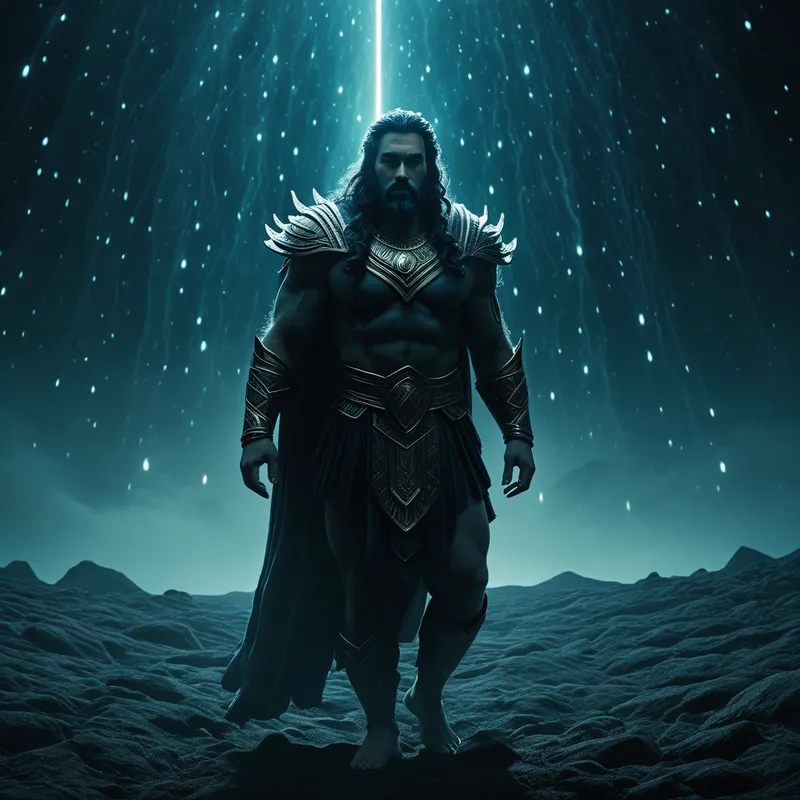
Before the world was a world, before time was a measure, there existed only the Infinite One, Ein Sof, a boundless light of pure potential. In a profound act of self-withdrawal, Tzimtzum, this light receded to make a hollow, a womb of darkness, a vessel awaiting form. From the heart of this withdrawn light, a single, radiant point emerged—the first utterance, the first intention of something other than Self.
This point was not a thing, but a voice. It was the breath of the Divine, and as it exhaled into the void, it formed not one word, but twenty-two primordial essences: the Hebrew letters. They swirled in the blackness, not as ink on parchment, but as living forces, each a unique constellation of divine energy, each a specific channel for the light of Ein Sof to flow into the nascent universe.
The letters gathered before the Creator. Aleph (א), the first, stood in silent humility, containing within its form the paradox of all beginnings—the unity of above and below, the breath before speech. From Aleph’s silence sprang Bet (ב), whose shape is a house, and with it came the first spoken word: Bereshit (“In the beginning”). As Bet was uttered, the concept of duality, of inside and outside, was born, and the scaffolding of creation was set.
Then came Gimel (ג), whose form is a runner, dispensing the divine beneficence that now flowed. Dalet (ד), the door, opened pathways for this flow to enter specific domains. And so it continued, each letter stepping forward to contribute its essence to the grand design. Hei (ה) brought the gift of breath and revelation; Vav (ו) descended like a hook, connecting the heavenly and the earthly. Zayin (ז), a sword, carved distinctions; Chet (ח), a gateway, offered both life and a boundary to transcend.
The letters were not passive tools but active, conscious collaborators. Yod (י), the smallest point, the seminal spark, contained the concentrated power of all that would follow. Lamed (ל), the towering heart, reached upward to learn, guiding creation toward its source. Mem (מ), the waters of the deep, and Nun (נ), the faithful fish swimming within them, brought forth the seas of potential and the life that moves through them.
With Samekh (ס), the encircling support, the universe gained stability. Ayin (ע), the eye, bestowed the power of vision and insight. Peh (פ), the mouth, gave creation voice and expression. Tzadi (צ), the righteous hunter, sought to align all things with divine justice.
As the final letters added their qualities—Kuf (ק) with its holiness, Reish (ר) with its expansive spirit, Shin (ש) with its threefold fire of peace, and Tav (ת) with its seal of truth and completion—the cosmos crystallized. The stars were inscribed with letters of fire. The elements were combinations of their sounds. The soul of Adam was fashioned from their permutations. Reality itself was, and is, a divine language, a sacred text written with these twenty-two elemental glyphs of power.
Cultural Origins & Context
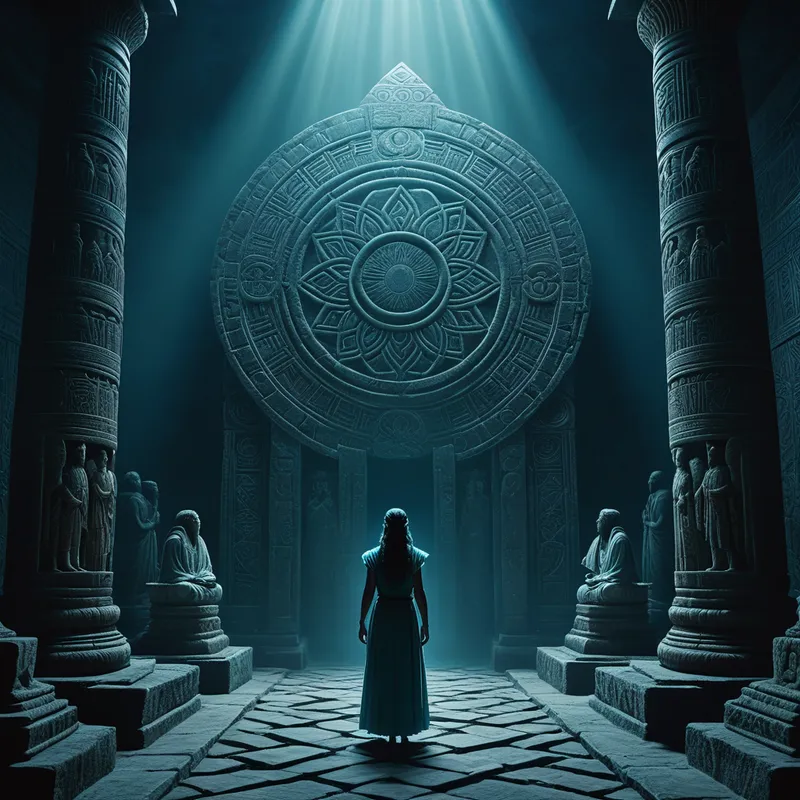
This cosmology is rooted in the heart of Jewish mystical tradition, known as Kabbalah, which blossomed most explicitly in medieval texts like the Sefer Yetzirah (The Book of Creation) and the Zohar (The Book of Splendor). The Sefer Yetzirah, a cryptic and ancient work, is foundational, positing the universe was created through “thirty-two wondrous paths of wisdom”: the ten Sefirot and the twenty-two letters.
This is not mere metaphor but a core ontological principle. In a tradition where the Torah is seen as the literal blueprint of existence, its constituent letters are understood as the fundamental substrate of that blueprint. The practice of Gematria, where letters double as numbers, further reveals a hidden, mathematical harmony woven into creation. The letters are thus the interface between the unknowable, transcendent God (Ein Sof) and the manifested, immanent world. They are the vessels that can bear the infinite light without shattering, the precise channels through which divine will becomes substance, law, and life.
Symbolic Architecture
The architecture of the letters is multi-dimensional. Each letter possesses a form (its written shape), a name (its spoken identity), a numerical value (Gematria), a musical note, and a specific spiritual energy. They are organized into three categories reflecting their elemental nature: three Mother Letters (Aleph, Mem, Shin) associated with the primordial elements of Air, Water, and Fire; seven Double Letters (Bet, Gimel, Dalet, etc.) corresponding to the seven planets and the days of the week, embodying dualities like life/death, peace/strife; and twelve Simple Letters (Hei, Vav, Zayin, etc.) linked to the zodiac signs, months, and human faculties.
The letter is not a sign for a sound, but a chamber for a specific frequency of divine energy. To write or contemplate a letter is to tune the soul to that frequency.
This system creates a holographic universe where macrocosm and microcosm reflect one another. The human body, the annual cycle, the celestial spheres—all are maps of the same twenty-two foundational forces. The work of the mystic is to learn this alphabet of being, to rearrange the inner letters of one’s soul to spell “wholeness” (Shalom) and thus participate consciously in the ongoing act of creation.
The Dreamer's Resonance
From a depth psychological perspective, the Twenty-Two Letters represent the archetypal structures of the psyche itself. They are the primordial forms that pattern human consciousness, the innate, pre-linguistic “atoms of meaning” from which all thought, image, and emotion coalesce. Just as they structure the cosmos in the myth, they structure the inner world.
The journey through the letters is a journey of individuation. Confronting the silent Aleph is to encounter the Self before ego. Engaging with the duality of Bet is to acknowledge the psyche’s inherent splits—conscious and unconscious, persona and shadow. The transformative fire of Shin burns away psychic dross, while the encompassing support of Samekh speaks to the need for a containing, nurturing structure in the soul. To work with these letters psychologically is to engage in a profound act of self-creation, assembling the disparate parts of one’s being into a coherent, living word—a unique utterance of the divine within the human sphere.
Alchemical Translation
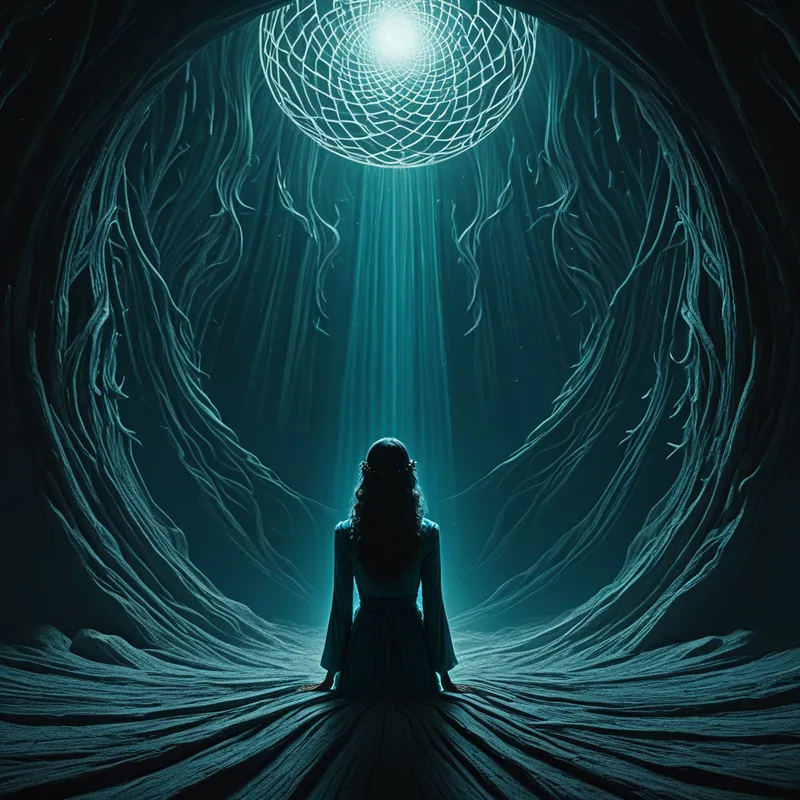
The alchemical process mirrored in the letters is the opus contra naturam—the work against nature, which is here the work of returning fragmented reality to its source. The base material of the soul is the chaotic, unarranged “clay” of experience. The letters are the seals and formulas that transmute this clay into the gold of consciousness.
The first matter is the unarticulated longing of the soul. The fire is the focused attention of meditation. The vessel is the disciplined mind. The gold produced is the realized Word, the Self that has become a clear utterance of the Divine.
The practitioner, like an alchemist, must first separate (analyzing the component letters/forces within a complex emotion or life situation), then purify (contemplating each letter’s essence to cleanse it of distortion), and finally recombine (consciously integrating these purified forces into a new, more harmonious psychic compound). The ultimate goal is to become a living Sefer Torah, a scroll where the letters of one’s life are perfectly aligned, revealing the hidden text of one’s divine purpose.
Associated Symbols
Explore related symbols from the CaleaDream lexicon:
- Letter — The fundamental unit of inscribed meaning, a vessel for spirit that bridges the abstract and the manifest, containing infinite potential within a finite form.
- Quill of Creation — The divine instrument that inscribes destiny onto the parchment of reality, a symbol of the active, formative power of consciousness and will.
- Root — The hidden, foundational source from which all visible forms emerge, analogous to the transcendental origin of the letters before they manifest in sound and shape.
- Temple — A constructed space where the divine alphabet is made manifest through ritual, prayer, and sacred architecture, mirroring the universe as God’s dwelling.
- Mirror — A surface that reflects, suggesting the relationship between the upper and lower worlds, where the divine letters are reflected in their earthly counterparts.
- Key — An instrument that unlocks hidden chambers of wisdom, much as understanding the letters unlocks the secrets of the Torah and the self.
- Circle — A symbol of unity, completion, and the encompassing nature of Ein Sof, within which the linear sequence of letters unfolds.
- Light — The primordial substance of the Divine that is channeled, filtered, and given specific quality through each individual letter.
- Door — A threshold between states of being, represented by letters like Dalet, which open pathways for divine influx and conscious passage.
- Seed — The concentrated potential of an entire being or world, embodied in the letter Yod, the seminal point from which all other forms extend.
- Language — The structured system of communication that constructs reality, of which the 22 letters are the pure, pre-linguistic foundational elements.
- Fire — The transformative and revelatory energy, associated with the Mother Letter Shin, which purifies, illuminates, and empowers the creative act.