The Twelve Apostles Myth Meaning & Symbolism
A myth of twelve ordinary men called to an impossible task, forming the living foundation of a new world through faith, failure, and ultimate transformation.
The Tale of The Twelve Apostles
Listen. The story begins not in a palace, but in the dust. It begins with a voice, cutting through the marketplace clamor and the silent despair of fishermen mending their nets. It was a voice that did not command, but called. It said, “Follow me.”
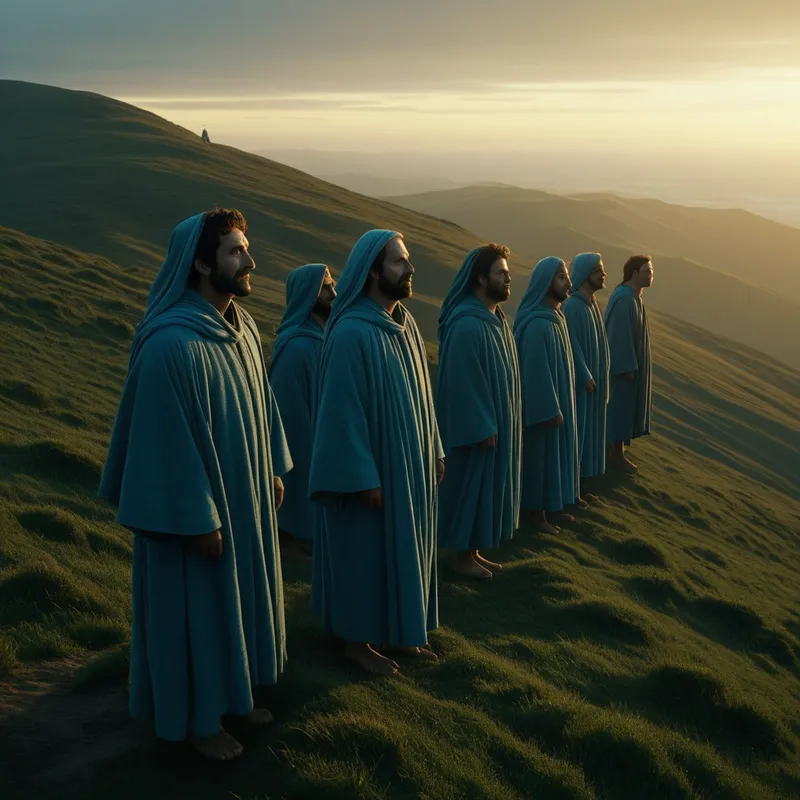
And they did. They left the weight of their known worlds: the smell of fish and tax ledgers, the familiar grip of doubt. They followed a man whose eyes held the quiet fire of a different dawn. He walked the roads of Judea, and they walked with him, a ragged constellation orbiting a strange sun. They were twelve. Simon, whom he called Peter, all storm and impulse. Andrew, his brother, who first heard the call. James and John, sons of thunder, craving a place at the right hand. Philip, who reasoned. Bartholomew, in whom he saw no guile. Thomas, whose fingers would later seek proof in wounds. Matthew, the outcast collector. James, son of Alphaeus. Thaddaeus. Simon the Zealot, who dreamed of revolution. And Judas Iscariot, keeper of the purse, whose eyes grew shadowed by a calculus of silver.
For three years, they walked through a parable. They saw the blind receive sight, not just of light, but of meaning. They saw the hungry fed with a few loaves, a miracle of multiplication that whispered of a different kind of kingdom. They heard teachings that turned the world upside down: the last shall be first, the meek shall inherit, love your enemy. They slept under stars, argued over greatness, and in quiet moments, on a boat rocked by waves, they felt a terrifying peace in his presence that stilled the very storm.
Then, the world turned to night. In a garden of ancient olives, under a moon that witnessed everything, the kiss of a friend became a signal. The one they called Rabbi was taken. Their constellation shattered. Peter, in a courtyard, denied him three times as a cock crowed, the sound a blade to his soul. The others fled into the darkness, their courage unraveling like old cloth. And Judas, his bargain complete, found the weight of thirty pieces of silver was the weight of the world.
They huddled behind locked doors, men shipwrecked by their own failure. The foundation was gone. But then, a miracle not of spectacle, but of presence. He stood among them, not as a ghost, but as a reality more solid than the walls. He showed them his wounds—not as scars of defeat, but as seals of a terrible, loving truth. “Peace be with you,” he said, and the words were a forge, remaking their broken hearts.
He left them, not with an ending, but a beginning. On a mountain, as a wind from another world stirred their robes, he ascended, and they were left staring at the sky, not empty, but charged with promise. Then came the fire. In that same upper room, a rushing wind and tongues of flame that did not consume, but ignited. The fearful fishermen became proclaimers. The foundation, once a single stone, was now twelve living pillars. They went out, each carrying an ember of that fire, to the very ends of the known earth, building a new world not of stone and sword, but of spirit and story. The tale of the Twelve had become the foundation for all tales to come.
Cultural Origins & Context
This story emerged from the fertile, fraught ground of 1st-century Judea, a culture straining under Roman occupation and yearning for messianic deliverance. It was not crafted by court poets but born in the oral testimonies of early communities. The primary sources, the Gospels and the Acts of the Apostles, were written decades after the events, not as dispassionate history, but as “proclamation”—faithful remembering meant to shape identity and practice.
The story was told in house churches, whispered in catacombs, and proclaimed in market squares. Its tellers were not bards seeking entertainment, but witnesses and their successors, building a collective memory. Societally, the myth functioned as an origin story for the ekklesia (the called-out assembly). It explained how a movement centered on a crucified teacher could survive and explode across the empire. The Twelve represented the new Israel, a symbolic reconstitution of the people of God, now built on the cornerstone of apostolic witness rather than tribal lineage. They were the human, fallible guarantee of the story’s truth, the living bridge between the historical Jesus and the burgeoning, global faith.
Symbolic Architecture
At its core, the myth of the Twelve is a profound map of psychic transformation from a scattered collective to an integrated, purposeful whole. The Apostles are not distant saints but archetypal facets of the human psyche called to a unifying center.
The call is not to perfection, but to presence. It is the summons of the Self to the ego, asking it to leave the familiar shore of its small identity.
The number twelve is profoundly symbolic, echoing the twelve tribes, the twelve signs of the zodiac, and the complete cycle of time. It represents a new, complete order of reality. Each Apostle embodies a different human quality: Peter’s impulsivity, Thomas’s doubt, John’s devotion, Matthew’s redemption from social scorn, Judas’s capacity for tragic betrayal. Together, they form the total human response to the divine. The myth insists that the foundation of the new consciousness (the Kingdom of Heaven) is built precisely through and including these flawed, contradictory elements. The betrayal by Judas Iscariot is not a mere plot device but the essential shadow-work of the myth. The integration of the psyche requires confronting the part of ourselves that, for reasons of resentment, greed, or disillusioned idealism, would sell out the highest calling.
The climax is not the crucifixion alone, but the post-resurrection appearances and Pentecost. This is the symbolic death of the old, fragmented ego-structure and the birth of a psyche animated by a transpersonal center. The locked room of fear becomes the upper room of empowerment.
The Dreamer's Resonance
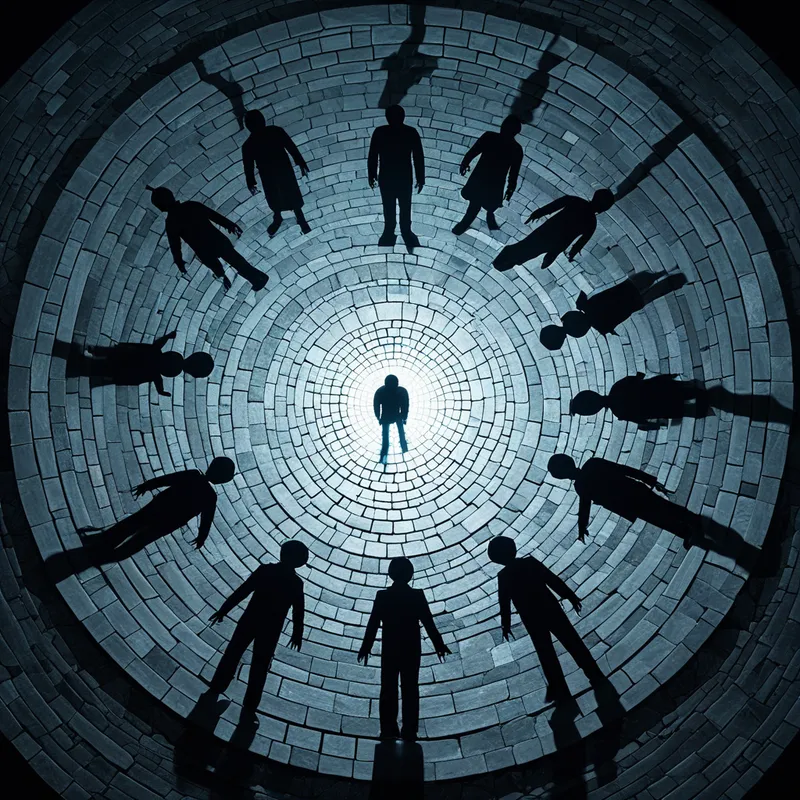
When this mythic pattern stirs in the modern dreamer, it signals a profound shift in one’s inner community. To dream of being called to a circle of twelve, or to find oneself among a group of disparate figures on a momentous journey, speaks to the psyche’s preparation for a greater responsibility—a calling to integrate one’s disparate talents and roles into a coherent life’s work.
Dreams of betrayal within such a group often mirror the dreamer’s confrontation with their own shadow. The “Judas” figure may represent a neglected talent, a buried resentment, or a pragmatic cynicism that feels ready to sabotage a nascent spiritual or creative endeavor for the “silver” of short-term security or vindication. The somatic feeling is often one of chilling dread or hollow guilt upon waking.
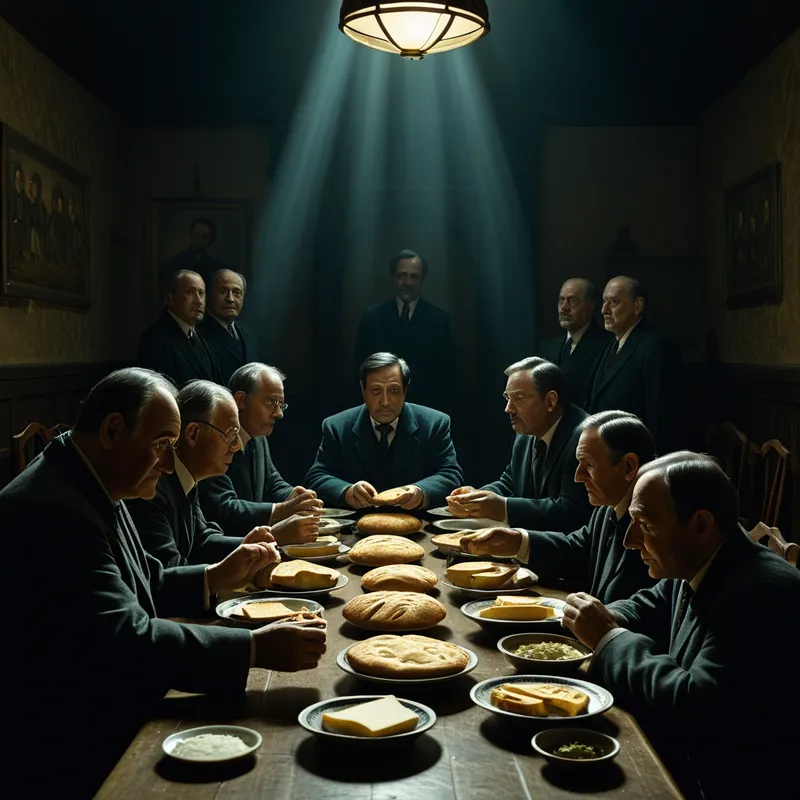
Conversely, dreams of a shared meal, a calming of a storm, or especially a gathering in a room filled with a strange, peaceful wind or light indicate the successful navigation of this crisis. It marks the moment when the inner council—the various sub-personalities and archetypes—stops warring and begins to collaborate, infused by a sense of purpose that transcends the individual ego. The feeling is one of profound, quiet empowerment and somatic expansion.
Alchemical Translation
The alchemical journey of the Apostles is the individuation process in narrative form. The prima materia is the ordinary life: fishing nets, tax booths, political zeal. The call is the first stirring of the Self, the entelechy, which feels disruptive and irrational to the established ego-order.
The nigredo, the blackening, occurs in Gethsemane and the courtyard of denial. It is the necessary dissolution, where all prior understanding, courage, and loyalty are burned away, leaving only the ash of failure.
This is the dark night of the soul, where the ego’s project is utterly defeated. The betrayal and crucifixion symbolize the death of the old, heroic ego that believed it could build the kingdom through force of will or purity of ideology. The three days in the tomb are the mortificatio, the essential period of gestative darkness where the transformation occurs unseen.
The resurrection appearances are the albedo, the whitening. This is not a return to the old life, but the emergence of a new psychic substance. The wounds are still visible, but now they are sacred—integrated, not erased. The ego, represented by the Apostles, now relates to the Self (the risen Christ) in a new way: not as followers of an external leader, but as vessels for an indwelling spirit.
Finally, Pentecost is the rubedo, the reddening, the final stage of coagulation and empowerment. The integrated psyche, having passed through dissolution and illumination, now becomes a generative source for the world. The “fire” is the fully embodied, active consciousness that can speak to the “many tongues” of the inner and outer world’s complexities. The individual’s journey is complete not in solitary enlightenment, but in becoming a living foundation, a pillar in the human community, transmitting the transformed spirit through their own unique, healed, and now essential voice. The twelve become one, and the one is expressed through the twelve.
Associated Symbols
Explore related symbols from the CaleaDream lexicon: