
The Trickster's Voice Myth Meaning & Symbolism
A myth of a stolen, chaotic voice that reveals the necessity of integrating the disruptive, creative, and hidden parts of the self.
The Tale of The Trickster's Voice
Listen. Before the world settled into its habits, when the wind still argued with the stone and the river debated its course, there was a sound that held the seeds of all things. It was the Voice of Anansi, of Loki, of Coyote. It was laughter that cracked mountains and whispers that seduced roots into the earth. This Voice was not a song of order, but the raw material of possibility—jests, lies, truths disguised as riddles, and stories that had not yet chosen their shape.
The other powers of the world, the Makers of Law, grew weary. The Voice unsettled their careful designs. It convinced the sun to linger too long at the horizon, painting the sky with colors of rebellion. It taught the rabbit to doubt its burrow and the fish to dream of flight. Chaos, beautiful and terrifying, bloomed in its wake.
So, in council, they decided the Voice must be contained. Not destroyed, for even they sensed its primal necessity, but bound. With threads of solemnity and locks of rigid custom, they crafted a vessel: a drum of mute wood and silent skin. In a great convergence, as the Trickster regaled the moon with a particularly scandalous joke, they fell upon it. Not the Trickster itself, which slipped away as smoke, but the very sound from its throat. They captured the shimmering, cacophonous essence and sealed it within the drum, burying it deep beneath the World Tree where only the dead and the dreaming culture.") might hear its faint, frustrated pulse.
And the world… changed. It became reliable. Seasons turned with metronomic precision. Animals followed their natures without question. Stories became predictable, morals clear. A great stillness fell, a silence so profound it felt like a weight. Creativity withered. Laughter lost its edge. The people moved through a life that was correct but utterly, soul-crushingly known.
Generations passed. Then came a listener, a dreamer with ears attuned to the silence. In a vision, they heard the muffled beat from below the roots. Compelled, they journeyed, digging not with hands but with longing. They found the drum, its surface now vibrating with a pent-up storm. There was no instruction, only an impulse. They struck it.
The sound that erupted was not a single note, but the birth-cry of a forgotten world. It was the chaos of creation itself. It shattered the dreamer’s old certainties, but from the fragments, new, wilder, more vibrant shapes began to form. The Voice was free, not to rule, but to roam—forever intertwined with the dreamer’s own breath, a permanent, creative disruption in the heart of the now-living world.

Cultural Origins & Context
The motif of the stolen or bound Trickster’s voice is not the property of a single culture, but a haunting echo across continents. We find its fragments in West African tales where Anansi’s cunning is temporarily muted by a community tired of his schemes. It whispers in Norse lore, where Loki’s silver tongue is literally sewn shut as punishment. It resonates in Native American narratives where Coyote loses his voice after a boast, forcing the world to experience his silence.
This was not a myth told to children for simple amusement, though it contains humor. It was a sacred story told by elders and shamans during times of cultural stagnation, when rituals had become empty and social structures oppressive. Its function was societal shadow-work. By narrating the capture of the chaotic voice, the community could safely acknowledge their own collective desire for order and control. By telling of its release, they rehearsed the necessary, terrifying act of cultural renewal. The myth served as a psychic pressure valve and a map for navigating the inevitable cycles of rigidity and revolution within the tribe’s own psyche.
Symbolic Architecture
The Trickster’s Voice symbolizes the raw, unintegrated force of the unconscious—specifically, the disruptive, innovative, and amoral energy of the psyche that refuses to be domesticated by the conscious ego (the Makers of Law). It is not evil, but it is dangerous. It is the source of inspiration and the origin of sabotage.
The Voice is the psychic principle of enantiodromia—the tendency of any extreme position to generate its opposite. Too much order inevitably creates the pressure for chaos.
The drum-vessel represents the ego’s attempt to compartmentalize this energy, to bury it in the depths of the personal or collective unconscious. The “listener” or dreamer who retrieves it is the emerging consciousness, the ego strength that has matured enough to no longer fear disintegration but to seek a more complete synthesis. The act of striking the drum is the courageous, often crisis-driven, decision to engage with what has been repressed, accepting the temporary shattering of one’s former identity as the price of a more authentic, creative life.

The Dreamer's Resonance
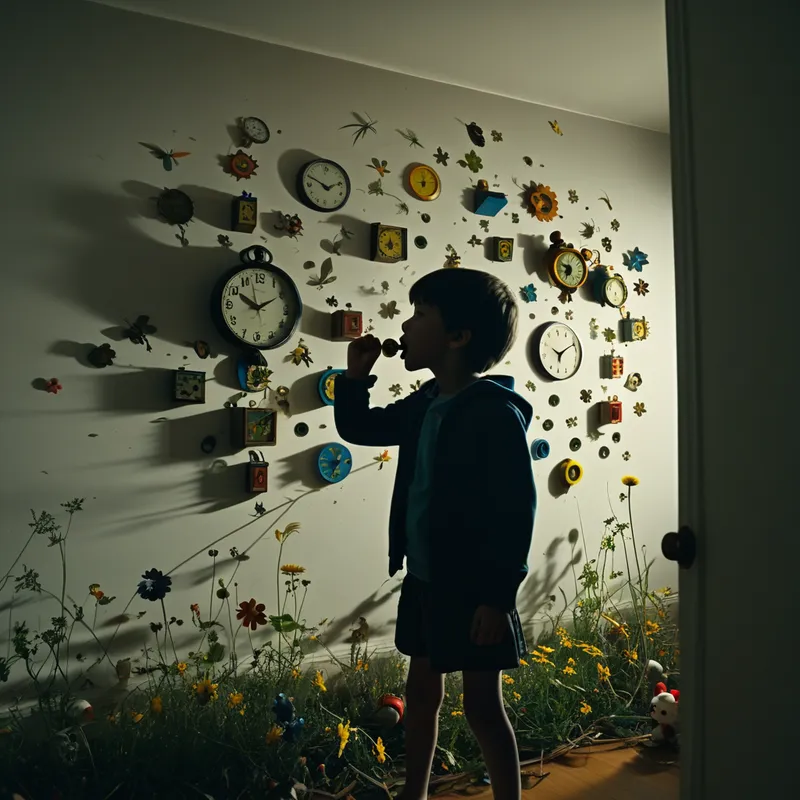
When this myth activates in the modern psyche, it often manifests in dreams of muffled sounds, sealed containers, or trapped animals struggling to speak. One might dream of finding a forgotten room in their house filled with chaotic, beautiful junk, or of a pet or child who suddenly speaks with shocking, taboo-breaking wisdom. Somatic experiences accompany this: a literal tightness in the throat, a stammer, or conversely, an uncontrollable urge to laugh or shout at inappropriate times.
Psychologically, this indicates a process where a long-repressed aspect of the self—a creative drive, a sexual energy, a rebellious opinion, a traumatic memory—is gathering strength and seeking expression. The ego’s old structures (the job, the persona, the “shoulds”) are the drumskin straining under pressure. The dreamer is in the prelude to a necessary disruption. The tension is between the fear of the chaos this voice will bring and the soul’s deep knowledge that the current “order” is a living death.
Alchemical Translation
The alchemical journey modeled here is the coniunctio oppositorum—the sacred marriage of order and chaos. The modern individual’s path of individuation is not about becoming perfectly ordered, but about becoming a vessel capable of containing and channeling this fundamental tension.
The goal is not to silence the Trickster, but to become a skilled drummer—one who can play the rhythm of order with the melody of chaos.
The first stage (nigredo) is the recognition of the dull, heavy silence—the depression, anxiety, or meaninglessness that signals a life overly constrained by the “law.” The digging (albedo) is the introspective work of therapy, journaling, or artistic exploration, bringing the buried “drum” into awareness. The striking of the drum is the rubedo, the reddening—a moment of passionate, often painful, eruption where the repressed content floods into consciousness. It feels like a breakdown.
But the final stage (citrinitas, leading to the elusive albedo) is the integration. The freed Voice does not destroy the dreamer; it complexifies them. The individual learns to hold their civic responsibility and their subversive humor, their discipline and their spontaneity. They become a living crossroads where structure and innovation meet. The Trickster’s Voice, once a external threat, becomes the internal source of their most authentic creativity and adaptive wisdom, ensuring they never fossilize into a mere echo of someone else’s law.
Associated Symbols
Explore related symbols from the CaleaDream lexicon: