The Tower of Glass Myth Meaning & Symbolism
A hero is lured to a magical, illusory tower in the sea, where he must confront enchantment and his own desires to win his freedom and sovereignty.
The Tale of The Tower of Glass
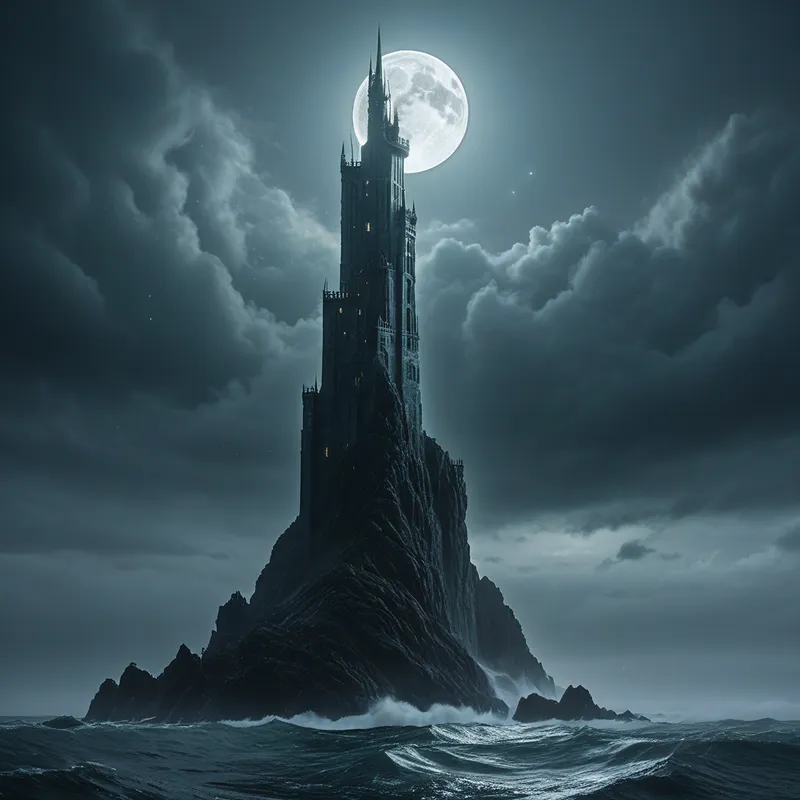
Listen, and let the fire’s glow carry you across the grey, sighing waves to the edge of the world. There, in the mist where memory and magic bleed together, stands a sight to still the heart and steal the breath: The Tower of Glass.
It rises from the sea, not built by mortal hand, but born of enchantment. Its walls are of clearest crystal, catching the weak sun and the cold moon, burning with a cold, inner fire that promises warmth. It is a siren song made solid, a dream given form. And to this tower came a hero, a man of renown—some say it was Cú Chulainn, in a tale of his youth; others whisper of Conaire Mór or a lost prince of the Tuatha Dé Danann. He stood on the rugged shore, the salt wind tearing at his cloak, and he saw the Tower. It called to him not with a voice, but with a deep, resonant pull in his spirit. It whispered of rest, of glory, of a kingship won without blood, of a beauty that would never fade.
He found a boat, a frail craft of skin and wicker, and set out across the churning, whale-road. The waves sought to swallow him, the winds to dash him back, but the Tower’s light was his compass. When he finally reached its impossible base, slick with spray, he found a door. It opened without a sound.
Inside was a splendor that mocked the courts of Tara. Feasts that never diminished, harps that played themselves, and at its heart, a woman of such devastating beauty that the very sight was a kind of pain. She was the keeper of the tower, a queen of this glass realm. She offered him everything: her love, her throne, the endless peace of this perfect, crystalline world. He stayed. Days blurred into seasons. He wore robes of fine silk, ate food that tasted of nostalgia, and drank wine that promised forgetfulness. He was a king in a cage of light, and for a time, he forgot the cage.
But the soul remembers the wind. In the deep watches of the night, when the enchanted music faded, he would hear it—the distant, relentless crash of the sea against the foundation. He would feel a chill that no phantom fire could warm. He looked at his perfect queen and saw, for a fleeting second, not a woman, but a reflection of his own longing. The glory felt weightless; the love, an echo. The Tower of Glass was not a fortress, but a mirror, and in it, he saw a ghost of himself.
The conflict was not with a monster, but with the enchantment woven into his own bones. To leave was to deny the beauty before him, to call the deepest desire of his heart a lie. It was a battle fought in silence, in the space between one breath and the next. One morning, he turned from the radiant queen, from the laden table, and walked to the door. He did not look back. The moment his foot touched the crude boat, the Tower’s light did not dim—it vanished. As he rowed, the waves fighting him once more, he glanced over his shoulder. There was only the empty, grey sea and the crying gulls. The Tower was gone, or perhaps it had never been, save in the place where longing builds its palaces.

Cultural Origins & Context
The tale of the Tower of Glass, or Túr Gloine, is a recurring motif woven through the tapestry of Irish mythological cycles, particularly the Ulster Cycle and the later Immrama (voyage tales). It is less a single, fixed story and more a powerful narrative pattern—a mythic algorithm for a specific spiritual peril. These stories were the province of the fili, the poet-seers who preserved history, law, and cosmology in intricate verse.
Its societal function was profound. In a culture that valued sovereignty, strength, and earthly connection (dúchas), the myth served as a warning against a passive, enchanted sovereignty. It taught that true kingship—of a land or of oneself—could not be received as a gift from an otherworldly force. It had to be earned through struggle, choice, and a return to the mortal, imperfect world. The Tower represented the Sídhe at its most seductive and dangerous: not a place of battle, but of blissful stagnation. The hero’s journey to and from the Tower models the essential Celtic heroic ideal—not just prowess in arms, but the far greater courage of discernment and the will to remain real.
Symbolic Architecture
The Tower is the ultimate symbol of the brilliant, fragile persona. It is constructed not of stone, but of the projections of our deepest desires: for perfection, for ease, for an end to yearning. Its glass walls represent a consciousness that is all surface and transparency, yet utterly impermeable. You can see out, but you cannot touch the world; the world sees only a distorted reflection of you.
The Tower of Glass is the soul’s most beautiful prison, built from the very materials of its liberation.
The sea it rises from is the unconscious, vast, chaotic, and real. The tower is an anomaly, an ordered, crystalline structure imposed upon the formless deep. The enchanting queen is the anima figure trapped in its own spell, offering a relationship that is, in fact, a narcissistic loop. The hero’s initial voyage is the inflation of the ego, lured by the promise of a self completed by external magic. His agonizing stay is the period of identification with this perfect, false self. The chilling realization and the decision to leave constitute the birth of individual consciousness—the moment one chooses authentic, flawed existence over perfect, meaningless illusion.
The Dreamer’s Resonance
When this myth stirs in the modern psyche, it manifests in dreams of stunning, sterile beauty. You may dream of a breathtaking modern penthouse with floor-to-ceiling windows, yet feel a profound, inexplicable loneliness. You may dream of a relationship or a job that looks perfect from the outside—all gleaming surfaces and accolades—but within the dream, you are searching frantically for an exit, or you notice a single, hairline crack spreading across a wall.
Somatically, this can feel like being wrapped in a cold, electric blanket—comfort that stifles. Psychologically, it is the process of confronting the golden shadow: not the repressed darkness, but the dazzling, idealized version of ourselves we feel we should be, which is just as alienating. The dreamer is experiencing the soul’s rebellion against a life of curated perfection, whether on social media, in career, or in spiritual bypassing. The dream’s tension is the friction between the seductive comfort of the illusion and the deep, bodily knowing that to stay is to cease to exist.
Alchemical Translation
The alchemical journey mirrored in this myth is the solve et coagula—dissolve and coagulate—applied to the psyche. The hero’s initial state is one of yearning (the prima materia). The voyage to the tower and his enchantment is the dissolution: his old identity is dissolved in the solvent of projected fantasy. He becomes one with the illusion.
His crisis is the crucial separatio, the blackening (nigredo). This is not a failure, but the necessary putrefaction of the false self. In the silence of the tower, the brilliant light reveals its own emptiness. This despair is the furnace.
The shattering of the illusion is not a catastrophe, but the first sound of the true self being born.
The decision to leave is the coagulation, the whitening (albedo). He chooses to re-form himself, not from the materials of enchantment, but from the act of choosing itself. Rowing back across the chaotic sea is the enduring work of individuation—a repeated, effortful motion against the tide of collective fantasy. He returns to the shore not with a trophy, but with sovereignty. The vanished tower leaves no physical relic, only a wisdom etched in his bones: that the most perilous otherworld is the one we build to escape our own, and that true power begins when we turn our back on the gift that would make us a ghost. The self is not found in the crystal palace, but forged in the salt spray of the return journey.
Associated Symbols
Explore related symbols from the CaleaDream lexicon: