The Torajan Death Ritual Myth Meaning & Symbolism
A myth where death is not an end but a long, communal journey, demanding elaborate rituals to guide the soul home and heal the living.
The Tale of The Torajan Death Ritual
Listen. In the high, mist-wrapped mountains of Sulawesi, where the clouds sleep in the valleys and the rice grows in steps to the sky, death is not a sudden door. It is a long, slow path, and the soul is a traveler who must be prepared.
When a person’s breath stills, the people do not weep in haste. They speak softly. “To Makula’,” they say. “He is sick.” For the body is merely sleeping, and the soul lingers nearby, confused, tethered by the love and the unfinished business of the living. The family washes the body with water scented with leaves, wraps it in layers of sacred cloth, and lays it in the south corner of the tongkonan. Here, in the house built on the bones of buffalo and facing north to the realm of the gods, the To Makula’ remains. For months. Sometimes for years.
The house becomes a threshold. Smoke from the kitchen fire still rises for them. Food is brought. News of the family is shared. The soul listens, growing accustomed to its new state, while the living begin the immense labor of love: the gathering. They must call the clan, from the farthest islands. They must save every coin, raise every buffalo, weave every textile. For the journey ahead is costly, and no soul can walk it alone.
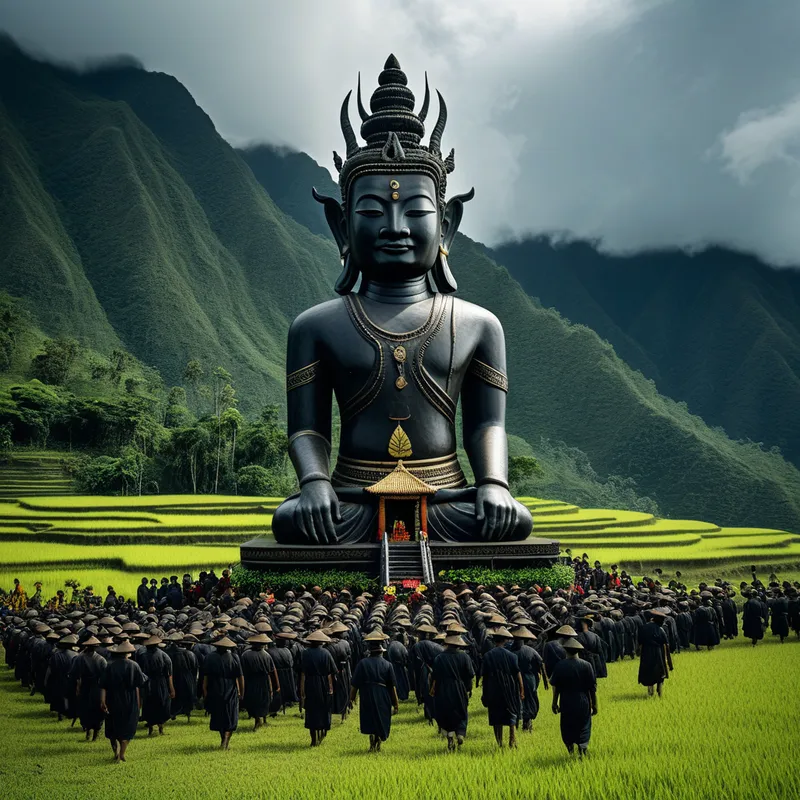
Then comes the day—the air thick with the scent of betel nut and anxiety. The drums begin, a heartbeat for the mountain. The To Makula’ is carried from the tongkonan, not as a burden, but as the guest of honor. They are placed high on a funeral tower, beneath a shade that mimics the roof of the ancestral home. Before them unfolds a sea of faces, a river of ritual. The climax is the Ma’tinggoro Tedong. A chosen buffalo, its hide dark and glossy, is led to the center. With a single, precise cut, its life is offered. Its spirit, it is said, will become the steed for the soul, carrying it swiftly to Puya.
For days, the ceremony unfolds—a cacophony of chants, dances, and feasting that is both grief and celebration. Finally, the time comes for the final ascent. The body is carried up the sheer limestone cliffs to the liang pa’, the high houses of the dead. Here, among the bones of ancestors, the body is laid to rest. A tau-tau, carved in its likeness, is placed on a balcony, watching over the valley of the living. The soul, now properly fed, honored, and equipped, begins its true journey to the south, to Puya. The door between worlds, held open so long and so tenderly, is finally allowed to close. The living, exhausted and emptied, feel a new space open within them—not of absence, but of a presence that has been fully and properly sent on its way.
Cultural Origins & Context
This is not a single myth penned by an ancient bard, but a living, breathing mythological framework enacted by the Torajan people of South Sulawesi, Indonesia. It is an Aluk Todolo, or “the way of the ancestors,” a complex cosmology that divides the world into the realm of the gods (the north), the realm of humans (the center), and the realm of the dead and demons (the south). The funeral ritual, called Rambu Solo’, is the most critical ceremony within this cosmology, a societal obligation of staggering scale.
The myth is passed down not through books, but through practice. Each funeral is a retelling. The elders who oversee the ritual, the family who saves for years, the entire community that participates—they are all keeping the story alive. Its function is profound: it mediates the terrifying unknown of death into a known, arduous, but navigable process. It transforms a personal, biological event into a communal, cultural project, ensuring social cohesion, redistributing wealth through sacrificial animals and feasts, and affirming the status of the family and the enduring power of the tongkonan. In a very real sense, the ritual creates the afterlife through collective action.
Symbolic Architecture
At its core, this [ritual](/symbols/ritual “Symbol: Rituals signify structured, meaningful actions carried out regularly, reflecting cultural beliefs and emotional needs.”/)-myth is a grand symbolic [operation](/symbols/operation “Symbol: An operation signifies a process of change or transformation that often requires deliberate effort and planning.”/) to transfigure the meaning of [death](/symbols/death “Symbol: Symbolizes transformation, endings, and new beginnings; often associated with fear of the unknown.”/) from an end into a transition. It is a psychic map for a [journey](/symbols/journey “Symbol: A journey in dreams typically signifies adventure, growth, or a significant life transition.”/) the living cannot take but must imagine in exquisite detail.
The body is not a corpse, but a seed. The elaborate ritual is the soil, rain, and sun required to germinate its passage to another world.
The prolonged [period](/symbols/period “Symbol: Periods in dreams can symbolize cyclical patterns, renewal, and the associated emotions of loss or change throughout life.”/) where the deceased is “sick” (To Makula’) symbolizes the psyche’s refusal to accept a traumatic [rupture](/symbols/rupture “Symbol: A sudden break or tear in continuity, often representing abrupt change, separation, or the shattering of established patterns.”/). It is a [period](/symbols/period “Symbol: Periods in dreams can symbolize cyclical patterns, renewal, and the associated emotions of loss or change throughout life.”/) of [incubation](/symbols/incubation “Symbol: A period of internal development, rest, or hidden growth before emergence, often associated with healing, creativity, or transformation.”/), where the [reality](/symbols/reality “Symbol: Reality signifies the state of existence and perception, often reflecting one’s understanding of truth and life experiences.”/) of [loss](/symbols/loss “Symbol: Loss often symbolizes change, grief, and transformation in dreams, representing the emotional or psychological detachment from something or someone significant.”/) is slowly metabolized by the [family](/symbols/family “Symbol: The symbol of ‘family’ represents foundational relationships and emotional connections that shape an individual’s identity and personal development.”/) and the [community](/symbols/community “Symbol: Community in dreams symbolizes connection, support, and the need for belonging.”/). The tongkonan itself becomes a temenos, a sacred container for this [alchemy](/symbols/alchemy “Symbol: A transformative process of purification and creation, often symbolizing personal or spiritual evolution through difficult stages.”/).
The sacrificial buffalo is a key [symbol](/symbols/symbol “Symbol: A symbol can represent an idea, concept, or belief, serving as a powerful tool for communication and understanding.”/) of Sacrifice, but not in a punitive sense. It represents the concrete, [material](/symbols/material “Symbol: Material signifies the tangible aspects of life, often representing physical resources, desires, and the physical world’s influence on our existence.”/) cost of transformation—the [life](/symbols/life “Symbol: The symbol of ‘Life’ represents a journey of growth, interconnectedness, and existential meaning, encompassing both the joys and challenges that define human experience.”/) [energy](/symbols/energy “Symbol: Energy symbolizes vitality, motivation, and the drive that fuels actions and ambitions.”/), resources, and social [capital](/symbols/capital “Symbol: A capital city represents the center of power, governance, and national identity, often symbolizing authority, structure, and collective aspirations.”/) that must be willingly surrendered to fuel a [soul](/symbols/soul “Symbol: The soul represents the essence of a person, encompassing their spirit, identity, and connection to the universe.”/)‘s [passage](/symbols/passage “Symbol: A passage symbolizes transition, movement from one phase of life to another, or a journey towards personal growth.”/) and to heal the community’s wound. The tau-tau effigy is a powerful [symbol](/symbols/symbol “Symbol: A symbol can represent an idea, concept, or belief, serving as a powerful tool for communication and understanding.”/) of the Double or the enduring [persona](/symbols/persona “Symbol: The social mask or outward identity one presents to the world, often concealing the true self.”/). It allows the living to relate to the departed not as a decaying [body](/symbols/body “Symbol: The body in dreams often symbolizes the dreamer’s self-identity, personal health, and the relationship they have with their physical existence.”/), but as a watchful [presence](/symbols/presence “Symbol: Presence in dreams often signifies awareness or acknowledgment of something significant in one’s life.”/), mediating the ongoing [relationship](/symbols/relationship “Symbol: A representation of connections we have with others in our lives, often reflecting our emotional state.”/) between the worlds.
The Dreamer’s Resonance
When this mythic pattern stirs in the modern dreamer, it rarely appears as a literal Torajan ceremony. Instead, it manifests as dreams of prolonged, complex preparations for a journey one is reluctant to take. It might be a dream of being late for a flight, but spending hours meticulously, compulsively packing the wrong items. It could be a dream of a house where a silent, respected figure remains in an upstairs room, and the dreamer’s task is to bring them meals and news for an indefinite period.
Somatically, this speaks to a psyche grappling with a necessary ending that is being resisted. The “death” may be of a relationship, a career, an identity, or a deeply held belief. The body in the dream may feel heavy, anxious, or stuck in a loop of preparation. The ritualistic actions—the packing, the feeding, the waiting—are the psyche’s innate attempt to create a container for what feels uncontainable: change, loss, transformation. The dreamer is in the To Makula’ phase, where the old state is officially gone, but the new one cannot be born until a profound internal and external process is completed.
Alchemical Translation
For the individual on the path of individuation, the Torajan ritual is a masterful model for psychic transmutation. It teaches that integration—particularly of the Shadow or the acceptance of mortality—cannot be rushed or intellectualized. It must be ritualized.
The ego must become the grieving family and the entire village, dedicating immense time and energy to honor what is passing, rather than hastily burying it.
The first alchemical stage is acknowledgment (the To Makula’ in the house). One must consciously “host” the dying aspect of oneself, feel its presence, and speak to it. The second is the sacrificial offering (the Ma’tinggoro Tedong). What prized possession—a long-held grievance, a comforting illusion, a source of pride—must be willingly slaughtered to provide energy for this journey? The third is the communal witness (the feast and dance). This translates to bringing this process into relationship—through therapy, art, or trusted community—so it is not a private pathology but a human passage.
Finally, the ascent to the cliff tomb is the act of giving the transformed content a permanent, honored place in the inner landscape. It is no longer active in daily life, but it is enshrined in memory and meaning, watching over the psyche like a tau-tau on a cliff. The soul of that old self is sent to its own Puya, freeing the living psyche to move forward, not with forgetfulness, but with completed grief.
Associated Symbols
Explore related symbols from the CaleaDream lexicon:
- Ritual — The entire framework of action is a ritual, transforming a biological fact into a culturally meaningful journey, providing a container for the chaos of grief.
- Journey — The core narrative is the soul’s journey to Puya, mirroring the psychological journey from attachment to release.
- Sacrifice — The water buffalo sacrifice represents the necessary surrender of life energy (time, money, emotion) to fuel transformation for both the departed and the community.
- Bridge — The ritual itself acts as a bridge between the world of the living and the dead, and between the psyche’s state of denial and acceptance.
- Community — The myth is impossible alone; it underscores that profound psychic transitions require witness, support, and shared labor.
- Ancestor — The goal of the ritual is to successfully join the realm of ancestors, turning the deceased into a benevolent, watchful presence for the living lineage.
- House — The tongkonan is the sacred container where transformation begins, symbolizing the self or the psyche as a vessel for incubation.
- Buffalo — As the sacrificial vehicle, it symbolizes strength, wealth, and the concrete, earthly resources offered up to spiritual ends.
- Cliff — The high burial site represents the final, elevated resting place for what has been transformed, a sacred integration into the enduring landscape of the self.
- Effigy — The tau-tau symbolizes the enduring image or memory of what has passed, allowing for continued relationship beyond physical form.
- Grief — The entire, prolonged ceremony is an externalized, active process of grieving, refusing to relegate sorrow to a private, hurried moment.
- Feast — The communal eating represents the recycling of life and energy, affirming that from death comes nourishment for the continuity of the community.