
The Throat Singing Origin Myth Meaning & Symbolism
A myth of two sisters who, facing starvation, create a game of breath and sound to summon the spirits of the land and sea, birthing katajjaq.
The Tale of The Throat Singing Origin
Listen. The wind does not just blow across the ice; it sings through the cracks in the floe. The sea does not just swell; it groans a deep, resonant bass under its frozen skin. But there was a time when people had forgotten how to hear this song. A time of the great hunger, when the caribou vanished into the white haze and the seal holes froze shut for a moon and then another.
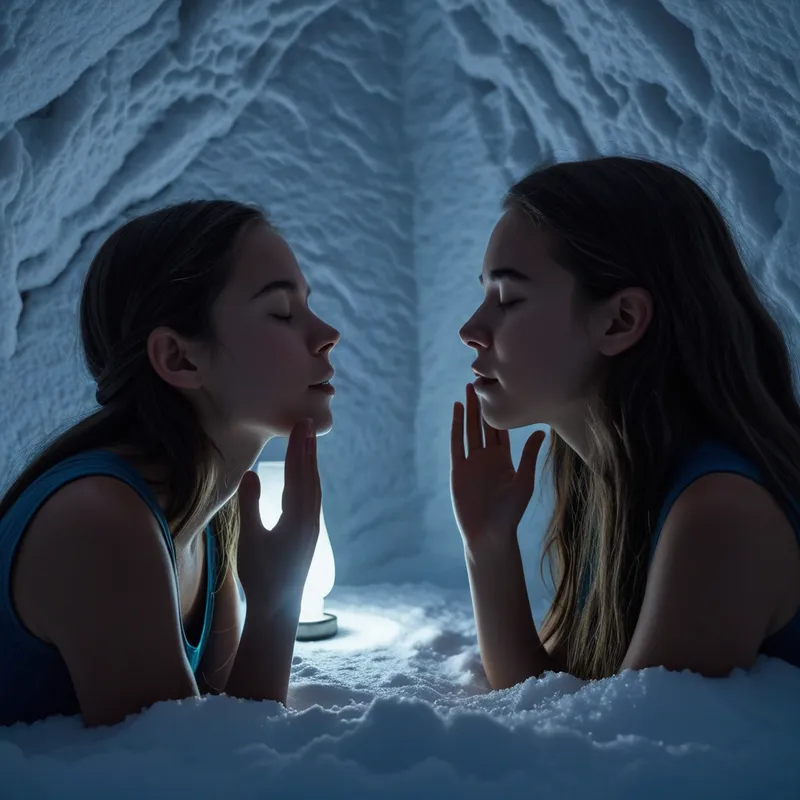
In a snow-house that grew colder and quieter with each passing day, two sisters waited. Their names are lost to the wind, but their breath remains. The elder’s breath was steady, like the pulse of the deep ocean. The younger’s was quick, like the panting of the fox on the run. Their stomachs were hollow drums. Their world had shrunk to the circle of dim light from the qulliq, and the sound of each other’s fading hope.
Silence in such a place is not empty. It is a weight. It is the tuurngaq that sits on your chest, stealing warmth and thought. The elder sister looked at the younger, whose eyes were wide with a fear too deep for tears. They could not speak of the hunger. Words would make it real. They could only breathe.
And so, they began to breathe at each other. Face to face, so close their breath mingled in a cloud. It was not speech. It was a game, a desperate pantomime to keep the crushing silence at bay. One would let out a short, sharp exhalation—hah! The other would match it, then answer with a low, guttural tone from deep within her chest—khhh. Back and forth. A rhythm emerged from their shared air. A call. And then, a response.
They were not just breathing. They were listening. To the spaces between the breaths. To the way sound could be shaped not on the tongue, but in the throat, in the belly, in the hollow of the chest. The elder found a sound like the crunch of snow under a bear’s paw. The younger answered with the high, thin whistle of wind over a ridge. Their game deepened. They stood, pressing their shoulders together, feeling the vibrations pass from one body to the other. The sounds became animals. The guttural push became the groan of the ugjuk surfacing. The sharp intake became the cry of the ukpik.
They were no longer just two hungry girls in a snow-house. They were a drum of skin and bone. They were a conduit. The sounds they pulled from the depths of themselves began to pull something from the depths of the world outside. The air in the shelter grew thick, charged. The flame of the qulliq danced to their rhythm. And then, in the complex, interlocking tapestry of their breath-song—the katajjaq—they heard an answer.
It was not with ears. It was in their bones. A deep, resonant hum, the voice of the ice itself. A chittering, playful counter-rhythm, the spirit of the arctic fox. The great, mournful song of the whale far under the ice, now vibrating up through the frozen sea and into the soles of their feet. They had not summoned food. They had summoned the presence of the land. The spirits of the animals heard their own voices reflected in this human game and drew near, curious, compassionate.
The crushing silence was gone, filled with a living, breathing soundscape. The weight of despair lifted, replaced by the electric vitality of creation. They sang until their throats were raw and their bodies trembled not from cold, but from effort. And when they finally stopped, exhausted, they slept a deep, dreamless sleep. At dawn, the younger sister went to the breathing hole and found a fat seal, waiting as if listening. The hunger was broken. They had not hunted the seal. They had sung with the spirit of the seal, and in that communion, the gift was given.
Cultural Origins & Context
This origin story for katajjaq is not a myth of gods on mountaintops, but of human ingenuity in the most intimate and desperate theater of survival: the family dwelling. Passed down orally, most often from grandmothers to granddaughters during the long winter nights, it served a profound dual function. On one hand, it was an etiological tale, explaining the genesis of a unique and vital cultural art form. On the other, it was a pedagogical narrative, embedding the core values of Inuit life.
The story emphasizes cooperation over individualism (the sisters work in tandem, not alone), resilience in the face of existential threat, and a deep, animistic reciprocity with the environment. The spirits—inua—of animals and elements are not distant deities but communicative presences. The myth taught that creativity itself is a survival tool, and that sound, breath, and rhythm are technologies as crucial as the harpoon or the ulu. It was typically shared not as a formal legend, but as the implicit “why” behind the practice, often told just as girls began to learn the physically and rhythmically demanding game from their elders, grounding the technique in profound purpose.
Symbolic Architecture
At its [heart](/symbols/heart “Symbol: The heart symbolizes love, emotion, and the core of one’s existence, representing deep connections with others and self.”/), this is a myth about generating [life](/symbols/life “Symbol: The symbol of ‘Life’ represents a journey of growth, interconnectedness, and existential meaning, encompassing both the joys and challenges that define human experience.”/) from the brink of [dissolution](/symbols/dissolution “Symbol: The process of breaking down, dispersing, or losing form, often representing transformation, release, or the end of a state of being.”/). The silence represents psychic [entropy](/symbols/entropy “Symbol: In arts and music, entropy represents the inevitable decay of order into chaos, often symbolizing creative destruction, impermanence, and the natural progression toward disorder.”/), the collapse of meaning and [connection](/symbols/connection “Symbol: Connection symbolizes relationships, communication, and bonds among individuals.”/) that precedes spiritual and physical [death](/symbols/death “Symbol: Symbolizes transformation, endings, and new beginnings; often associated with fear of the unknown.”/). The sisters’ game is an act of pure, spontaneous creation—a [ritual](/symbols/ritual “Symbol: Rituals signify structured, meaningful actions carried out regularly, reflecting cultural beliefs and emotional needs.”/) born from necessity.
The first art is often born not from abundance, but from the precise point where language fails and the body must speak its own raw poetry.
The [throat](/symbols/throat “Symbol: Represents communication, expression, and the transmission of thoughts.”/) is the central [symbol](/symbols/symbol “Symbol: A symbol can represent an idea, concept, or belief, serving as a powerful tool for communication and understanding.”/)—the narrow [passage](/symbols/passage “Symbol: A passage symbolizes transition, movement from one phase of life to another, or a journey towards personal growth.”/) between the inner world of [breath](/symbols/breath “Symbol: Breath symbolizes life, vitality, and the connection between the physical and spiritual realms.”/), thought, and [emotion](/symbols/emotion “Symbol: Emotion symbolizes our inner feelings and responses to experiences, often guiding our actions and choices.”/), and the outer world of [expression](/symbols/expression “Symbol: Expression represents the act of conveying thoughts, emotions, and individuality, emphasizing personal communication and creativity.”/) and impact. The myth depicts the [transmutation](/symbols/transmutation “Symbol: A profound, alchemical process of fundamental change where one substance or state transforms into another, often representing spiritual evolution or personal metamorphosis.”/) of passive [breath](/symbols/breath “Symbol: Breath symbolizes life, vitality, and the connection between the physical and spiritual realms.”/) (mere survival) into active, shaped sound (cultural and spiritual survival). The back-to-back or face-to-face [posture](/symbols/posture “Symbol: Posture in dreams represents one’s stance in life, social presentation, and inner confidence or submission. It reflects how one carries themselves through challenges and relationships.”/) of the singers creates a closed circuit, a [microcosm](/symbols/microcosm “Symbol: A small, self-contained system that mirrors or represents a larger, more complex whole, often reflecting the universe within an individual.”/). Within that circuit, the polarities of their voices—high and low, sharp and soft, inhalation and exhalation—create a dynamic [tension](/symbols/tension “Symbol: A state of mental or emotional strain, often manifesting physically as tightness, pressure, or unease, signaling unresolved conflict or anticipation.”/) that becomes generative. This is a model of the psyche itself, where the interplay between conscious and unconscious, ego and [shadow](/symbols/shadow “Symbol: The ‘shadow’ embodies the unconscious, repressed aspects of the self and often represents fears or hidden emotions.”/), can produce the transcendent function: a new, living [symbol](/symbols/symbol “Symbol: A symbol can represent an idea, concept, or belief, serving as a powerful tool for communication and understanding.”/) (the song) that bridges a previously un-crossable gap.
The Dreamer’s Resonance
To dream of this myth is to dream of a creative impasse so profound it feels like starvation. The dreamer may find themselves in a barren, silent landscape (an empty office, a frozen relationship, a sterile studio) with one other person. The task is not to do something, but to make sound together. The somatic experience is key: a constriction in the throat, a feeling of breathlessness, or conversely, the shocking, visceral release of a sound one did not know they could produce.
Psychologically, this dream pattern signals a confrontation with a “spiritual hunger.” The conscious mind has exhausted its resources. The dream urges a descent into pre-verbal, bodily intelligence—to use the breath and the vibration as a probe into the unconscious. The other person in the dream often represents an aspect of the dreamer’s own psyche (an inner sister, a rival, a companion) with whom they must cooperate to create this new “language.” The resolution comes not with a solution, but with the emergence of a new, shared rhythm—the birth of an internal dialogue that can finally engage with the nourishing but ignored spirits of one’s own inner world (instincts, talents, forgotten passions).

Alchemical Translation
The alchemical process mirrored here is solve et coagula: dissolve and coagulate. First, the solid structures of hope and normalcy dissolve into the hunger and silence (solve). The ego’s plans are useless. From this liquefied state of crisis, the sisters engage in a playful, almost childish, yet fiercely disciplined practice. They take the raw materia prima of their breath—the fundamental life force—and through rhythmic opposition and partnership, coagulate it into a new, potent form: the song (coagula).
For the modern individual, this myth models the individuation journey through the medium of creative block or existential crisis. The “ice” is the frozen state of the personality. The “seal” that finally appears is the symbol of the Self, the nourishing wholeness, but it cannot be taken by force; it must be attracted through authentic expression.
The spirit will not answer a plea born of lack, but it is irresistibly drawn to the beauty of a pattern it recognizes as its own.
The work is to stop seeking outside for sustenance, and instead, turn inward with a partner (a therapist, a creative collaborator, the inner animus/anima) and begin the often awkward, repetitive, deep-game of sounding out the contours of the unconscious. The goal is not a product, but the process of vibration itself—the re-animation of a world that had grown silent and dead. The resulting “throat singing” is the unique, resonant signature of an individual psyche that has learned to speak in its own dual-voiced truth, thereby restoring its connection to the nourishing flow of life.
Associated Symbols
Explore related symbols from the CaleaDream lexicon:
- Throat — The narrow passage of transformation where inner breath and spirit are shaped into outer sound and meaning, representing the courage to give voice to the ineffable.
- Breath — The raw, animating life force and the primal material from which all creative and spiritual acts are forged, symbolizing the spirit made tangible.
- Sisters — Represents the essential duality and cooperation within the psyche or a relationship, where contrasting forces must harmonize to generate something new.
- Spirit — The conscious, communicative essence of all things (inua), signifying the myth’s core theme of animistic communion and reciprocal relationship with the world.
- Hunger — The profound void, both physical and spiritual, that serves as the crucible and catalyst for desperate, transformative creation.
- Ice — The frozen, silent, and seemingly lifeless state of the psyche or circumstances that must be penetrated and vibrated into fluidity through resonant effort.
- Song — The achieved harmony and patterned vibration that emerges from struggle, acting as a bridge between the human and the numinous, the individual and the cosmos.
- Game — The playful, rule-bound container that allows for profound experimentation and risk-taking, turning a life-or-death struggle into a creative act.
- Dance — The physical, rhythmic counterpart to the vocal game, representing the full-bodied engagement and kinetic partnership required for true co-creation.
- Circle — The closed circuit of energy between the singers and the self-contained, ritual space of the snow-house, symbolizing a sacred, generative microcosm.
- Dream — The state of receptive listening and inner vision necessary to perceive the answering call of the spirits, representing the myth’s origin in deep, intuitive knowing.
- Healing — The ultimate outcome, where the restoration of spiritual connection and creative flow leads directly to the mending of physical and psychic fracture.