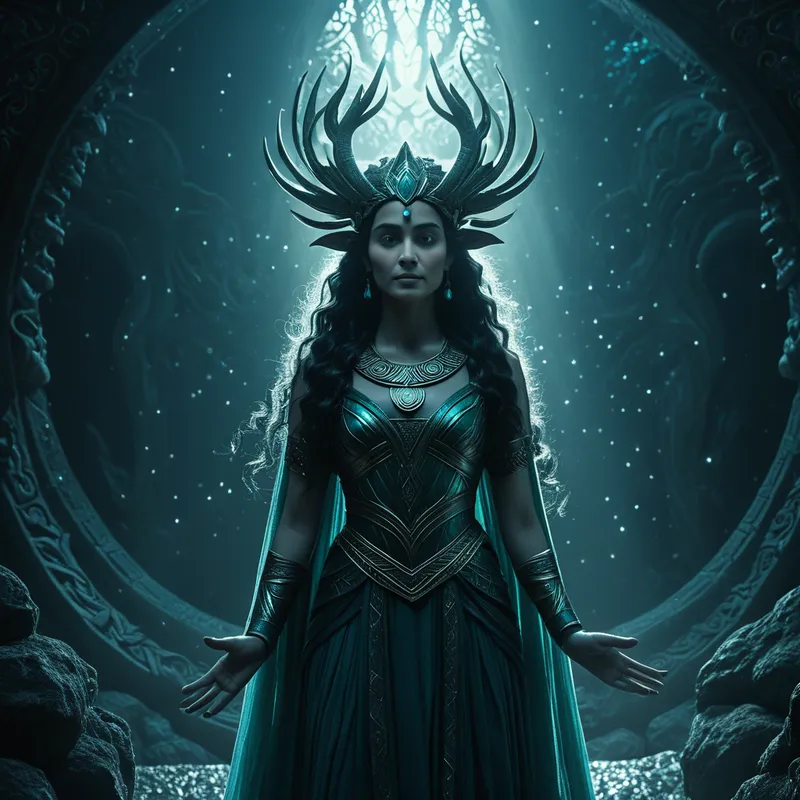
The Three Sacred Treasures of Japan
The sacred sword, mirror, and jewel that symbolize the Japanese imperial throne, embodying divine authority and the unbroken lineage of the emperor.
The Tale of The Three Sacred Treasures of Japan
In the beginning, when [the world](/myths/the-world “Myth from Tarot culture.”/) was still thick with primordial [chaos](/myths/chaos “Myth from Greek culture.”/), the Sun Goddess, [Amaterasu](/myths/amaterasu “Myth from Japanese Shinto culture.”/) Ōmikami, withdrew. Grieving and enraged by the violence of her brother [Susanoo](/myths/susanoo “Myth from Japanese culture.”/), she sealed herself within the Heavenly Rock Cave, plunging the heavens and earth into utter darkness. The myriad gods gathered, their laughter and revelry echoing outside [the cave](/myths/the-cave “Myth from Platonic culture.”/) door. Before this door, they placed a sacred mirror, crafted by [the divine smith](/myths/the-divine-smith “Myth from Various culture.”/) Ishikoridome. Its polished surface caught the first glimmers of the dancing goddess [Ame-no-Uzume](/myths/ame-no-uzume “Myth from Japanese culture.”/). Peering from her darkness, [Amaterasu](/myths/amaterasu “Myth from Japanese Shinto culture.”/) saw a brilliant, unfamiliar divinity in [the mirror](/myths/the-mirror “Myth from Various culture.”/)—her own radiant essence reflected back to her. Drawn by this luminous other, she opened the door, and light was restored to [the world](/myths/the-world “Myth from Tarot culture.”/). This mirror, Yata no [Kagami](/myths/kagami “Myth from Japanese culture.”/), became the first treasure, a vessel of her living presence.
From Susanoo’s tail, after his descent to the land of Izumo, came a great sword discovered within the body of the eight-headed serpent, Yamata no Orochi. This was the sword [Kusanagi-no-Tsurugi](/myths/kusanagi-no-tsurugi “Myth from Japanese culture.”/), the “Grass-Cutter.” It was a blade born from a act of chaotic violence, yet its power was offered in reconciliation and proof of valor to Amaterasu. It represented not mere destruction, but the cutting away of impurity and the taming of wild, chthonic forces.
The third treasure, the jewel Yasakani no Magatama, has its roots in an earlier celestial drama. When Amaterasu sent her grandson, Ninigi-no-Mikoto, to rule the Central Land of Reed Plains, she bestowed upon him these three items. The curved magatama beads, strung together, were among her gifts. They held the essence of her spirit, a condensed, tangible form of her benevolence and life-giving power.
Thus armed with [the Mirror of wisdom](/myths/the-mirror-of-wisdom “Myth from Buddhist culture.”/), the Sword of valor, and the Jewel of benevolence, Ninigi descended to earth. His great-grandson would become the first legendary Emperor, Jimmu. From that moment to the present day, these Three Sacred Treasures—the Imperial Regalia—have been passed in solemn secrecy from sovereign to sovereign. They are never displayed to public gaze; their power resides in their unseen presence, a direct, unbroken thread of divine mandate stretching from the Plain of High Heaven to [the Chrysanthemum Throne](/myths/the-chrysanthemum-throne “Myth from Japanese culture.”/). They are not owned, but held in sacred trust, the physical proof of a pact between the celestial and the mortal, the invisible heart of a nation’s soul.
Cultural Origins & Context
The Treasures emerge from the foundational texts of Japanese identity: the Kojiki (Records of Ancient Matters, 712 CE) and the Nihon Shoki (Chronicles of Japan, 720 CE). These were not mere histories but deliberate acts of mythopoetic statecraft, compiled to consolidate the authority of the Yamato line by anchoring it in an unassailable divine origin. The Treasures are the ultimate symbols of this project.
In the Shinto worldview, where kami (spirits or gods) inhabit and animate all things, these objects are not mere representations. They are shintai—“god-bodies.” They are vessels in which the essence, the mitama, of the divine permanently resides. Their transfer during the Senso and Daijōsai rites is the critical, mystical moment of succession. The emperor does not simply inherit political power; he is entrusted with the very substance of Amaterasu’s spirit, becoming the chief priest of the nation and the living node between heaven and earth.
This context frames their profound secrecy. To see them is not to witness finery, but to gaze directly upon the naked divine—an act considered perilously taboo. Their power is in their hiddenness, a mystery that fuels their legitimacy. They exist in the realm of faith and tradition, not empirical verification, making them immune to historical challenge. They are the ultimate argument for legitimacy, written not in text, but in the silent, continuous act of sacred transmission.
Symbolic Architecture
The [Three Treasures](/symbols/three-treasures “Symbol: A spiritual triad representing fundamental principles of existence, often seen as body-mind-spirit or heaven-earth-humanity.”/) form a complete psychic and cosmological [system](/symbols/system “Symbol: A system represents structure, organization, and interrelated components functioning together, often reflecting personal or social order.”/). They are a [triad](/symbols/triad “Symbol: A grouping of three representing spiritual unity, divine completeness, and cosmic balance across many traditions.”/) governing the fundamental aspects of sovereign [authority](/symbols/authority “Symbol: A symbol representing power structures, rules, and control, often reflecting one’s relationship with societal or personal governance.”/) and, by extension, the integrated self.
The Mirror (Yata no Kagami) represents wisdom, [truth](/symbols/truth “Symbol: Truth represents authenticity, honesty, and the quest for knowledge beyond mere appearances.”/), and self-[reflection](/symbols/reflection “Symbol: Reflection signifies self-examination, awareness, and the search for truth within oneself.”/). It is the [instrument](/symbols/instrument “Symbol: An instrument symbolizes creativity, communication, and the means by which one expresses oneself or influences the world.”/) that revealed Amaterasu to herself, ending her retreat. It symbolizes the [clarity](/symbols/clarity “Symbol: A state of mental transparency and sharp focus, often representing resolution of confusion or attainment of insight.”/) of [consciousness](/symbols/consciousness “Symbol: Consciousness represents the state of awareness and perception, encompassing thoughts, feelings, and experiences.”/), the [ability](/symbols/ability “Symbol: In dreams, ‘ability’ often denotes a recognition of skills or potential that one possesses, whether acknowledged or suppressed.”/) to perceive [reality](/symbols/reality “Symbol: Reality signifies the state of existence and perception, often reflecting one’s understanding of truth and life experiences.”/)—and one’s own [nature](/symbols/nature “Symbol: Nature symbolizes growth, connectivity, and the primal forces of existence.”/)—without [distortion](/symbols/distortion “Symbol: The alteration of form, sound, or perception from its original state, often creating unsettling or creative effects.”/). In the ruler, it is the quality of honest judgment and enlightened [perception](/symbols/perception “Symbol: The process of becoming aware of something through the senses. In dreams, it often represents how one interprets reality or internal states.”/). Psychologically, it is the function of consciousness itself, the “I” that observes and integrates.
The Sword (Kusanagi-no-Tsurugi) represents valor, [decision](/symbols/decision “Symbol: A decision in a dream reflects the choices one faces in waking life and can symbolize the pursuit of clarity and resolution.”/), and the power to cut through [obscurity](/symbols/obscurity “Symbol: A state of being unclear, hidden, or difficult to perceive, often representing the unknown, unconscious, or unresolved aspects of life.”/) and evil. Forged in a mythic battle, it is not a [symbol](/symbols/symbol “Symbol: A symbol can represent an idea, concept, or belief, serving as a powerful tool for communication and understanding.”/) of aggression for its own sake, but of decisive [action](/symbols/action “Symbol: Action in dreams represents the drive for agency, motivation, and the ability to take control of situations in waking life.”/), protection, and the severing of bonds to impurity and [chaos](/symbols/chaos “Symbol: In Arts & Music, chaos represents raw creative potential, uncontrolled expression, and the breakdown of order to forge new artistic forms.”/). It is the executive function, the will that acts in the world to establish and maintain order.
The Jewel (Yasakani no Magatama) represents benevolence, [compassion](/symbols/compassion “Symbol: A deep feeling of empathy and concern for others’ suffering, often involving a desire to help or alleviate their pain.”/), and the attractive, [life](/symbols/life “Symbol: The symbol of ‘Life’ represents a journey of growth, interconnectedness, and existential meaning, encompassing both the joys and challenges that define human experience.”/)-giving power of the [spirit](/symbols/spirit “Symbol: Spirit symbolizes the essence of life, vitality, and the spiritual journey of the individual.”/). The curved, [comma](/symbols/comma “Symbol: A punctuation mark representing a brief pause, connection, or transition, often symbolizing rhythm, flow, and the spaces between thoughts or actions.”/)-shaped magatama is an ancient symbol of the [soul](/symbols/soul “Symbol: The soul represents the essence of a person, encompassing their spirit, identity, and connection to the universe.”/). This [treasure](/symbols/treasure “Symbol: A hidden or valuable object representing spiritual wealth, inner potential, or divine reward.”/) embodies [empathy](/symbols/empathy “Symbol: The capacity to understand and share the feelings of others, often manifesting as emotional resonance or intuitive connection in dreams.”/), the [capacity](/symbols/capacity “Symbol: A measure of one’s potential, limits, or ability to contain, process, or achieve something, often reflecting self-assessment or external demands.”/) to attract loyalty and love, and the fertile, nurturing [aspect](/symbols/aspect “Symbol: A distinct feature, quality, or perspective of something, often representing a partial view of a larger whole.”/) of authority. It is the affective, connective force that binds a people to their sovereign.
Together, they form an indivisible whole: the Mirror to see truth, the Sword to act upon it, and the Jewel to imbue that action with compassionate spirit. A ruler lacking one becomes a tyrant (Sword without Mirror), a passive philosopher (Mirror without Sword), or a weak sentimentalist (Jewel without Sword). Their balance is the ideal of enlightened rule.
This [architecture](/symbols/architecture “Symbol: Architecture in dreams often signifies structure, stability, and the framing of personal identity or life’s journey.”/) extends to their purported physical locations, mapping the sacred geography of Japan: the Jewel at the Imperial [Palace](/symbols/palace “Symbol: A palace symbolizes grandeur, authority, and the pursuit of one’s ambitions or dreams, often embodying a desire for stability and wealth.”/) in Tokyo (the present seat), the Mirror at the Grand [Shrine](/symbols/shrine “Symbol: A sacred structure for worship, offering, or remembrance, representing connection to the divine, ancestors, or spiritual forces.”/) of Ise (the spiritual [heart](/symbols/heart “Symbol: The heart symbolizes love, emotion, and the core of one’s existence, representing deep connections with others and self.”/)), and the Sword at Atsuta Shrine in Nagoya (a center of historical martial spirit). They are a nation’s soul distributed across its [body](/symbols/body “Symbol: The body in dreams often symbolizes the dreamer’s self-identity, personal health, and the relationship they have with their physical existence.”/), held in [equilibrium](/symbols/equilibrium “Symbol: A state of balance, stability, or harmony between opposing forces, often representing inner peace or external order.”/).
The Dreamer’s Resonance
To encounter [the Three Treasures](/myths/the-three-treasures “Myth from Taoist culture.”/) in the inner landscape of a dream is to confront the archetypal core of the Ruler. They speak to the dreamer’s relationship with their own authority, legitimacy, and inner sovereignty.
The hidden Mirror may appear when one is avoiding a painful self-truth. It asks: Where are you refusing to see yourself clearly? What aspect of your being have you shut away in a cave of shame or grief? Its revelation is the return of light to the [psyche](/myths/psyche “Myth from Greek culture.”/), the reintegration of a disowned self.
The buried Sword emerges in dreams of paralysis or besiegement. It signifies a needed but feared act of severance—cutting ties to a toxic relationship, a stifling job, or an outworn identity. It is the dream’s gift of decisive power, the courage to confront one’s personal “serpents.”
The lost Jewel manifests in dreams of barrenness or isolation. It calls attention to a withered capacity for empathy, joy, or self-love. To recover it is to reconnect with one’s vital, attractive spirit, to nurture and be nurtured.
As a triad, they pose the fundamental questions of psychological integration: Can I see myself honestly (Mirror)? Can I act with integrity on that truth (Sword)? Can I do so with a compassionate heart (Jewel)? To dream of receiving them is a profound call to assume responsibility for one’s own inner kingdom.

Alchemical Translation
The alchemical process mirrored in the myth of the Treasures is one of [separatio](/myths/separatio “Myth from Alchemical culture.”/) and [coniunctio](/myths/coniunctio “Myth from Alchemical culture.”/)—separation and sacred reunion. Amaterasu’s retreat into the cave is the [nigredo](/myths/nigredo “Myth from Alchemical culture.”/), [the dark night of the soul](/myths/the-dark-night-of-the-soul “Myth from Christian Mysticism culture.”/), where all conscious light is extinguished. The gods’ gathering and the crafting of the mirror represent the difficult, collaborative work of the psyche in crisis, forging a new tool of consciousness.
The mirror held before the cave door is the pivotal moment. It is the creation of a symbolic third, an objective representation of the Self, which can draw the alienated consciousness (the Sun) out of its identification with darkness. This is the albedo, the whitening, where spirit recognizes itself in its reflection.
The descent of the Treasures to earth with Ninigi is the [rubedo](/myths/rubedo “Myth from Alchemical culture.”/), the reddening or realization, where the integrated spiritual principle is embodied in the material world—the “divine right” made manifest in human rule. The continuous, secret transmission of the Treasures is the [circulatio](/myths/circulatio “Myth from Alchemy culture.”/), the endless cycle of [death](/myths/death “Myth from Tarot culture.”/) and rebirth, of one emperor succeeding another, ensuring the eternal return and renewal of this divine principle within the temporal realm.
Psychologically, this is the process of individuation. [The ego](/myths/the-ego “Myth from Jungian culture.”/) (the imperial line) does not create [the Self](/myths/the-self “Myth from Jungian culture.”/) (Amaterasu), but is charged with its stewardship. The individual must undergo the darkness, forge the tools of reflection and action, and ultimately bear the responsibility of embodying a wholeness greater than themselves, passing this hard-won consciousness forward in the lineage of their own becoming.
Associated Symbols
Explore related symbols from the CaleaDream lexicon:
- Mirror — The instrument of self-revelation and truth, reflecting not merely image but essence, capable of ending interior darkness.
- Sword — A symbol of discernment and decisive action, cutting through illusion and impurity to establish clarity and order.
- Sun — The radiant source of life and consciousness, whose withdrawal brings chaos and whose return restores cosmic and psychic order.
- Cave — [The womb](/myths/the-womb “Myth from Various culture.”/) of transformation and the place of retreat, where the spirit undergoes necessary darkness before emerging renewed.
- Door — [The threshold](/myths/the-threshold “Myth from Folklore culture.”/) between states of being, a portal that can be sealed in grief or opened to revelation and return.
- Tradition — The living chain of transmission that carries sacred meaning across generations, granting legitimacy and continuity.
- Crown — The visible emblem of invisible authority, representing the burden, duty, and divine sanction of sovereignty.
- Light — The primordial good born from confrontation with darkness, representing consciousness, truth, and divine presence.
- Ritual — The prescribed, symbolic action that re-enacts mythic events, making the eternal present and binding the community to its sacred source.
- Three Treasures — The archetypal triad of wisdom, action, and compassion, whose balance constitutes complete spiritual and worldly authority.