The Temptation of Christ Myth Meaning & Symbolism
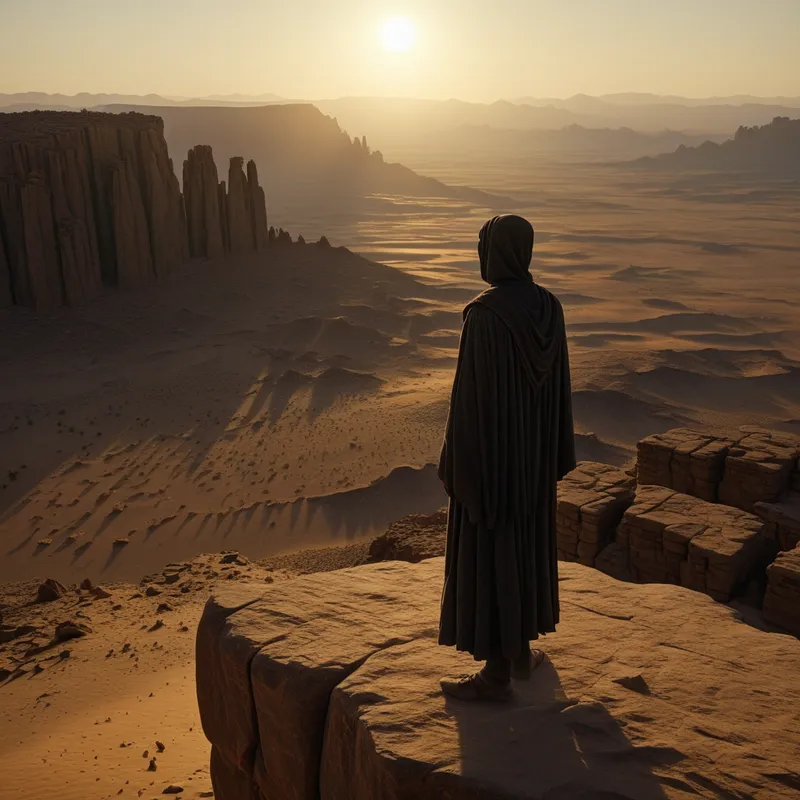
A solitary figure in the desert wilderness confronts three archetypal offers of power, testing the integrity of the nascent self against the world's illusions.
The Tale of The Temptation of Christ
The Spirit drove him out into [the wilderness](/myths/the-wilderness “Myth from Biblical culture.”/).
Into the vast, whispering silence where the sun is a hammer and [the wind](/myths/the-wind “Myth from Various culture.”/) carries the voices of forgotten things. For forty days and forty nights, he was with the wildness, and the wildness was with him. He ate nothing. His body became a parchment stretched over bone, his thirst a deep well echoing with the memory of rain. In that absolute reduction, where the soul is laid bare to [the sky](/myths/the-sky “Myth from Persian culture.”/), the Adversary came.
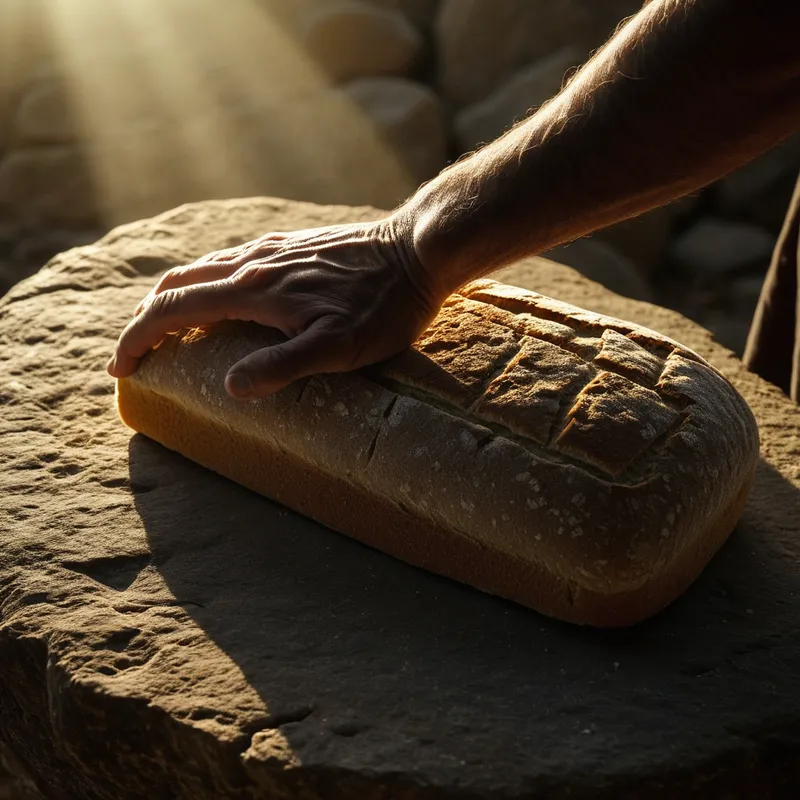
He did not arrive with thunder. He came as a knowing, a presence that filled the emptiness between the stones. “If you are the Son of God,” the voice was like polished flint, smooth and sharp, “command this stone to become bread.”
The man looked from the smooth, sun-warmed stone to the hollow ache in his belly. The temptation was not of hunger, but of identity. To use the sacred connection, the whispered truth of his being, for mere sustenance. To bend the inward mystery to the outward need. He breathed the dry air. “It is written,” he said, his voice a rasp of dust, “One does not live by bread alone.”
The Adversary smiled, a flicker in the heat haze. He led him up, higher than the eagles, to a place where the whole world unrolled beneath them like a tapestry of power and sorrow. Cities glittered like scattered coins, armies moved like ants, kingdoms breathed with the pulse of ten thousand desires. In an instant, the vision was offered, all authority and splendor. “All this will be yours,” the voice promised, a kingmaker’s whisper, “if you will worship me.”
To have [the world](/myths/the-world “Myth from Tarot culture.”/), to shape it, to save it by its own rules. The price was a single, hidden gesture of allegiance. The man turned his face from the glittering panorama. “It is written,” he said, and his words fell like a seal upon the offer, “You shall worship the Lord your God, and him only shall you serve.”
Then, to the holy city, to the very pinnacle of the Temple. The wind tore at his robe. Far below, the courtyard stones were tiny tiles. “If you are the Son of God,” the Adversary murmured, standing beside him as a theologian, “throw yourself down from here. For it is written, ‘He will command his angels concerning you, to protect you,’ and ‘On their hands they will bear you up, so that you will not dash your foot against a stone.’”
The ultimate temptation: not of need, nor of power, but of spectacle. To force the hand of the divine, to turn faith into a public guarantee, to trade mystery for miraculous proof. To leap is to demand the net. The man looked not at the stones below, but into the nature of the test itself. “It is said,” he replied, the final word settling like a cornerstone, “You shall not put the Lord your God to the test.”
The Adversary departed from him until an opportune time. And angels came and attended him. The wilderness remained, but it was no longer a place of trial. It had become a place of clarity, a kingdom of a different order, won not by taking, but by refusing.
Cultural Origins & Context
This narrative is found in the synoptic gospels of Matthew and Luke, with a briefer account in Mark. It functions as a critical initiation story placed immediately after [Jesus](/myths/jesus “Myth from Christian culture.”/)‘s baptism in the Jordan River—a moment of divine affirmation (“You are my beloved Son”)—and before the commencement of his public ministry. In the Second Temple Judaism of the 1st century, [the desert](/myths/the-desert “Myth from Biblical culture.”/) was a potent symbolic landscape. It was the place of Israel’s 40-year testing after [the Exodus](/myths/the-exodus “Myth from Abrahamic culture.”/), the haunt of prophets like Elijah, and the home of ascetic communities like the Essenes. The 40-day period directly echoes the 40 years of wilderness wandering, framing [Jesus](/myths/jesus “Myth from Christian culture.”/) as recapitulating and fulfilling Israel’s story.
The story was passed down within early Christian communities as a foundational ethical and Christological paradigm. It served to define the nature of Jesus’s messiahship against contemporary expectations of a political or militaristic liberator. It was not a magic trick to win followers but a private, spiritual consolidation of identity. Societally, it modeled a radical form of integrity, teaching that true power and authority are derived from obedience to a transcendent moral and spiritual order, not from the manipulation of physical need, political force, or divine leverage.
Symbolic Architecture
The [wilderness](/symbols/wilderness “Symbol: Wilderness often symbolizes the untamed aspects of the self and the unconscious mind, representing a space for personal exploration and discovery.”/) is the [prima materia](/myths/prima-materia “Myth from Alchemical culture.”/) of the [soul](/symbols/soul “Symbol: The soul represents the essence of a person, encompassing their spirit, identity, and connection to the universe.”/), the stripped-bare state of [consciousness](/symbols/consciousness “Symbol: Consciousness represents the state of awareness and perception, encompassing thoughts, feelings, and experiences.”/) where all non-essentials fall away. The 40 days represent a complete cycle of [incubation](/symbols/incubation “Symbol: A period of internal development, rest, or hidden growth before emergence, often associated with healing, creativity, or transformation.”/), a psychic [gestation](/symbols/gestation “Symbol: A period of development and preparation before a significant birth or emergence, symbolizing potential, transformation, and the journey toward manifestation.”/) where the newly affirmed “self” (the Son) must face its own latent potentials and shadows.
The three temptations are not random evils but a precise, archetypal catalog of the soul’s potential corruptions. They represent three fundamental ways the developing consciousness can be hijacked, three false paths of [inflation](/symbols/inflation “Symbol: A dream symbol representing feelings of diminishing value, loss of control, or expansion beyond sustainable limits in one’s life or psyche.”/).
The first temptation is to turn the sacred into the utilitarian. It is the shadow of the Material Prima: using spiritual insight or personal gifts merely to serve the ego’s comfort and survival. It confuses sustenance with substance.
The second temptation is the shadow of the Power Archetype: acquiring worldly influence by compromising core allegiance. It is the deal with the devil in every boardroom and political campaign—the belief that one can use corrupt means for a righteous end.
The third temptation is the shadow of the Religious Function: coercing the divine, turning faith into a guaranteed system, and seeking spiritual validation through dramatic, risk-free proof. It is religion as ego insurance.
The Adversary here is [less](/symbols/less “Symbol: The concept of ‘less’ often signifies a need for simplicity, reduction, or minimalism in one’s life or thoughts.”/) a external [monster](/symbols/monster “Symbol: Monsters in dreams often symbolize fears, anxieties, or challenges that feel overwhelming.”/) and more the personification of the logical, compelling, and utterly reasonable voice of the world’s wisdom. He is the [shadow](/symbols/shadow “Symbol: The ‘shadow’ embodies the unconscious, repressed aspects of the self and often represents fears or hidden emotions.”/) of the newly emerging Self, the part that knows all the shortcuts.

The Dreamer’s Resonance
When this mythic pattern stirs in the modern dreamer, it often manifests not as a biblical tableau, but as a profound inner crossroads. The dreamer may find themselves in a stark, minimalist landscape—an empty office at night, a bare stage, a featureless plain. A figure, often familiar yet strangely authoritative (a former mentor, a sleek businessman, a knowing version of the dreamer themselves), presents offers.
The somatic experience is key: a tightening in the gut for the first offer (the bread of immediate relief), a swelling in the chest for the second (the intoxicating lure of control), and a dizzying, vertiginous feeling for the third (the cliff-edge of demanded certainty). The dream is a somatic rehearsal of integrity. The “opportune time” of the Adversary’s return is the dreamer’s daily life—moments of vulnerability, ambition, or doubt where these same three archetypal shortcuts whisper anew.
To dream this is to undergo a psychic initiation. [The ego](/myths/the-ego “Myth from Jungian culture.”/) is being tested not by external monsters, but by its own latent desires for easy power, quick solutions, and guaranteed security. The resolution in the dream—whether the dreamer refuses, hesitates, or accepts—maps the current state of the soul’s consolidation.
Alchemical Translation
The Temptation is the alchemical [Nigredo](/myths/nigredo “Myth from Alchemical culture.”/) of the individuation journey. After the baptismal illumination, one must enter the desert of analysis, where the glowing promise of the new self is confronted by all the ways it can go wrong. This is the necessary mortificatio—the killing of potential false paths.
The process models psychic transmutation by demonstrating that strength is forged through conscious refusal. The “gold” produced is not a tangible object but an integrated consciousness that has consciously rejected the alloys of inflation.
Each refusal is an act of [separatio](/myths/separatio “Myth from Alchemical culture.”/), distinguishing the authentic self from the seductive complexes that would capture it. Turning stone to bread would fuse the spiritual with the merely instinctual. Worshipping for kingdoms would fuse [the self](/myths/the-self “Myth from Jungian culture.”/) with the power complex. Testing God would fuse faith with egoic certainty. By saying “no,” the consciousness creates a sacred, empty space—the vas or vessel—within which a different kind of identity, one based on relationship and integrity rather than consumption and control, can form.
The final attendance of angels symbolizes the arrival of reconciling symbols and inner resources that only become available after the trials are endured. These are not rescues, but confirmations. The modern individual undergoing this alchemy moves from a identity built on “what I can have, control, or prove” to one grounded in “who I am” in relationship to a deeper, non-negotiable center. The wilderness ceases to be a place of deprivation and becomes the inner kingdom itself, the clear, uncluttered landscape of a self that owns nothing but is truly free.
Associated Symbols
Explore related symbols from the CaleaDream lexicon: