The Temenos Myth Meaning & Symbolism
The myth of the sacred precinct, a hallowed space cut from the wilderness where the divine and human meet, creating a vessel for transformation.
The Tale of The Temenos
Listen. Before the first stone was laid for [the temple](/myths/the-temple “Myth from Jewish culture.”/), before the first hymn was sung to [the sky](/myths/the-sky “Myth from Persian culture.”/)-father, there was a need. A hunger in the human soul for a place that was not a place, a clearing in the chaos of [the world](/myths/the-world “Myth from Tarot culture.”/).
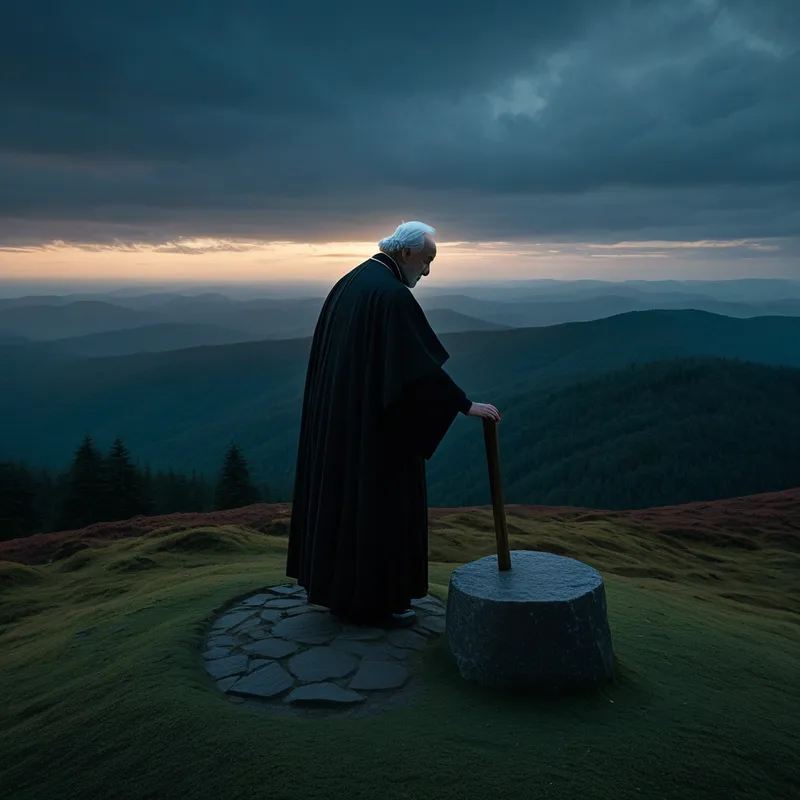
It began not with a god, but with a gesture. A king, his heart heavy with the noise of his people and the whispers of the wild, climbed a hill where the eagles circled. [The wind](/myths/the-wind “Myth from Various culture.”/) carried the scent of [thyme](/myths/thyme “Myth from Greek culture.”/) and distant rain. He carried a rope of woven flax and a staff of olive wood, hard and true. He did not speak. He walked, and as he walked, he listened—not with his ears, but with his bones. He felt where [the earth](/myths/the-earth “Myth from Hindu culture.”/) hummed with a different frequency, where [the veil](/myths/the-veil “Myth from Various culture.”/) between what is seen and what is eternal grew thin as morning mist.
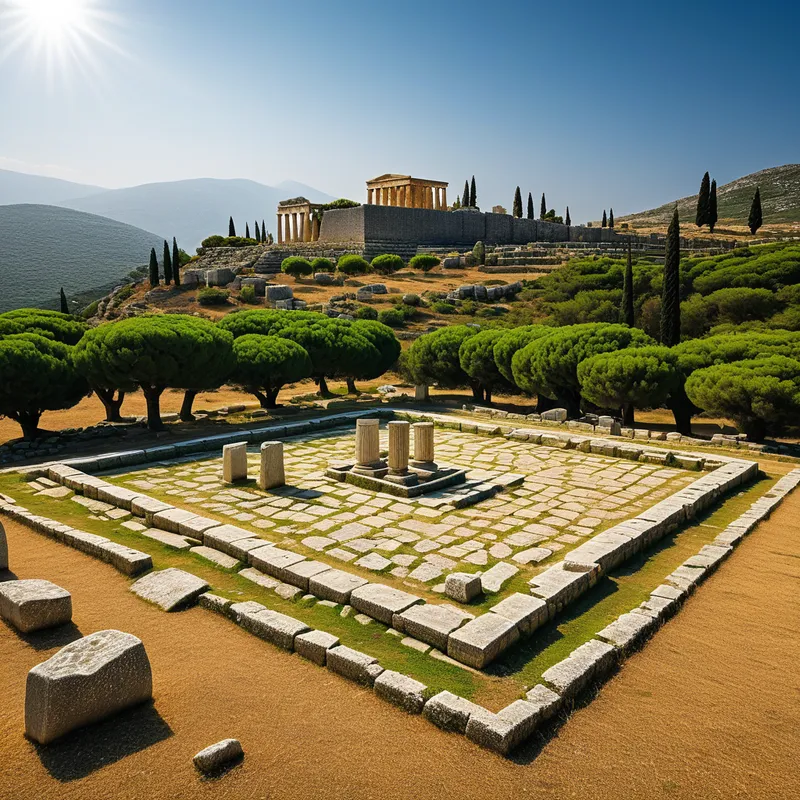
Here, he stopped. He drove his staff into the soil. From this point, his attendants stretched the rope, walking the four sacred directions, tracing a perfect square upon the living earth. With each footfall, they chanted a single, low note—a sound to anchor the space. Then, with bronze tools that flashed in the sun, they cut a furrow along the line of the rope. This was the [temenos](/myths/temenos “Myth from Greek culture.”/) itself, the cut, the separation. The soil turned up was dark and rich, the life-blood of the land now drawn as a line.
As the trench was dug, the air within [the square](/myths/the-square “Myth from Platonic culture.”/) grew still. The sounds from beyond—the rustle of beasts, the chatter of birds—seemed to fade, replaced by a profound, listening silence. At the center, where the staff had pierced, they built an altar of unhewn stone, an herm. They anointed it with oil and wine, the first libation. And as the wine sank into the stone, a presence descended. It was not a vision of Zeus or Athena, but a feeling of potential, like the held breath before a word is spoken. The temenos was now awake. It was a vessel, empty and waiting. Only then could the temple be conceived, a house for a specific god, built within this already-sanctified womb of space. The sacred precinct was born—not conquered, but revealed; not built, but consecrated.
Cultural Origins & Context
The concept of the temenos was not a single myth narrated by poets like [Homer](/myths/homer “Myth from Greek culture.”/) or Hesiod, but a fundamental ritual and architectural principle woven into the fabric of ancient Greek life. It was a practice, a sacred technology. From the grand Panhellenic sanctuaries like Delphi and Olympia to the local shrine in a farmer’s field, the act of defining a temenos was the essential first step in creating a relationship with the divine.
This practice was administered by priests and city founders (oikistés). Its function was deeply societal: it established order (kosmos) out of chaos and wilderness (eschatia). The temenos was a legal and spiritual entity; violence was forbidden within it, making it a place of asylum and negotiation. It was where the community’s relationship with its gods was negotiated through sacrifice and festival, reinforcing social cohesion and identity. It was passed down not just in stories, but in the lived experience of every citizen who crossed from the profane agora into the holy silence of a precinct.
Symbolic Architecture
Psychologically, the myth of the temenos is the [archetype](/symbols/archetype “Symbol: A universal, primordial pattern or prototype in the collective unconscious that shapes human experience, behavior, and creative expression.”/) of the sacred container. It represents the fundamental [human](/symbols/human “Symbol: The symbol of a human represents individuality, complexity of emotions, and social relationships.”/) act of creating a differentiated psychic [space](/symbols/space “Symbol: Dreaming of ‘Space’ often symbolizes the vastness of potential, personal freedom, or feelings of isolation and exploration in one’s life.”/) where transformation can occur.
The temenos is not a wall to keep the world out, but a membrane to make relationship possible. It defines an interior where the soul can hear itself think.
The [ritual](/symbols/ritual “Symbol: Rituals signify structured, meaningful actions carried out regularly, reflecting cultural beliefs and emotional needs.”/) cutting of the [boundary](/symbols/boundary “Symbol: A conceptual or physical limit defining separation, protection, or identity between entities, spaces, or states of being.”/) trench symbolizes the necessary act of discrimination. One must say “this is not that” to create a self. The [wilderness](/symbols/wilderness “Symbol: Wilderness often symbolizes the untamed aspects of the self and the unconscious mind, representing a space for personal exploration and discovery.”/) outside represents the undifferentiated unconscious—potentially creative but also overwhelming and formless. The ordered space within represents the nascent ego, a place of focus and potential [consciousness](/symbols/consciousness “Symbol: Consciousness represents the state of awareness and perception, encompassing thoughts, feelings, and experiences.”/). The central [altar](/symbols/altar “Symbol: An altar represents a sacred space for rituals, offering, and connection to the divine, embodying spirituality and devotion.”/), the [omphalos](/myths/omphalos “Myth from Greek culture.”/), symbolizes the point of [connection](/symbols/connection “Symbol: Connection symbolizes relationships, communication, and bonds among individuals.”/) between this conscious space and the transpersonal [depths](/symbols/depths “Symbol: Represents the subconscious, hidden emotions, or foundational aspects of the self, often linked to primal fears or profound truths.”/), the [axis](/symbols/axis “Symbol: A central line or principle around which things revolve, representing stability, orientation, and the fundamental structure of reality or consciousness.”/) where divine [energy](/symbols/energy “Symbol: Energy symbolizes vitality, motivation, and the drive that fuels actions and ambitions.”/) (the numinosum) can enter and be integrated.
The temenos, therefore, is a [symbol](/symbols/symbol “Symbol: A symbol can represent an idea, concept, or belief, serving as a powerful tool for communication and understanding.”/) of the [psyche](/myths/psyche “Myth from Greek culture.”/) itself. Its integrity—the maintenance of its boundary—is what allows for the safe confrontation with unconscious contents. Without this container, any encounter with the divine or the deep unconscious risks being a psychotic flood. With it, it becomes a ritual of transformation.
The Dreamer’s Resonance
When the archetype of the temenos stirs in the modern psyche, it often manifests in dreams of potent, bounded spaces. One might dream of a walled garden discovered in a chaotic city, a perfectly clean and quiet room in a cluttered house, or a geometric pattern of light on the floor that defines a zone of safety. The somatic feeling is one of relief, expansion, and deep breath within the space, often contrasted with anxiety or threat perceived just beyond its edge.
These dreams signal a critical psychological process: the establishment or reinforcement of a psychic boundary. The dreamer may be undergoing a period of chaotic emotional influx, intellectual overload, or moral ambiguity. The dreaming mind is constructing a temenos—a sanctuary for the soul where it can retreat, integrate, and reconnect with its own core values and instincts. It is the psyche’s way of saying, “Here, in this defined space, you can do your work. Here, you are safe enough to be vulnerable, to listen, to change.”
Alchemical Translation
In the alchemical process of individuation, the creation of the temenos corresponds to the foundational stage of [nigredo](/myths/nigredo “Myth from Alchemical culture.”/) and the beginning of albedo. The [nigredo](/myths/nigredo “Myth from Alchemical culture.”/) is the chaotic, undifferentiated wilderness—the swamp of one’s unresolved complexes and shadow material. The act of defining the temenos is the first conscious operation upon this [prima materia](/myths/prima-materia “Myth from Alchemical culture.”/).
The alchemist does not begin by seeking the gold, but by building the vessel that can withstand the fire needed to produce it.
For the modern individual, this translates to the disciplined creation of sacred space in one’s life—not necessarily physical, but psychological and temporal. It is the daily meditation practice, the journaling ritual, the therapeutic hour, the walk in nature without a phone. It is any practice where one deliberately cuts a trench in the field of daily demands and says, “This time, this attention, is consecrated to the work of the soul.”
Within this self-created temenos, the central altar is the focused attention of [the ego](/myths/the-ego “Myth from Jungian culture.”/) upon [the Self](/myths/the-self “Myth from Jungian culture.”/). Here, the chaotic impulses (the outer wilderness) and the divine inspirations (the numinous presence) can be brought to the altar, witnessed, and offered. They are not acted out blindly nor rejected in fear, but contained and transformed. The ultimate goal is not to live forever within the temenos, but to so integrate its quality of sacred order that one can move through the outer world without being dissolved by it, carrying the temple within. The boundary stone becomes not a limit, but the definition of a centered being.
Associated Symbols
Explore related symbols from the CaleaDream lexicon: