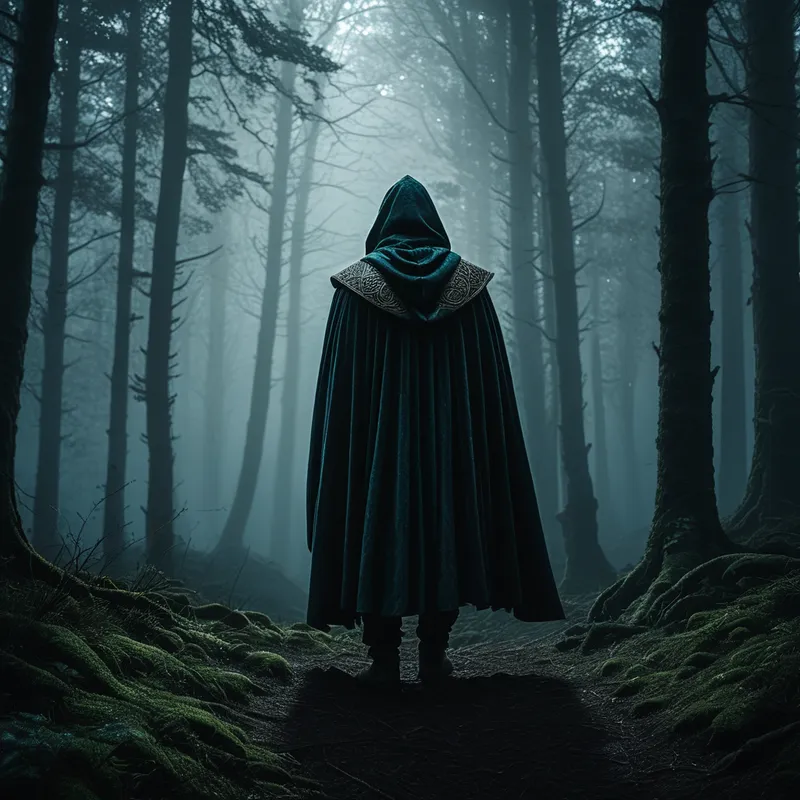
The Tarnkappe Myth Meaning & Symbolism
A myth of a magical cloak granting invisibility, revealing the profound psychological price and power of confronting one's hidden, shadow self.
The Tale of The Tarnkappe
Listen, and let the fire’s crackle become the whisper of wind through the Yggdrasil’s highest boughs. This is not a tale of thunder, but of silence. Not of the hammer’s blow, but of the shadow it casts.
In the deep, resin-scented forests of Midgard, where sunlight fell in dappled, broken coins upon the moss, there walked a figure whose name was often spoken in the same breath as a sigh. He was a hero, yes, but of a different mettle. His battles were not always against giants or serpents, but against the unseen currents of fate and the heavy cloak of his own lineage. He carried a burden, a legacy that was both gift and curse, a lineage that tied him to the Æsir yet bound him to the earth.
His quest was one of reclamation. A treasure, not of gold, but of essence, had been taken, hidden away in a hall that stood at the edge of knowing, guarded by a being whose sight was as sharp as winter ice. To walk openly was to fail. To be seen was to be shattered. He needed to become a ghost in the world of the living, to move as a thought moves through the mind—present, potent, but utterly unseen.
His path led him to a forge that was not lit by fire, but by gloaming. There, masters of craft who understood the substance of darkness and the texture of twilight worked their art. They did not offer him a sword. They offered him a becoming. From the pelt of a beast that dwells where light dies, from the feathers of the raven who is the Allfather’s eyes, from the very breath of mist that rises from cold streams at dusk, they wove it. The Tarnkappe.
It settled on his shoulders not as cloth, but as a second skin of potential. It was the weight of unspoken words, the chill of a forgotten memory. When he drew its hood over his head, the world did not vanish—he did. The rustle of leaves continued, but his footfall made no sound. The guard’s keen eyes swept over him, seeing only the empty space he now occupied. He was a walking secret, a void shaped like a man. He passed through thresholds unseen, his breath the only sound in the silent hall, a ghost reclaiming a piece of his own soul. The triumph was not in battle, but in passage. The victory was the silent return, the treasure secured not by force, but by the profound and unsettling power of not being.

Cultural Origins & Context
The Tarnkappe is a potent motif woven through the broader tapestry of Germanic heroic legend, most famously appearing in the Middle High German Nibelungenlied and associated with the figure of Siegfried (or Sigurd in the Norse Eddic tradition). While not the property of a major deity like Odin’s spear or Thor’s hammer, its power places it firmly in the realm of numinous artifacts, objects that bend the rules of reality. These stories were not scripture, but living breath, passed down by skalds and storytellers in feasting halls, their rhythms paced to the beating of the heart and the drinking horn’s passage.
Its societal function was multifaceted. On one level, it is a classic folkloric “object of power,” fulfilling a narrative need for stealth and supernatural aid. On a deeper level, it spoke to a culture intimately familiar with concealment and revelation. In the long, dark winters, the unseen was a constant companion—the hidden predator, the spirit in the forest, the obscured path. The Tarnkappe mythologized this experience, transforming the fear of the unseen into a tool that could be mastered. It also reflected a keen understanding of social and psychological dynamics: the power of the outsider, the advantage of the overlooked, and the profound transformation that occurs when one steps outside the visible bounds of their prescribed role.
Symbolic Architecture
The Tarnkappe is far more than a plot device. It is a perfect symbol for the psychological shadow—all that we are, but do not wish to see, or do not dare to show. To don the cloak is to consciously enter the shadow realm, to become one with the disowned, hidden, and often potent aspects of the self.
The cloak does not make the hero disappear from the world; it makes the world disappear from the hero, forcing a confrontation with the raw, unadorned self.
The hero’s use of the cloak is never for trivial ends. It is employed for a critical mission: to reclaim a treasure (wholeness), to pass a guardian (the conscious ego’s defenses), or to survive an otherwise impossible ordeal. This mirrors the psychological truth that engaging with our shadow is not an act of vanity, but of necessity for growth. The cloak itself is ambivalent—it grants immense power (insight, freedom from persona), but at a cost. The wearer is isolated, unseen, cut off from the comforting illusions of social recognition. They must operate from a place of pure interiority, where motive and action are one, unmediated by the gaze of others.

The Dreamer's Resonance
When this mythic pattern stirs in the modern dreamer, it signals a profound somatic and psychological process: the activation of the shadow and the negotiation of personal invisibility. To dream of possessing or wearing a cloak of invisibility often arises when one feels chronically overlooked, powerless, or when harboring a secret self that feels too dangerous to expose.
The somatic experience might be one of simultaneous lightness (freedom from scrutiny) and a chilling, existential cold (the isolation of the unseen). The dreamer may find themselves moving through familiar spaces—a workplace, a family home—utterly unnoticed, a ghost in their own life. This is not a fantasy of escape, but a psyche-initiated drill. It is the unconscious forcing an experience of what it feels like to operate from the shadow position. The process asks: What parts of you have you made invisible to survive? What power resides in that hidden place? And what is the treasure—the authentic feeling, the unexpressed talent, the buried truth—that you are now able to retrieve because no one is watching?

Alchemical Translation
The journey of the Tarnkappe is a precise model for the alchemical stage of nigredo, the blackening, and the subsequent transmutation in the individuation process. The first, voluntary step into the shadow (donning the cloak) is the descent into the prima materia—the chaotic, dark base matter of the soul. It feels like a loss of identity, a dissolution of the prized persona.
The act of becoming invisible to the world is the precondition for becoming visible to oneself.
The silent passage past the guardian represents the confrontation with the ego’s defenses—the internal critic, the fear of shame, the attachment to a pleasing self-image—which must be bypassed not through battle, but through stealthy, patient self-observation. The retrieval of the treasure is the integration of a shadow content: perhaps a fierce anger that transforms into healthy boundaries, a vulnerable sadness that becomes empathy, or a “unheroic” cunning that evolves into strategic wisdom.
Finally, the hero must remove the cloak. This is critical. Permanent invisibility is psychosis, not individuation. The alchemical translation is complete only when the reclaimed treasure—now transformed by its journey through the shadow—is brought back into the light of day and integrated into the conscious personality. The wearer returns, visible once more, but fundamentally altered. They have learned to wield the power of the unseen not to vanish, but to move through the visible world with greater depth, authenticity, and sovereignty. The Tarnkappe is not a garment to live in, but a tool for the most sacred of journeys: the one that leads back to the hidden heart of the self.
Associated Symbols
Explore related symbols from the CaleaDream lexicon: