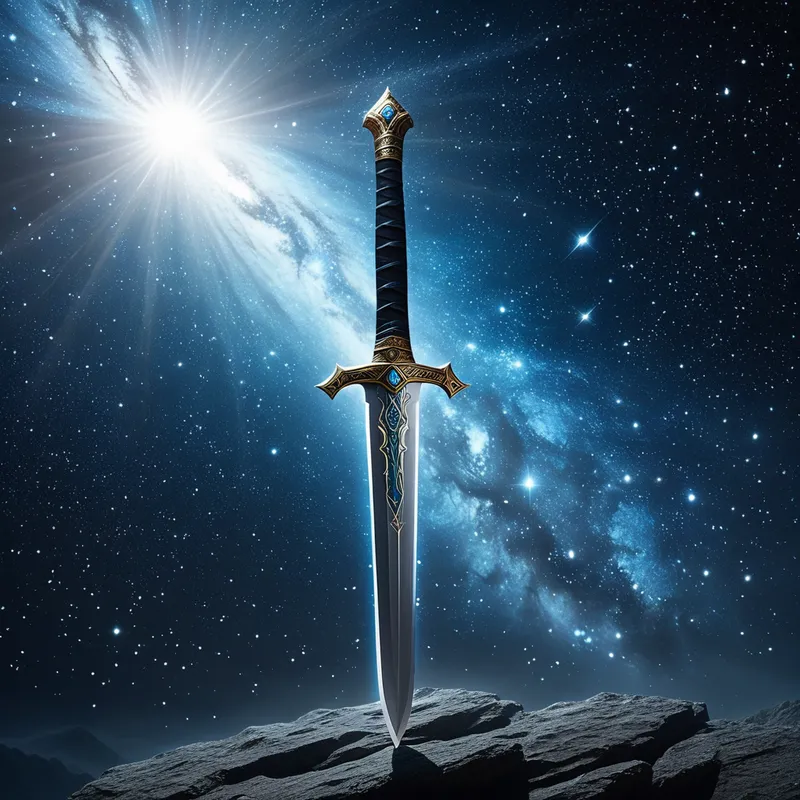
The Sword of the Spirit Myth Meaning & Symbolism
A divine weapon of living truth, forged from the Word itself, wielded to discern reality from illusion and liberate the soul from inner bondage.
The Tale of The Sword of the Spirit
Listen, and hear the tale of the weapon not forged in any earthly fire.
In the beginning was the Word, and the Word was with God, and the Word was God. From this primordial utterance, from this vibration that spun stars into being, a principle was crystallized. Not a blade of iron, but a blade of living truth. It was placed in the armory of the heavens, a weapon for a warfare not of flesh and blood, but against principalities, against powers, against the rulers of the darkness of this age.
The stage is the human heart, a contested kingdom. Shadows whisper there—the serpent’s old lies of separation, the chilling voice of accusation, the seductive murmur of despair that calls reality a prison with no key. These are the rulers of the air, and they build fortresses of thought, high walls of illusion that keep the soul in a dim twilight, mistaking the cage for the world.
Then comes the bearer. Not always a warrior in gleaming armor, but often one weary, wrestling in the midnight garden of their own soul. They stand in the arena of temptation, or in the cold cell of persecution, or simply in the quiet agony of doubt. And in that moment of supreme crisis, when the shadows congeal and press close, they remember. They reach not for a hilt of steel, but into the very fabric of their faith. They grasp the promise. They utter the declaration.
And it appears—not in the hand, but as the hand, as an extension of their very spirit. The Sword of the Spirit, which is the Word of God. It does not gleam with reflected light; it is light, a sharp, living clarity that cuts the air itself. It makes no sound as it swings, yet its passage is a silent thunder that unravels lies. Where it points, confusion dissipates. Where it strikes, binding cords of fear snap. It does not slay flesh, but it slays falsehood. It is the ultimate discernment, separating soul from spirit, joint from marrow, the real from the illusory.
With this sword, the bearer stands. The whispering shadows shriek and recoil, for they cannot endure the utterance of pure truth. The fortress walls of "I am not enough" or "You are alone" crumble into dust before its unwavering edge. The battle ends not with an enemy's death, but with the bearer's liberation, standing in a cleared space, breathing the free air of a truer reality. The sword then fades, having done its work, leaving behind not a wound, but a scar of remembrance, and a heart armed with its echo.
Cultural Origins & Context
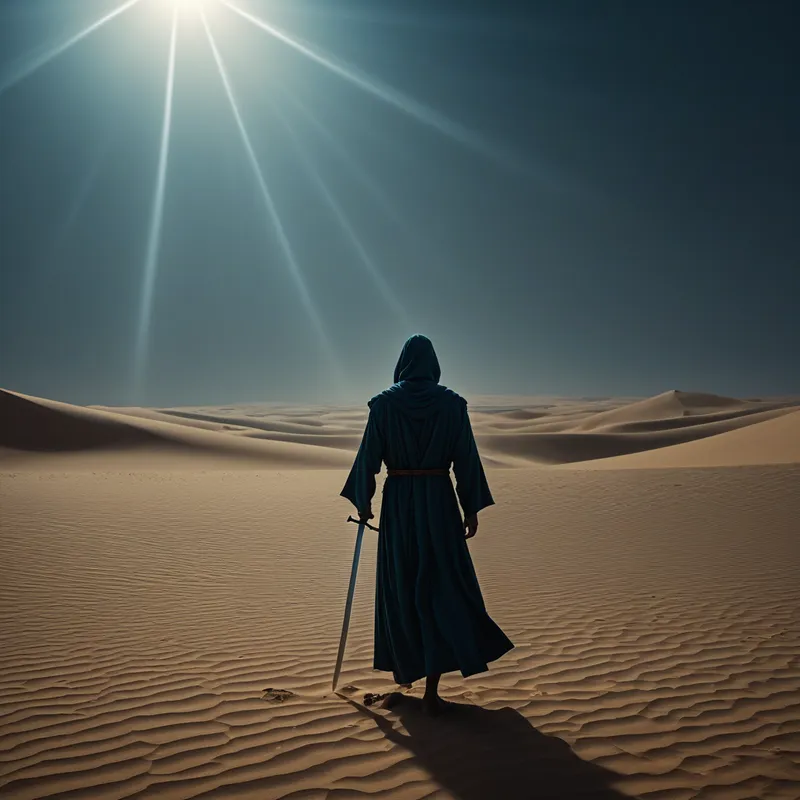
This mythic image finds its primary source in the Pauline epistles of the New Testament, specifically the Letter to the Ephesians. Written in the first century CE, it forms part of the "Armor of God" passage—a metaphorical kit for spiritual endurance. Its cultural function was multifaceted. For early Christian communities facing social ostracism and periodic persecution, it provided a powerful internal narrative: their struggle was not against Roman authorities or hostile neighbors per se, but against a cosmic, spiritual disorder. The "sword" was the only offensive weapon in an otherwise defensive set of armor (belt, breastplate, shield, helmet), indicating that the active proclamation and application of divine truth was their means of advancing, not just enduring.
It was passed down through homilies, catechisms, and art. Medieval knights saw it as sanctifying their warrior ethos, while mystics like Teresa of Ávila internalized it as the weapon of contemplative prayer, cutting through distractions to union with the divine. Its societal function was to create a resilient psychological identity. By framing their experience through this myth, believers could transmute victimhood into a purposeful, heroic struggle, armed with an invincible, spiritual weapon.
Symbolic Architecture
Psychologically, the Sword of the Spirit represents the faculty of discernment raised to its highest, most active power. It is not merely analysis; it is the courageous application of a foundational truth to disintegrate a psychic complex.
The sword does not create truth; it is truth in its active, penetrating, and liberating form.
The "Word" (Logos) is the structuring principle of reality. Thus, the sword symbolizes the moment an individual aligns their consciousness with a reality deeper than their personal fears, biases, or societal conditioning. The "enemies" are the autonomous complexes and shadow elements: internalized voices of the critic, the addict, the coward, the tyrant. These entities hold power only through the falsehood of their claims. The sword's stroke is the realization "This is not who I am," or "This thought does not define my reality."
The hero is the ego, momentarily transcending its smallness to wield a tool of the Self. The setting—the heart, the desert, the prison—is the isolated, conflicted psyche itself.
The Dreamer's Resonance
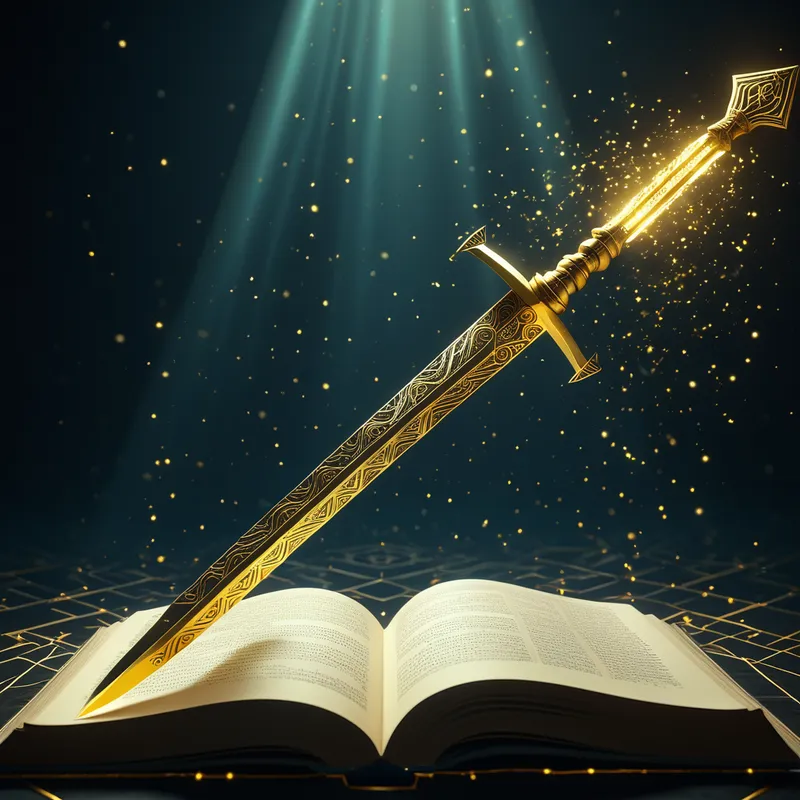
When this myth surfaces in modern dreams, the dreamer is likely in a critical phase of differentiation or confronting a pervasive life-lie. One might dream of finding a glowing knife that cuts through webs, a key that is also a blade, or using a beam of focused light to dispel a fog.
Somatically, this can correlate with a felt sense of constriction in the chest or throat (the fortress) giving way to a sudden, deep breath of relief and expansion upon "wielding the sword." Psychologically, the process is one of moving from passive suffering to active engagement with an internal conflict. The shadowy adversaries in the dream—often faceless figures, monsters of mist, or seductive but hollow forms—represent psychic contents that have remained unchallenged. The act of finding and using the sword signifies the ego gathering enough strength from the Self's resources (inner truth, core values, forgotten wisdom) to confront and dispel these elements. It is the dream-ego's first, decisive step in shadow-work.

Alchemical Translation
The alchemical process mirrored here is separatio—the crucial operation of distinguishing the essential from the dross, the true gold from the base matter of the psyche. The myth models the individuation journey's most decisive turn: from being shaped by unconscious complexes to consciously engaging with them.
The ore of the personality is heated in the furnace of crisis. The Sword of the Spirit is the tool that performs the cut, liberating the nascent, authentic self from the slag of internalized falsehoods.
First, there is identification with the prison (the ego believes the limiting complex is "me"). Then, through grace, crisis, or deep work, comes the recollection of the sword (the latent connection to the Self, the Logos principle within). The wielding is the terrifying, exhilarating act of applying a transcendent truth to a personal pain. "I am not my failure." "My worth is not contingent." This is the rubedo, the reddening—not a bloody battle, but the infusion of conscious, courageous life.
The triumph is not the destruction of the unconscious, but the establishment of a conscious relationship with it. The shadows that fled are not annihilated; they are stripped of their illegitimate authority and can later be integrated. The individual is left standing, not as a conqueror over a dead foe, but as a liberated sovereign in their own psyche, having used the ultimate tool of discernment to carve out a space for genuine, self-authored life. The sword, thereafter, remains as an ever-available function of the differentiated spirit—the capacity to cut through illusion and choose reality, again and again.
Associated Symbols
Explore related symbols from the CaleaDream lexicon: