The Sword of Ali Myth Meaning & Symbolism
The tale of the legendary sword Zulfiqar, gifted to Ali ibn Abi Talib, embodying divine justice, spiritual sovereignty, and the cleaving of falsehood from truth.
The Tale of The Sword of Ali
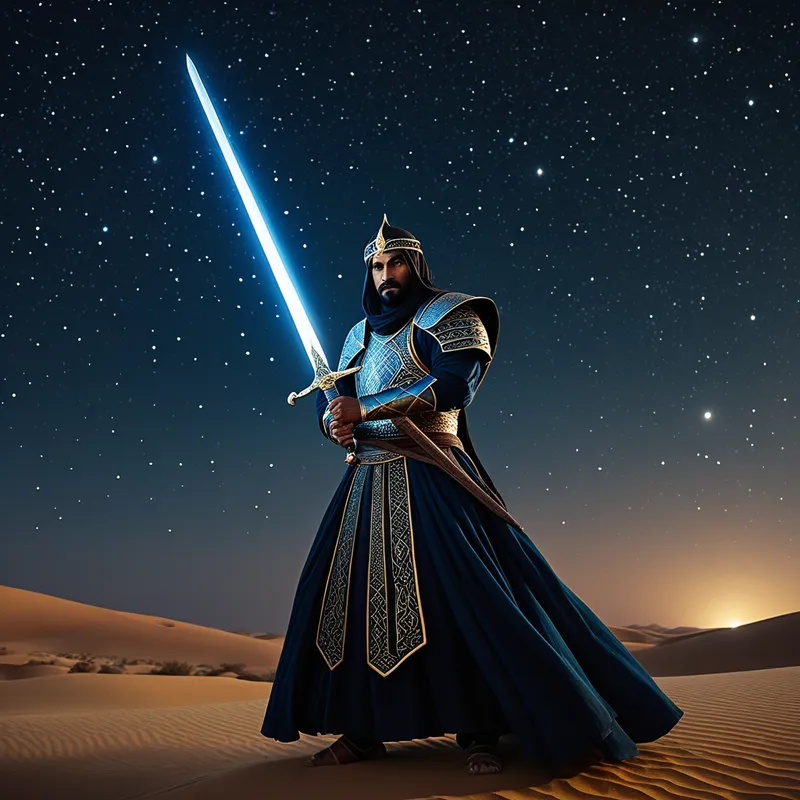
Listen, and let the sands of time part. In the blistering crucible of the desert, where the sun is a hammer and the horizon a mirage, a new dawn was breaking. It was not just a dawn of light, but of revelation. Among the faithful, a lion walked in the form of a man: Ali ibn Abi Talib. His courage was a well-known verse, his faith the bedrock of the nascent community.
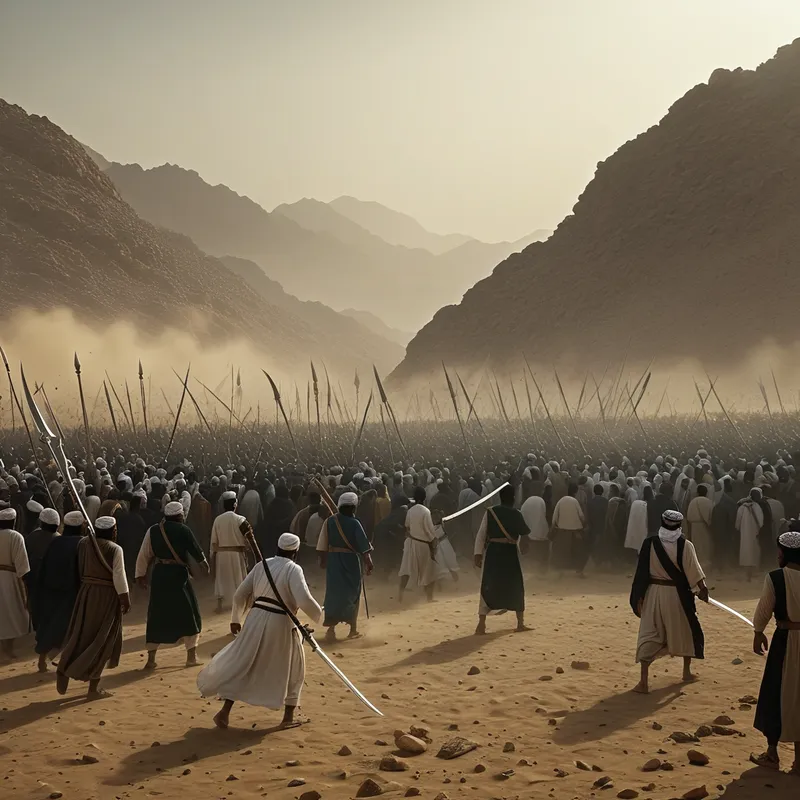
The scene was the Battle of Uhud. The air was thick with the din of clashing iron, the cries of men, and the choking dust of desperation. The tide turned against the believers; the line threatened to shatter. In that moment of supreme trial, the Prophet Muhammad, peace be upon him, stood as a mountain of calm. He saw Ali, his sword broken, his resolve unbroken.
From his own hand, the Prophet passed a weapon. This was no ordinary blade. It was Zulfiqar. Forged in a legend beyond mortal smiths, its blade was said to be split at the tip into two distinct points, a divine bifurcation. As Ali grasped its hilt, a transformation occurred. The weight of the sword was not of steel, but of covenant. A light, some say, emanated from its edge—not a light that blinds, but one that reveals.
Ali turned to the fray. Before him stood a champion of the opposing force, clad in formidable armor, a symbol of brute opposition. With Zulfiqar in hand, Ali did not merely strike; he enacted a principle. The legendary stroke is sung in poetry and history: with one blow, he cleaved the warrior, his armor, and the shield he held—all were split asunder. The blow was so profound, so final, that it echoed beyond the battlefield into the realm of myth. It was said the sword itself cried out, “La fata illa Ali, la saif illa Zulfiqar!” — “There is no hero but Ali, no sword but Zulfiqar!”
The sword became an extension of his arm, a manifestation of a divine mandate for justice. It was not an instrument of rage, but of precise, terrifying discernment. It did not conquer for the sake of dominion, but to cut through the darkness of oppression and falsehood. In the hands of Ali, Zulfiqar was the physical expression of a truth that separates reality from illusion, right from wrong, with the finality of a lightning strike in the desert night. The battle’s outcome was sealed, not just by force of arms, but by the appearance of a symbol that would forever mark the spiritual landscape.
Cultural Origins & Context
The story of Zulfiqar is deeply embedded in the early history of Islam and the profound reverence for Ahl al-Bayt. It originates from historical accounts of the 7th century, primarily within Islamic historiographical and hadith traditions. The narrative was not confined to dry chronicles; it was breathed into life by storytellers (qussas), poets, and later, by mystical (Sufi) orders. It was passed down in mosques, in market squares, and in the intimate gatherings of devotees.
Its societal function was multifaceted. Historically, it cemented the legendary status of Ali as the paragon of chivalry (futuwwa) and martial virtue. Spiritually, especially within Shia Islam, Zulfiqar became a potent emblem of Ali’s divine right to leadership (Imamah) and his role as the defender of the faith. The sword transcended its physicality to become a symbol of spiritual sovereignty and the enduring struggle (jihad) against injustice. In popular culture, depictions of Zulfiqar adorned banners, talismans, and jewelry, serving as a protective symbol and a reminder of a heroic ideal that balanced immense power with unwavering piety.
Symbolic Architecture
At its core, Zulfiqar is not merely a [weapon](/symbols/weapon “Symbol: A weapon in dreams often symbolizes power, aggression, and the need for protection or defense.”/), but a metaphysical [instrument](/symbols/instrument “Symbol: An instrument symbolizes creativity, communication, and the means by which one expresses oneself or influences the world.”/). Its most striking feature—the forked or double-pointed [blade](/symbols/blade “Symbol: A sharp-edged tool or weapon symbolizing cutting action, separation, precision, or violence. It represents both creative power and destructive force.”/)—is its primary [symbol](/symbols/symbol “Symbol: A symbol can represent an idea, concept, or belief, serving as a powerful tool for communication and understanding.”/). This [bifurcation](/symbols/bifurcation “Symbol: A fork, split, or division representing a critical choice, duality, or the branching of paths in life or consciousness.”/) represents divine discernment. It is the [capacity](/symbols/capacity “Symbol: A measure of one’s potential, limits, or ability to contain, process, or achieve something, often reflecting self-assessment or external demands.”/) to make critical distinctions, to separate [truth](/symbols/truth “Symbol: Truth represents authenticity, honesty, and the quest for knowledge beyond mere appearances.”/) from falsehood, essence from [appearance](/symbols/appearance “Symbol: Appearance in dreams relates to self-image, perception, and how you present yourself to the world.”/), justice from tyranny.
The sword does not create the division; it reveals the division that already exists. It is the agent of a cosmic clarity.
Ali, as the wielder, symbolizes the integrated [human](/symbols/human “Symbol: The symbol of a human represents individuality, complexity of emotions, and social relationships.”/) who has aligned his will with a transcendent principle. He is the al-Insān al-Kāmil in [action](/symbols/action “Symbol: Action in dreams represents the drive for agency, motivation, and the ability to take control of situations in waking life.”/). The sword, therefore, is an extension of his spiritual state. The broken sword he discards represents outmoded forms of [strength](/symbols/strength “Symbol: ‘Strength’ symbolizes resilience, courage, and the ability to overcome challenges.”/), ego-based power that fails under ultimate pressure. Zulfiqar is gifted, not taken, symbolizing that true [authority](/symbols/authority “Symbol: A symbol representing power structures, rules, and control, often reflecting one’s relationship with societal or personal governance.”/) and capability are bestowed from a higher [source](/symbols/source “Symbol: The origin point of something, often representing beginnings, nourishment, or the fundamental cause behind phenomena.”/) when the individual is prepared and positioned correctly. The act of cleaving the armored [warrior](/symbols/warrior “Symbol: A spiritual archetype representing inner strength, discipline, and the struggle for higher purpose or self-mastery.”/) is a powerful [image](/symbols/image “Symbol: An image represents perception, memories, and the visual narratives we create in our minds.”/) of penetrating illusion. The [armor](/symbols/armor “Symbol: Armor represents psychological protection, emotional defense, and the persona presented to the world. It symbolizes both safety and the barriers that separate us from vulnerability.”/) is the hardened [defense](/symbols/defense “Symbol: A protective mechanism or barrier against perceived threats, representing boundaries, security, and resistance to external or internal challenges.”/) of dogma, pride, or false [identity](/symbols/identity “Symbol: Identity represents the sense of self, encompassing personal beliefs, cultural background, and social roles.”/); Zulfiqar cuts through to the vulnerable truth beneath.

The Dreamer’s Resonance
When the myth of the Sword of Ali surfaces in modern dreams, it often signals a profound interior crisis requiring decisive action and supreme discernment. The dreamer may not see a literal sword, but feel its presence: a sharp, clarifying pressure in a situation of moral or psychological confusion.
Somatically, one might dream of a heavy, potent object in the hand, or a sudden, clean sensation of cutting through a tangled, oppressive mass. Psychologically, this myth activates when the dreamer faces a “battle of Uhud” within—a point where internal or external pressures threaten to overwhelm their core values or integrity. The dream presents the archetype of the sword as an innate resource. It suggests the psyche is ready to discard a “broken sword”—an ineffective coping mechanism, a compromised belief, or a passive stance—and accept a more potent, spiritually-aligned power. The dream is an invitation to wield discernment, to make the difficult cut that separates one from a toxic relationship, a self-deceiving narrative, or an unjust situation. There is often accompanying anxiety, for to wield such a sword is to accept the responsibility and isolation of a truth-teller.
Alchemical Translation
The alchemical process modeled here is that of separatio—the crucial stage of separation and purification. In the laboratory of the soul, the prima materia (the chaotic raw material of the psyche) must be subjected to the sword’s edge.
Individuation demands we become our own Ali, discerning what in us belongs to the eternal Self and what belongs to the temporal, armored persona.
The “battlefield” is the conflicted landscape of our own lives. The “broken sword” is the ego’s initial attempt at control, which inevitably fails when faced with the shadow or the Self. The moment the Prophet (representing the guiding, transcendent function of the Self) gifts Zulfiqar is the moment of grace where a higher pattern intervenes. Accepting the sword is the act of aligning personal will with the archetypal mandate of the Hero. The subsequent “cleaving” is the painful but necessary act of psychic surgery: cutting away inflated fantasies, severing identification with complexes, and dividing conscious attitude from unconscious possession. The goal is not destruction, but liberation. The twin blades ensure the cut is precise, allowing for a discrimination that is just and balanced. Through this process, the base metal of unconscious conflict is transmuted into the gold of conscious integrity. One becomes, in a sense, a vessel for a principled force greater than oneself, capable of enacting justice both inwardly and outwardly.
Associated Symbols
Explore related symbols from the CaleaDream lexicon:
- Weapons (Sword/Axe) — The archetypal instrument of discernment, will, and decisive action, with Zulfiqar representing its most spiritually refined form.
- Hero — Ali embodies this archetype, not through seeking glory, but through his unwavering commitment to justice and his role as the divinely-supported champion.
- Light — The celestial glow often associated with Zulfiqar represents divine truth, illuminating the correct path and revealing hidden realities in the darkness of conflict.
- Shadow — The armored warrior cleaved by Ali represents the confronting and integrating of the shadow—the dense, resistant aspects of falsehood and opposition, both internal and external.
- Justice — The core principle enacted by the sword, representing the cosmic law that demands truth be separated from falsehood and balance be restored.
- Mountain — Symbolizes the unwavering faith and steadfastness of Ali, and the monumental challenges that require a heroic, principled stand.
- Thunder — The resounding, awe-inspiring impact of Zulfiqar’s stroke, representing a sudden, transformative revelation or a decisive act that changes the spiritual landscape.
- Vision — The gift of the sword is preceded by the Prophet’s discernment, representing the higher vision or insight required to know when and to whom true power should be entrusted.
- Warrior — The spiritual warrior who fights not for conquest, but for the protection of truth and the community, with discipline and piety.
- Chaos — The battlefield of Uhud represents the chaotic forces of conflict and doubt that the ordered, clarifying principle of the sword must confront and master.
- Order — The principle embodied by Zulfiqar and its wielder, representing the divine law and structure that is imposed upon chaos through righteous action and discernment.
- Destiny — The sword is an instrument of fate, marking Ali’s preordained role and representing the moment an individual steps fully into their archetypal purpose.