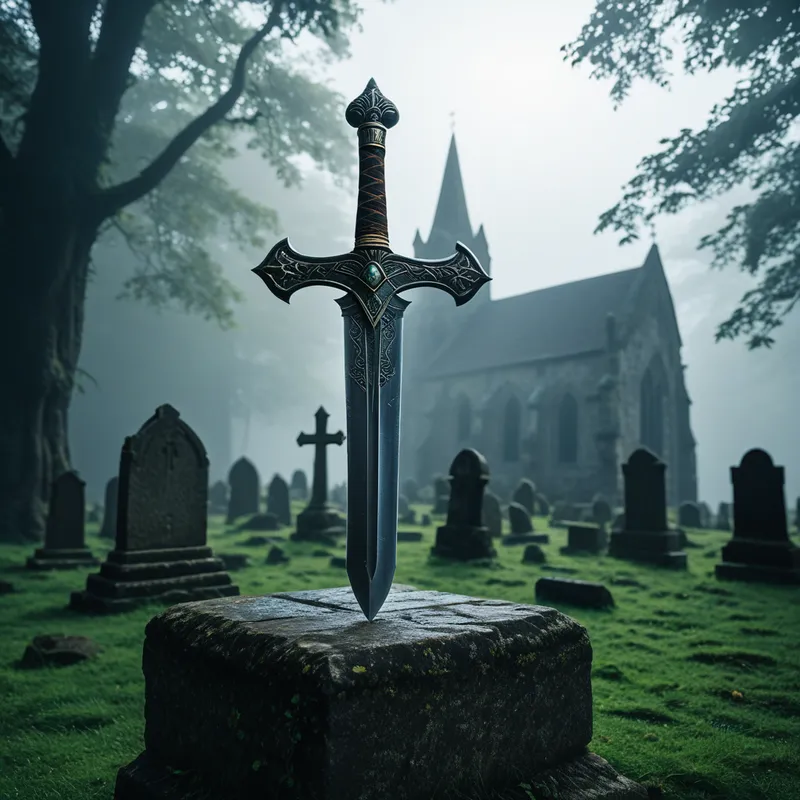
The Sword in the Stone Myth Meaning & Symbolism
A sword, embedded in an anvil upon a stone, awaits the one with the rightful heart to draw it, proving a kingdom's true sovereign.
The Tale of The Sword in the Stone
Listen, and hear a tale of a land adrift. The king was dead, and with him, the old law. A cold wind of ambition and sorrow swept across the isles. The great lords, clad in steel and pride, gathered in the old city of London, their voices a clamor of discord. They sought a sign, a miracle, for only a wonder could unite a broken people.
And a wonder appeared.
On Christmas morn, in the churchyard of the greatest church, the people found a marvel that stilled all tongues. A great square stone of marble, like an altar from a forgotten age, stood where no stone had been. And upon it sat a heavy anvil of iron. And through the anvil and into the heart of the stone was thrust a splendid sword. The winter sun caught its pommel, a jewel of clear light, and on the golden hilt were written words in letters of fire: Whoso pulleth out this sword of this stone and anvil, is rightwise king born of all England.
A great cry went up! The mightiest dukes and boldest barons pushed forward. First came the proud, their hands strong from war. They gripped the hilt, strained until the veins stood out on their necks, and pulled with all their worldly might. The sword did not stir. It was as if the stone had grown roots to the center of [the earth](/myths/the-earth “Myth from Hindu culture.”/). Then came the cunning, who tried to twist and lever it. The sword remained, unmoved and mocking. Then the desperate, who prayed and wept as they pulled. Still, it held fast. The hope that had bloomed like a winter rose began to wither into despair. The sword remained, a beautiful, unyielding promise, while the land grew colder.
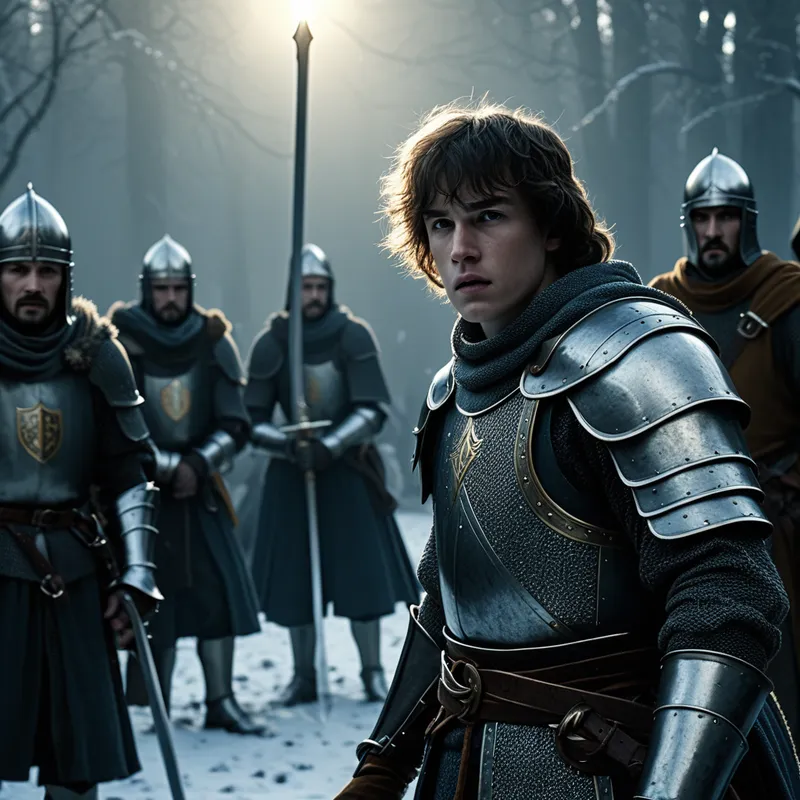
The tale turns to a forgotten boy, a ward serving a kind knight. His name was Arthur. On the day of a great tournament, a tournament meant to find a king by strength of arms, this boy was tasked with fetching a sword for his foster-brother. In haste, he came upon the silent churchyard and the stone. Seeing no one to ask, and thinking only of his duty, he walked to the anvil. He knew the legend, but in that moment, it was not a test of kingship, but a simple solution to a forgotten sword. He placed his hand on the cold hilt.
There was no strain. No epic struggle. It was as if the sword had been waiting only for this touch, for this unassuming hand. It slid forth from its stony womb with a sound like a sigh of release, a clear, sweet note that sang of rightness. He stood there, a boy holding a kingdom, the weight of destiny settling on his shoulders as lightly and terribly as a crown.
Cultural Origins & Context
The story of the Sword in the Stone is most famously crystallized in the Arthurian legends of medieval Britain, particularly in the works of writers like Sir [Thomas](/myths/thomas “Myth from Christian culture.”/) Malory in Le Morte d’Arthur and earlier in Robert de Boron’s [Merlin](/myths/merlin “Myth from Arthurian culture.”/). However, its roots tap into a universal, primordial pattern far older than [the knights of the Round Table](/myths/the-knights-of-the-round-table “Myth from Arthurian culture.”/).
This is a myth of sacral kingship. Across Indo-European cultures, from the Celtic lands to Scandinavia and India, the rightful ruler is not merely the strongest, but the one chosen by the land itself, or by the gods. The sword in the stone functions as a divine ordeal, a mechanism that bypasses human politics and bloodline arguments to reveal a deeper, spiritual legitimacy. It was a story told in courts and by firesides to explain the mystery of true authority: why one person, and not another, can hold the fragile peace of a nation. It served as societal wish-fulfillment and divine justification, assuring people that their ruler was not an accident of birth or violence, but the manifest will of a deeper order.
Symbolic Architecture
The myth’s power lies in its stark, alchemical [symbolism](/symbols/symbolism “Symbol: The use of symbols to represent ideas or qualities, often conveying deeper meanings beyond literal interpretation. In dreams, it’s the language of the unconscious.”/). Each element is a [piece](/symbols/piece “Symbol: A ‘piece’ in dreams often symbolizes a fragment of the self or a situation that requires integration, reflection, or understanding.”/) of a profound psychological [puzzle](/symbols/puzzle “Symbol: A symbol representing the challenge of solving complex problems, finding order in chaos, or assembling fragmented aspects of self or reality.”/).
The [Stone](/symbols/stone “Symbol: In dreams, a stone often symbolizes strength, stability, and permanence, but it may also represent emotional burdens or obstacles that need to be acknowledged and processed.”/) represents the unconscious, the collective, and the unyielding [weight](/symbols/weight “Symbol: Weight symbolizes burdens, responsibilities, and emotional loads one carries in life.”/) of tradition and [the world](/myths/the-world “Myth from Tarot culture.”/)-as-it-is. It is the hardened [reality](/symbols/reality “Symbol: Reality signifies the state of existence and perception, often reflecting one’s understanding of truth and life experiences.”/) of our circumstances, our familial patterns, and the dormant potential within the [psyche](/myths/psyche “Myth from Greek culture.”/). The Anvil placed upon it signifies the transformative [crucible](/symbols/crucible “Symbol: A vessel for intense transformation through heat and pressure, symbolizing spiritual purification, testing, and alchemical change.”/), the point where will meets [destiny](/symbols/destiny “Symbol: A predetermined course of events or ultimate purpose, often linked to spiritual forces or cosmic order, representing life’s inherent direction.”/) and is shaped. The Sword is pure, focused [consciousness](/symbols/consciousness “Symbol: Consciousness represents the state of awareness and perception, encompassing thoughts, feelings, and experiences.”/)—the will, [truth](/symbols/truth “Symbol: Truth represents authenticity, honesty, and the quest for knowledge beyond mere appearances.”/), and the penetrating power of discernment. It is the individual [spirit](/symbols/spirit “Symbol: Spirit symbolizes the essence of life, vitality, and the spiritual journey of the individual.”/), the “[logos](/myths/logos “Myth from Christian culture.”/)” that can cut through [confusion](/symbols/confusion “Symbol: A state of mental uncertainty or disorientation, often reflecting internal conflict, lack of clarity, or overwhelming choices in waking life.”/) and illusion.
The sword is not pulled by force, but by fitness. It is not claimed; it recognizes its claimant.
Thus, the act of drawing the sword is not a feat of physical [strength](/symbols/strength “Symbol: ‘Strength’ symbolizes resilience, courage, and the ability to overcome challenges.”/), but an act of sympathetic [resonance](/symbols/resonance “Symbol: A deep, sympathetic vibration or connection, often in sound or feeling, that amplifies and harmonizes across systems.”/). Arthur’s success lies in his state of being—his [innocence](/symbols/innocence “Symbol: A state of purity, naivety, and freedom from guilt or corruption, often associated with childhood and moral simplicity.”/), his lack of calculated ambition, his pure intent focused on service (fetching the sword for another). He is the [puer aeternus](/symbols/puer-aeternus “Symbol: The eternal youth archetype representing perpetual adolescence, divine child energy, and resistance to mature adulthood.”/) who has not yet been corrupted by the [persona](/symbols/persona “Symbol: The social mask or outward identity one presents to the world, often concealing the true self.”/) of ambition. The sword responds to this inner alignment, this “rightwise” [heart](/symbols/heart “Symbol: The heart symbolizes love, emotion, and the core of one’s existence, representing deep connections with others and self.”/). The myth tells us that true sovereignty—over a [kingdom](/symbols/kingdom “Symbol: A kingdom symbolizes authority, belonging, and a sense of identity within a larger context or community.”/) or one’s own [life](/symbols/life “Symbol: The symbol of ‘Life’ represents a journey of growth, interconnectedness, and existential meaning, encompassing both the joys and challenges that define human experience.”/)—begins with an inner [condition](/symbols/condition “Symbol: Condition reflects the state of being, often focusing on physical, emotional, or situational aspects of life.”/) of integrity, not an outer display of power.
The Dreamer’s Resonance
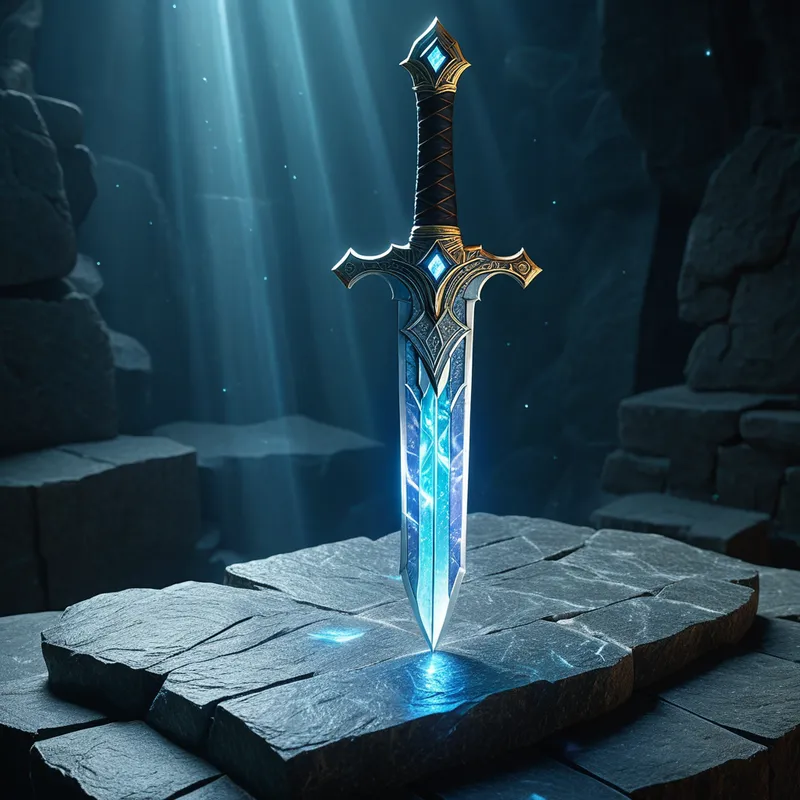
When this myth stirs in the modern dreamscape, it often appears at a crossroads of identity and purpose. To dream of the sword in the stone is to feel the call to claim an aspect of your own authority that feels locked away, integrated into the stony ground of your history or self-doubt.
You may dream of standing before the stone, feeling its cold, imposing presence. The somatic experience is key: the feeling of your hand on the hilt, the tension in your arm and back as you pull, and the subsequent rush of either failure (the sword stuck fast) or astonishing, effortless success. The former speaks to a perceived misalignment—perhaps you are trying to claim a power through ego (“I should be king”) rather than through authentic selfhood. The latter, the successful draw, often accompanies a psychological breakthrough where you have, perhaps unconsciously, integrated a shadow aspect or accepted a difficult truth, thereby becoming “rightwise” for a new phase of life. The shadowy onlookers in the dream are your internalized doubts, parental voices, and societal expectations, witnessing your attempt to redefine yourself.
Alchemical Translation
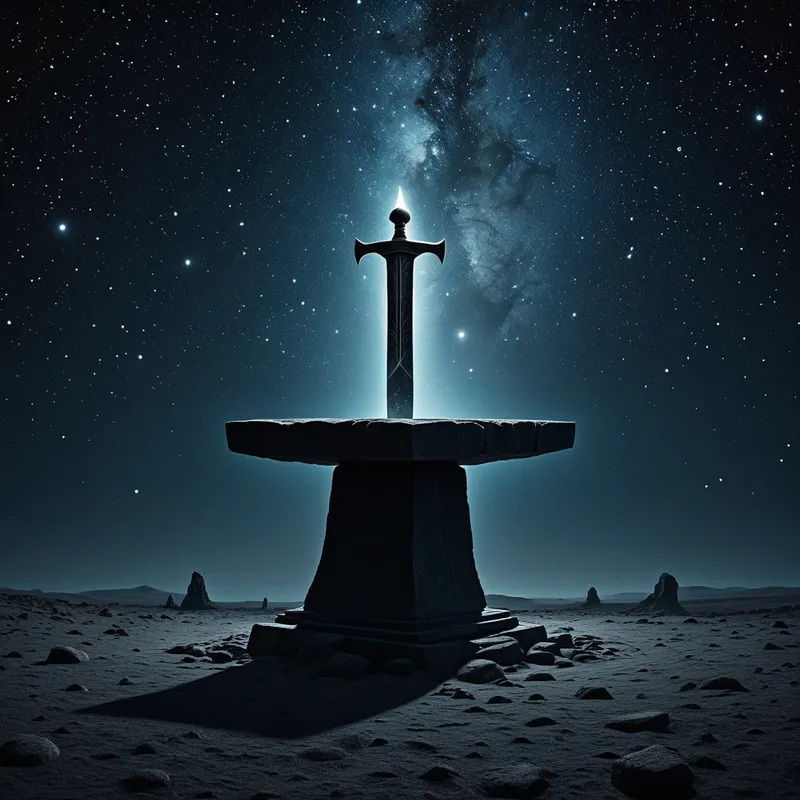
The journey of the Sword in the Stone is a perfect map for the Jungian process of individuation. The stone and anvil represent the initial, confining state of the psyche, where one’s potential (the sword) is trapped in the heavy matter of the personal and collective unconscious. The conscious ego is like the knights who try and fail—it believes willpower and [persona](/myths/persona “Myth from Greek culture.”/) are enough to extract one’s true self.
The alchemical work is not to strengthen the arm, but to transform the heart. One must, like Arthur, move from a state of ego-driven striving to one of humble service to [the Self](/myths/the-self “Myth from Jungian culture.”/). This often means attending to the forgotten, menial tasks of the soul (Arthur’s errand) with sincerity. It is in these acts of psychological honesty that one stumbles upon the central test.
The stone does not release the sword; it releases the sword to the one who has become, through inner work, the rightful container for its power.
Drawing the sword is the moment of psychic transmutation. The inert potential (sword in stone) becomes active, conscious power (sword in hand). This is the claiming of one’s own inner authority, the “kingship” of the Self. The kingdom that is unified is the previously warring factions of the psyche. For the modern individual, this myth does not promise a crown, but something far more precious: the realization that your unique power and purpose are not granted by the world, but are waiting, embedded in the very core of your being, to be recognized and claimed by the one who is, at last, rightly prepared to wield it.
Associated Symbols
Explore related symbols from the CaleaDream lexicon: