The Sword Bridge Myth Meaning & Symbolism
A hero must cross a bridge of a single, impossibly sharp blade to reach a sacred island and fulfill a divine quest, testing his very soul.
The Tale of The Sword Bridge
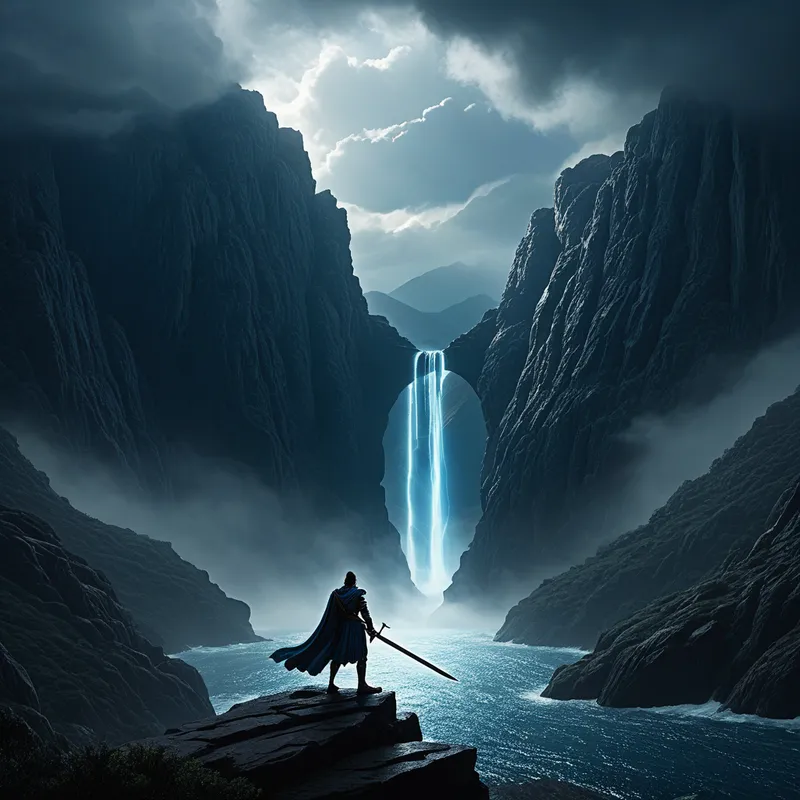
Hear now, and let your spirit still. For I will tell of a crossing not of stone or wood, but of honed purpose and terror. In the age when gods walked closer and the air thrummed with their will, there stood a hero—let us call him Alexandros—burdened by a fate not his own. An oracle, her voice the rustle of dry leaves in a sacred cave, had spoken: to cleanse a great stain upon his lineage, he must retrieve the Hiera Kteis, the Sacred Wedge, from the altar of Hephaestus on the Isle of Tekhnitis.
But the gods do not make gifts of their treasures. To reach the smith-god’s forge-isle, one must cross the Gorge of Diairesis. And across that fathomless black cleft, where winds howled with the voices of forgotten suicides, there lay the only path: the Xiphophoros Gefyra.
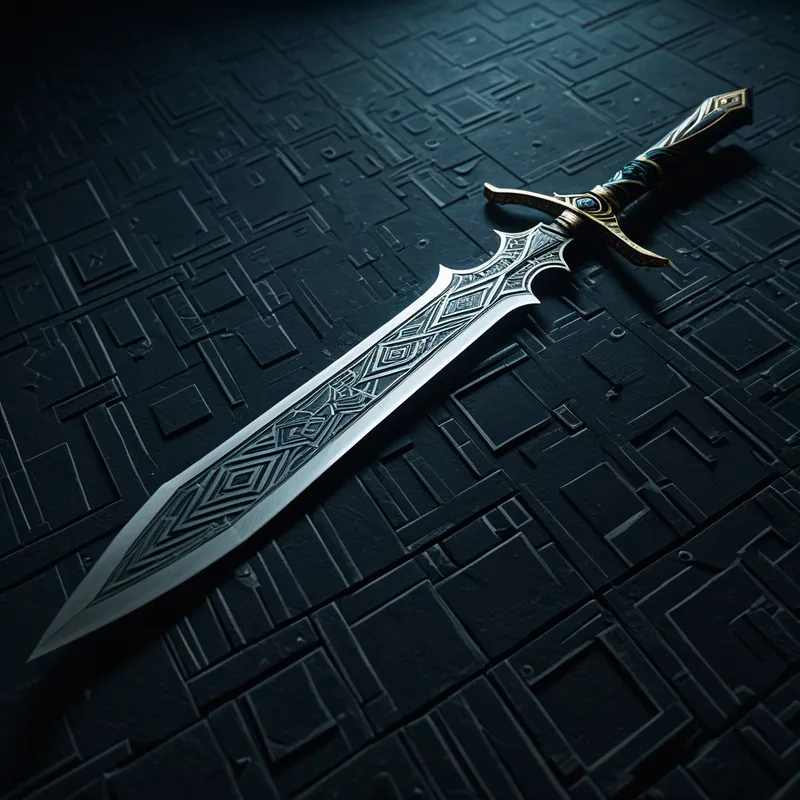
It was no bridge of mortal making. A single blade, wide as two men, yet thin as a thought, forged in a star’s heart and quenched in the river Phlegethon. It spanned the void, gleaming with a cold, blue-white light. Its edge, it was said, could split a falling hair lengthwise. No rail, no gentle slope—only a perfect, razor line against the abyss.
Alexandros stood at its precipice. The cold of the metal seeped into the air, frosting his breath. Below, only darkness and a distant, watery sigh. To look upon the bridge was to feel your own fragility, to see the sharp line that divides being from nothingness. He removed his sandals, feeling the gritty earth, the last comfort of the known world. A prayer died on his lips; this was beyond prayer. This was an agreement made between his soul and the universe.
He placed his right foot upon the edge.
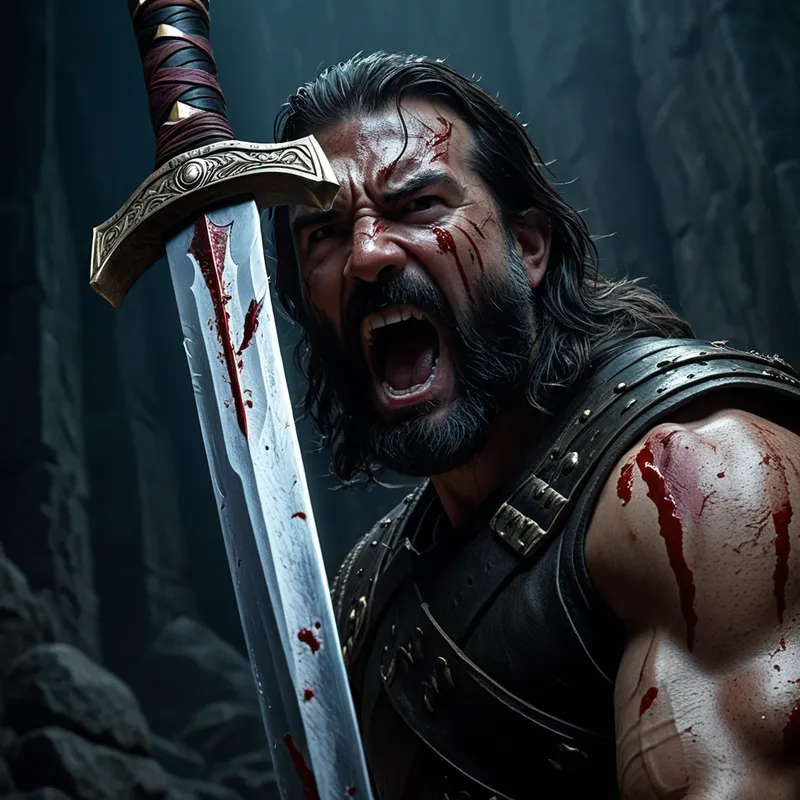
A searing line of fire shot through him. Not just flesh, but memory, doubt, fear—all that was superfluous was pared away. Each step was an eternity of focus. The wind plucked at him. The blade sang a faint, high note beneath his weight. He did not look down. He did not look back. His world contracted to the next inch of gleaming steel, the next breath, the next impossible placement of a bleeding foot. He was not walking on a sword; he was being walked through by it, refined and cut to his essential shape.
Blood traced a delicate path behind him, a crimson testament on the silver line. Time lost meaning. There was only the edge, the agony, and the far shore, a hazy outline in the mist. When his lead foot finally found not cold metal but warm, mossy stone, he collapsed, not in triumph, but in the raw, shuddering silence of one remade. The bridge, behind him, gleamed, indifferent. The Sacred Wedge lay ahead, glowing softly in the dim forge-light. The crossing was complete.
Cultural Origins & Context
The myth of the Sword Bridge is not found in the canonical works of Homer or Hesiod, but emerges from the rich tapestry of later didactic and local cult traditions, particularly those associated with oracular sites like Delphi and hero cults in the Peloponnese. It functions as a aition—a foundational story—for rites of passage and initiation, especially for young warriors and those seeking purification (katharsis).
Told by priests and rhapsodes at festivals honoring heroes or Hermes Psychopompos (guide of souls), its primary societal function was pedagogical and psychological. It served as an allegory for the extreme trials required to transition from one state of being to another: from youth to adulthood, from impurity to purity, from mortal fallibility to a state worthy of divine audience. The bridge was a literalization of the "narrow path" or the "razor’s edge" of righteous action, a concept explored in earlier philosophy but here rendered in visceral, mythic terms.
Symbolic Architecture
The Sword Bridge is a master symbol of the liminal—the threshold itself made manifest. It is not merely an obstacle but the transformative medium.
The bridge does not lead to transformation; the crossing is the transformation.
The Blade represents absolute, uncompromising reality. It is the truth that cuts through illusion, the decisive moment that admits no ambiguity, the keen edge of consciousness itself. It is neutral but lethal to inattention. The Abyss beneath is the unconscious, chaotic, and unformed—the potential for dissolution and madness that underlies all conscious endeavor. The hero, balanced between them, embodies the ego, the "I," attempting to navigate this terrifying interface between cosmic order and chaos.
The act of crossing barefoot is one of ultimate vulnerability and direct contact. There is no mediation, no insulation from the reality of the ordeal. The shed blood is not merely sacrifice but signature; it is the price of passage and the indelible mark of having truly engaged with the foundational sharpness of existence. The journey is one of radical simplification, of being pared down to one’s essential, purposeful core.
The Dreamer's Resonance
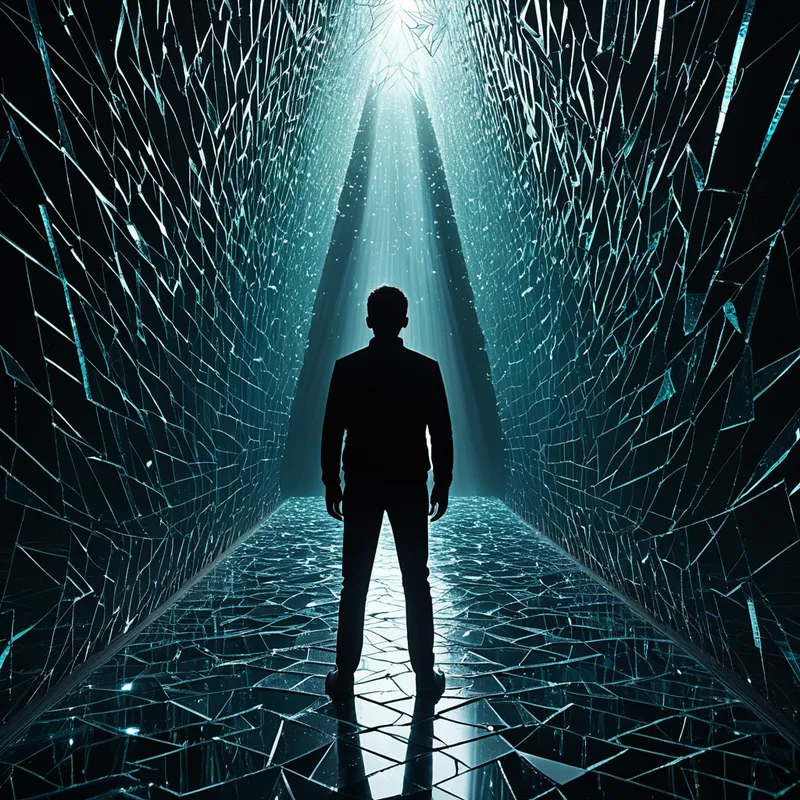
When this myth stirs in the modern unconscious, it often manifests in dreams of precarious crossings: narrow beams over office canyons, ledges on skyscrapers, or literal bridges of glass or light. The somatic feeling is one of acute, focused anxiety—a tightness in the chest and calves, a hyper-awareness of balance. This is the psyche signaling a critical threshold in waking life.
Psychologically, the dreamer is navigating a "sword bridge" scenario: a career decision with no safe middle ground, the terrifying vulnerability of deep emotional commitment, the passage through a health crisis, or the act of speaking a difficult truth that will cut relationships cleanly. The dream rehearses the required state of consciousness. The fear of falling is the fear of psychic disintegration, of failing the test and regressing. The dream’s focus is never the destination, but the quality of attention and the endured tension on the path. To dream of successfully crossing, even in fear, indicates the ego’s capacity to integrate this high-stakes, refining tension.
Alchemical Translation
In the alchemy of the soul, the process of individuation requires a series of such crossings. The Sword Bridge models the separatio and mortificatio stages—the necessary separation from comfortable identifications and the "killing" of the outmoded self.
The ego must consent to walk the edge that will cut it away from its own familiar shape.
The modern individual faces their own Sword Bridge whenever they must enact a value that isolates them, must bear the sharp loneliness of a principled stand, or must commit to a path that feels terrifyingly singular. The "sacred island" is the nascent Self, the wholeness waiting on the other side of the ordeal. The forge of Hephaestus symbolizes the creative, shaping power that can only be accessed after the crossing—we must be cut down to size before we can be remade.
The myth teaches that transcendence is not an escape from reality but a deeper, more painful engagement with it. The bridge is not bypassed; it is traversed. The triumph is not in avoiding the cut, but in understanding that the bleeding is part of the path, and that on the other side, one does not receive a prize so much as become qualified, by ordeal, to receive it. The final alchemical product is not the Sacred Wedge, but the hero who, having crossed the blade, can now hold it.
Associated Symbols
Explore related symbols from the CaleaDream lexicon: