The Alchemy of Initiation: When the Dream Demands You Be Reborn
Initiation is not an event you attend. It is a process you survive. In the dreaming world, it announces itself not with fanfare, but with a deep, somatic tremor—a recognition in the marrow that the ground upon which you’ve built your identity is about to give way. This is the psyche’s most sacred and severe architecture: a ritual of un-becoming so that a more authentic becoming can take root. To dream of initiation is to stand at the threshold where the self you know is invited to die, not for an end, but for a transmutation.
The Somatic Echo
Before the mind conjures a single image, the body knows. It begins as a cold, hollow resonance in the pit of the stomach, a feeling of anticipatory gravity, as if you are being pulled toward a center that is also an abyss. The breath becomes shallow, held in the chest like a secret. There is a metallic taste on the tongue, the taste of ozone before a storm or of old coins—the taste of time and transformation. Muscles tense not with fear of a predator, but with the profound unease of a system preparing for a fundamental rewrite. This is the visceral prelude: the somatic echo of the old structure sensing the arrival of the wrecking ball and the blueprint both.
The Dreamer's Log
The dreamer stands before a full-length mirror, but the reflection is a flawless porcelain mask, not a face. A voice, their own yet not, says, “You must break it to see.” Their hand rises, not in a fist, but with a single, deliberate finger. As they tap the mask, a hairline crack spiderwebs from the point of contact, and through the fissures, they see not bone or blood, but a swirling galaxy of luminous, interconnected nodes.
The alchemical interpretation: The conscious persona (the mask) must be voluntarily fractured to reveal the true, cosmic architecture of the authentic Self.

The False Lead
Do not mistake initiation for mere misfortune or a simple “bad dream.” It is not the chaos of random suffering, but a orchestrated chaos. A nightmare may chase you; an initiation holds the door open and asks you to walk through. The terror is not a sign of error, but of accuracy. The difference lies in the aftermath: a nightmare leaves you shaken in the same world; an initiation, even failed, leaves that world subtly but irrevocably altered. You cannot return to the same mental room. The furniture has been moved.
Psychological Architecture
This is the Shadow work of foundation-laying. Individuation—the process of becoming an integrated, whole Self—requires not just adding new rooms to the house of the psyche, but demolishing load-bearing walls you believed were permanent. Initiation dreams are the blueprints for this demolition. They force a confrontation with the internal family of sub-personalities: the inner Orphan who fears abandonment, the shadow Ruler who demands rigid control, the Caregiver who smothers growth to maintain safety. The initiation ritual in the dream is the psyche’s method of putting this entire system into a state of creative dissolution. The old hierarchies, the old contracts of “this is who I am,” are suspended. In that terrifying, liminal space, you are not who you were, and not yet who you will be. You are pure potential, which feels identical to pure annihilation.
Mythic Resonance
Consider Inanna, the Sumerian goddess, descending through the seven gates of the Underworld. At each gate, a piece of her regalia—her crown, her lapis beads, her royal robe—is stripped away, until she stands naked and bowed before her sister, Ereshkigal, and is killed. Her resurrection is only possible after this total, willing deconstruction. This is not a punishment, but a protocol. Our modern initiations mirror this myth: the dream of being stripped of titles, roles, and defenses (the job, the relationship, the identity) is the gate. The death is the ego’s temporary dissolution. The myth tells us the ordeal is not a deviation from the path; it is the path to sovereignty.
Symbolic Nodes
- Thresholds & Gateways: Doors that are neither open nor shut, arches, bridges over chasms.
- Ordeals: Silent tests, impossible tasks, walking on knives or through fire.
- Stripping & Unveiling: Loss of clothing, armor, or symbolic objects (keys, tools, crowns).
- Guides & Opponents: Faceless elders, silent judges, or internalized authorities who administer the test.
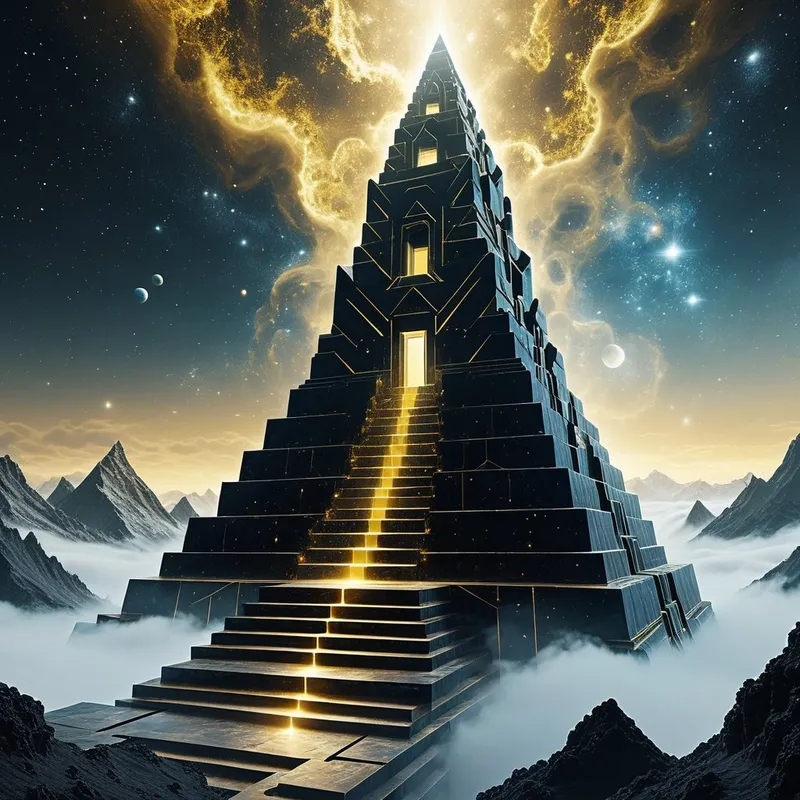
- Sacred/Forbidden Spaces: Labyrinths, inner sanctums, sterile laboratories, ancient temples fused with machinery.
Archetypal Resonance
The Magician Archetype is the master of ceremonies for the initiation dream. Not the Shadow Magician who manipulates reality for personal gain, but the true Magician as Alchemist and Visionary, who understands the fundamental laws of psychic transformation and applies the pressure necessary for change. The somatic echo—the charged, ozone feeling—is the Magician’s energy field, the crackle of potential. This archetype resonates because initiation is the ultimate act of transmutation: it takes the lead of a outgrown identity and, through the intense heat of ordeal, seeks to turn it into the gold of authentic sovereignty. The Magician does not offer comfort; it offers the catalyst and the crucible.
The Alchemical Process
The alchemy of initiation is Calcination—the application of searing heat to reduce a substance to its essential, powdered ash. Psychologically, this is the experience of intense, concentrated pressure that incinerates the ego’s superfluities. The “heat” is the shame of being seen naked without your mask, the grief for the self you must release, the terror of the void. This is not a gentle warming. It is the furnace. The process demands you stay present in this fire, to let it burn away the narratives of “I should be,” “I must remain,” and “I am afraid to become.” The transmutation occurs in the moment you stop fighting the combustion and realize, in the heart of the blaze, that you are not the fuel being consumed, but the observer of the flame. From that ash, mixed with the waters of released emotion (the dream’s often-present tears or floods), a new, denser, more resilient foundation can be formed.

The Integration Protocol
Question 1: What mask or title did the dream ask you to remove? What did you fear would be lost if you took it off?
Question 2: Where in the dream did you feel the most profound resistance? Was it at the threshold, during the ordeal, or at the moment of potential revelation?
Question 3: If the “you” that entered the dream did not survive it, what single, essential quality of your awareness did make it through?
Action 1 (Somatic Anchoring): For one minute upon waking, place a hand on the part of your body that held the most tension during the dream. Breathe into that space, not to change the sensation, but to acknowledge it as the physical record of your ordeal.
Action 2 (Unstructured Glyph): Without using words, take a pen and paper and let your hand draw the feeling of the initiation. Not the images, but the visceral quality—the pressure, the hollow, the crackle. Let it be an abstract glyph, a sigil of your own transformation.
Action 3 (Threshold Ritual): Physically mark a threshold in your home (a doorway, a gate). Stand before it and name aloud one small, outgrown identity you are willing to leave behind (e.g., “the perpetual helper,” “the one who must know”). Step across. Do not look back.
Final Validation
The path of initiation is harrowing because it is real. To feel its gravity is not a sign of weakness, but a testament to the profound significance of the shift occurring within you. The dream does not bring this chaos; it reveals the chaos that is already, and necessarily, underway in the depths of your becoming. You are not being broken. You are being re-patterned. Honor the terror, then honor the courage that meets it. For on the other side of this sacred rupture lies not a simpler life, but a more sovereign one—a life you are no longer wearing, but inhabiting, from the center out.