
The story of Philomela Myth Meaning & Symbolism
A princess, silenced by violence, weaves her truth into a tapestry, transforming into a nightingale whose song is born of profound suffering.
The Tale of The story of Philomela
Listen, and hear a story woven not just in words, but in blood, thread, and feathers. In the ancient land of Athens, there lived a king, Pandion, who had two daughters. The elder was Procne, a woman of stately grace, given in marriage to Tereus, a king from the wild north of Thrace, as a reward for his aid in war. The younger was Philomela, whose voice was like clear water over stones and whose fingers could make the loom sing with colors more vivid than life itself.
Years passed. Procne, in her distant Thracian court, longed for her sister with a deep, somatic ache. She begged Tereus to sail to Athens and bring Philomela for a visit. Tereus agreed. But when he beheld Philomela—her youth, her artless beauty, the music of her speech—a dark fire was kindled in his barbarian heart. The voyage back was not to Thrace, but to a hidden, wooded lodge deep in the forest. There, with promises turned to threats, he forced himself upon her. When her screams tore the silent grove, he did not flinch. When she swore to proclaim his crime to the world, to the gods, to her sister, a colder cruelty seized him.
He drew his sword. Not to kill her, but to murder her voice. He seized her tongue and cut it from her mouth. The sound was not a scream, but a wet, final silence. He left her there, imprisoned, a living secret in a stone cell, believing her story had died with her tongue.
But he forgot her hands.
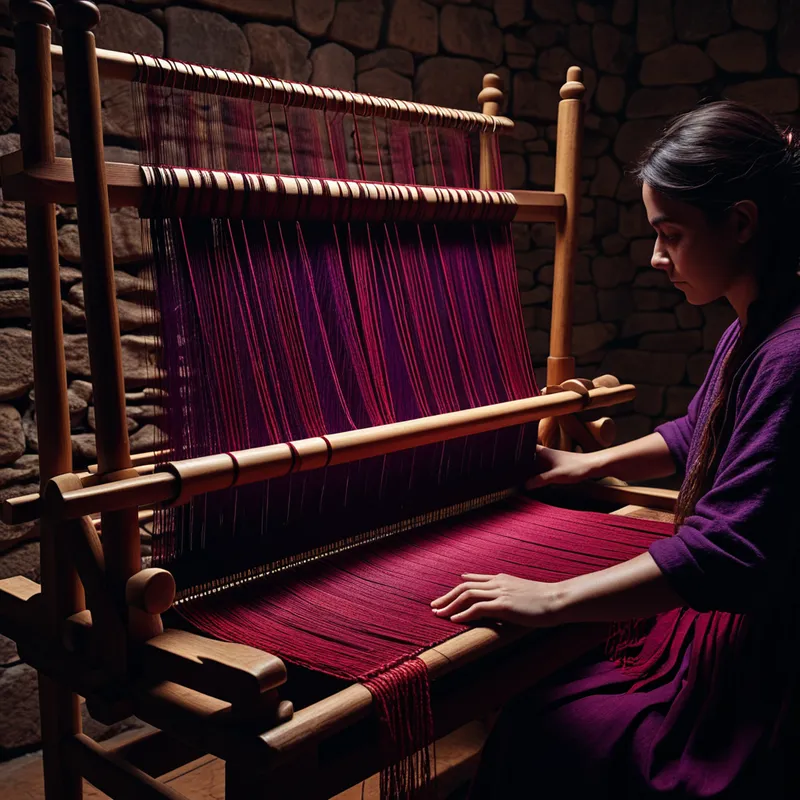
In the darkness, with only the loom her jailers provided to pass the time, Philomela’s grief did not fester into passive despair. It distilled into a furious, silent purpose. Her hands, the instruments of her art, became her new voice. She gathered threads of purple and crimson, of white and somber grey. Day after day, month after month, she wove. She wove not patterns or scenes of idyll, but the stark, terrible truth. There, in the tapestry, was Tereus’s betrayal, his violence, the brutal silencing. She wove her own story into the very warp and weft, a damning document in thread.
When it was complete, she folded it, and with gestures of desperate pleading, convinced an old servant woman to carry this woven cry to the one person who would understand its language: Queen Procne.
Procne received the cloth. She unfolded it slowly, in the privacy of her chambers. As her eyes traced the horrific narrative, the colors seemed to bleed, the figures to move. She did not scream. A silence colder than Philomela’s settled upon her. The festival of Dionysus was near, a time when women roamed the wilds in frenzied rites. Under this sacred, chaotic cover, Procne found her sister’s prison. The reunion was wordless—a clasp of hands, a meeting of eyes holding identical storms. In that silent communion, a terrible justice was conceived.
They returned to the palace. There was Itys, Procne’s young son by Tereus, innocent and smiling. In a madness born of profound, twisted grief—a grief that sought to make Tereus feel a loss as absolute as the one he had inflicted—the sisters killed the boy. They cooked his flesh and served it to Tereus at a feast. As the king gorged himself, demanding to see his son, Philomela stepped forward. She threw the child’s severed head upon the table. The silence broke. Tereus’s roar of horror shook the hall. He drew his sword, chasing the two women through the palace and out into the forest, his thirst for vengeance now absolute.
As he closed in, the gods, witnesses to this spiral of atrocity, intervened. Before his blade could strike, they transformed them all. Tereus became a hoopoe, a bird with a savage crest and a foul stench. Procne became a swallow, forever darting and crying. And Philomela, the silenced weaver, was given a new voice. She became a nightingale. To this day, she hides in the thickets, and her song—so heartbreakingly beautiful—is the story woven from her suffering, sung forever into the night.
Cultural Origins & Context
This harrowing tale comes to us from the Greco-Roman world, most famously recorded in Ovid’s Metamorphoses. It is a myth that exists in the borderlands between civilization and wilderness, between the ordered world of Athens and the barbaric realm of Thrace. Its function was not merely to shock, but to articulate the unspeakable. In a patriarchal ancient world, it gave narrative form to the horrors of sexual violence, familial betrayal, and the systemic silencing of women’s testimony. The story was passed down as a cautionary tale about the explosive, transformative potential of repressed truth. It asks a terrifying question: what happens when the sanctioned channels for justice and voice are destroyed? The answer it provides is one of catastrophic, metamorphic creativity.
Symbolic Architecture
At its core, this is a myth about the violation of the creative spirit and its monstrous, glorious rebirth. Philomela’s tongue is not just an organ of speech; it is the symbol of her agency, her connection to community, and her right to testify. Its removal represents the ultimate attempt to control narrative, to bury truth in the private, somatic prison of the victim.
The tapestry is the psyche’s non-negotiable demand to be heard. When the mouth is sealed, the soul will speak through the hands.
The loom becomes the transformed vessel of consciousness. Weaving, a traditionally feminine and civilized art, is weaponized into a medium for truth-telling. The tapestry is a map of trauma, an externalized memory that bypasses the shattered verbal faculty to communicate directly with the empathetic understanding of another (Procne). Psychologically, Philomela represents the archetypal Shadow of the “good sister”—the rage, cunning, and capacity for terrible vengeance that arises when innocence is annihilated. The final metamorphosis into birds is the ultimate dissociation, a psychic shattering so profound that the human form can no longer contain it. Yet, in this dissolution, a new, poignant form of expression is born.
The Dreamer's Resonance
To dream of this myth is to be in the grip of a profound psychological process centered on silenced trauma and the search for a voice. One might dream of being unable to scream, of having one’s mouth filled with cloth or earth. One might dream of intricate, urgent weaving, creating an object of vital importance whose meaning is terrifyingly clear upon waking. The somatic feeling is one of constriction in the throat and chest, coupled with a furious, focused energy in the hands and fingers.
Such dreams often surface when a truth—personal, creative, or traumatic—is being consciously or unconsciously suppressed. The psyche is enacting the mythic pattern: the violence of silencing (the Tereus figure, often an aspect of the dreamer’s own internalized oppressor), the imprisonment in the isolated “lodge” of shame or secrecy, and the furious, creative work of finding an alternative mode of expression. The dream is a signal that the unconscious is weaving its tapestry, preparing to send its message to the conscious mind (the Procne aspect), no matter how devastating the potential consequences of that revelation may be.
Alchemical Translation
The alchemy of Philomela’s story is the transmutation of passive suffering into active, creative form. The initial state is nigredo—the blackening, the brutal violation, the descent into the utter darkness of isolation and muteness. The imprisonment is the mortificatio, a death of the old, naive self. The loom work is the central, crucial albedo—the whitening. It is the conscious, painstaking work of distillation. Here, the raw, chaotic prima materia of agony, rage, and humiliation is patiently sorted, given structure, and woven into a coherent image. This is the essence of therapeutic or artistic process: making meaning out of madness.
The nightingale’s song is the rubedo, the reddening—not a return to innocence, but the creation of a new, more complex beauty forged in the fires of suffering.
For the modern individual, the myth models the path of individuation through shadow integration. One must first confront the “Tereus” within—the inner tyrant that seeks to silence uncomfortable truths for the sake of a false peace. One must then do the silent, solitary work of the loom: journaling, painting, therapy, any discipline that externalizes the inner narrative. Finally, one must accept the metamorphosis. The goal is not to return to the self that existed before the trauma, but to become the “nightingale”—a being whose very expression, whose unique song and contribution to the world, is intrinsically shaped and deepened by the wounds it carries. The voice that emerges is not the original voice, but a more profound one, born of the marriage between destruction and artistry.
Associated Symbols
Explore related symbols from the CaleaDream lexicon: