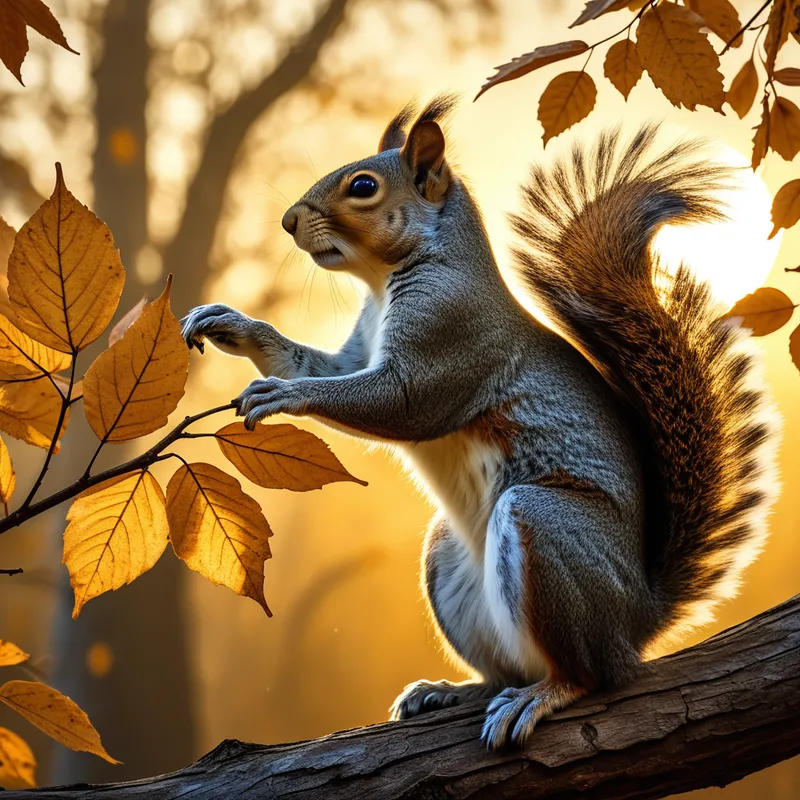
The Squirrel Myth Meaning & Symbolism
A small squirrel, through selfless sacrifice, saves the world from perpetual darkness, creating the sun's path and the cycle of day and night.
The Tale of The Squirrel
In the First Days, when [the world](/myths/the-world “Myth from Tarot culture.”/) was still soft and dark, a great trouble fell upon the People. The Sun, who was a being of immense power and light, grew angry. She felt taken for granted, her daily journey across [the sky](/myths/the-sky “Myth from Persian culture.”/) a burden. In her wrath, she retreated into her lodge deep in the west and refused to come out. She pulled the sky-blanket of night over herself and vowed to sleep forever.
Darkness, cold and complete, settled over the land. It was not the gentle, star-dusted darkness that brings rest, but a thick, hungry dark that swallowed sound and hope. The rivers slowed to a silent crawl. The corn ceased its whispering growth. The People huddled in their lodges, their fires guttering low, their hearts growing heavy with a chill that no flame could touch. The animals, too, were afraid. The bear’s deep rumble faded. The wolf’s howl was smothered. The world was holding its breath, dying in silence.
A council was called among the animals. The great and powerful spoke first. The Bear, massive and strong, lumbered to the west. He roared at Sun’s lodge, shaking the trees. “Come out!” he bellowed. But Sun only pulled the blanket tighter. The light did not stir. The Eagle soared next, flying high on the black wind to peer into the lodge. “Your people need your light!” he cried. Sun turned her face to the wall. The darkness deepened.
One by one, the large and mighty tried, and one by one, they failed. Despair, colder than the air, began to seep into the council. It was then that a small voice, a chittering, nervous sound, spoke from the edge of the gathering.
“I will try.”
All turned. It was Tsisdu, the Squirrel. The others looked at her tiny form, her busy paws, her tail that was but a wisp of fur. The Fox snorted. The Deer shook her head. “You? What can you do that the great ones could not?” they asked.
Tsisdu did not answer with words. She simply set off, a dart of gray-brown fur vanishing into the oppressive black. She did not go to the front of Sun’s lodge. Instead, she scrambled up to the roof, her claws finding purchase where no other could. She was small, unnoticed. At the peak of the lodge, she found a tiny crack, a place where a single sliver of light, warm and golden, seeped out from Sun’s imprisoned glory. Without a second thought, Tsisdu began to gnaw. She gnawed at the hardened clay and woven branch, her teeth, small but sharp, working tirelessly.
Hours passed. Her teeth ached. Her paws grew sore. But she gnawed on, driven by a memory of light on leaves, of warm nuts, of a world alive. Finally, with a last, desperate effort, she broke through. A blinding shaft of pure sunlight lanced out, striking her full in the face. It was searing, unbearable. But instead of fleeing, Tsisdu did something unthinkable. She put her mouth directly over the brilliant, molten beam.
She bit the light.
A piece of the Sun, a burning, living ember, came away in her teeth. The pain was instant and catastrophic. The fierce light scorched her mouth, her cheeks, her throat. It burned her paws as she clutched her prize. With the stolen fire in her jaws, Tsisdu turned and ran. She ran not for the council, but for the eastern edge of the world, where the sky meets the land.
As she ran, the pain of the light transformed her. The fur on her back, where the beam had touched her, was singed into dark stripes. Her paws, clutching the sun-piece, became blackened. But she ran, a tiny comet of agony and purpose, trailing sparks of dawn. She reached the eastern rim and, with all her strength, hurled the piece of Sun into the sky.
It soared, blossomed, and ignited the heavens. The world was flooded with a gentle, new light—not the full, angry glare of Sun, but the first, rosy glow of dawn. Seeing her own light shining in the world, Sun was shamed and stirred. Reluctantly, she emerged from her lodge and began her journey across the sky once more, chasing the piece Tsisdu had stolen.
And so, day returned. But Tsisdu was forever changed. Her mouth remained stretched, her paws dark, her back striped with the memory of her sacrifice. From that day on, she chattered constantly, as if still trying to speak through the pain, and she would forever run up and down the trees, as if remembering her desperate, world-saving sprint from west to east.
Cultural Origins & Context
This myth belongs to the rich oral tradition of the Ani-Yunwiya, the Cherokee people. It was not a mere children’s story but a didahnvwisgi (a teaching story), told by elders and storytellers around the fire during the long nights. Its function was multifaceted. It explained a natural phenomenon—the origin of the squirrel’s distinctive physical marks and behavior. More profoundly, it encoded core Cherokee values into the fabric of the cosmos: the importance of community over individual pride, the efficacy of cleverness and perseverance over brute strength, and the sacred responsibility of all beings, no matter how small, to maintain tohi—the harmonious balance of the world.
The story was a narrative anchor in a worldview where the animal people were once like humans, possessing language and society, and played active roles in shaping the world. It reinforced the understanding that the cosmos is participatory; its order is not guaranteed but is continually upheld through acts of courage and sacrifice.
Symbolic Architecture
At its [heart](/symbols/heart “Symbol: The heart symbolizes love, emotion, and the core of one’s existence, representing deep connections with others and self.”/), the myth of Tsisdu is an ode to the power of the marginal, the overlooked, and the apparently insignificant. The great archetypal powers—Bear (raw [strength](/symbols/strength “Symbol: ‘Strength’ symbolizes resilience, courage, and the ability to overcome challenges.”/)) and [Eagle](/symbols/eagle “Symbol: The eagle is a symbol of power, freedom, and transcendence, often representing a person’s aspirations and higher self.”/) (lofty [perspective](/symbols/perspective “Symbol: Perspective in dreams reflects one’s viewpoints, attitudes, and how one interprets experiences.”/))—fail because they operate from a place of assumed [authority](/symbols/authority “Symbol: A symbol representing power structures, rules, and control, often reflecting one’s relationship with societal or personal governance.”/). They confront the [problem](/symbols/problem “Symbol: Dreams featuring a ‘problem’ often symbolize internal conflicts or challenging situations that require resolution and self-reflection.”/) directly, with the tools of their domain, and are rebuffed.
The true hero is not the one who shouts at the darkness, but the one who becomes a needle, stitching the light back into the world’s fabric with silent, painful persistence.
The [Squirrel](/symbols/squirrel “Symbol: Squirrels often symbolize playfulness, resourcefulness, and the ability to gather and store for future needs.”/) represents the [psyche](/myths/psyche “Myth from Greek culture.”/)’s resourceful instinct. She operates not from the center of power but from the periphery. She uses gnawing persistence (small, consistent [effort](/symbols/effort “Symbol: Effort signifies the physical, mental, and emotional energy invested toward achieving goals and personal growth.”/)) instead of force. Her approach is lateral, moving not to the [door](/symbols/door “Symbol: A door symbolizes transition, opportunity, and choices, representing thresholds between different states of being or experiences.”/) but to the roof, finding the crack where light already leaks. Psychologically, she embodies the part of us that works in the shadows of our [awareness](/symbols/awareness “Symbol: Conscious perception of self, surroundings, or internal states. Often signifies awakening, insight, or heightened sensitivity.”/), the nagging [intuition](/symbols/intuition “Symbol: The immediate, non-rational understanding of truth or insight, often described as a ‘gut feeling’ or inner knowing that bypasses conscious reasoning.”/) or the quiet, stubborn resolve that addresses a problem not head-on, but through a back channel of the [soul](/symbols/soul “Symbol: The soul represents the essence of a person, encompassing their spirit, identity, and connection to the universe.”/).
Her ultimate act—biting the light—is the quintessential [image](/symbols/image “Symbol: An image represents perception, memories, and the visual narratives we create in our minds.”/) of sacrificial internalization. To bring light ([consciousness](/symbols/consciousness “Symbol: Consciousness represents the state of awareness and perception, encompassing thoughts, feelings, and experiences.”/), hope, change) back into a darkened world (a depressed psyche, a stagnant [life](/symbols/life “Symbol: The symbol of ‘Life’ represents a journey of growth, interconnectedness, and existential meaning, encompassing both the joys and challenges that define human experience.”/)), one must first take it into one’s own being, and this process is inherently painful. It burns. It changes you irrevocably. The squirrel’s transformed [body](/symbols/body “Symbol: The body in dreams often symbolizes the dreamer’s self-identity, personal health, and the relationship they have with their physical existence.”/) is not a [punishment](/symbols/punishment “Symbol: A dream symbol representing consequences for actions, often tied to guilt, societal rules, or internal moral conflicts.”/), but a testament—a living scar that is also a [badge](/symbols/badge “Symbol: A badge represents identity, authority, belonging, and validation. It signifies membership, achievement, or official status within a group or system.”/) of honor, the permanent record of her encounter with the divine [source](/symbols/source “Symbol: The origin point of something, often representing beginnings, nourishment, or the fundamental cause behind phenomena.”/).

The Dreamer’s Resonance
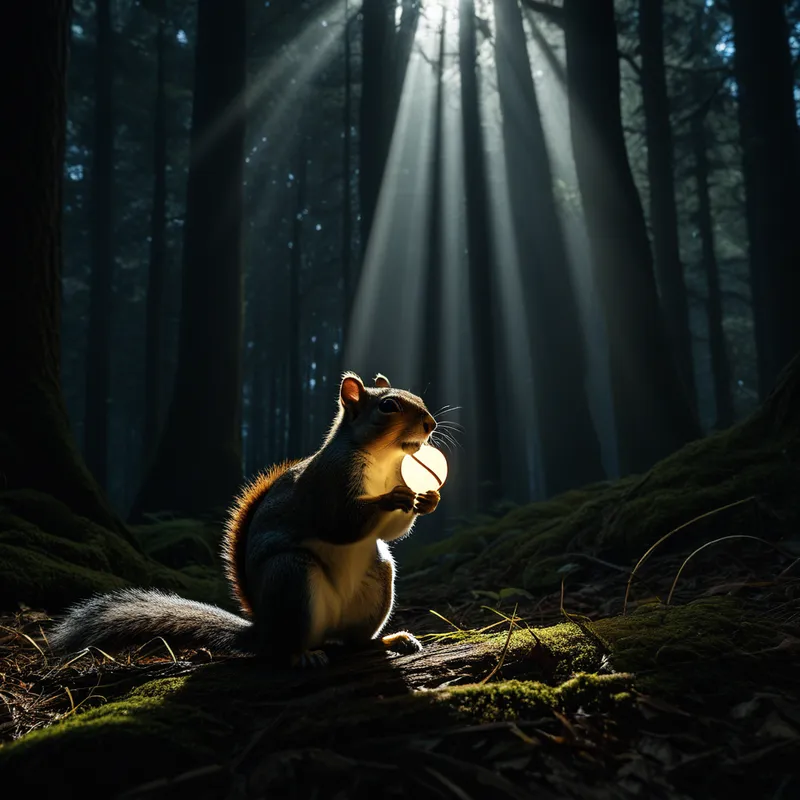
When the myth of The Squirrel stirs in modern dreams, it often signals a process of humble integration. Dreaming of a squirrel frantically running, gathering, or, most potently, carrying a glowing object in its mouth, points to a psychological moment where a grand, ego-driven solution has failed. The dreamer may be in a period of “cosmic darkness”—depression, creative block, or spiritual aridity.
The squirrel in the dream is the soul’s insistence on a different way. It somaticizes the need for small, diligent, often unnoticed work. The aching jaw in a dream, or the sensation of holding something painfully hot, can be the body echoing Tsisdu’s sacrifice. It asks: What tiny, persistent action is being demanded of you? What crack of light are you being called to gnaw at, even though the task seems beneath your station or too painful to bear? The dream is an affirmation that salvation often comes not from a heroic crusade, but from a committed, gritty, and deeply personal act of retrieval.
Alchemical Translation
In the alchemical vessel of individuation, the myth maps the process of [solve et coagula](/myths/solve-et-coagula “Myth from Alchemical culture.”/)—dissolving the old, rigid form and coagulating a new, integrated one. The “dark night of the soul” is Sun’s retreat. [The ego](/myths/the-ego “Myth from Jungian culture.”/)’s first attempts to solve it (the Bear and Eagle) represent applying old, familiar strengths, which only leads to deeper despair.
The Squirrel is the emergence of the anima/animus or the guiding archetype in a humble, instinctual form. Its work is the solve: the patient, gnawing dissolution of the hardened roof of our defenses, our cynicism, or our grandiosity that seals us off from the light.
The alchemical fire is not just the sun’s rage, but the searing pain of internalizing a new consciousness. We are not burned by the light we observe, but by the light we consent to carry.
Biting the light is the moment of capturing the transcendent function—seizing the reconciling symbol that bridges the conscious and unconscious. The run eastward is the coagula: the painful but purposeful integration of this new awareness into the fabric of the waking self. The resulting transformation—the striped back, the darkened paws—is the [rubedo](/myths/rubedo “Myth from Alchemical culture.”/), the reddening. It is the evidence of [the opus](/myths/the-opus “Myth from Alchemical culture.”/) completed. The individual is forever marked, not with wounds of victimhood, but with the sacred scars of one who has wrestled with a divine force and, through humble sacrifice, restored the diurnal rhythm of their own soul. The chattering is the new, perhaps anxious, voice of this integrated self, forever communicating its hard-won truth.
Associated Symbols
Explore related symbols from the CaleaDream lexicon: