The South-Pointing Chariot Myth Meaning & Symbolism
A legendary emperor, lost in a primordial fog, is guided by a celestial chariot whose figure always points south, restoring cosmic and earthly order.
The Tale of The South-Pointing Chariot
Listen, and hear the tale from when the world was soft clay, and the breath of heaven still mingled with the dust of earth.
In the age of Huangdi, the Yellow Emperor, a great perturbation arose. Not from barbarian hordes or rebellious floods, but from the very breath of the world itself. A miasmic fog, thick as liquid jade and cold as forgotten stars, descended from the Mount Buzhou. It swallowed the plains of Zhongyuan, drowned the mountains, and blotted out the sun and moon. In this fog, direction died. North, south, east, west—these became mere words, ghosts of meaning. The Emperor’s armies, mighty and loyal, stumbled like blind children. Messengers circled back to their starting points, weeping in confusion. The cosmic order, the Dao itself, seemed to unravel.
The Emperor stood in his silken tent, the grey tendrils of the fog coiling around the braziers. He could feel the disquiet in the land, a shudder in the dragon-lines beneath the soil. His sage advisors cast shells and stalks, but the patterns spoke of a celestial dislocation. “The Polestar is veiled,” they whispered. “The Heavenly Mandate is obscured. We are lost in the belly of Hundun.”
Then, from among the master artisans and cunning engineers, stepped a figure. Some say it was the Minister Fang Bo; others whisper it was a celestial smith sent by the Jade Emperor himself. He prostrated himself before Huangdi. “August Sovereign,” he intoned, his voice cutting through the muffling fog, “the heavens may hide their face, but the principle of direction cannot be erased. Grant me your mandate, and I shall build a chariot that holds the south in its heart.”
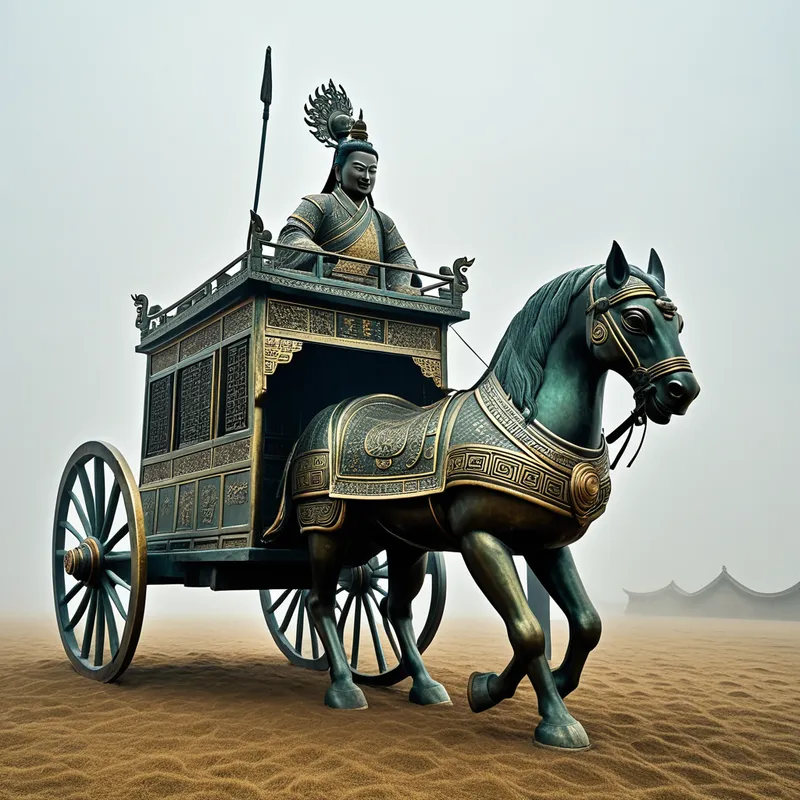
With imperial decree, the forges of the kingdom roared. They smelted the finest bronze, alloyed with sacred metals fallen from the sky. They carved a figure from heartwood of the ancient Fusang tree, gilding it in gold. The chariot they built was not for speed, but for sovereignty—a massive, rolling platform of cosmic assertion. At its center, they placed the gilded figure on a complex series of interlocking gears, connected to the wheels with sublime ingenuity.
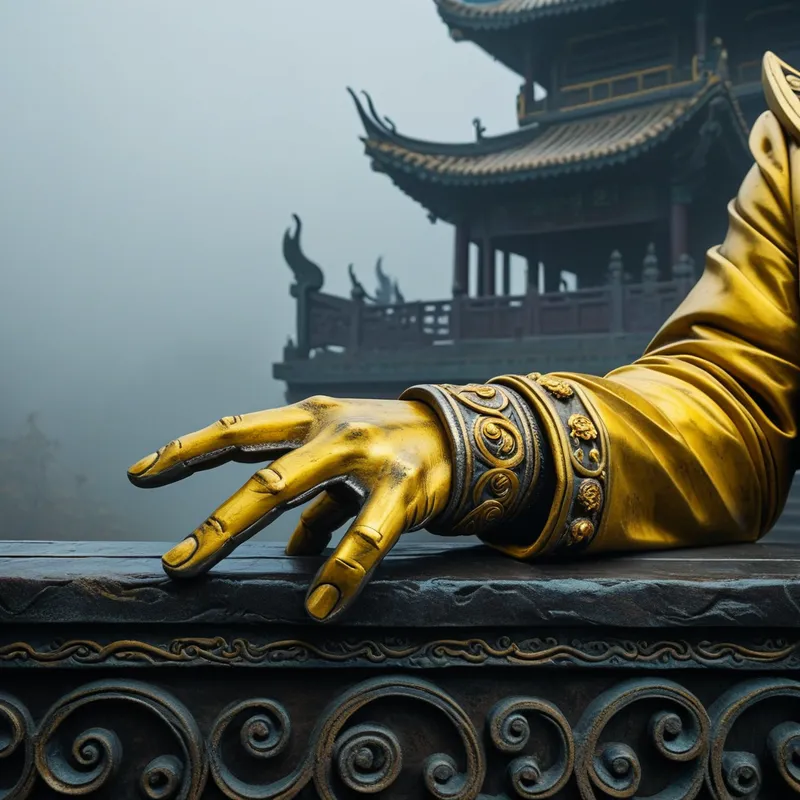
The day of testing arrived. The fog clung, impenetrable. The Emperor mounted the chariot. As the oxen strained forward, the wheels began to turn. And through a miracle of mechanics—or perhaps a pact with the immutable laws of the cosmos—the gilded figure moved. It rotated, it adjusted, and then… it held. Its outstretched arm pointed, unwavering, through the grey soup of the world. South. Always south.
With this celestial compass, Huangdi advanced. The fog, robbed of its power to disorient, began to thin. His armies reformed behind the unerring pointer. Order was restored to the campaign, and by extension, to the realm. The South-Pointing Chariot became more than a tool; it became a symbol of the Emperor’s De, his power to impose cosmic harmony upon earthly chaos. Where the chariot rolled, the Dao was made visible again.
Cultural Origins & Context
The South-Pointing Chariot, or Zhǐnánchē, occupies a fascinating space between legend and historical ingenuity. Its earliest textual references appear in texts like the Lüshi Chunqiu and later elaborated in the Shiji, often attributed to the reign of the Yellow Emperor, a foundational culture-hero. While the device is mythological in these ancient contexts, it later inspired very real mechanical devices in Chinese history—complex differential gear systems built during the Three Kingdoms period and Song Dynasty that could keep a figure pointing south regardless of the carriage’s turns.
This duality is key. The myth served a profound societal function: it legitimized imperial authority by linking it to cosmic navigation. The Emperor was not just a political ruler but a cosmocrator, the one who could discern and maintain universal order (Dao) amidst chaos. The story was passed down by historians, court scholars, and engineers, blurring the line between moral parable and technological aspiration. It functioned as an “orienting myth” for the civilization itself, asserting that through wisdom (Fang Bo’s craft) and virtue (Huangdi’s mandate), humanity could find its way through any obscurity.
Symbolic Architecture
At its core, the myth is a profound allegory for consciousness asserting itself against the undifferentiated background of the unconscious. The all-consuming fog represents the primal, chaotic state of Hundun, the unformed potential from which all life emerges and into which it can dissolve. It is the inner confusion, the loss of identity, the depression or crisis where all paths seem equally meaningless or invisible.
The South-Pointing Chariot is not a magnet seeking polarity; it is the assertion of an inner truth so fundamental it creates its own north.
The chariot itself symbolizes the constructed vehicle of the psyche—the ego, the persona, the disciplined mind and body—necessary to navigate the world. But the true magic is the gilded figure and its gear system. This represents the Self, in the Jungian sense, the central, ordering principle of the total personality. The ingenious mechanism signifies the complex, often unconscious psychic processes (the differential gears of memory, instinct, and archetype) that allow the Self to maintain its orientation despite the twisting, turning, and backtracking of the conscious ego’s journey.
“South” in Chinese cosmology is not arbitrary. It is the direction of the sun at its zenith, associated with fire, brightness, clarity, and the Yang principle. To always point south is to hold a constant orientation toward consciousness, illumination, and divine order, even when plunged into the Yin-like fog of the unknown.
The Dreamer's Resonance
When this myth stirs in the modern unconscious, it often manifests in dreams of profound disorientation coupled with a singular, reliable guide. One might dream of being lost in a vast, featureless airport, a labyrinthine hospital, or an endless forest, where maps are blank and signs are in gibberish. The somatic feeling is one of gut-wrenching anxiety, a vertigo of the soul.
Then, an object appears: a wristwatch whose second hand pulses southward, a smartphone app that shows only a steady arrow, or a childhood toy that stubbornly faces one direction. This is the dream-ego’s encounter with the South-Pointing function. The psychological process is one of re-orientation. The dreamer is navigating a life transition, an ethical dilemma, or a creative block—a personal “fog.” The psyche, in its wisdom, is constructing its own chariot, pointing toward the inner “south,” the core values or calling that remain true despite external chaos. The dream is an invitation to identify that inner compass and trust its mechanism, which operates on a logic deeper than conscious reason.
Alchemical Translation
The individuation process modeled here is not one of heroic conquest, but of sovereign orientation. The first stage is the descent into the fog: the necessary dissolution of old, rigid identities and certainties (the nigredo). The ego, like Huangdi’s army, is rendered helpless, forcing a reliance on a deeper authority.
The building of the chariot represents the active engagement with the unconscious—the “cunning craft” of therapy, active imagination, or artistic creation that forges a new relationship between conscious and unconscious contents (the gears). The culminating act is not defeating the fog, but moving through it while maintaining inner alignment.
The ultimate alchemy is the realization that the pointer and the point are one. The true south is not a destination on a map, but the integrity of the pointing itself.
The modern individual’s “imperial mandate” is their own authenticity. The triumph is the realization that one’s center of gravity, one’s psychological “south,” is an internal, immutable fact. Chaos (fog) does not disappear from life, but it loses its power to dis-orient. One learns to move through confusion, betrayal, or loss with the chariot of a disciplined life, guided by the golden figure of the Self, whose direction—toward meaning, toward wholeness—is kept true by the mysterious, perfect gearing of the soul’s own innate design. The journey continues, but one is never truly lost again.
Associated Symbols
Explore related symbols from the CaleaDream lexicon: