The Snow Lion of Tibet Myth Meaning & Symbolism
A majestic creature of pure mind and fearless joy, symbolizing the enlightened energy that roams the highest peaks of consciousness and reality.
The Tale of The Snow Lion of Tibet
Listen, and let your mind travel to the Roof of the World, where the air is thin and the silence is a presence. Here, in the land where earth scrapes the sky, the story is not carved in stone but woven into the wind. It is told that in the primordial age, when the world was still forming its intentions, a profound emptiness echoed across the highest peaks. This was not a void of absence, but a pregnant stillness, a canvas of pure potential awaiting the first stroke of being.
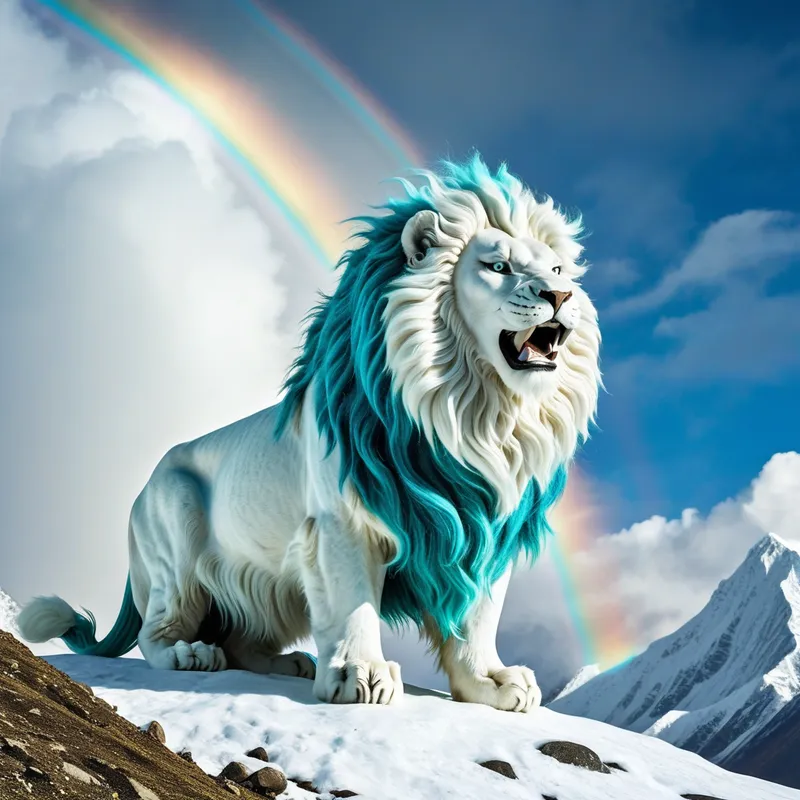
From the union of the radiant, boundless Sky and the unwavering, nurturing Earth, a vibration arose. It was a sound that was also a color—the brilliant, healing hue of turquoise. This vibration coalesced, not into a form bound by flesh and bone, but into a being of pure mind and joyous energy. It was the Snow Lion. Its body was the essence of the purest, untouched snow, not cold, but radiant with inner warmth. Its magnificent mane was not hair, but cascading waterfalls of living turquoise, each strand humming with the vitality of a mountain spring. Its eyes held the piercing clarity of a diamond and the boundless compassion of a Bodhisattva.
This lion did not stalk prey, for it was itself the embodiment of fearless delight. Its domain was the most treacherous, glorious passes—the places where ordinary creatures faltered from thin air and dizzying heights. With a playful, thunderous roar that shook avalanches loose not in destruction, but in a dance of elemental release, it proclaimed its sovereignty over fear itself. It was said its roar did not cause terror, but rather, it shattered the ice of ignorance in the hearts of those who heard it, even as a distant echo on the wind.
The Snow Lion became the guardian and the manifestation of these ultimate heights. Where it placed its paw, a Lotus of ice would bloom. Its breath condensed into clouds that nourished the valleys below. It was often seen in the retinue of Chenrezig, its joyful energy complementing his boundless compassion, and as the mount of Manjushri, whose flaming sword cuts through delusion. The lion carried the wisdom that fearlessness is not the absence of danger, but the profound understanding that one’s true nature is as vast, pristine, and unshakable as the mountain upon which it stands.
Cultural Origins & Context
The image of the Snow Lion is woven deeply into the fabric of Tibetan culture, predating and then being seamlessly integrated into Tibetan Buddhist iconography. It is a celestial animal, one of the Four Dignities, which represent core qualities of the path. Unlike myths conveyed solely through epic poetry, the Snow Lion is primarily transmitted through vibrant visual language: in thangka paintings, temple murals, ceremonial mandalas, dance, and even political symbology as the national emblem of Tibet.
Its societal function is multifaceted. On one level, it is a protective symbol, its image adorning homes and temples to ward off negative influences. On a spiritual level, it is a constant visual meditation. For monks and practitioners, to visualize or behold the Snow Lion is to invoke its qualities within oneself. It is a teaching without words, a reminder that the enlightened mind (sugatagarbha) is not a weak, passive state, but one of vibrant, untamed joy and fearless confidence. The myth was kept alive by artists and lamas, who understood that some truths are better felt through image and symbol than through doctrinal text.
Symbolic Architecture
The Snow [Lion](/symbols/lion “Symbol: The lion symbolizes strength, courage, and authority, often representing one’s inner power or identity.”/) is a masterful symbolic construct. Its white [body](/symbols/body “Symbol: The body in dreams often symbolizes the dreamer’s self-identity, personal health, and the relationship they have with their physical existence.”/) represents absolute purity, the fundamental [nature](/symbols/nature “Symbol: Nature symbolizes growth, connectivity, and the primal forces of existence.”/) of mind, unstained by conflicting emotions or dualistic thought. The turquoise mane symbolizes the active, compassionate [energy](/symbols/energy “Symbol: Energy symbolizes vitality, motivation, and the drive that fuels actions and ambitions.”/) that naturally arises from that purity—the [life-giving waters](/symbols/life-giving-waters “Symbol: Life-giving waters symbolize sustenance, nurturing, and the cyclical nature of life and death, serving as a vital resource for survival.”/) of wisdom flowing into the world.
The Snow Lion does not conquer the mountain; it is the mountain’s own fearless heart made manifest.
Its habitat is the most critical clue. By residing only on the highest, coldest, most isolated peaks, it symbolizes that the ultimate wisdom (prajnaparamita) and fearless joy (sukha) are found not in the comfortable valleys of [convention](/symbols/convention “Symbol: A convention often signifies collective understanding, agreements, or shared knowledge, embodying the pursuit of goals and unity among individuals.”/) and [distraction](/symbols/distraction “Symbol: A state of diverted attention from a primary focus, often representing avoidance, fragmentation, or competing priorities in consciousness.”/), but through confronting the most daunting aspects of existence and our own psyche. The lion’s roar is the proclamation of this realized [truth](/symbols/truth “Symbol: Truth represents authenticity, honesty, and the quest for knowledge beyond mere appearances.”/), a sound that dispels the silent, chilling fog of doubt and [anxiety](/symbols/anxiety “Symbol: Anxiety in dreams reflects internal conflicts, fears of the unknown, or stress from waking life, often demonstrating the subconscious mind’s struggle for peace.”/). Psychologically, it represents the integrated Self that has faced the [abyss](/symbols/abyss “Symbol: A profound void representing the unconscious, the unknown, or a spiritual threshold between existence and non-existence.”/) of its own insignificance and returned with a triumphant, unshakable vitality.
The Dreamer’s Resonance
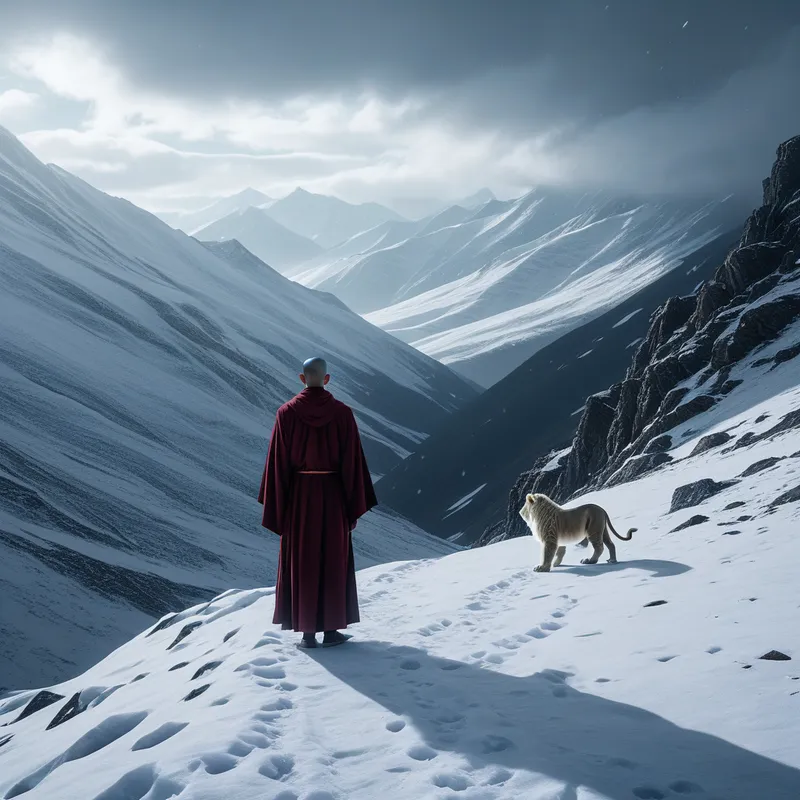
When the Snow Lion pads into modern dreams, it rarely arrives with fanfare. It may appear as a fleeting white shape in a blizzard, a sense of powerful, calm presence behind you on a high Pathway, or as the source of a resonant, silent roar that vibrates through your dream body.
This visitation often coincides with a psychological process of confronting a “peak” challenge—a situation requiring immense personal integrity, a confrontation with a lofty ideal, or the need to find inner stability amidst emotional chaos. The somatic feeling upon waking may be one of expanded chest, a deep, calm breath, or a residual tingling energy. The lion emerges when the dreamer’s psyche is attempting to synthesize a higher perspective, to access a part of the self that is not victimized by circumstance but can stand firm in its essential dignity and power. It is the archetype of the Hero activated not for battle with external monsters, but for the inner conquest of fear.
Alchemical Translation
The myth of the Snow Lion provides a profound map for the alchemical process of individuation—the journey toward becoming an integrated, authentic individual. The initial state is the “valley” of confused identity, where one’s energy is dissipated in worldly concerns and internal conflicts.
The call to the Mountain is the call to self-confrontation and discipline. The arduous climb represents the difficult work of introspection, meditation, or therapy—facing the thin air of loneliness, the chilling winds of old wounds, and the dizzying heights of one’s own potential. The ordinary ego fears this ascent, for it threatens dissolution.
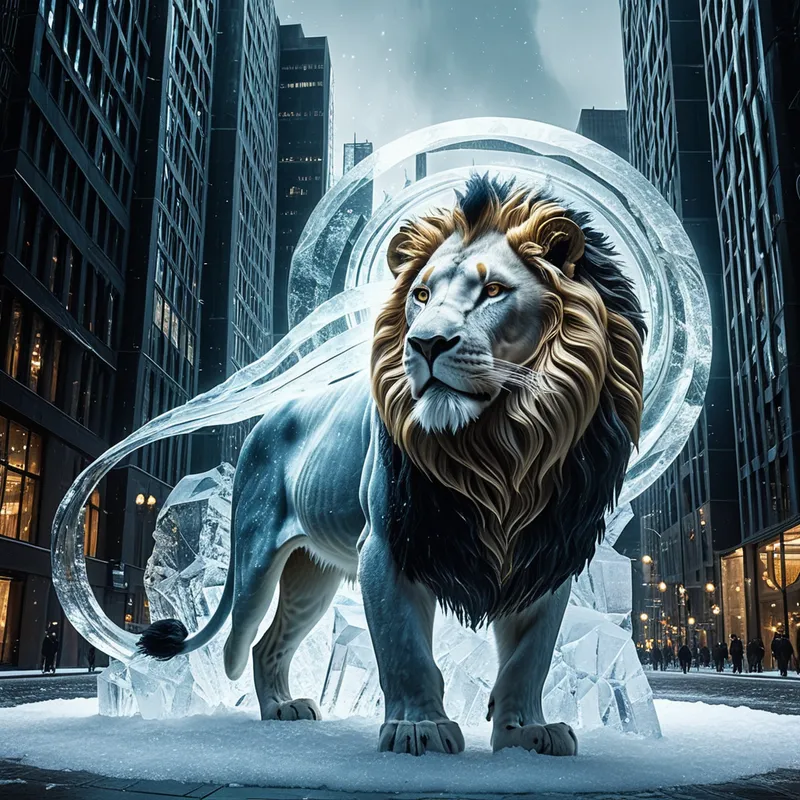
The alchemical fire is not in a furnace, but in the joyful roar that transmutes the leaden weight of fear into the gold of fearless being.
Meeting the Snow Lion on the peak is the moment of psychic transmutation. It symbolizes the realization that one’s true nature is not the fragile, climbing ego, but the majestic, indestructible awareness that was always already there. The lion’s qualities of fearless joy and vibrant energy are recognized as innate. This is not an inflation of the ego, but its graceful surrender to a much vaster identity. The individual does not become the lion; they remember they are of its essence. The return, then, is not a descent back into pettiness, but the ability to carry that mountain-peak confidence and clarity into the valleys of everyday life, transforming one’s engagement with the world. The Ritual is complete: the base metal of a fear-bound life is transmuted into the gold of a life lived with fearless, joyful authenticity.
Associated Symbols
Explore related symbols from the CaleaDream lexicon:
- Lion — The universal archetype of courage, majesty, and primal power, here refined into a celestial being of pure mind and enlightened energy.
- Mountain — The ultimate challenge and destination, representing the lofty peaks of consciousness, spiritual aspiration, and the arduous path to self-realization.
- Snow — Symbolizes pristine purity, the blank slate of primordial awareness, and the transformative, insulating quality of higher wisdom.
- Sky — Represents boundless space, openness, the ultimate nature of reality (shunyata), and the limitless domain in which the Snow Lion’s mind roams freely.
- Hero — Embodies the journey of confronting fear and transcending limitation, aligning with the Snow Lion’s role as the archetypal conqueror of inner obstacles.
- Light — The radiant, illuminating quality of the Snow Lion’s being, representing wisdom (prajna) that dispels the darkness of ignorance and fear.
- Courage — The fearless delight (shinjang) that is the Snow Lion’s primary characteristic, a bravery rooted in wisdom rather than aggression.
- Journey — The essential ascent to the high peaks, mirroring the spiritual path (lam) and the psychological process of confronting one’s highest self.
- Wind — The medium through which the Snow Lion’s roar travels, symbolizing the transmission of teachings, the breath of life (prana), and the intangible yet powerful force of truth.
- Mirror — Reflects the Snow Lion’s function as a symbol showing us our own innate, pure, and fearless Buddha-nature, if we have the clarity to see it.
- Dance — The playful, joyful movement of the Snow Lion across the peaks, representing the spontaneous and blissful activity of an enlightened mind.
- Crown — Symbolizes the sovereign rule of wisdom over the kingdom of one’s own psyche, with the Snow Lion as the guardian of this royal dignity.