
The Snake Woman Siberian Myth Meaning & Symbolism
A hunter's forbidden love for a serpent spirit reveals the sacred, terrifying bond between humanity and the untamed soul of the world.
The Tale of The Snake Woman Siberian
Listen, and hear the tale whispered on the wind that cuts through the larch trees, carried on the breath of the frozen river. In the time when the world was a conversation between the people and the spirits, there lived a hunter named Bayan. His arrows flew true, and his heart was as steady as the permafrost. Yet, in the deepest part of the forest, where the light fell in dappled, green-gold pools and the air hummed with a silence older than sound, he felt a longing he could not name.
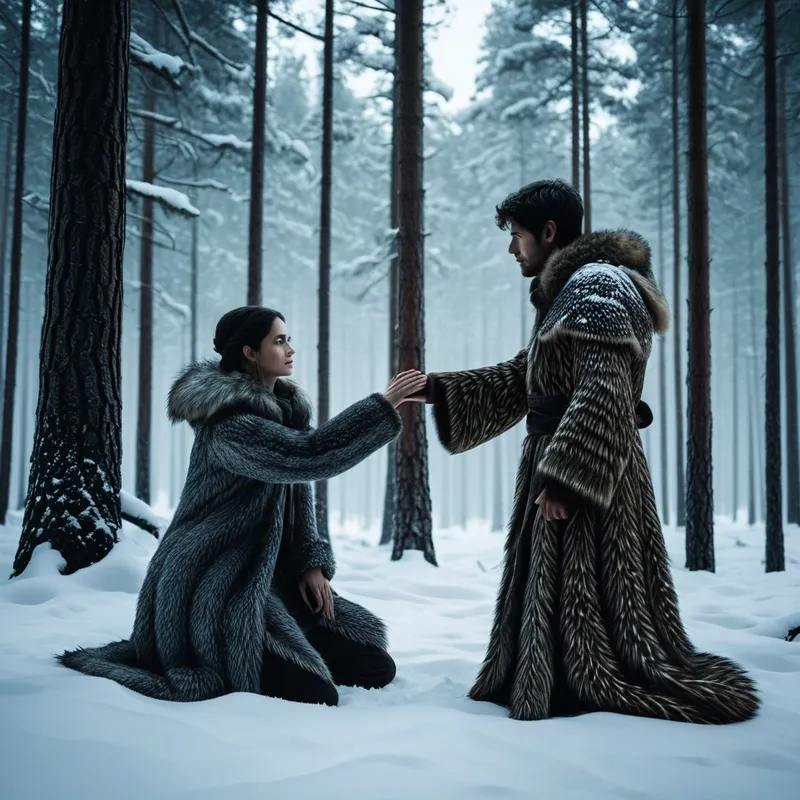
One evening, as the sun bled into the western hills, he followed the track of a great elk to a clearing he had never seen. In its center lay a still, black pool, its surface a perfect mirror of the darkening sky. And there, at its edge, was a woman. Her hair was the color of midnight moss, her skin pale as birch bark. She was weeping, and each tear that fell into the pool hissed softly, sending a ripple across the glassy surface. Bayan’s breath caught. He stepped forward, offering a skin of water. She looked up, and her eyes were not human eyes. They were vertical slits of molten gold, holding the ancient patience of stone and the swift danger of a striking viper.
She was Izhien, a spirit of the deep earth and the hidden waters, a daughter of the world’s old, scaled blood. She had taken this form to feel the sun on skin that was not stone, to know the grief that comes with a beating heart. A taboo as old as the mountains hung between them: the people of the sun and the spirits of the underworld must not intertwine. Yet, in that silent clearing, a thread was spun. He visited her not with offerings of fear, but with the quiet presence of one who listens. She, in turn, showed him the secret paths of the beasts, the herbs that heal deep wounds, and the songs that calm the storm.
Seasons turned. Their forbidden bond became a secret warmth in the vast cold. But the world knows its balances. The other hunters grew suspicious of Bayan’s uncanny luck and his long absences. The shaman, who could hear the discontent of the land spirits, dreamed of a great serpent coiling around the heart of the tribe, bringing both power and peril. One day, driven by fear and duty, they followed him.
They burst into the clearing as Bayan sat with Izhien, her head resting on his shoulder. At the sight of the armed men, a terrible change came over her. Her form shimmered, her legs fused into a powerful, scaled body of iridescent green and black. A collective gasp of terror echoed. The shaman raised his drum, his voice cracking in a chant of banishment. Izhien reared up, not to strike, but in a posture of profound sorrow and defiance. She looked once at Bayan—a look that held all the love and loneliness of two worlds—and then slid into the black pool. The waters closed over her without a ripple, leaving the clearing emptier than any space on earth.
Bayan never hunted in that part of the forest again. But sometimes, on the eve of the first thaw, people would say they saw a woman with eyes of gold watching from the tree line, and the game that year would be plentiful yet strangely gentle. The bond was broken, yet the thread remained, woven now into the very fabric of the land—a permanent, aching reminder of the love that dared to bridge the impossible.
Cultural Origins & Context
This myth finds its roots among the diverse, animistic traditions of Siberia’s indigenous peoples, such as the Khanty, Mansi, Evenki, and others. In these cultures, the world is profoundly alive, inhabited by a multitude of Izhien and Khozhu. Myths were not mere stories but living maps of reality, passed down orally by elders and shamans around the hearth fire during the long winter nights. The tale of the Snake Woman served a crucial societal function: it delineated the sacred boundaries between the human community and the wild, spirit world. It taught respect for the immense, often dangerous power of the Underworld, while simultaneously acknowledging the irresistible, creative pull that exists between these realms. It was a narrative container for the awe, terror, and profound yearning that humans feel toward the utterly “Other.”
Symbolic Architecture
At its core, this myth is a drama of coniunctio oppositorum—the sacred conjunction of opposites. The hunter, Bayan, represents the conscious, daylight ego, the human order of tribe, law, and known paths. The Snake Woman, Izhien, embodies the unconscious, instinctual, and chthonic soul of the world—the wild, fertile, amoral, and deeply intelligent force that exists outside human structures.
The serpent is not a monster to be slain, but the soul of the land itself, offering a terrifying wholeness to the one who can bear to meet its gaze.
Their union is the ultimate taboo because it promises a transformation so complete it threatens the existing order. The serpentine form of the woman is key. The Serpent sheds its skin, symbolizing immortality and regeneration. It moves between earth and water, bridging elements. Her tears, which hiss in the water, signify the potent, transformative essence of emotion that belongs to this deep feminine spirit—a grief for a lost unity. The Pool is the portal itself, the reflective surface of the unconscious into which the soul must descend.
The Dreamer's Resonance
When this myth stirs in modern dreams, it often signals a profound encounter with the anima or animus in its most primal, “untamed” form. Dreaming of a serpentine figure, a transformative union in a forest, or a forbidden love with a non-human entity points to a powerful initiation from the psyche. The somatic process is one of both attraction and deep fear—a “chill” of recognition alongside a magnetic pull. Psychologically, the dreamer is being confronted by aspects of their own soul that have been exiled as too wild, too powerful, too alien to their conscious identity. This is not a gentle integration but a sacred confrontation. The grief present in the myth mirrors the dreamer’s own grief for a lost connection to their instinctual, creative, and deeply spiritual core.

Alchemical Translation
The myth models the alchemical opus of individuation, specifically the nigredo and coniunctio stages. Bayan’s journey into the forbidden forest is the descent into the prima materia of the soul—the chaotic, fertile darkness. His conscious world (the tribe) must be left behind. The love for Izhien represents the ego’s engagement with the transformative power of the unconscious. This is not a conquest, but a courtship, requiring vulnerability and the suspension of judgment.
The triumph is not in possession, but in the irreversible transformation wrought by the encounter. The old self ‘dies’ in the love of the Other.
The inevitable intervention of the tribe (the shaman, the community) represents the crushing power of the collective psyche, the internalized voices of convention and fear that seek to abort the individuation process. The resolution—the separation and the enduring, subtle connection—is crucial. The complete, permanent union in human terms is impossible; the ego cannot become the unconscious. But once the bond is forged, the individual is forever changed. They carry the “golden-eyed” perspective within. They can no longer live solely in the daylight world but become a liminal figure, a walker between worlds, their creativity and perception forever deepened by the touch of the serpent-soul. The myth teaches that wholeness is found not in final resolution, but in the capacity to hold the sacred tension between human and spirit, known and unknown, in a single, beating heart.
Associated Symbols
Explore related symbols from the CaleaDream lexicon:
- Snake — The core symbol of the myth, representing the untamed, cyclical, and deeply intelligent soul of the world, the instinctual force that offers transformation through sacred encounter.
- Forest — The liminal space where the human world meets the wild spirit world, the realm of the unknown unconscious where the transformative meeting takes place.
- Water — The element of the unconscious, emotion, and the primordial depths, represented by the black pool which serves as both mirror and portal to the underworld.
- Mirror — The surface of the pool reflects not just an image, but the true, soul-nature of the one who gazes into it, revealing the hidden self.
- Door — The taboo union itself acts as a psychic doorway, an opening to a new state of being that, once passed through, cannot be fully closed.
- Taboo — The sacred prohibition that creates the tension necessary for profound transformation, marking the boundary that must be respectfully crossed for growth.
- Love — Not a simple romance, but the eros principle that drives the union of opposites, the irresistible force that seeks to make the fragmented whole.
- Grief — The essential emotion of the Snake Woman, signifying the deep sorrow of separation between spirit and human realms, and the necessary mourning for a lost unity.
- Transformation — The ultimate purpose and outcome of the encounter, the alchemical change of the individual’s psyche through engagement with the deep, wild soul.
- Soul — The ultimate prize and participant, as both the hunter’s human soul and the world-soul represented by the Snake Woman seek recognition and connection.
- Dream — The myth itself operates like a collective dream, a narrative from the cultural unconscious mapping the process of encountering the deepest aspects of the self.
- Shadow — The Snake Woman represents not the personal shadow, but the transpersonal or “golden” shadow—the majestic, powerful, and awe-inspiring aspects of the psyche that are initially perceived as alien and dangerous.