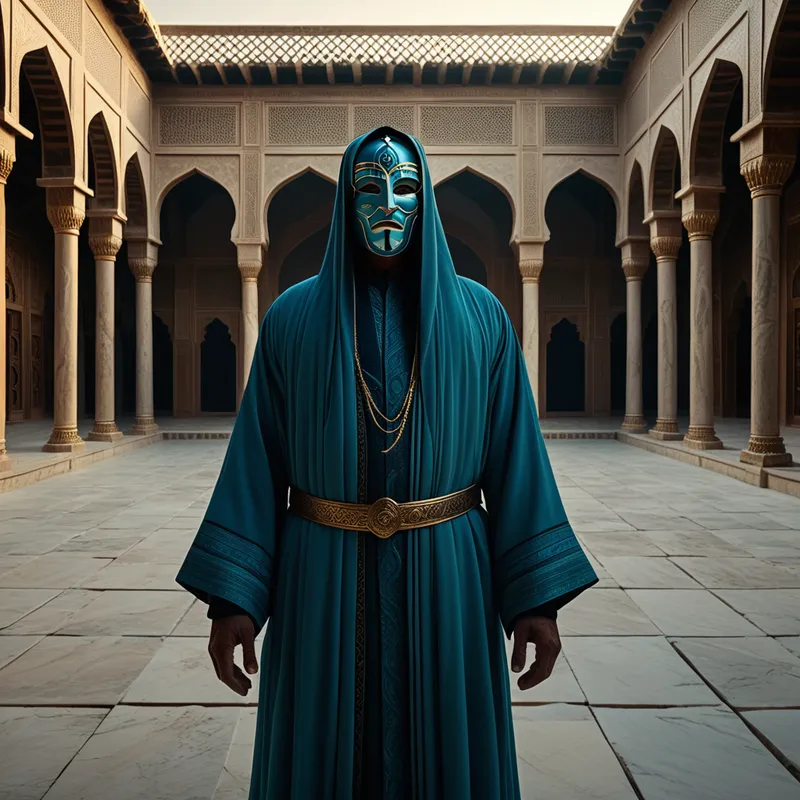
The Sleeper Awakened Myth Meaning & Symbolism
A man is tricked into believing a lavish fantasy is his true life, confronting the nature of reality, identity, and the self upon waking.
The Tale of The Sleeper Awakened
Listen, and let the sands of time part. In the luminous age of the Caliph Harun al-Rashid, there lived in Baghdad a man of modest means but noble heart, named Abu al-Hasan. His life was a simple rhythm: the comfort of his mother’s home, the company of honest friends, the peace of a quiet salat at dusk. Yet, in his cup of contentment, there lay a single drop of bitterness—a disdain for the pretensions and intrusions of the Persians in his city.
One evening, as he aired this grievance aloud in the street, fate, in the form of the disguised Caliph himself, overheard him. Intrigued by this passionate commoner, the Commander of the Faithful conceived a divine jest. He commanded his most trusted vizier, Ja’far al-Barmaki, to bring the man to the palace under cover of night, to be anointed with rosewater and dressed in the Caliph’s own regalia, and laid upon the royal bed.
Abu al-Hasan awoke to a symphony of servitude. A hundred voices whispered “Commander of the Faithful.” Silken hands proffered trays of ambergris and musk. He blinked in the blinding gold of the chamber, the weight of a heavy crown upon his brow. He protested—“I am Abu al-Hasan!”—but the courtiers merely smiled, insisting his majesty was recovering from a night of vivid dreams. They presented him with accounts of the kingdom, brought petitioners for his judgment, and led him to a feast that would shame the courts of Solomon. The sensory onslaught was absolute: the taste of spiced lamb and honeyed figs, the scent of oudh rising from braziers, the cool touch of marble under his bare feet, the dizzying sight of dancers like swirling constellations.
For days, the magnificent illusion held. He ruled, he feasted, he began to believe. Then, one night, he was given a sleeping draught. He awoke, not in the palace, but back in his old room in his mother’s house, wearing his simple clothes. His cries of protest were met with his mother’s worried tears. The palace, the throne, the title—all had vanished like a mirage. The solid world of his former life now felt like the dream, thin and insubstantial. He mourned the loss of his glorious fantasy, descending into a melancholy that baffled all who knew him.
The Caliph, observing this profound transformation, repeated the trick. Once more, Abu al-Hasan was spirited to the palace to “awaken” as the Caliph. But this time, the veil had been pierced. When the courtiers again addressed him as their sovereign, a terrible wisdom dawned in his eyes. He played along, but the flavor of the feast was now ash, the music a discordant hum. He had seen the machinery of the illusion. In a final, poignant act, he requested the singer who had performed on the night of his first “awakening” to sing the very same song. As the familiar notes filled the air, he wept—not for the lost palace, but for the lost certainty of his own self. He was neither the humble Abu al-Hasan nor the mighty Caliph, but a soul suspended between two truths, forever Awake to the question: what is real?
Cultural Origins & Context
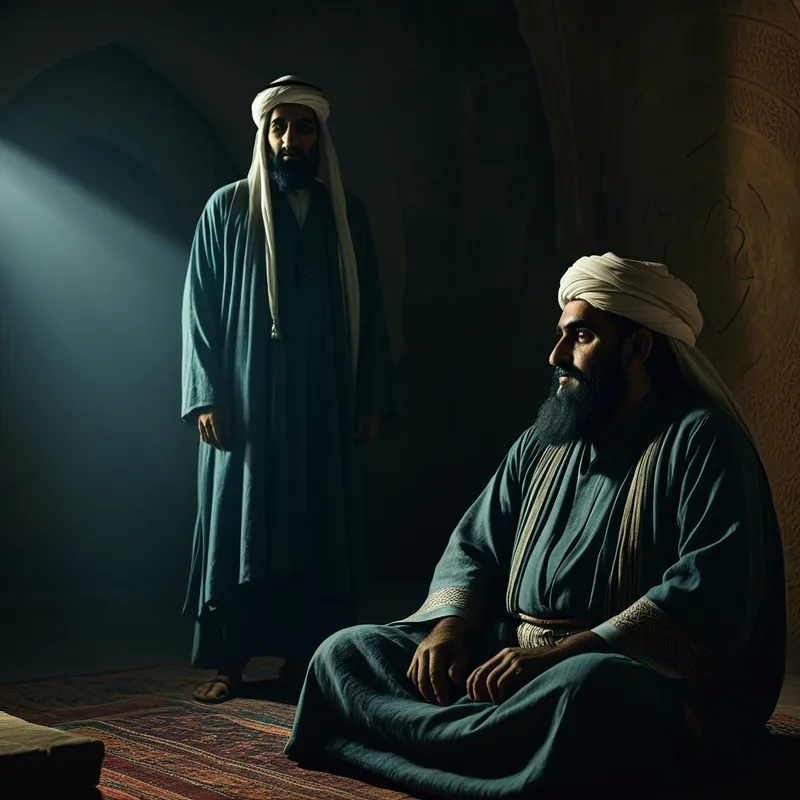
This intricate tale is woven into the immortal tapestry of One Thousand and One Nights. While often framed as an elaborate royal prank, its roots dig deep into the philosophical and mystical soil of the Islamic Golden Age. Baghdad, under the Abbasids, was a crucible where Greek philosophy, Persian storytelling, Indian mathematics, and Arab poetic tradition melded. In such an environment, stories were not mere entertainment; they were vessels for exploring profound questions of ontology, epistemology, and divine providence.
The tale would have been told in coffeehouses and courtly gatherings, serving multiple functions. On one level, it was a cautionary fable about the dangers of discontent and the perils of wishing for a life beyond one’s station. On another, it was a sophisticated satire on the nature of power and authority—if a common man can play the Caliph so convincingly, what is the foundation of the Caliph’s own legitimacy? Most deeply, it resonated with Sufi thought, which frequently employed metaphors of sleep and awakening to describe the soul’s journey from ignorance (jahiliyya) to gnosis (ma’rifa) of God. The story asks the listener, as it asked Abu al-Hasan: upon what throne do you base your identity?
Symbolic Architecture
The myth’s power lies in its layered symbolism, constructing a labyrinth where the protagonist—and by extension, the listener—must confront the architecture of their own perceived reality.
The greatest prison is the one whose walls you cannot see, whose gate you do not believe exists.
The Palace is the ultimate symbol of the Persona, an elaborate, gilded identity projected onto the individual by external forces (society, family, our own aspirations). It is convincing, beautiful, and feels utterly real until its context is shifted. The First Awakening represents the initial, often traumatic, inflation of the ego—a sudden identification with a grander, more powerful self-image. It is seductive and can feel like destiny.
The Second Awakening (back home) is the crucial confrontation with the Shadow. It is the collapse of the inflated ego, a brutal return to the repressed, “smaller” self one tried to escape. The ensuing depression is not a pathology but a necessary dissolution, the death of an illusion. The Final Repetition of the trick is where true consciousness emerges. Abu al-Hasan can no longer fully believe either reality. He occupies a liminal space—the birth of the Witness. He sees the game, and in that seeing, transcends its rules.
The Dreamer’s Resonance
When this mythic pattern stirs in the modern Dream, it signals a profound somatic and psychological reckoning. You may dream of suddenly being in a position of immense authority for which you feel utterly unprepared, or of returning to an old home that now feels alien and unreal. These are not simple anxiety dreams.
Somatically, this process often manifests as vertigo, a literal loss of grounding. The body, the anchor of reality, feels untethered. There can be a pervasive fatigue—the exhaustion of maintaining a fiction. Psychologically, it is the ego’s system undergoing a “hard reboot.” The dreamer is experiencing what Abu al-Hasan experienced: the deconstruction of a foundational self-narrative. This could be the story of “the successful one,” “the caretaker,” “the victim,” or “the intellectual.” The dream state acts as the Caliph’s servants, insistently presenting the old identity, testing the dreamer’s attachment to it. To awaken from such a dream is to feel a profound disorientation, but also the first, fragile breath of a more authentic air.
Alchemical Translation
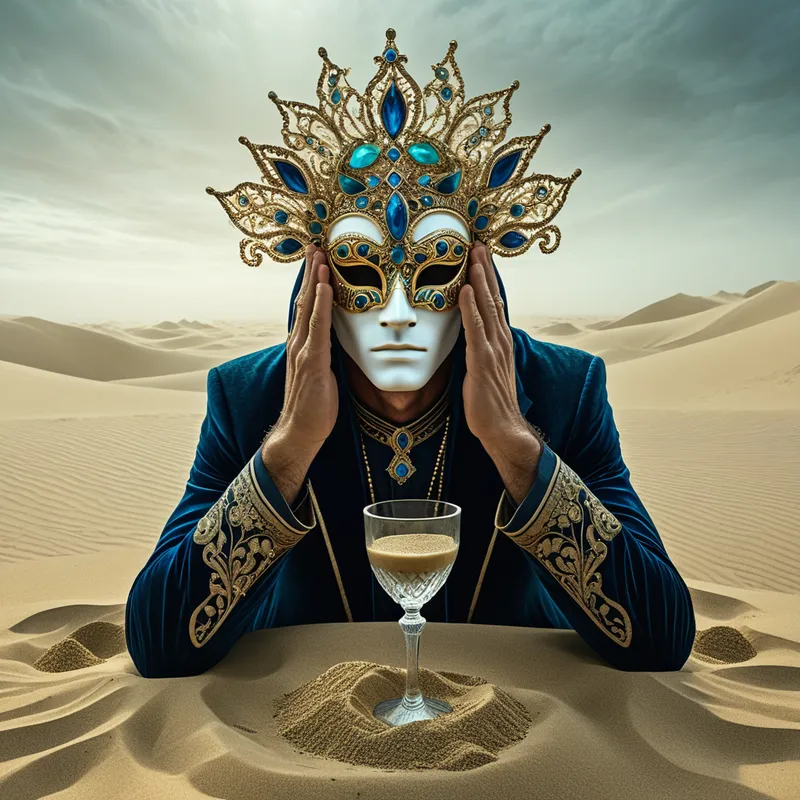
The myth of The Sleeper Awakened is a precise map of the alchemical Nigredo, the blackening, and the beginning of the Albedo. It models the individuation journey not as a heroic conquest, but as a disillusionment.
Individuation begins not with finding oneself, but with losing every self one thought one was.
The process starts with Projection (the Caliph projects a royal identity onto the commoner). We all live initially by projection, identifying with roles given by parents and culture. Then comes Inflation (Abu al-Hasan believes he is the Caliph). This is the “I am my job, my status, my relationship” phase. The crucial alchemical fire is Dissolution (the return home). Here, the materia prima—the crude stuff of the psyche—is broken down. The ego’s royal garments are stripped away, leaving the naked, confused core. This feels like failure, depression, a dark night.
The final, transcendent stage is Conscious Observation (the second palace experience). The individual no longer is the role, but can observe themselves playing it. This is the Lapis Philosophorum of this myth: the attainment of a perspective that can hold multiple, contradictory realities without being consumed by any single one. The goal is not to choose the humble home over the glorious palace, or vice versa. The goal is to become the one who knows he has lived in both, and in that knowing, becomes something more than either—a truly Awakened soul, sovereign over the inner kingdom of the self.
Associated Symbols
Explore related symbols from the CaleaDream lexicon:
- Dream — The primary medium of the myth, representing both the illusory nature of constructed reality and the deeper, truth-revealing function of the unconscious.
- Awaken — The core action and goal, signifying the traumatic but necessary shift from unconscious identification to conscious observation of one’s own life.
- Mask — The ornate persona of the Caliph that is placed upon Abu al-Hasan, symbolizing the social and psychological roles we wear and mistake for our true face.
- Palace — The gilded prison of the inflated ego, a magnificent but false identity constructed from external validation and personal aspiration.
- Home — The symbol of the original, perhaps neglected or rejected, self—the shadow realm one must return to and integrate.
- Mirror — The mechanism of the entire story, reflecting back a false image so convincingly that it forces a confrontation with the very nature of reflection and identity.
- Sleep — The state of unconscious living, of taking one’s life narrative and social role at face value without deeper questioning.
- Throne — The seat of power and identity; the myth asks who has the right to sit upon it, and exposes it as a transferable object, not an intrinsic quality.
- Key — Represented by the specific song that unlocks Abu al-Hasan’s memory and seals his disillusionment, a trigger that opens the door between realities.
- Shadow — The humble, rejected life of Abu al-Hasan that returns with a vengeance, containing the truth he tried to escape and the foundation for a more whole self.
- Ritual — The elaborate, repeated ceremony performed by the Caliph’s court, mirroring how societal and personal rituals reinforce our chosen identities until they feel like fate.
- Destiny — The central question of the myth: is our destiny the grand role we aspire to, or the humble truth we awaken to? It shows destiny as malleable, a story we co-create and can revise.