The Sistine Chapel Myth Meaning & Symbolism
A divine commission transforms a stone ceiling into a cosmic narrative of creation, judgment, and the human soul's yearning for transcendence.
The Tale of The Sistine Chapel
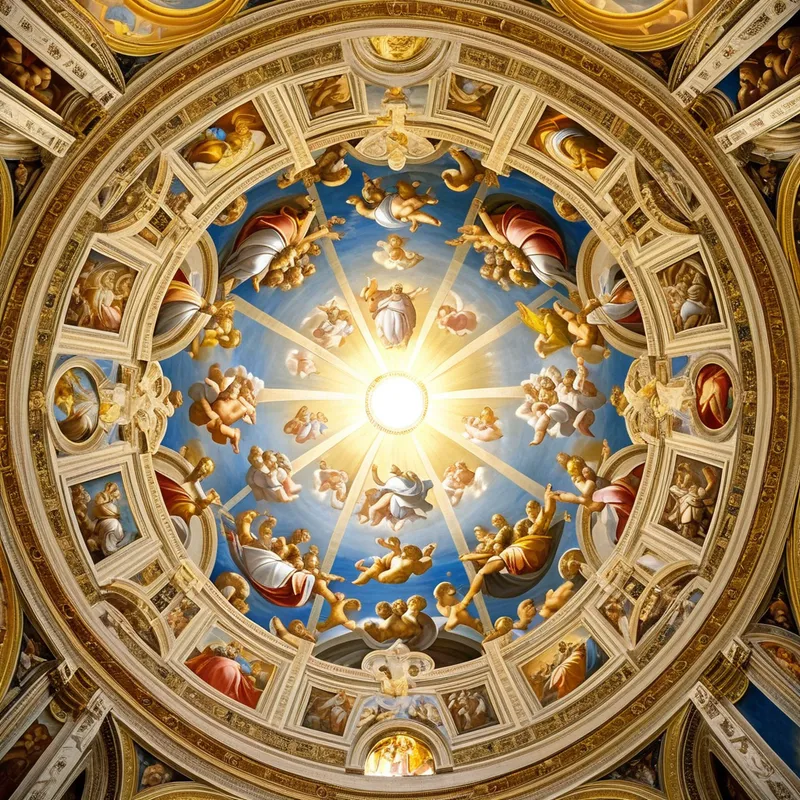
Listen, and hear a tale not of parchment, but of plaster and pigment. It begins not in a time, but in a space—a vast, hollow mountain of stone, a cavernous vessel built to hold the breath of the divine. Its walls were bare, its vault a barren, curved sky of waiting stone. And into this silence walked a man of fire and chisel, a sculptor named Michelangelo. He did not wish for this task. He was called, a reluctant prophet, to a labor that would break his body and sear his sight.
The conflict was the ceiling itself. It was a wilderness of empty plaster, a blankness that taunted the ambition of a pope. The rising action was the agony of creation. For four long years, the man lay on his back, his neck bent in perpetual prayer to the stone above. His world inverted; heaven was the wooden scaffold, earth the aching muscles of his spine. From his brush and mallet, a cosmos was born.
First, he divided the light from the dark. Then, from a swirl of divine energy, the Adam</ab title> was formed—not from below, but from above. A mighty hand, surrounded by a host of angels, reached across the void. A finger, charged with the spark of life, extended toward a languid, beautiful, yet inert hand. The space between them crackled with the unsaid word, the breath not yet given. You could feel the tension in the plaster—the divine urgency, the human potential, suspended in a heartbeat before contact.
The story unfolded across the curved firmament. The sun and moon were placed. The waters were gathered. Eve was drawn from the side of sleeping Adam, her form emerging as if from the very rock. Then came the Fall, the bitter fruit, the expulsion—a sweeping, tragic march from a garden of delicate colors into a harsh, barren world, driven by a fiery angel’s sword.
And at the far end, where the altar waits, he painted the end of all things: The Last Judgment. Here, the Christ is not the gentle shepherd, but the cosmic judge, his raised hand a gesture of terrible finality. Bodies rise from the earth, some drawn upward by hope, others dragged down by their own weight into a churning darkness. The entire narrative, from the first spark to the final reckoning, arcs across that stone sky—a complete epic of origin, fall, and destiny, witnessed by prophets and sibyls who line the vault, their bodies twisted with the strain of seeing eternity.
Cultural Origins & Context
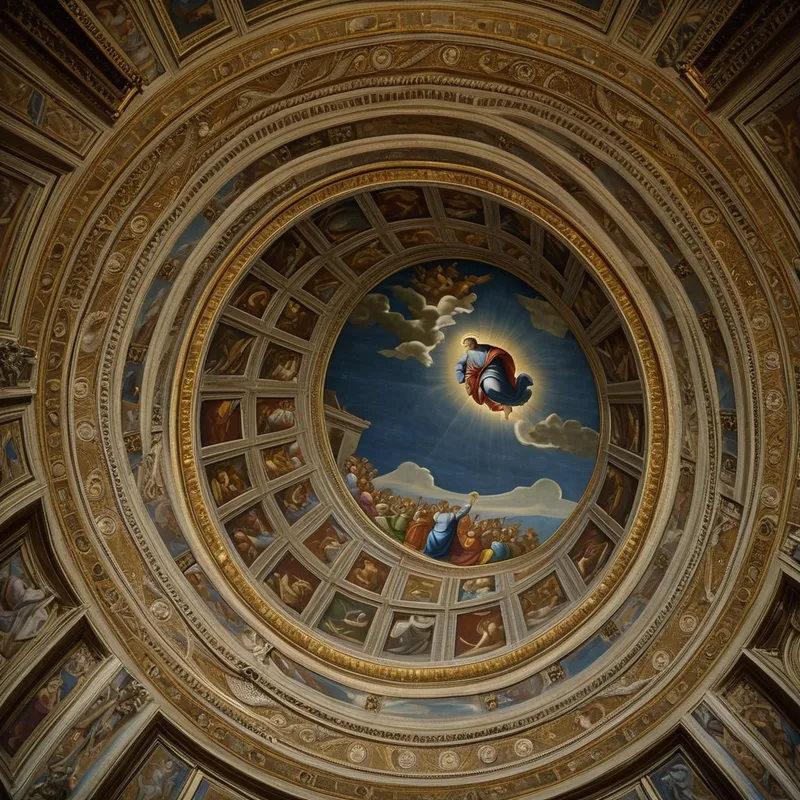
This is a myth born in the crucible of the Renaissance, a time when human intellect and divine faith engaged in a fervent, sometimes tense, dialogue. The patron, Pope Julius II, was a warrior-pope seeking to assert the power and glory of the Church through monumental art. The Sistine Chapel itself was the papal chapel, the site of the conclave where cardinals elect a new pope. Its walls were already adorned with frescoes of the lives of Moses and Christ by masters like Botticelli.
The ceiling’s narrative was not a spontaneous vision but a carefully constructed theological argument, devised by papal theologians. It was a visual catechism for the elite, a way to solidify doctrine and inspire awe in a largely illiterate world. Michelangelo, however, was the vessel. The myth was passed down not orally, but visually, through the silent, overwhelming presence of the images themselves. For centuries, only a privileged few—popes, cardinals, artists—witnessed it directly. Its societal function was dual: to glorify God and the Church that claimed to be His conduit, and to place humanity, in all its flawed grandeur, at the center of the divine drama.
Symbolic Architecture
The Sistine Chapel ceiling is not merely a Bible story; it is a map of the soul’s architecture. The ceiling itself symbolizes the vault of the heavens, the dome of the skull, and the collective psyche of Western civilization. It represents the human aspiration to project our deepest stories onto the cosmos, to find our narrative in the stars.
The space between the fingers of God and Adam is the most charged void in all of art—it is the gap between potential and being, between the call of the Self and the consciousness of the ego.
Adam represents the nascent human ego—beautiful, receptive, but passive, awaiting the animating spark of the divine, the connection to the greater Self. The Prophets and Sibyls encircling the central scenes are the archetypal voices of intuition and foresight, the parts of the psyche that perceive patterns and destinies larger than the individual. The Last Judgment on the altar wall is the ultimate confrontation with the Shadow—the inevitable moment when all that has been repressed, denied, or unlived rises for integration or condemnation.
The Dreamer's Resonance
To dream of the Sistine Chapel is to dream of a vast, internal cosmology. The dreamer may find themselves lying on their back, looking up at a painted ceiling in a familiar room that has suddenly become sacred and immense. The somatic feeling is one of awe mixed with neck-strain—the tension between the longing for transcendence and the physical limitations of the body.
Psychologically, this dream emerges when the individual is undergoing a profound process of re-contextualizing their life’s narrative. The “ceiling” is the upper limit of their current consciousness. The figures painted upon it are the archetypal forces, inherited beliefs, and cultural scripts that define their world. The dream signals a moment where these overarching patterns are being examined, perhaps for the first time. The feeling of being small beneath it reflects the ego’s humility before the psyche’s grand design. It is a dream of being inside the myth that made you, and sensing a call to either submit to its judgment or participate in its ongoing creation.
Alchemical Translation
The alchemical process modeled here is the opus magnum—the great work of transforming base matter (plaster, the mundane self) into spiritual gold (a vision of wholeness). Michelangelo’s reluctant, painful labor is the nigredo, the blackening, the descent into the arduous, introverted work of the soul. The application of vibrant color onto the intonaco is the albedo, the whitening, where insights begin to crystallize into form.
The entire chapel becomes a vas hermeticum, a sealed container where the opposites—divine/human, creation/judgment, prophecy/ignorance—are held in tension until a transcendent third emerges.
The final stage, the rubedo or reddening, is not in the completion of the paint, but in the experience of the viewer. It is the moment of awe, the mysterium tremendum et fascinans, when the individual standing in that space feels the totality of the narrative arc within themselves. They see their own innocent potential (Adam), their falls and exiles, their moments of prophetic insight, and they face their personal last judgment—not as damnation, but as the necessity of integrating their shadow to achieve wholeness. The myth teaches that individuation is a cosmic drama played out on the ceiling of one’s own soul, a relentless, beautiful, and terrifying act of creation for which we are both the artist and the fresco.
Associated Symbols
Explore related symbols from the CaleaDream lexicon: