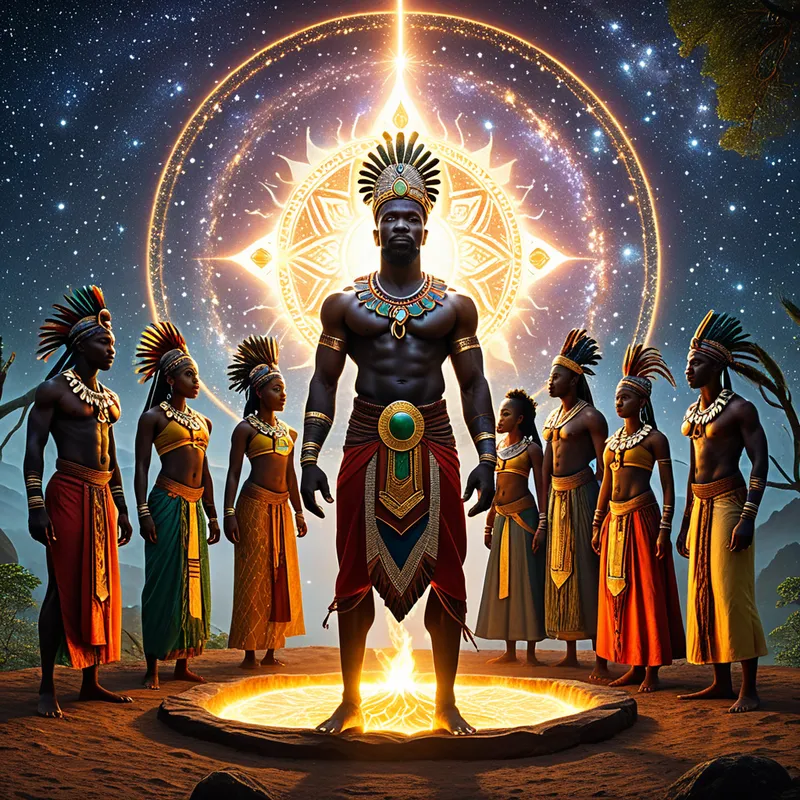
The Seven African Powers Myth Meaning & Symbolism
A myth of seven divine forces, fragmented by a great scattering, who must be remembered and reunited to restore balance and power to a displaced people.
The Tale of The Seven African Powers
Listen. There is a story woven not in thread, but in memory, carried not on papyrus, but on the salt-wind breath of the Middle Passage.
Before time was counted as it is now, the world was whole. The orisha walked openly with humanity. Their power was the rhythm of the earth, the logic of the storm, the compassion of the river. They were a council of seven: the unyielding justice of Ogun in his forge; the deep, nurturing mystery of Yemaya</ab title> in her moonlit ocean; the fierce, transformative truth of Shango in his thunderous dance; the wise, healing touch of Osain in his whispering grove; the clarifying, cutting destiny of Elegua at the path's beginning; the sustaining, grounding abundance of Oya in her windswept marketplace; and the radiant, sovereign order of Obatala on his mountain of creation.
Their harmony was the song of existence. But a great forgetting was coming. A rupture, vast and violent as a continent cracking. A wind of chains and sorrow rose, a storm that did not cleanse but scattered. It was the Great Scattering. The people were torn from the soil that knew their names, and the orisha, whose power is rooted in relationship, were fragmented. Their unified song shattered into seven lonely notes, cast across a brutal, gray ocean.
In the hold of the ship, in the heat of the field, in the secrecy of the night, the people felt the silence where the song had been. A profound amnesia threatened the soul itself. But in the darkness, a grandmother hummed a fragment of a rhythm that sounded like waves. A man striking iron felt a forgotten fire in his blood. A woman tending herbs sensed a root’s secret voice. A child drawing in the dirt made a pattern of crossroads.
They were not just remembering. They were calling. From the forge’s spark, Ogun’s resilience. From the laundry stone by the river, Yemaya’s solace. From the sudden summer storm, Shango’s defiant power. From a bundle of leaves, Osain’s remedy. From a forked stick in the path, Elegua’s choice. From the whirlwind of change, Oya’s transformative force. From the longing for peace and creation, Obatala’s clarity.
One by one, the notes were found. Not in their original grandeur, but in the grit of survival. The Seven were not lost; they were hidden in the work of the hands, the resilience of the spirit, the coded language of song and story. The myth tells that they were reunited not in a distant heaven, but here, in the very act of remembrance. In the simmering pot that became an altar, in the rhythmic strike that became prayer, in the quilt sewn with hidden maps. The council was reconvened in diaspora. Their power was no longer a given of the land, but a hard-won truth of the spirit, a sacred alliance forged in the crucible of displacement. The song was remade, different, scarred, but unbroken. A new harmony, born of fracture and fierce love.
Cultural Origins & Context
This is not a myth of a singular, ancient text, but a living narrative emergent from the crucible of the Transatlantic Slave Trade. Its roots are primarily in the Yoruba traditions of West Africa, where the veneration of a pantheon of orishas was a complex, societal spiritual practice. The "Seven African Powers" represents a profound act of cultural syncretism and survival within the African Diaspora, particularly in the Caribbean and the Americas.
Enslaved Africans, violently stripped of their languages, families, and direct ties to their land-based shrines, performed a miraculous feat of spiritual memory. They recognized the core essences of their deities in the saints of Catholicism imposed upon them—Yemaya found in Our Lady of Regla, Ogun in Saint Peter, Shango in Saint Barbara. This was not mere hiding, but a profound alchemical translation. The myth was passed down not by bards in courts, but by elders in kitchens, by practitioners in clandestine ceremonies, by the rhythms in work songs and the symbols in folk art. Its societal function was, and remains, one of re-membering: putting the fragmented self and community back together, asserting a divine identity and a source of power in the face of systemic attempts to annihilate both.
Symbolic Architecture
At its heart, the myth is a blueprint for psychic integration in a state of profound dislocation. The Seven are not merely external gods; they represent the seven core faculties of a complete human spirit fractured by trauma.
The journey from fragmentation to wholeness is not a return to a lost Eden, but the courageous assembly of a new soul from the scattered pieces of the old.
Elegua is the archetype of the beginning, the spark of consciousness and choice that initiates any healing journey. Ogun is the will, the focused force required to cut through internal and external obstacles. Yemaya is the deep, unconscious emotional body, the source of nurture and primal feeling. Shango is the fiery energy of passion, justice, and righteous anger that must be mastered. Osain is the intuitive, natural wisdom of the body and the earth. Oya is the spirit of sudden change, transformation, and the winds that sweep away the old. Obatala is the higher mind, the seat of consciousness, ethics, and the drive toward ordered creation. The "Great Scattering" is the universal experience of trauma, oppression, or profound loss that dis-integrates these inner faculties.
The Dreamer's Resonance
When this myth stirs in the modern dreamscape, it often manifests as dreams of searching for lost objects in a vast, unfamiliar landscape, or of trying to assemble a broken vessel whose pieces are scattered across different rooms or worlds. The dreamer may encounter seven distinct figures, or see seven colors, lights, or sounds that feel vitally important but disconnected.
Somatically, this can correlate with a feeling of being "all over the place," of having one's energy, focus, and emotional center fragmented. Psychologically, it indicates a process where parts of the self—perhaps the assertive part (Ogun), the nurturing part (Yemaya), the passionate part (Shango)—have been dissociated or suppressed due to life's "scatterings": grief, burnout, identity crises, or relational trauma. The dream is the psyche's ritual space, beginning the work of calling these exiled parts home, of sensing the specific "note" each one carries.
Alchemical Translation
The individuation process modeled here is not the classical Jungian journey of a hero to a central, monolithic Self. It is the diaspora of the Self—a model for those whose wholeness must be a federation, a council, a dynamic harmony of powers that have known separation.
The alchemy occurs in the act of sacred naming: to look at your wound and call it Ogun's forge, to feel your grief and call it Yemaya's ocean, to harness your rage and call it Shango's lightning. This is the transmutation of suffering into sovereignty.
The first step is Elegua's recognition: acknowledging the crossroads, the need for change. Then, Ogun's work: the disciplined, often painful effort of introspection and boundary-setting. Yemaya's embrace: allowing the deep feelings to surface and be held. Shango's truth: claiming one's right to exist and be respected. Osain's remedy: seeking healing and intuitive guidance. Oya's transformation: allowing old identities to be swept away. Finally, Obatala's clarity: synthesizing these experiences into a new, conscious, and ethical way of being. The goal is not to erase the scars of the scattering, but to weave them into the fabric of a power that is resilient precisely because it is composite, remembered, and fiercely chosen.
Associated Symbols
Explore related symbols from the CaleaDream lexicon:
- Ocean — The vast, traumatic space of the Middle Passage and the deep, unconscious emotional realm of Yemaya, representing both the cause of fragmentation and the source of nurturing wisdom.
- Key — Held by Elegua, it symbolizes the opening of doors to forgotten parts of the self and the unlocking of destiny through conscious choice.
- Fire — The transformative and purifying force of Shango, representing righteous anger, passion, and the catalytic energy needed for change.
- Tree — The sacred domain of Osain, symbolizing rooted wisdom, natural healing, and the interconnected network of life that survives transplantation.
- Circle — The ultimate symbol of the reconvened council, representing wholeness, unity, protection, and the cyclical nature of fragmentation and healing.
- Ritual — The embodied practice of remembrance through which the scattered powers are called back and honored, turning daily acts into sacred communion.
- Root — The connection to ancestral source and original identity that persists beneath the trauma of displacement, seeking new ground in which to grow.
- Mask — The necessary guise of syncretism, where the faces of saints concealed the orishas, representing the survival of inner truth through adaptive outer forms.
- Bridge — The spiritual and psychological connection forged between the ancestral homeland and the diaspora, between the fragmented self and the integrated whole.
- Iron — The substance of Ogun, symbolizing resilience, strength, tools of survival, and the will to cut a path forward.