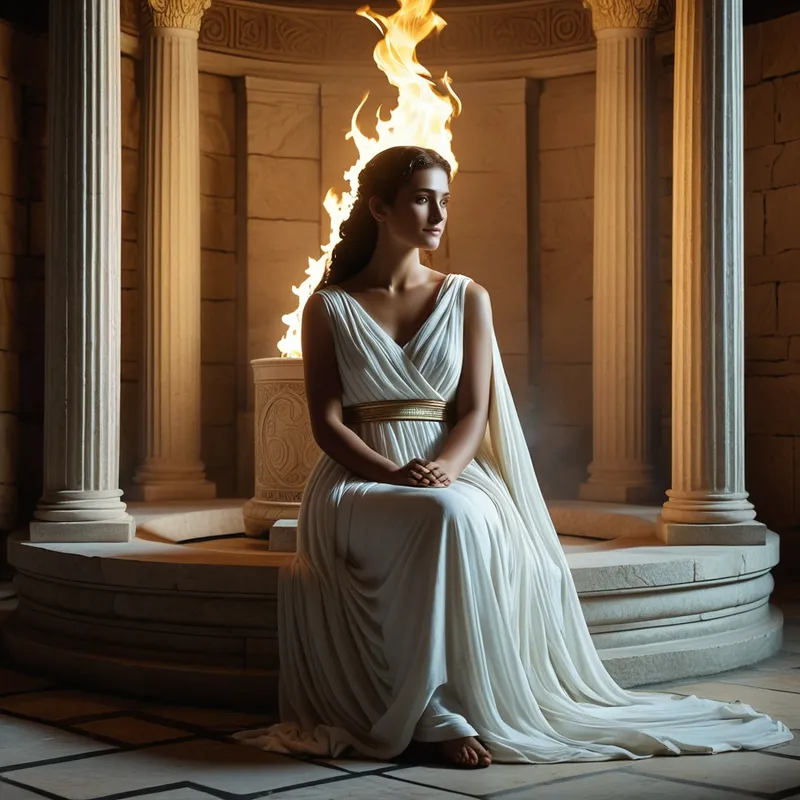
The Roman goddess Vesta Myth Meaning & Symbolism
The goddess of the sacred hearth, whose eternal flame represents the unbroken center of home, state, and soul, guarded by the Vestal Virgins.
The Tale of The Roman goddess Vesta
Before the first stone of Rome was laid, before the first king drew breath, there was [the Hearth](/myths/the-hearth “Myth from Norse culture.”/). And from the Hearth, there was [Vesta](/myths/vesta “Myth from Roman culture.”/).
She was not a goddess of distant mountains or capricious seas, but of the center. Her domain was the circle of warmth at the heart of every home, the crackle of the first fire lit against the primordial dark. When [the world](/myths/the-world “Myth from Tarot culture.”/) was formless and cold, it was Vesta who taught mortals to kindle not just fire for cooking, but fire for being. To gather around a single point of light and call it family, call it community, call it sacred.
In the misty dawn of the city, her divine will took form in a temple unlike any other. It was not a rectangle reaching for the heavens, but a circular hut, a tholos, echoing the shape of the primitive roundhouse and the very curve of [the womb](/myths/the-womb “Myth from Various culture.”/). Its door was not of wood, but of woven wicker, a permeable boundary between the profane world and the holy interior. And within, there was no statue, no idol of gold or marble. There was only the Fire.
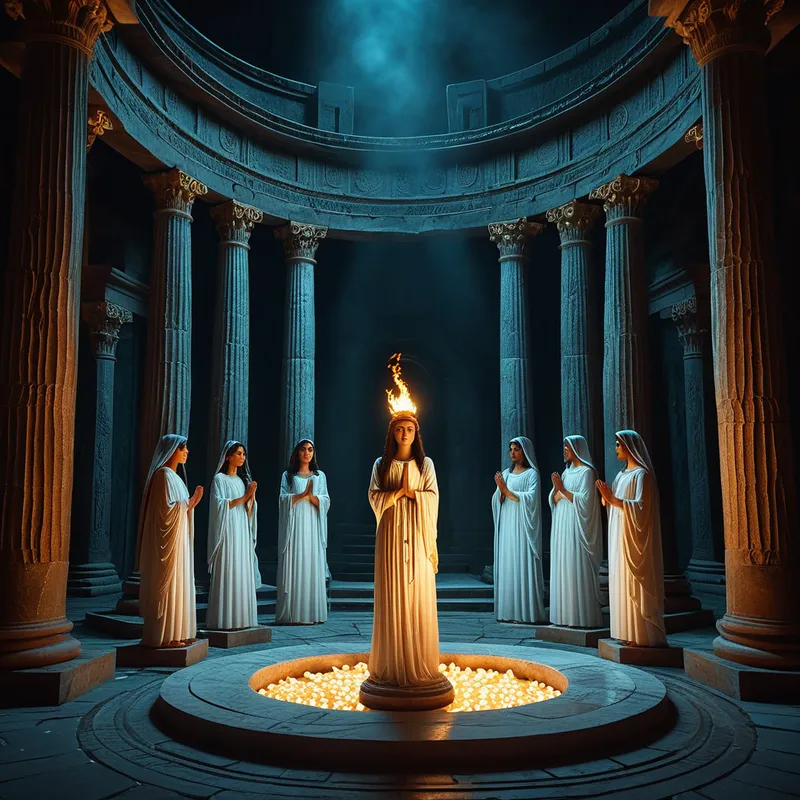
This was the Aedes Vestae, and its flame was the breath of Rome itself. To let it die was to sever the city’s soul from its founding moment, to unravel the covenant with the gods. So, the daughters of Rome were chosen. Six girls, taken from noble families before the age of ten, sworn to Vesta for thirty years. They became the Vestal Virgins.
Their lives were a living ritual. They drew [water](/myths/water “Myth from Chinese culture.”/) from a sacred spring, baked the holy mola salsa, and above all, they tended the Flame. Day and night, through festival and famine, war and peace, their watch was unceasing. They moved through the Forum in solemn procession, their white robes and elaborate headdresses marking them as both utterly human and utterly set apart. Their purity was not merely physical chastity; it was the integrity of the center, the unbroken attention required to maintain the source.
And the world outside that circular temple knew chaos. Kings fell. Consuls argued. Legions marched and bled. Yet, within the wicker doorway, the flame persisted—a silent, unwavering witness. It was the promise that no matter how far the empire stretched, its heart remained here, in this humble round space, guarded by women who had forgone personal lineage to become the mothers of the state’s continuity. The fire was the soul of the home, magnified to become the soul of the civilization. Its gentle, constant light was the one [thing](/myths/thing “Myth from Norse culture.”/) Rome dared not live without.
Cultural Origins & Context
Vesta’s origins are profoundly archaic, reaching back to the Indo-European past. Her name is cognate with the Greek [Hestia](/myths/hestia “Myth from Global/Universal culture.”/), and both descend from the Proto-Indo-European root for “hearth” and “to burn.” She represents one of the most ancient and fundamental layers of Roman religion: the cult of the [household gods](/myths/household-gods “Myth from Ancient Egyptian culture.”/), the [Lares](/myths/lares “Myth from Roman culture.”/) and [Penates](/myths/penates “Myth from Roman culture.”/), who were nourished by the hearth’s flame.
Her public cult was uniquely Roman, however, and central to the Roman conception of the state as an extended family. [The Temple](/myths/the-temple “Myth from Jewish culture.”/) of Vesta stood in the Roman Forum, the political and civic heart of the city, yet its form was domestic. This was the brilliant synthesis: the state was the home. The Vestals, though priestesses of a major public cult, performed duties any Roman matron would perform at her own hearth—cleaning, fetching water, preparing ritual food.
The myth was not passed down as a narrative of adventures, but as a living, breathing institution. Its “story” was the ritual itself, performed daily for over a thousand years. It was told through the sight of the Vestals, through the public prayers for the flame’s safety, and through the absolute terror that gripped the city if the fire ever went out—an omen of catastrophic doom. Its societal function was anchoring. In a world of conquest, change, and ambition, Vesta’s cult was the immutable center, the psychological and spiritual anchor that allowed for all that outward expansion.
Symbolic Architecture
Vesta is the [archetype](/symbols/archetype “Symbol: A universal, primordial pattern or prototype in the collective unconscious that shapes human experience, behavior, and creative expression.”/) of the sacred center. She is not the [goddess](/symbols/goddess “Symbol: The goddess symbolizes feminine power, divinity, and the nurturing aspects of life, embodying creation and wisdom.”/) of fire’ destructive or transformative power, but of its sustaining, illuminating, and unifying [presence](/symbols/presence “Symbol: Presence in dreams often signifies awareness or acknowledgment of something significant in one’s life.”/). Her [symbolism](/symbols/symbolism “Symbol: The use of symbols to represent ideas or qualities, often conveying deeper meanings beyond literal interpretation. In dreams, it’s the language of the unconscious.”/) is an [architecture](/symbols/architecture “Symbol: Architecture in dreams often signifies structure, stability, and the framing of personal identity or life’s journey.”/) of the [soul](/symbols/soul “Symbol: The soul represents the essence of a person, encompassing their spirit, identity, and connection to the universe.”/).
The hearth is not merely where the fire burns; it is the axis mundi of the domestic world, the still point around which all daily life revolves.
The circular [temple](/symbols/temple “Symbol: A temple often symbolizes spirituality, sanctuary, and a deep connection to the sacred aspects of life.”/) symbolizes wholeness, containment, and the sacred [boundary](/symbols/boundary “Symbol: A conceptual or physical limit defining separation, protection, or identity between entities, spaces, or states of being.”/). It is a [temenos](/myths/temenos “Myth from Greek culture.”/), a protected psychic [space](/symbols/space “Symbol: Dreaming of ‘Space’ often symbolizes the vastness of potential, personal freedom, or feelings of isolation and exploration in one’s life.”/) where the core [identity](/symbols/identity “Symbol: Identity represents the sense of self, encompassing personal beliefs, cultural background, and social roles.”/)—of a person, a [family](/symbols/family “Symbol: The symbol of ‘family’ represents foundational relationships and emotional connections that shape an individual’s identity and personal development.”/), a nation—is safeguarded. The eternal flame is the [symbol](/symbols/symbol “Symbol: A symbol can represent an idea, concept, or belief, serving as a powerful tool for communication and understanding.”/) of conscious continuity, the unbroken thread of [awareness](/symbols/awareness “Symbol: Conscious perception of self, surroundings, or internal states. Often signifies awakening, insight, or heightened sensitivity.”/) and tradition that links past, present, and future. It is the light of [consciousness](/symbols/consciousness “Symbol: Consciousness represents the state of awareness and perception, encompassing thoughts, feelings, and experiences.”/) itself, which must be tended lest it [flicker](/symbols/flicker “Symbol: A brief, unstable light or movement suggesting transition, uncertainty, or the ephemeral nature of perception and reality.”/) and die.
The Vestal Virgins embody the psychological principle of dedicated [attention](/symbols/attention “Symbol: Attention in dreams signifies focus, awareness, and the priorities in one’s life, often indicating where the dreamer’s energy is invested.”/). Their chastity is a profound symbol of psychological integrity—the [energy](/symbols/energy “Symbol: Energy symbolizes vitality, motivation, and the drive that fuels actions and ambitions.”/) (libido) that might go into creating biological progeny is instead wholly consecrated to maintaining the central, spiritual fire of the [community](/symbols/community “Symbol: Community in dreams symbolizes connection, support, and the need for belonging.”/). They represent the part of the [psyche](/myths/psyche “Myth from Greek culture.”/) that must remain objective, devoted, and set apart from personal dramas to serve the greater, enduring Self.
The greatest taboo—allowing the flame to die—symbolizes the catastrophic [loss](/symbols/loss “Symbol: Loss often symbolizes change, grief, and transformation in dreams, representing the emotional or psychological detachment from something or someone significant.”/) of center, a descent into psychic [dissolution](/symbols/dissolution “Symbol: The process of breaking down, dispersing, or losing form, often representing transformation, release, or the end of a state of being.”/) where identity and meaning are extinguished.
The Dreamer’s Resonance
When the myth of Vesta stirs in the modern unconscious, it often manifests in dreams of core sanctuary or its terrifying absence.
One may dream of a single, perfectly maintained room in a dilapidated house, a warm light in a vast cold landscape, or a small, precious flame they must protect from howling winds. These dreams point to the dreamer’s successful, if fragile, maintenance of an inner sanctum—a sense of self, a value, or a creative spark that is being consciously tended amidst life’s chaos.
Conversely, dreams of extinguished hearths, cold ashes, or frantic, failed attempts to relight a fire signal a “Vesta crisis.” The dreamer may be experiencing burnout, a loss of spiritual or emotional center, or a feeling that their fundamental identity is under threat. The somatic experience is often a deep, cold emptiness in the chest or gut—the hearth gone dark. The psychological process is one of re-finding and re-consecrating what is truly central, often requiring a withdrawal from external demands to stoke the inner flame.
Alchemical Translation
The alchemical process modeled by Vesta is not one of dramatic death and rebirth, but of sacred maintenance. In the journey of individuation, we are not always called to slay dragons; we are perpetually called to tend the fire.
Individuation is not only the heroic quest for the gold; it is the daily, humble labor of keeping the crucible at the right temperature.
The first step is establishing the temenos—creating a protected, regular practice (meditation, journaling, art) that serves as our circular temple. This is the sacred space where the noise of the [persona](/myths/persona “Myth from Greek culture.”/) and the demands of the outer world are held at bay.
The second is kindling and identifying the central flame. What is the non-negotiable source of light and warmth in our psyche? Is it a core value, a relationship to the divine, a creative purpose? This flame is our inner Vesta.
The third and lifelong task is the Vestal service. This is the discipline of daily attention. We must “fetch the sacred water” of introspection, “clean the temple” of distracting complexes, and vigilantly guard the flame from the “winds” of cynicism, neglect, and fragmentation. We consecrate a portion of our life-energy—our inner virgin—exclusively to this maintenance.
The ultimate alchemical translation is the realization that this inner hearth is the Philosopher’s Stone. It is the incorruptible, eternal center that transmutes the base metals of chaotic experience into the gold of meaning. It is the fire that does not consume, but sustains; the light that does not blind, but reveals the true shape of home, wherever we are. To become the keeper of one’s own flame is to achieve the most profound and quiet victory: the unbroken continuity of [the Self](/myths/the-self “Myth from Jungian culture.”/).
Associated Symbols
Explore related symbols from the CaleaDream lexicon: