The River of Milk Myth Meaning & Symbolism
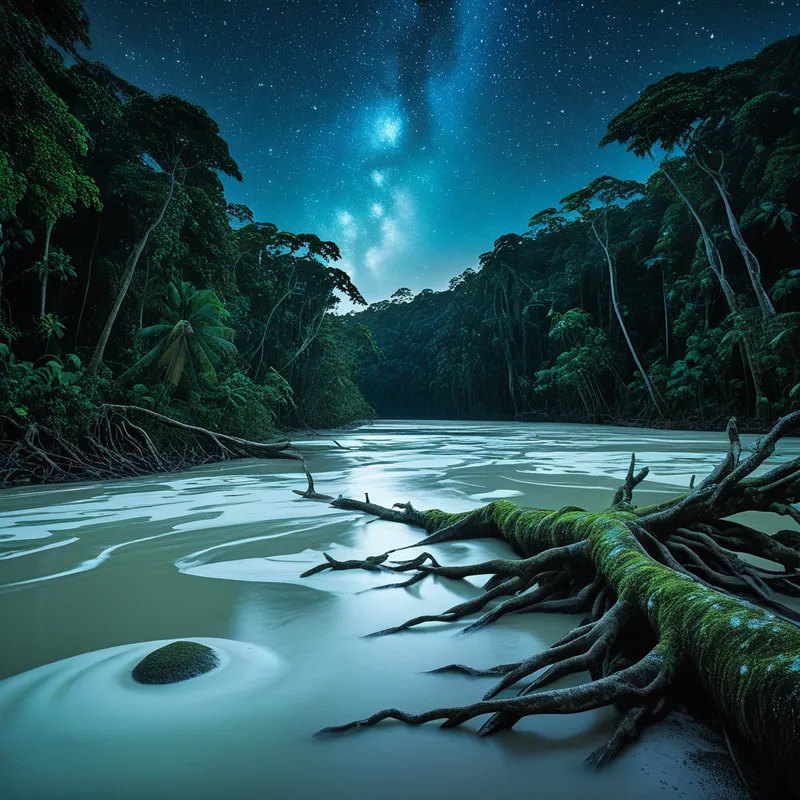
A celestial goddess weeps a river of life-giving milk, creating the world and offering a path of nourishment and remembrance to all beings.
The Tale of The River of Milk
In the time before time, when the world was a single, dreaming seed, there was only the Great Darkness and the First Song. From the song, a being of light coalesced—Yara, the One Who Hears the Forest Breathe. She held within her the potential for all life, a warmth like a womb holding countless stars. But the darkness was silent, and the song echoed without reply. A profound loneliness, vast and deep as the sky, grew within her.
This loneliness became a pressure, a sorrow that had no name, for there was nothing yet to name. It swelled in her heart, a tightness that sought release. She looked into the endless dark, and from her eyes, the first tears fell. They were not tears of water, but of her own essence, her life-force, her nourishment. They fell as a stream of radiant, warm milk, pure and white as the heart of the moon.
The milk did not vanish into the dark. It pooled, then began to flow, carving a path through the formless void. Where it touched, the darkness shivered and became substance. The first banks of soft, dark earth rose to contain the flow. From these banks sprouted the first tendrils of green—not yet trees, but the promise of them. The river grew, fed by Yara’s endless, silent weeping. It became a great, winding artery of light, a Iara-ete, flowing through the newborn world.
As the river flowed, its nourishing spray touched the earth. Where each drop landed, life quickened. Hard shells of seeds softened and split. Insects hummed to life on newly-formed leaves. The first birds, their feathers still damp with creation, found their voices in the branches that now reached over the flowing milk. The forest grew dense and loud around the river, a chorus answering Yara’s original, lonely song. The river was not just water; it was the first food, the first drink, the first medicine. The jaguar and the tapir drank side-by-side, their animosity not yet born. The people, when they emerged from the clay of the riverbank, knew to cup their hands and drink, and in drinking, they remembered—not a memory of a thing, but the memory of being connected, of being part of the great flow from which they came.
Yara’s tears did not cease. To sustain the world, her sacrifice had to be eternal. She became the sky, her body the canopy of night, and the river of milk became a shimmering path across the heavens and a hidden current beneath the earth, surfacing in sacred springs and in the milk of every mother that nourishes her child. The world was alive, fed by a river of sacred tears, a testament that from profound solitude comes the ultimate act of nourishing creation.

Cultural Origins & Context
This myth, known in fragments and variations across numerous Indigenous Amazonian cultures, belongs not to a written canon but to the oral tapestry of the rainforest itself. It is a story told by elders, shamans, and grandmothers, often during rituals of initiation, childbirth, or healing. Its transmission is performative and situational, woven into songs, body paints, and the very instructions for preparing sacred drinks.
Its societal function is multifaceted. Primarily, it is an etiological myth, explaining the origin of the Amazon River and its life-sustaining power, as well as the Milky Way galaxy (Caminho da Anta). More profoundly, it establishes a cosmological principle of reciprocal care. The world exists because of a divine act of self-sacrificial nourishment. This sets the ethical template for human society: to take from the forest (to drink from the river, to hunt, to gather) is to participate in a sacred exchange that demands gratitude, ritual, and reciprocal care-taking. The myth encodes the sacredness of motherhood and breastmilk, positioning the act of nursing as a microcosm of Yara’s cosmic nourishment. It is a narrative anchor for ecological knowledge, reminding people that the river’s abundance is not a given but a continuous gift from a conscious, feeling cosmos.
Symbolic Architecture
At its core, the [River](/symbols/river “Symbol: A river often symbolizes the flow of emotions, the passage of time, and life’s journey, reflecting transitions and movement in one’s life.”/) of Milk is the archetypal [symbol](/symbols/symbol “Symbol: A symbol can represent an idea, concept, or belief, serving as a powerful tool for communication and understanding.”/) of the [Life](/symbols/life “Symbol: The symbol of ‘Life’ represents a journey of growth, interconnectedness, and existential meaning, encompassing both the joys and challenges that define human experience.”/)-Giving Feminine. It is not a passive [landscape](/symbols/landscape “Symbol: Landscapes in dreams are powerful symbols representing the dreamer’s emotional state, personal journey, and the broader context of life situations.”/) feature but an active, sentient flow of psychic and physical sustenance.
The River of Milk represents the primordial substrate of the Soul—the unconscious in its nourishing, generative aspect, from which all consciousness and identity emerge.
The figure of Yara embodies the ultimate [paradox](/symbols/paradox “Symbol: A contradictory yet true concept that challenges logic and perception, often representing unresolved tensions or profound truths.”/) of creation: that life springs from a wound, from a [rupture](/symbols/rupture “Symbol: A sudden break or tear in continuity, often representing abrupt change, separation, or the shattering of established patterns.”/) of wholeness (her solitude) that manifests as a flow (her tears). Her [loneliness](/symbols/loneliness “Symbol: A profound emotional state of perceived isolation, often signaling a need for connection or self-reflection.”/) is not a personal failing but the necessary precondition for [relationship](/symbols/relationship “Symbol: A representation of connections we have with others in our lives, often reflecting our emotional state.”/). The milk is her essence given form; it is [emotion](/symbols/emotion “Symbol: Emotion symbolizes our inner feelings and responses to experiences, often guiding our actions and choices.”/) made substance, demonstrating that deep feeling is not merely internal but is world-forming. The river’s dual [nature](/symbols/nature “Symbol: Nature symbolizes growth, connectivity, and the primal forces of existence.”/)—celestial ([Milky Way](/symbols/milky-way “Symbol: The Milky Way represents both the vastness of the universe and the interconnectedness of existence, serving as a metaphor for the journey of life and cosmic consciousness.”/)) and terrestrial (Amazon)—symbolizes the bridge between the spiritual and the [material](/symbols/material “Symbol: Material signifies the tangible aspects of life, often representing physical resources, desires, and the physical world’s influence on our existence.”/), the ideal and the manifest. To drink from it is to internalize this bridge, to remember one’s divine origins while being fully embodied.
The myth also presents a non-[linear](/symbols/linear “Symbol: Represents order, predictability, and a direct, step-by-step progression. It symbolizes a clear path from cause to effect.”/), cyclical model of time and nourishment. The river is not a one-time [event](/symbols/event “Symbol: An event within dreams often signifies significant life changes, transitions, or emotional milestones.”/) but a perpetual becoming. Yara’s eternal weeping signifies that creation is not a finished act but an ongoing process, a constant psychic and biological [lactation](/symbols/lactation “Symbol: Symbolizes nourishment, nurturing, and primal caregiving. Often represents emotional or creative sustenance and maternal instincts.”/) that sustains the [universe](/symbols/universe “Symbol: The universe symbolizes vastness, interconnectedness, and the mysteries of existence beyond the individual self.”/).
The Dreamer’s Resonance
When this myth stirs in the modern dreamer, it often surfaces during periods of profound emotional depletion, creative drought, or a felt sense of existential isolation. To dream of a white, nourishing river, especially one that evokes a feeling of sacred maternal care, signals a deep somatic and psychological process.
The psyche is attempting to reconnect with its own inner Iara-ete—the internal wellspring of unconditional nourishment that has been forgotten or blocked. The dream may present a polluted or dried-up river, reflecting the dreamer’s feeling of being cut off from their own vitality or unable to self-soothe. Alternatively, finding and drinking from the river in a dream can be a profound experience of somatic healing, often accompanied by feelings of warm, liquid light flooding the chest. This is the psyche’s ritual of self-administering the “first medicine,” initiating a process of re-mothering the self. It speaks to a need to honor one’s emotional outpourings—tears, creative expression, care for others—not as losses, but as sacred, world-sustaining acts. The dream is an invitation to weep the tears that need to flow, trusting that what is released is not merely pain, but the very substance that can nourish new growth.

Alchemical Translation
For the individual navigating the path of individuation, the River of Milk models the alchemical stage of solutio—dissolution into the nurturing prima materia—and its transmutation into sustained life.
The journey begins with the acknowledgment of the “Great Darkness” and the “First Song”—the latent potential and the calling of the Self, which initially manifests as a painful sense of solitude or alienation from one’s superficial identity. This loneliness is the prima materia, the leaden weight that must be embraced, not avoided. The alchemical work is to allow this feeling to be fully felt, to let it “weep.” In psychological terms, this is the courageous descent into authentic emotion, vulnerability, and the unconscious.
The transmutation occurs when the ego’s lonely isolation is consciously sacrificed, allowing its essence to flow outward as creative, nourishing action.
Yara’s tears becoming milk is the ultimate alchemical transformation: the poison becomes the cure. Personal grief, when consciously borne, is distilled into compassion. Private insight is translated into shared wisdom. The individual’s unique suffering becomes the very river that nourishes their world—their relationships, their art, their purpose. The goal is not to stop the flow, but to become a conscious vessel for it, to recognize oneself as both Yara (the eternal source) and the one who drinks from the bank (the recipient of grace). One learns to sustain oneself from one’s own depths while also contributing to the collective nourishment. The individuated person does not hoard their essence; they let it flow in a reciprocal circuit with life, understanding that their true self is sustained by this very act of sacred, perpetual giving.
Associated Symbols
Explore related symbols from the CaleaDream lexicon:
- River — The central, dynamic symbol of life, consciousness, and the perpetual flow of psychic energy from the unconscious source into the world of form.
- Milk — The essence of primal nourishment, unconditional giving, and the sacred substance that transforms potential life into manifest, growing reality.
- Mother — The archetypal embodiment of the source, representing the cosmos’s capacity for generative sacrifice, protection, and sustaining love.
- Sacrifice — The voluntary pouring out of one’s own essence for the sake of creating and sustaining life, which is not a loss but a transformation into a greater circuit of meaning.
- Dream — The nocturnal river within, the medium through which the modern psyche accesses and drinks from this primordial, nourishing stream of symbolic truth.
- Healing — The direct result of reconnecting with the River of Milk, a process of receiving the fundamental nourishment required to mend physical, emotional, and spiritual fractures.
- Goddess — The personified, conscious aspect of the nourishing principle, Yara, who teaches that divinity is felt in the act of compassionate outflow.
- Moon — The celestial body that governs cycles, fluids, and the feminine, often seen as a reflector of the River of Milk’s light and a regulator of its tidal flow within the soul.
- Cup — The vessel of the individual soul or ego, which must be held open to receive the flowing nourishment from the greater river of the Self.
- Fertile Riverbank — The psyche’s receptive and grounded aspect, where the nourishing flow of the unconscious meets consciousness, allowing new growth and ideas to take root.
- Milky Way — The celestial mirror of the terrestrial river, symbolizing the myth’s cosmic scale and the soul’s connection to an infinite, starry source of origin.
- Tears — The initial, raw emotion that, when allowed its sacred passage, undergoes alchemical transmutation into the milk of human kindness and creative sustenance.