
The River of Heaven Myth Meaning & Symbolism
The myth of the divine infant's spilled milk forming the starry river, a tale of cosmic nourishment, divine accident, and eternal celestial architecture.
The Tale of The River of Heaven
Listen, and let your mind ascend to the silver-dusted heights where the air is the breath of gods. Here, upon the sun-drenched marble and cloud-soft slopes of Mount Olympus, the drama of the cosmos unfolds in the intimate chambers of the divine family.
The queen, Hera, rests. From her, the very essence of sovereignty and creation flows. Into her care is brought an infant, not of her blood, but a son of her husband’s mortal infidelity: the child Heracles, whose destiny is written in stars yet unseen. The babe is placed at her divine breast, a desperate gambit for a future only prophecy can see.
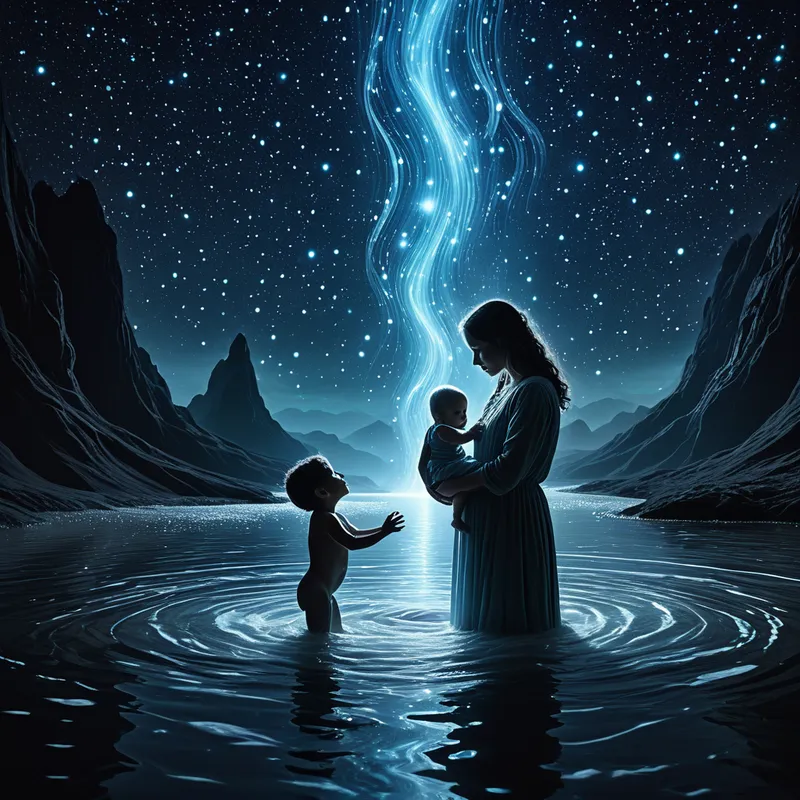
In the quiet sanctum, the infant feeds. But this is no ordinary child; his divine strength is nascent, a smoldering fire in his tiny form. As he suckles, the taste of ambrosia-like nourishment floods his senses—a power too potent, a connection too profound. He drinks with a hero’s hunger, and in that overwhelming rush of divine essence, he startles. His tiny mouth releases the nipple, and from his lips, not a cry, but a stream of radiant, liquid light erupts.
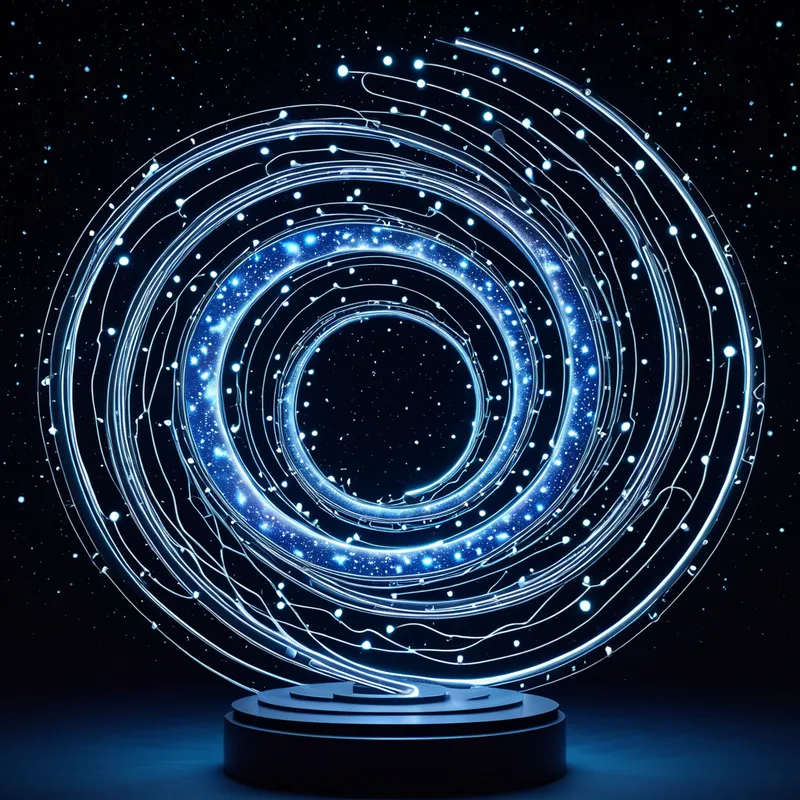
It arcs into the air, a brilliant spray against the twilight canvas of the heavenly dome. It does not fall. It hangs, then flows, spreading in a great, shimmering cascade across the vault of night. The milk, imbued with Hera’s own divine power, becomes a path, a swirling, star-flecked river of impossible luminosity. Hera herself pulls back, not merely in shock, but in a moment of cosmic realization. Her reflexive gesture, born of surprise, becomes an act of unintentional creation. Where the milk scatters, it crystallizes into points of cold, enduring fire. Where it flows in great currents, it paints nebulous clouds of soft radiance.
Thus, the Galaxias Kyklos, the “Milky Circle,” is born from a moment of nourishing, shock, and release. It is not built by careful design, but spilled from the heart of divine domesticity, an eternal monument to an infant’s fierce vitality and a goddess’s potent, if unintended, gift. The heavens now bear a scar of sublime beauty, a story written in light for all mortals to gaze upon and wonder.

Cultural Origins & Context
This ethereal myth finds its roots not in the grand, state-sponsored epics of Homer, but in the more allusive, explanatory tradition of mythography. It is a tale classified as an aition, a story that explains the origin of a thing—in this case, the most prominent and mysterious feature of the night sky: the hazy, star-strewn band we call the Milky Way.
The earliest surviving account comes from the pseudo-Aristotelian work De Mundo (On the Cosmos), and it is later recounted by the Roman mythographer Ovid and the Greek geographer Pausanias. Its transmission was likely oral and scholarly, a piece of cosmological lore used to connect the familiar (mother’s milk, a strong infant) to the awe-inspiring and distant (the starry heavens). In a culture where astronomy and astrology were deeply interwoven with divinity, the myth served a crucial function: it humanized the cosmos. It placed a story of family, nurture, and accidental creation at the center of the celestial map, making the vast, impersonal night sky a testament to a specific, dramatic moment in the lives of the gods. It provided a narrative anchor for shepherds, sailors, and philosophers alike as they pondered the shimmering path above.
Symbolic Architecture
Beneath its charming surface, the myth of the River of Heaven is a profound allegory of creation arising from rupture, and of nourishment that transcends its original intent.
The river itself is the ultimate symbol of the unintended consequence that becomes eternal law. It is order born from accident, beauty from disruption. It represents the cosmic principle that from the intimate and personal (a mother nursing a child) can spring the universal and eternal (the galaxy).
The most enduring structures of the soul and the cosmos are often founded not on careful plan, but on a moment of profound, unscripted overflow.
Heracles represents the nascent, ravenous Self—the psychic force of potential that must consume powerful, even alien, nourishment to achieve its destiny. His act is not one of violence, but of overwhelming vitality. Hera, often cast as the vengeful stepmother, here embodies the archetypal Great Mother in a complex form. She is the source of the nourishing substance, and her shock is the necessary rupture that allows that substance to be transformed from private sustenance into public, celestial architecture. The milk is the prima materia—the raw, potent stuff of life and power. When it leaves its contained, functional state, it is alchemized by the air of possibility into something transcendent and star-born.
The Dreamer's Resonance
When this myth stirs in the modern unconscious, it often manifests in dreams of unexpected flows, radiant spills, and starry transformations. To dream of a river of light in the sky, or of nourishing a child who then transforms the environment, is to touch this archetypal pattern.
Somnologically, this signals a process where a deep, perhaps unconscious, source of psychic nourishment or creative energy (the “milk”) has been engaged. The “infant” is a new, vulnerable, but potent aspect of the Self coming to life—a nascent talent, a recovering vulnerability, a budding idea. The dreamer may be in the phase of feeding this new self, drawing from inner reserves they didn’t know they had (the Hera aspect within). The critical moment—the spill—represents the point where this internal process can no longer be contained privately. It must be externalized, often through an accident, a surprise, or an overwhelming emotional release. The somatic feeling is one of sudden, radiant expansion—a shock followed by awe, as an inner process becomes visible, takes up space, and begins to structure one’s internal “cosmos.” It is the dream of psychic potential moving from private consumption to public, luminous expression.
Alchemical Translation
For the individual on the path of individuation, this myth is a masterful map of psychic transmutation. The process begins with the coniunctio, the sacred marriage of opposites within: the “Hera” principle (established structure, the container of identity, perhaps even one’s complexes) is confronted with the “Heracles” principle (the alien, heroic, demanding new potential born from the unconscious).
The first stage is nourishment. The ego (Hera) must consent, however reluctantly, to feed this new, disruptive self. This requires drawing on deep, perhaps resentfully guarded, reserves of life-force.
The critical alchemical stage is the rupture and projection. The nourishing substance, through the intensity of the encounter, is violently projected outward. This is the nigredo—the blackening, the shocking moment of crisis where the old container fails. The milk is not wasted; it is sublimated. It moves from the biological, personal realm to the celestial, transpersonal realm.
Individuation is not a tidy construction project. It is a celestial event, sparked when the nourishment for our hidden self overflows its private vessel and spills out to structure our entire sky.
Finally, we have cosmization. The spilled substance forms the River of Heaven—a new, permanent structure in the inner sky. This is the caelum, the heaven, the final goal of the alchemical work. The once-private struggle becomes the very architecture of one’s worldview, a guiding light of personal meaning. The myth teaches that our greatest contributions to our own soul’s cosmos—our guiding principles, our creative works, our enduring insights—are often the unexpected, radiant byproducts of an intimate, nourishing crisis. We do not build our heaven stone by stone; we spill it, star by star, from the depths of our most profound engagements.
Associated Symbols
Explore related symbols from the CaleaDream lexicon: