The Rich Young Ruler Myth Meaning & Symbolism
A wealthy man asks a holy teacher how to attain eternal life, only to be told he must give away everything he owns, and walks away in sorrow.
The Tale of The Rich Young Ruler
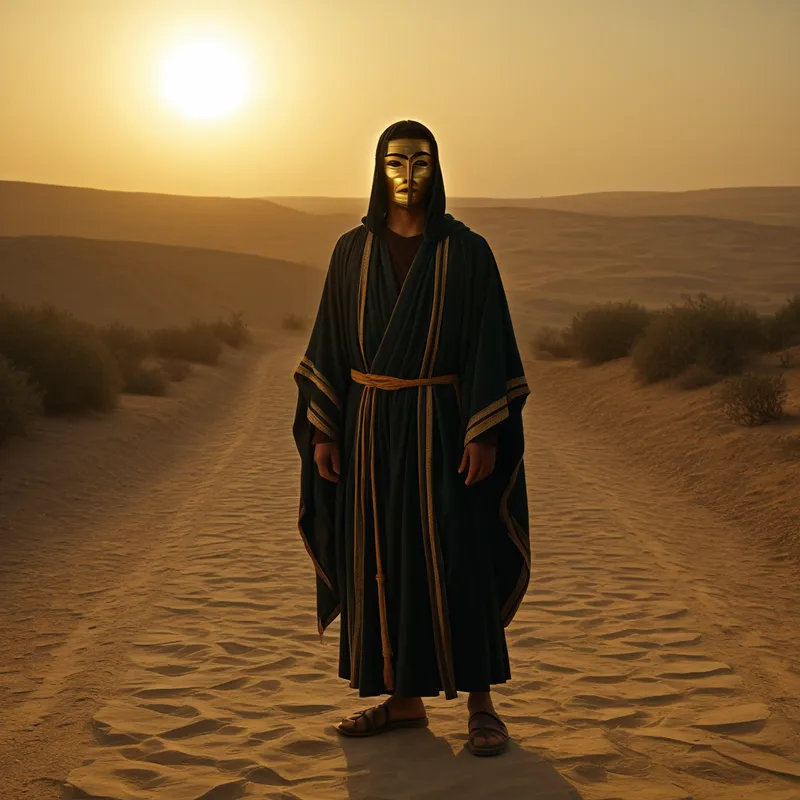
The sun was a hammer on the Judean road, beating the dust into a pale, hot haze. From the direction of the city, a figure approached the small crowd gathered around the teacher. He moved with the grace of privilege, his robes not the roughspun of the fishermen or farmers, but of fine, bleached linen, whispering against the earth as he walked. His face was unlined by the labor of the field, yet etched with a hunger no feast could satisfy.
He did not push through the throng, for it parted for him as water parts for a stone. He knelt there, in the dust, before the man called Yeshua. The gesture was perfect, respectful, yet it carried the weight of a soul testing the scales of a great transaction.
“Good Teacher,” he began, his voice clear, “what must I do to inherit eternal life?”
A stillness fell, deeper than the midday heat. The teacher’s eyes, which held the depth of a night sky, met his. “Why do you call me good? No one is good but God alone. You know the commandments: you shall not murder; you shall not commit adultery; you shall not steal; you shall not bear false witness; honor your father and mother.”
The young man’s reply was swift, a recitation polished by a lifetime of righteous effort. “Teacher, all these I have kept from my youth.” There was no boast in it, only the quiet, desperate certainty of one who has followed every rule on the map, yet finds himself lost.
And then the teacher looked at him. It was not a glance, but a seeing—a gaze that passed through the fine linen, the respectful posture, the impeccable record, and beheld the man within. And in that look was a love so vast and piercing it felt like a wound. The teacher saw the golden chain that gleamed not around his neck, but around his soul.
“One thing you lack,” the teacher said, and his words were soft, yet they fell like a chisel on marble. “Go, sell all that you have and give to the poor, and you will have treasure in heaven. Then come, follow me.”
The words hung in the air. The young ruler heard not an invitation, but a dismantling. Sell all. The words echoed in the vault of his identity. His great house, his lands, the chests of silver, the respect of the city elders, the very ground on which he stood—all of it, the substance of his self, was to be liquidated and scattered to the winds.
His face, which had been alight with earnest seeking, changed. A shadow passed over it, a cloud of profound interior calculation. The love in the teacher’s eyes became a mirror, and in it, he saw not a seeker of heaven, but a keeper of an earthly kingdom. The conflict was silent, total, and somatic. It was the war of two worlds within one breast.
The resolution was not a shout, but a collapse. His shoulders, which had been squared with purpose, slumped. The light in his eyes guttered out, replaced by a deep, grieving darkness. He did not argue. He did not bargain. He stood, the fine linen now seeming like a shroud, and turned away. He walked back down the road toward the city, toward the solid, weighty reality of his possessions. But he walked heavily, for his heart was now a stone of great sorrow. The teacher watched him go, and said to those who remained, “How hard it is for those who have wealth to enter the kingdom of God.”
Cultural Origins & Context
This narrative is embedded within the synoptic gospels—Matthew, Mark, and Luke—texts composed in the decades following the life of Jesus. It was an oral teaching long before it was inked on parchment, a story told and retold in the early ekklesia as they grappled with the radical, counter-cultural demands of their new faith.
The societal function was multifaceted. For a community that included both impoverished peasants and a few individuals of means, it served as a stark ethical challenge, prioritizing communal solidarity and dependence on divine providence over Greco-Roman and traditional values of patrimony and self-sufficiency. It also functioned as a boundary marker, defining the kind of total commitment required to be a disciple. The ruler is not condemned as evil; he is a tragic figure, a case study in the ultimate spiritual obstacle not of vice, but of virtue—the virtuous, successful, respectable self that cannot bear to die. The story was a warning and a mirror, forcing each listener to ask, “What is my ‘great possession’?”
Symbolic Architecture
At its core, this is not an economic parable but a psychological and spiritual autopsy of identity. The Rich Young Ruler is the archetype of the perfected ego. He has successfully built a self according to all the rules of his society: moral, religious, and material. He is the culmination of conscious development. His question about “eternal life” is the soul’s innate yearning for something beyond this well-constructed, yet finite, self.
The treasure in heaven is not a celestial bank account, but the unconstructed, authentic Self that can only emerge when the fortress of the ego is willingly abandoned.
His wealth is the ultimate symbol of this ego-structure. It is not merely money; it is security, status, identity, control, and a bulwark against the terrifying unknowns of fate and faith. The command to “sell all” is the call to enact a psychic death—the dissolution of the persona and the conscious values that have defined him. The “poor” represent the disowned, vulnerable, and unlived parts of his own psyche to which he must give his energy. His sorrow is the authentic grief of the ego facing its own necessary demise. He is not a villain, but a portrait of the profound human tragedy: choosing the known prison over the unknown liberation because the cost of the door is everything you are.

The Dreamer's Resonance
When this myth appears in modern dreams, it rarely manifests as a Biblical scene. Instead, the dreamer may find themselves in a high-rise office, offered a promotion that requires moving to a distant, soulless city. They may be handed the keys to a magnificent, empty mansion that fills them with dread. They may be at an airport, ticket in hand, but their luggage—filled with precious, heavy mementos—is too vast to check.
The somatic experience is key: a crushing weight in the chest, legs that refuse to move, or a profound, wordless grief upon waking. This is the psyche signaling a critical impasse in the individuation process. The dream-ego has reached the limit of its current structure. An opportunity for deeper alignment with the Self is present (the “teacher” or the “call”), but it demands the sacrifice of a cherished identity—perhaps the successful professional, the reliable caretaker, the admired intellectual, or the secure investor. The sorrow is the honest recognition of the price. The dream does not judge the choice to walk away; it faithfully reports the state of the inner conflict, making the cost conscious.

Alchemical Translation
The alchemical process mirrored here is nigredo, the blackening, the descent into the void. For the modern individual, the path of “following” the inner guide (the Self) requires a voluntary dissolution. We are not stripped of our wealth against our will; we are shown the door and must choose to walk through it.
The alchemical translation is the realization that our “riches”—our competencies, our reputations, our hard-won securities—are the prima materia, the base metal that must be surrendered to the fire of transformation. They are not evil; they are the necessary starting point. The tragedy of the ruler is that he mistakes the base metal for the final gold.
Individuation is not about adding more treasures to the storehouse of the ego, but about letting the storehouse itself burn, so that the phoenix of the true Self can rise from its ashes.
The process begins with the honest question: “What must I do?” It proceeds through the painful revelation of what we are still clinging to for our very sense of being. The triumph is not in necessarily becoming materially poor, but in achieving a state of inner poverty—a radical openness where the ego is no longer the landlord of the psyche, but a faithful tenant of something far greater. The myth does not end with the ruler’s departure; it echoes as an eternal question in the soul of every listener, an invitation to a death that is the only true beginning.
Associated Symbols
Explore related symbols from the CaleaDream lexicon: