
The Queen of Sheba Bilqis
The legendary Queen of Sheba, known as Bilqis in Islamic tradition, visits King Solomon in a story testing wisdom, faith, and sovereignty.
The Tale of The Queen of Sheba Bilqis
The sun over Sheba was a sovereign coin, and under its gaze, Bilqis ruled a kingdom of frankincense and myrrh, of trade routes and towering temples. Her wisdom was not whispered in courts but demonstrated in the prosperity of her land, a wisdom of earth and administration. Yet, a whisper of a different kind reached her—a rumor borne on the wings of birds and the tongues of merchants. It spoke of a king in the north, [Solomon](/myths/solomon “Myth from Biblical culture.”/), to whom God had given not just a kingdom, but command over the unseen: [the wind](/myths/the-wind “Myth from Various culture.”/), the jinn, and the very speech of animals. His wisdom was said to be a [divine light](/myths/divine-light “Myth from Christian culture.”/), piercing all obscurity.
Intrigued and cautious, a ruler assessing a potential rival or ally, Bilqis determined to test this legend. She sent a magnificent caravan: gold, jewels, and a question woven into a gift. But Solomon, whose sight penetrated veils, saw the test for what it was. He dismissed the material wealth; his court, built by jinn and attended by winds, had no need of it. His challenge was direct. He summoned his noble hoopoe and sent a letter back to Sheba, not with a merchant, but on the wing of destiny. The letter was an invitation, and a command: “Come to me in submission.”
Bilqis, the strategist, convened her council. They spoke of armies, but she spoke of letters. She perceived the power behind the words. In a move of profound political and spiritual intelligence, she chose to go herself, but she would not go unprepared. She sent her most cunning offering ahead: a throne, her throne, the very seat of her sovereignty. It was a riddle in cedar and gold. Would he take it? Could he even recognize it? Solomon’s response was an act of mystical dominion. Before her envoy’s eyes, her throne was transformed—altered in the blink of an eye. Some traditions say it was replicated perfectly by a jinn with knowledge of the Throne; others say it was her very throne, fetched from Sheba in an instant and made unrecognizable. When Bilqis arrived and was asked, “Is your throne like this?” she was faced with the impossible. To claim it was to admit a power that could reach into her very heart of power. To deny it was to lie against the evidence of her soul. She answered with the wisdom that defines her: “It is as if it were the very one.” A statement of profound ambiguity, acknowledging the miracle without surrendering her own discernment.
Her final test was one of elemental illusion. Solomon, wishing to remove any barrier to her seeing truth, ordered a palace floor of clear crystal to be laid over flowing [water](/myths/water “Myth from Chinese culture.”/). As Bilqis entered, her eyes deceived her; she saw a shimmering pool and, thinking to wade through, she gathered up her skirts, baring her legs. In that moment of perceived vulnerability, the illusion was broken. Solomon revealed the solid crystal beneath. The water was a mirror, showing her her own assumptions, her own earthly nature. It was in this moment of unveiled perception that Bilqis saw not just a trick, but the signature of a higher order. “My Lord,” she declared, “I have wronged myself.” With Solomon, she submitted not to a man, but to the God of All Worlds.
Cultural Origins & Context
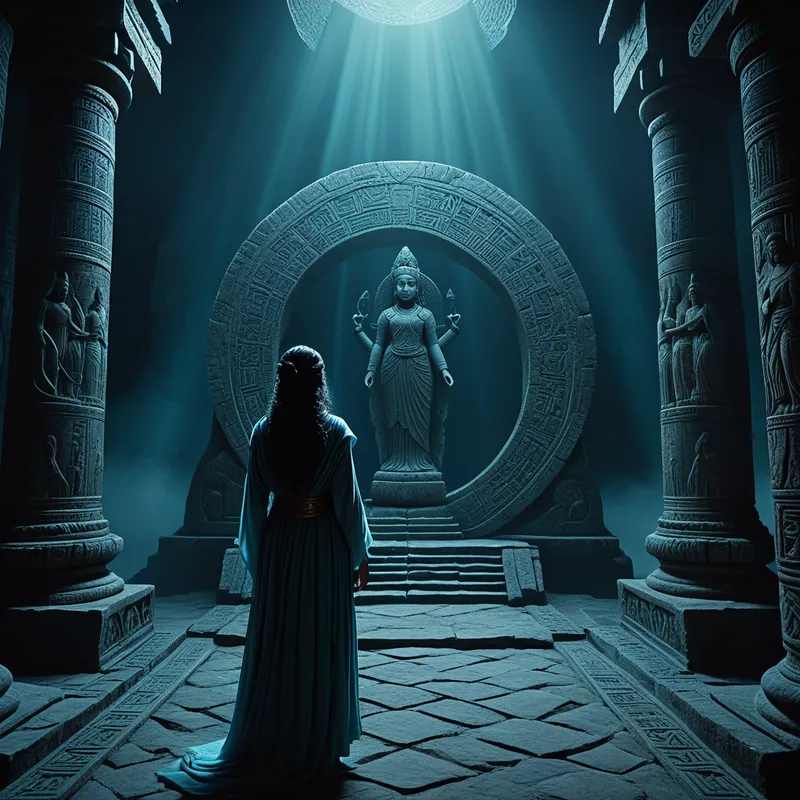
The figure of Bilqis emerges primarily from the Islamic exegetical tradition surrounding Chapter 27 (Surah An-Naml, “The Ant”) of the Qur’an. The Qur’anic account is majestic but sparse, focusing on the dialogue of the hoopoe, the exchange of letters, and the test of the throne. It is in the Qisas al-Anbiya (Stories of [the Prophets](/myths/the-prophets “Myth from Biblical culture.”/)), the rich body of tafsir, and historical works like al-Tabari’s that her story gains its vivid detail—her name, her lineage (often traced to jinn or kings), the nature of her throne, and the famous story of the glass floor.
This narrative sits at a critical intersection. It is a story of prophecy, demonstrating Solomon’s God-given authority. It is also a political narrative about the incorporation of a powerful, independent kingdom into the fold of divine monotheism. Bilqis is never portrayed as a villain or mere foil. Her wisdom is consistently validated; her conversion is a [triumph](/myths/triumph “Myth from Roman culture.”/) of intellect perceiving truth, not of coercion. She represents the pinnacle of human, worldly wisdom (hikmah) encountering and freely submitting to divine wisdom. Her rule of Sheba, a land often associated with wealth and pagan sun-worship, becomes a precursor to her greater role: the wise queen who recognizes and bows to ultimate reality.
Symbolic Architecture
The myth of Bilqis is built upon structures of [perception](/symbols/perception “Symbol: The process of becoming aware of something through the senses. In dreams, it often represents how one interprets reality or internal states.”/), sovereignty, and transformation. Each element is a deliberate [symbol](/symbols/symbol “Symbol: A symbol can represent an idea, concept, or belief, serving as a powerful tool for communication and understanding.”/) in a psychic [drama](/symbols/drama “Symbol: Drama signifies narratives, emotional expression, and the exploration of human experiences.”/).
The Throne is the fixed center of the Self, the seat of identity and temporal power. Solomon’s miraculous alteration of it represents the shocking, instantaneous transformation the ego undergoes when confronted by a greater, transpersonal reality. The old structure of self is not destroyed, but made strange, requiring a new mode of recognition.
The Crystal Floor over Water is the ultimate symbol of discernment. It represents the liminal space where illusion (the reflected water) and reality (the solid crystal) are indistinguishable to the untrained eye. To cross it, one must have faith in the guidance offered, or be made aware of one’s own reflexive, earthly nature. It is a test of spiritual perception, forcing a confrontation with one’s own shadow—the instinctual self (symbolized by the bared legs) that is revealed when intellectual certainties fail.
Bilqis’s [journey](/symbols/journey “Symbol: A journey in dreams typically signifies adventure, growth, or a significant life transition.”/) is an [alchemical process](/symbols/alchemical-process “Symbol: A symbolic transformation of base materials into spiritual gold, representing inner purification, integration, and the journey toward wholeness.”/). She begins as the ruler of a tangible, [material](/symbols/material “Symbol: Material signifies the tangible aspects of life, often representing physical resources, desires, and the physical world’s influence on our existence.”/) [kingdom](/symbols/kingdom “Symbol: A kingdom symbolizes authority, belonging, and a sense of identity within a larger context or community.”/) (the [nigredo](/myths/nigredo “Myth from Alchemical culture.”/) stage of base matter). The confrontation with Solomon’s power is the [separatio](/myths/separatio “Myth from Alchemical culture.”/) and mortificatio, where her worldly wisdom is separated from its divine [source](/symbols/source “Symbol: The origin point of something, often representing beginnings, nourishment, or the fundamental cause behind phenomena.”/) and her royal ego is humbled. Her ambiguous recognition of the [throne](/symbols/throne “Symbol: A seat of authority, power, and sovereignty, representing leadership, divine right, or social hierarchy.”/) is the conjunctio, a [marriage](/symbols/marriage “Symbol: Marriage symbolizes commitment, partnership, and the merging of two identities, often reflecting one’s feelings about relationships and social obligations.”/) of her discernment with the new [reality](/symbols/reality “Symbol: Reality signifies the state of existence and perception, often reflecting one’s understanding of truth and life experiences.”/). Her final submission and [conversion](/symbols/conversion “Symbol: A fundamental transformation in artistic style, technique, or medium, often representing a profound personal or creative shift.”/) are the [albedo](/symbols/albedo “Symbol: In alchemy, the whitening stage representing purification, spiritual ascension, and the emergence of consciousness from darkness.”/) and [rubedo](/myths/rubedo “Myth from Alchemical culture.”/)—purification and [culmination](/symbols/culmination “Symbol: A point of completion or climax in a process, often marking the end of a cycle and the achievement of a goal.”/)—resulting in a sovereign self now aligned with a transcendent principle.
The Dreamer’s Resonance
To dream of Bilqis is to dream of the encounter between the competent, worldly self and a numinous, ordering intelligence from beyond one’s own realm. She appears when the dreamer’s established identity—their “kingdom” of career, relationships, or self-image—is challenged by an insight or event that seems supernatural in its clarity and power. This is not an invasion, but an invitation.
The psychological tension lies in the response. Will one, like Bilqis’s council, react with defensive aggression? Or will one, like the Queen, engage with cunning curiosity? The test of the throne in a dream may manifest as a cherished possession or a core belief being suddenly, inexplicably changed. The dream-ego is asked: “Is this yours? Do you recognize it now?” The answer requires a surrender of literal-mindedness, an acceptance of transformation. The crystal floor moment is the dream of a crucial choice where things are not as they seem, where a step taken in fear of drowning leads to the discovery of solid ground. Bilqis guides the dreamer toward a wisdom that integrates practical intelligence with the courage to submit to a greater truth, forging a sovereignty that is not diminished, but deepened, by faith.

Alchemical Translation
The myth of Bilqis and Solomon is a precise allegory for the individuation process, where the conscious ego (Bilqis, the ruling principle of a rich but contained [psyche](/myths/psyche “Myth from Greek culture.”/)) encounters [the Self](/myths/the-self “Myth from Jungian culture.”/) (Solomon, the central, ordering archetype with authority over the unconscious).
The Hoopoe’s Letter is the call from the Self, delivered not through brute force but through the intuitive function—the “bird” of insight that can travel between conscious and unconscious realms. It is an undeniable summons to dialogue.
Bilqis’s Journey is the ego’s courageous descent into the unknown territories of the psyche. She brings her wealth—her conscious achievements and attributes—but finds they are currency of little value in this new realm. The real offering must be her very structure of identity.
The Submission is not a defeat of the ego, but its inclusion in a wider totality. Bilqis does not cease to be a queen; she becomes a queen under God. Psychologically, the ego that aligns itself with the Self does not vanish but finds its proper, delegated role. It trades the loneliness of absolute, brittle control for the authentic power of serving a deeper order. Her declaration, “I have wronged myself,” is the moment of profound self-honesty where the ego acknowledges its previous identification with the personal will as a limitation. The resulting union is a psyche where wisdom and faith, intellect and spirit, rule together.
Associated Symbols
Explore related symbols from the CaleaDream lexicon:
- Throne — The seat of sovereignty and conscious identity; the established center of power within the psyche or a kingdom.
- Queen — The archetypal feminine ruler; the mature, governing principle of the soul that administers with wisdom and authority.
- Mirror — A surface for reflection and revelation, exposing truth or illusion, as the crystal floor revealed Bilqis’s own nature.
- Water — The fluid realm of the unconscious, emotion, and illusion, over which a clear perception (crystal) must be laid.
- Wisdom’s Key — The insight or test that unlocks a higher understanding, such as the puzzle of the throne that opened Bilqis to a new reality.
- Islamic Mosque — A symbol of submission (islam) and oriented prayer; the architectural expression of the faith Bilqis ultimately embraces.
- Journey — The necessary passage from a known state to an unknown one, undertaken for the purpose of testing, learning, and transformation.
- Tapestry of Faith — The intricate weaving of belief, tradition, and personal experience into a coherent worldview, which Bilqis re-weaves upon her conversion.
- Crown — The visible symbol of legitimate authority and responsibility, which Bilqis never relinquishes but whose source she redefines.
- Light — The illuminating power of divine truth or profound insight that dispels the shadows of doubt and paganism.
- Door — [The threshold](/myths/the-threshold “Myth from Folklore culture.”/) between realms—Sheba and [Jerusalem](/myths/jerusalem “Myth from Biblical culture.”/), human wisdom and divine command, doubt and faith—which Bilqis consciously chooses to cross.