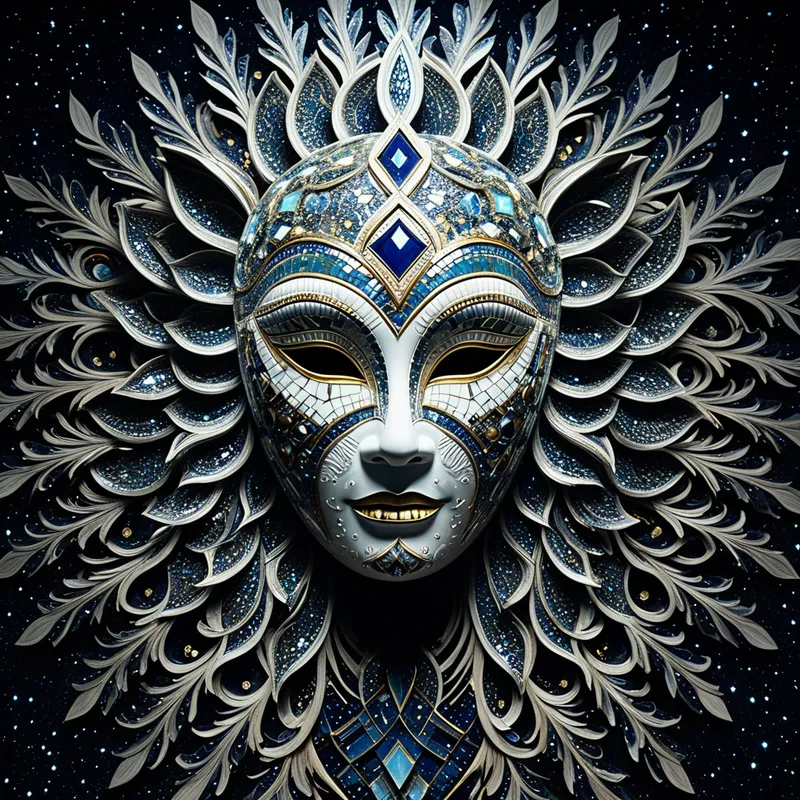
The persona masks of ancient G Myth Meaning & Symbolism
A myth of a primordial being who shatters into countless masks, embarking on an eternal journey to remember its true, unified face.
The Tale of The persona masks of ancient G
In the time before time, when the world was a single, dreaming breath, there existed G. G was not a god of a specific domain, but the potential of all domains. G was the silent hum before the first note, the blank page before the first story. G possessed a single, luminous face that was no face at all—a visage of pure, peaceful potential.
But the silence grew heavy. The potential yearned for expression. From the depths of its being, a question arose, not in words, but in a seismic tremor of being: "Who am I?"
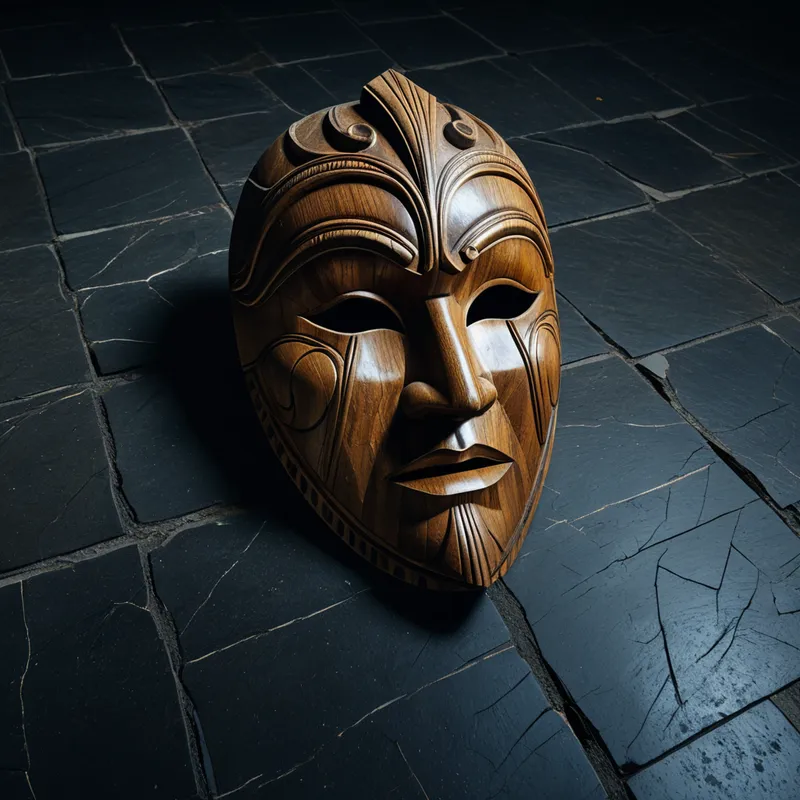
The question did not echo; it shattered. The force of that primal inquiry fractured the serene countenance of G. From the cracks spilled not blood, but identities. Each shard of its face crystallized into a mask—a Persona. There was the mask of the Weeping Mother, carved from warm, rain-soaked oak. There was the mask of the Silent Warrior, forged from cold, unyielding iron. The Laughing Fool tumbled out in polished cherry wood, while the Keeper of Secrets formed from dark, veined obsidian. Thousands upon thousands they fell, a glittering, clattering rain of selves into the void.
Each mask, believing itself to be the whole, awoke with a start. The Weeping Mother felt only the ache of separation. The Silent Warrior knew only the drive to defend its solitary existence. They scattered to the winds of the nascent world, each donning its mask and forgetting it was a mask. They built kingdoms of sorrow, fortresses of anger, theaters of joy—all isolated, all echoing with the hollow memory of a unity they could not name.
Yet, in the center of the great emptiness where G had once dwelt, a faint, persistent pulse remained. A single, unformed shard, the core of the original question, lay vibrating. This shard did not become a mask. It became the Seeker—a faceless, yearning wind that began to move through the world.
The Seeker’s journey is the rest of the tale. It wanders into the kingdom of the Weeping Mother and, by reflecting her compassion without being consumed by it, causes a hairline fracture to appear on her wooden mask. It stands before the Silent Warrior and, offering no threat, makes the chill of the iron mask feel suddenly lonely and heavy. In each encounter, the Seeker whispers not with words, but with presence: "Remember. You are more than this."
One by one, the masks begin to loosen. They do not vanish, but their edges soften. The Laughing Fool feels a pang of depth beneath his mirth. The Keeper of Secrets senses a longing to share her burden. The journey has no end, for new masks are born from every new experience. But the Seeker walks on, and in its wake, the clatter of isolated masks begins to soften into the distant, harmonious murmur of a face slowly, painfully, remembering how to be whole.
Cultural Origins & Context
The myth of the Persona Masks of Ancient G does not belong to a single culture, but arises as a recurring motif in the "Global/Universal" stratum of human storytelling—a term mythologists use for narratives so fundamental they appear in various forms across disparate civilizations. It is the story told not around a specific tribal fire, but whispered by the human psyche itself. It has been passed down through the language of dreams, the structure of rites of passage, and the universal dilemma of social adaptation.
We find its echoes in the shamanic initiations where the initiate "loses their face" to gain many spirits; in the theatrical traditions of Greece and Japan, where masks (persona in Latin, men in Noh) both reveal and conceal character; and in the philosophical inquiries from East to West about the nature of the Self versus the roles one plays. Its societal function is foundational: to explain the innate human experience of fragmentation. It provides a cosmic reason for why we feel different at work, at home, and in solitude, and offers a mythical map for the journey back to authenticity.
Symbolic Architecture
At its heart, this myth is a profound allegory for the birth of the ego and the construction of the Persona, in the Jungian sense. The primordial G represents the original, undifferentiated state of the psyche—the Self before consciousness asks its separating question.
The first mask is forged not to deceive the world, but to answer the psyche's most terrifying question: "Do I exist?"
The "shattering" is the inevitable trauma of consciousness entering a world of others. Each Persona Mask—the Weeping Mother, the Silent Warrior—symbolizes a complex, a bundle of energies and responses formed to navigate specific emotional and social landscapes. They are necessary for survival, but the myth warns of the central peril: identification. To believe "I am this mask" is to forget the larger, faceless being that wears it.
The Seeker is the symbol of the transcendent function, the psyche's innate drive toward Individuation. It is consciousness turning back upon itself, beginning the long work of re-collection.
The Dreamer's Resonance
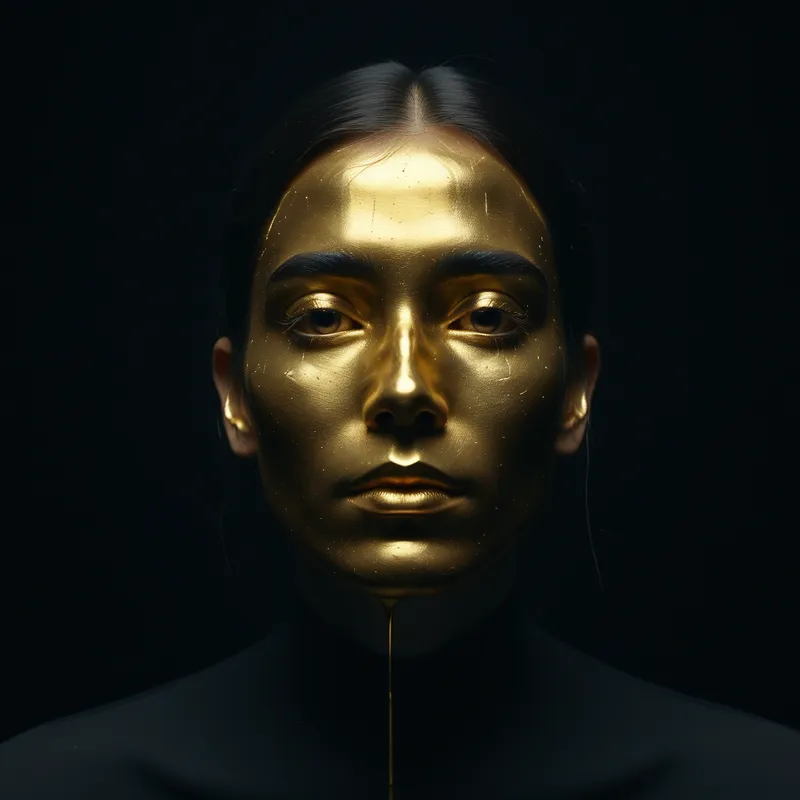
When this myth activates in the modern dreamscape, it often manifests as dreams of lost faces, shifting identities, or being trapped behind a mask you cannot remove. You may dream of being at a party where your face keeps changing in the mirror, or of frantically trying on countless outfits, none of which fit. These are not mere anxieties about social performance; they are somatic signals from the psyche that identification with a single Persona has become too rigid, too confining.
The psychological process underway is one of Shadow-work and persona differentiation. The dream ego is experiencing the strain of a role that has cracked under pressure—the caring parent who feels unseen, the successful professional who feels like an impostor. The dream is the Seeker at work, creating the necessary fracture to begin the process of asking, "Who am I beneath this role?"

Alchemical Translation
The alchemical journey modeled by this myth is the transmutation of leaden, rigid identification into the golden, fluid state of conscious selfhood. It is the opus of modern Individuation.
The first stage, Nigredo, is the initial shattering—the painful realization that "I am not who I thought I was," often triggered by crisis or profound disillusionment. The masks feel false, but the face beneath feels unknown. The second stage, Albedo, is the work of the Seeker: the careful observation and sorting of the masks. This is the psychological practice of noticing "This is my professional mask," "This is my defensive mask," without immediately judging or discarding them.
Wholeness is not the absence of masks, but the conscious craftsmanship of wearing them with choice, and the courage to sometimes lay them all aside.
The final stage, Rubedo, is not the destruction of the Persona, but its redemption. The masks, once prison walls, become tools in a toolkit. The Weeping Mother mask allows for deep empathy when needed, but can be set down. The Silent Warrior mask can be donned for protection, but not left to govern a peaceful heart. The integrated individual moves through the world with flexibility, connected to the faceless, potent core—the Ancient G within—that can wear many masks but is enslaved by none. The journey never ends, for life offers new roles, but the seeker has become the conscious wearer, the artist of its own multifaceted existence.
Associated Symbols
Explore related symbols from the CaleaDream lexicon: