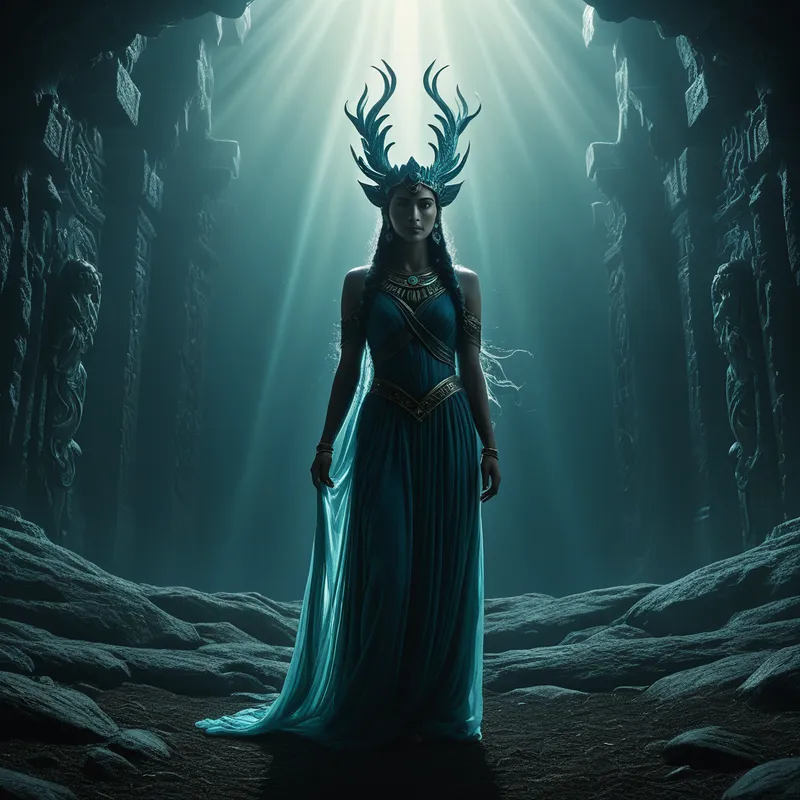
The Origin of Music African
An ancient African myth revealing how music was gifted to humanity by divine beings, connecting people through rhythm and melody.
The Tale of The Origin of Music African
In the time before time, when [the world](/myths/the-world “Myth from Tarot culture.”/) was a canvas of silent clay, the first people walked [the earth](/myths/the-earth “Myth from Hindu culture.”/) in quiet communion. They knew the language of [the wind](/myths/the-wind “Myth from Various culture.”/) and the speech of the rivers, but their own hearts beat in a rhythm they could not express, a melody trapped within the bone. [The world](/myths/the-world “Myth from Tarot culture.”/) was whole, yet it was incomplete, for it lacked the thread that would weave the soul of humanity to the soul of the cosmos.
The great sky father, whose thoughts were storms and whose breath was the dawn, looked upon his children. He saw their silent celebrations, their mute grief, and the unvoiced longing in their eyes as they gazed at the stars. In the deep vault of heaven, he convened with the earth mother, whose body was mountain and valley and whose pulse was the slow turning of seasons. Together, they understood the lack. The people had life, but they did not have the echo of life; they had being, but not the song of being.
The council of the [Orishas](/myths/orishas “Myth from African Diaspora culture.”/) and ancestors was called. Some argued that such a powerful force—the very vibration of creation—was too potent for mortal hearts. Others saw the silence as a wound in the world itself. It was [the trickster](/myths/the-trickster “Myth from Various culture.”/), the [shape-shifter](/myths/shape-shifter “Myth from Native American culture.”/) who walks the boundaries, who proposed a solution both dangerous and divine. “Let us not give them the song whole,” he said, a gleam in his eye. “Let us shatter it. Let each fragment find a home, and in the gathering of fragments, let them discover the whole.”
And so it was decreed. [The sky](/myths/the-sky “Myth from Persian culture.”/) father took a thunderbolt, the concentrated voice of the storm, and struck the silent, primordial baobab tree at the center of the world. Not to destroy it, but to awaken it. From the splintered bark, the first rhythms were born—the deep, resonant dun-dun of the earth’s heartbeat. The earth mother wept tears of joy, and where they fell upon hollow reeds by the riverbank, the reeds sighed, producing the first plaintive melodies of the flute.
The wind, carrying the news, rushed through forests of bamboo and across fields of dry grass, and in its passage created whistles, rasps, and sighs. The trickster, ever playful, caught the laughter of a stream and the chattering gossip of palm fronds, weaving them into complex, interlocking patterns. He then descended to the people, not in majesty, but in curiosity. He found a hunter, weary and quiet, and showed him how to stretch animal hide over a gourd, how the tension could capture and release sound. He showed a woman how different lengths of carved wood could sing different pitches when struck.
But the final, most crucial gift came from the ancestors. From the realm of the spirits, they sent the gift of memory and meaning. A rhythm was not just a sound; it was the footfall of the elephant. A melody was not just a sequence of notes; it was the story of [the river](/myths/the-river “Myth from Buddhist culture.”/)’s journey to the ocean. Music became [the vessel](/myths/the-vessel “Myth from Alchemical culture.”/) for myth, for history, for law, and for prayer. The first people, tentatively, began to tap, to blow, to pluck, and to sing. At first, the sounds were isolated—a drum here, a voice there. Then, one night under a full moon, a child began to hum a tune that matched the rhythm another was tapping on a stone. A third joined with a shaking gourd. Like fragments of a celestial mirror finding their whole, the individual sounds aligned. They did not simply play together; they conversed. They argued, they embraced, they questioned, and they affirmed.
In that moment, the first true music was born. It was not a performance, but a happening—a living, breathing entity created between them, connecting their individual hearts into a single, resonant community. They were no longer just people living on the earth; they were the earth giving voice to itself through them. The silence was forever broken, not by noise, but by a harmony that made the stars themselves hum in recognition.
Cultural Origins & Context
This foundational narrative, while varying in its specifics across the continent, finds its roots in the collective cosmological understanding of many African societies. It is not a singular, monolithic “African myth,” but a profound theme that echoes from the Dogon peoples of Mali to the Yoruba of Nigeria, the Akan of Ghana, and the Bantu-speaking cultures across central and southern Africa. The core belief is that music is not a human invention, but a divine inheritance—a fundamental, pre-existing element of the cosmos that was revealed or gifted to humanity.
In these worldviews, the universe is inherently sonic and vibrational. Creation itself was often an act of sound—a word, a chant, a divine drumbeat. Therefore, human music is a participation in and remembrance of that primordial creative act. It is a technology of connection, linking the individual to the community, the living to the ancestors, and humanity to the gods and the natural world. Music and dance are rarely mere entertainment; they are integral to rituals of healing, initiation, harvest, governance, and storytelling. The myth explains why music holds such sacred and social power: because its origin is sacred and social. It was given not to individuals, but to the collective, for the purpose of binding the collective together.
Symbolic Architecture
The myth’s [structure](/symbols/structure “Symbol: Structure in dreams often symbolizes stability, organization, and the framework of one’s life, reflecting how one perceives their environment and personal life.”/) is a profound map of psychic and social [integration](/symbols/integration “Symbol: The process of unifying disparate parts of the self or experience into a cohesive whole, often representing psychological wholeness or resolution of internal conflict.”/). The initial “silent [clay](/symbols/clay “Symbol: Clay symbolizes malleability, creativity, and the potential for transformation, representing the foundational aspect of life and the ability to shape one’s destiny.”/)” world represents a state of unconscious unity—a [paradise](/symbols/paradise “Symbol: A perfect, blissful place or state of being, often representing ultimate fulfillment, harmony, and transcendence beyond ordinary reality.”/), perhaps, but one without [differentiation](/symbols/differentiation “Symbol: The process of distinguishing or separating parts of the self, emotions, or identity from a whole, often marking a developmental or psychological milestone.”/) or conscious [expression](/symbols/expression “Symbol: Expression represents the act of conveying thoughts, emotions, and individuality, emphasizing personal communication and creativity.”/). The “unvoiced longing” in the people’s hearts symbolizes the emerging individual [psyche](/myths/psyche “Myth from Greek culture.”/) yearning for a means to articulate its experience and connect that experience to others.
The shattering of the song is the central alchemical image. It signifies that wholeness (the divine, cosmic music) must be disseminated and differentiated into fragments (individual rhythms, melodies, instruments) to be integrated at a higher level of consciousness by human agency.
The different deities contributing different elements reflect the polycentric [nature](/symbols/nature “Symbol: Nature symbolizes growth, connectivity, and the primal forces of existence.”/) of both the [cosmos](/symbols/cosmos “Symbol: The entire universe as an ordered, harmonious system, often representing the totality of existence, spiritual connection, and the unknown.”/) and [the self](/myths/the-self “Myth from Jungian culture.”/). The sky [father](/symbols/father “Symbol: The father figure in dreams often symbolizes authority, protection, guidance, and the quest for approval or validation.”/) provides structure ([rhythm](/symbols/rhythm “Symbol: A fundamental pattern of movement or sound in time, representing life’s cycles, emotional flow, and universal order.”/)), the [earth](/symbols/earth “Symbol: The symbol of Earth often represents grounding, stability, and the physical realm, embodying a connection to nature and the innate support it provides.”/) [mother](/symbols/mother “Symbol: The symbol of ‘Mother’ represents nurturing, protection, and the foundational aspect of one’s emotional being, often associated with comfort and unconditional love.”/) provides [emotion](/symbols/emotion “Symbol: Emotion symbolizes our inner feelings and responses to experiences, often guiding our actions and choices.”/) and flow ([melody](/symbols/melody “Symbol: A melody symbolizes emotion, memory, and communication, often representing the subconscious expressing itself through sound.”/)), the [trickster](/symbols/trickster “Symbol: A boundary-crossing archetype representing chaos, transformation, and the subversion of norms through cunning and humor.”/) provides complexity and surprise (syncopation, improvisation), and the ancestors provide context and meaning (lyric, tradition). The final, emergent [harmony](/symbols/harmony “Symbol: A state of balance, agreement, and pleasing combination of elements, often associated with musical consonance and visual or social unity.”/) created by the people together is greater than the sum of its parts—it is the [birth](/symbols/birth “Symbol: Birth symbolizes new beginnings, transformation, and the potential for growth and development.”/) of culture, of the social [soul](/symbols/soul “Symbol: The soul represents the essence of a person, encompassing their spirit, identity, and connection to the universe.”/).
The Dreamer’s Resonance
For the modern dreamer or psyche, this myth speaks directly to the origin of one’s inner voice and the need for creative expression as a bridge to community. The “silent clay” within us is that part of our being filled with unprocessed feeling, intuition, and potential that has not yet found its form. The “gods” and “ancestors” can be interpreted as archetypal forces of [the collective unconscious](/myths/the-collective-unconscious “Myth from Jungian culture.”/)—the innate, structuring patterns that seek expression through us.
The journey from silent longing to creating harmony with others mirrors the individuation process. We first hear our own isolated rhythm, our unique note. This can feel lonely, even chaotic. The myth assures us that this fragment is part of a larger, pre-existing whole. Our task is not to invent a song from nothing, but to faithfully sound our fragment and seek connection with others sounding theirs. In doing so, we move from the isolation of [the ego](/myths/the-ego “Myth from Jungian culture.”/) to the participatory consciousness of the Self, discovering that our personal melody only finds its full meaning in the communal symphony. Music, in this psychological reading, becomes a metaphor for authentic relationship and co-creation.
Alchemical Translation
The alchemical process here is one of [solve et coagula](/myths/solve-et-coagula “Myth from Alchemical culture.”/)—dissolve and coagulate. The divine, unified music is dissolved (shattered) into the raw materials of the world and the instincts of humanity. The human community then performs the coagulation, but not by returning to the original, undifferentiated state. They create a new, more complex unity that includes their own humanity.
The instruments themselves are alchemical vessels. The drum transforms animal hide and wood into the pulse of time. The flute transforms the breath of life and the plant of the earth into soaring spirit. The human voice transforms air and meaning into soul.
This is the translation of spirit into matter, and matter back into spirit, through the medium of conscious, creative act. The myth teaches that we are not passive recipients of grace, but active participants in revelation. The divine gift is the raw material; the human act of making music together is the completion of the gift. We become, in a very real sense, co-creators with the cosmos, our collective harmony answering the original harmony that sparked creation.
Associated Symbols
Explore related symbols from the CaleaDream lexicon:
- Music — The divine gift and emergent force that binds individual fragments of sound into a living, communicative whole, connecting soul to soul.
- Origin — The primordial, silent state from which all expression emerges, and the sacred moment of bestowal that defines a people’s purpose.
- Thunder — The violent, catalyzing voice of the sky that shatters silence and releases the foundational rhythms of existence.
- River — The source of melodic flow and the carrier of sound, representing the journey of music from its source to the community.
- Tree — The world axis and silent recipient of divine force, transformed into the first resonator and source of instrumental material.
- Drum — The captured heartbeat of the earth and the community, the instrument that organizes time and calls spirits to gather.
- Ancestors — The spiritual conduit who imbue raw sound with memory, meaning, law, and the weight of tradition.
- Trickster — The boundary-walker who deconstructs wholeness into playable parts and teaches the innovation and improvisation within tradition.
- Community — The living vessel in which isolated sounds alchemically transform into complex, conversational harmony.
- Harmony — The state of resonant relationship achieved not through uniformity, but through the conscious, creative alignment of differentiated parts.