The Origin of Hangul Myth Meaning & Symbolism
A king, a sage, and a goddess channel cosmic order into a script, birthing a language from the shapes of heaven, earth, and humanity to free a people's voice.
The Tale of The Origin of Hangul
In the age when the mountains of Joseon whispered secrets to the wind, and the people’s thoughts were caged behind a wall of foreign shapes, a great silence hung over the land. It was not a quiet of peace, but of stifled breath. The wisdom of the ancestors, the pleas of the farmers, the songs of the mothers—all were trapped in throats that lacked a true vessel. The kingdom used the complex, beautiful script of a distant empire, a script as elegant as caged birds and as inaccessible as the stars to the common soul.
Then arose a king, Sejong, whose heart was a drum that beat in time with the soil of his people. He walked among them and heard the silence. He saw the scholar, his eyes weary from deciphering a thousand intricate characters to read a single law. He saw the merchant, unable to mark his own ledger. He saw the widow, who could not read the letter from her son. A profound sorrow, heavy as a mountain, settled upon his spirit. This was the conflict: a nation of vibrant minds, living in a house whose key was held by a privileged few.
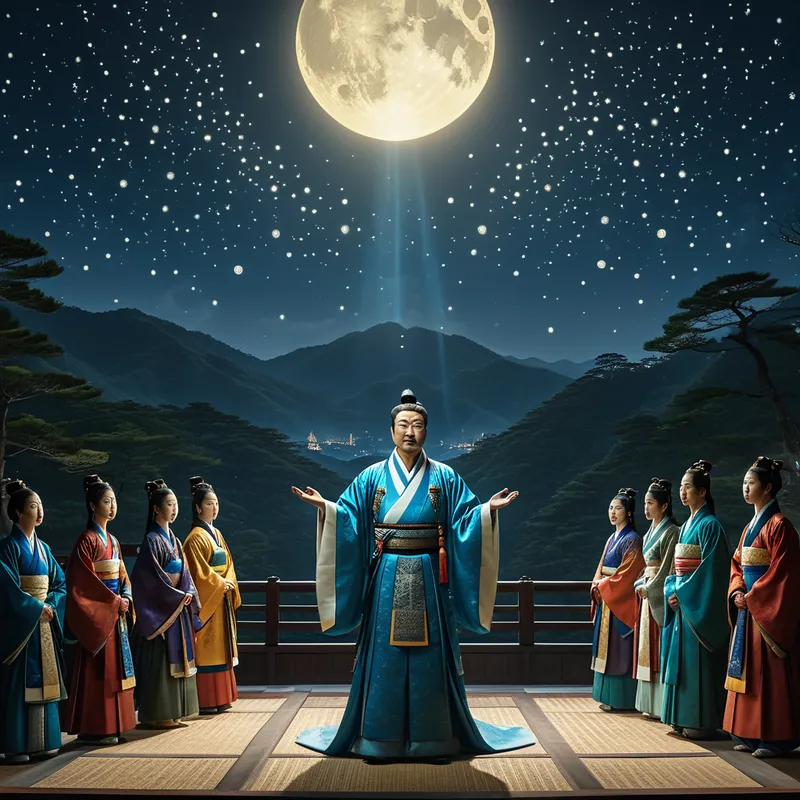
In the deepest watch of the night, when the veil between worlds grows thin, the king sought counsel not from his ministers, but from the cosmos itself. He retreated to his chamber, the Gyeonghoeru Pavilion reflected in the still pond of moonlight. He called upon the Samshin Halmoni, the grandmother spirits who weave the thread of fate and know the first patterns of all things. The air grew still, then vibrated with a presence ancient and kind.
A vision unfolded. The goddess showed him the architecture of existence: the round fullness of Cheon (heaven), represented by the circle •. She showed him the flat, solid plane of Ji (earth), represented by the square ▢. And she showed him the upright, living pillar of In (man), represented by the vertical line 丨. These were not mere shapes; they were the primal consonants from which all sound springs.
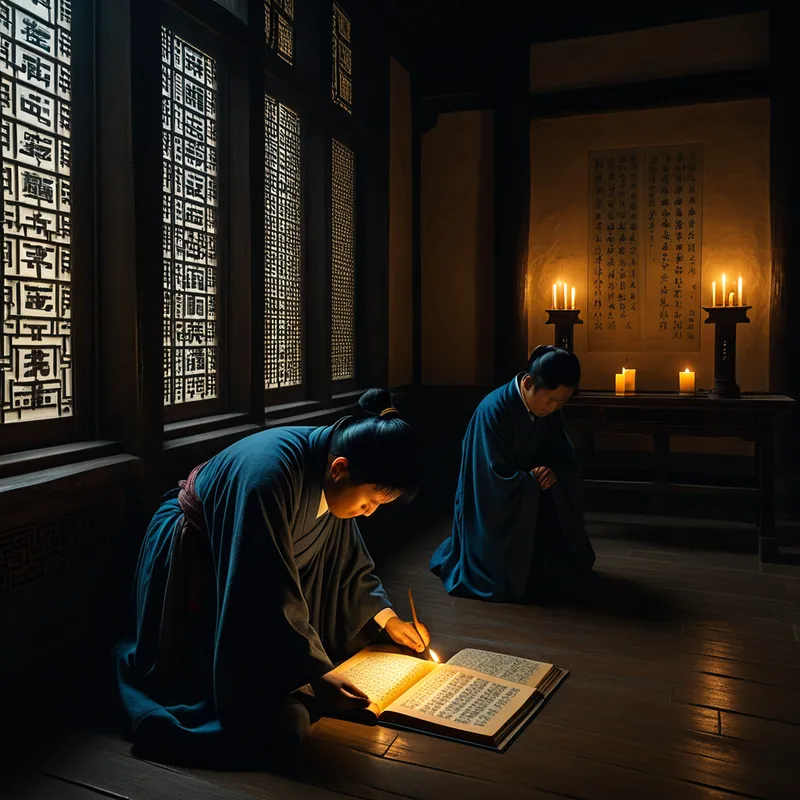
Then, the sage-king, his mind alight, began to combine. He took the shape of the heavens and touched it to the shape of man, and the consonant ‘ㄱ’ (giyeok) was born, the sound of a beginning. He saw the shape of a mouth forming sounds, the shape of the teeth, the position of the tongue. He designed vowels as points and lines representing the harmony of Yin and Yang. For days and nights, he and his loyal scholars in the Jiphyeonjeon worked, not copying, but listening—listening to the very phonetics of the Korean breath, the rhythm of its speech.
The resolution came not with a shout, but with a profound, echoing clarity. He presented Hunmin Jeongeum, “The Proper Sounds for the Instruction of the People.” It was a script so logical, so perfectly fitted to the spoken word, that a wise man could learn it in a morning, and a fool in ten days. The great silence over the land shattered. For the first time, the sound of a common man reading his own words aloud was heard—a sound more beautiful to the king than any symphony. The people’s voice, long buried, had been given a body of its own.
Cultural Origins & Context
This is not a myth of the misty, ancient past, but a documented historical event elevated to the status of sacred narrative. The core figure, King Sejong the Great (r. 1418–1450), is a historical monarch of the Joseon Dynasty. The mythologizing process began with the document itself: the prologue to the Hunmin Jeongeum Haerye (1446), which explains the philosophical and cosmological principles behind the alphabet’s design. It frames the creation as an act of profound benevolence and cosmic alignment, initiated by a king whose virtue attracted heavenly insight.
The myth was propagated by the state and by scholars, but its true carriers were the common people who experienced its liberating power. It functioned as a foundational story of cultural identity and intellectual sovereignty. In a Sinocentric world order, where the adoption of Chinese characters (Hanja) was a mark of civilization, the creation of a native script was a revolutionary act of self-definition. The myth asserts that Koreans did not merely receive culture, but could originate a system of order as elegant as the universe itself. It served to unite the people under a shared, accessible medium of thought, strengthening the national psyche against cultural domination.
Symbolic Architecture
At its [heart](/symbols/heart “Symbol: The heart symbolizes love, emotion, and the core of one’s existence, representing deep connections with others and self.”/), this is a myth about the incarnation of [spirit](/symbols/spirit “Symbol: Spirit symbolizes the essence of life, vitality, and the spiritual journey of the individual.”/) into form, and the liberation that comes when inner [reality](/symbols/reality “Symbol: Reality signifies the state of existence and perception, often reflecting one’s understanding of truth and life experiences.”/) finds its perfect external correspondence.
The birth of a script is the birth of a world; it is the moment the soul’s murmur finds a throat and becomes a song.
[King](/symbols/king “Symbol: A symbol of ultimate authority, leadership, and societal order, often representing the dreamer’s inner power or external control figures.”/) Sejong embodies the [archetype](/symbols/archetype “Symbol: A universal, primordial pattern or prototype in the collective unconscious that shapes human experience, behavior, and creative expression.”/) of the wise ruler, but his deeper [role](/symbols/role “Symbol: The concept of ‘role’ in dreams often reflects one’s identity or how individuals perceive their place within various social structures.”/) is that of the psychopomp. He stands between the chaotic, unarticulated suffering of the collective (the people’s silence) and the divine, geometric order of the [cosmos](/symbols/cosmos “Symbol: The entire universe as an ordered, harmonious system, often representing the totality of existence, spiritual connection, and the unknown.”/) (the shapes from Samshin). His [task](/symbols/task “Symbol: A task represents responsibilities, duties, or challenges one faces.”/) is [translation](/symbols/translation “Symbol: The process of converting meaning from one form or language to another, representing communication, adaptation, and the bridging of differences.”/). The foreign [script](/symbols/script “Symbol: The symbol of ‘script’ indicates a narrative or roadmap for one’s life, representing the conscious and unconscious stories we tell ourselves.”/) (Hanja) symbolizes a complex, imposed [persona](/symbols/persona “Symbol: The social mask or outward identity one presents to the world, often concealing the true self.”/)—beautiful but ill-fitting, creating a split between the people’s authentic experience and the tools to express it.
The shapes of [heaven](/symbols/heaven “Symbol: A symbolic journey toward ultimate fulfillment, spiritual transcendence, or connection with the divine, often representing life’s highest aspirations.”/) (•), [earth](/symbols/earth “Symbol: The symbol of Earth often represents grounding, stability, and the physical realm, embodying a connection to nature and the innate support it provides.”/) (▢), and man (丨) are the ultimate primordial symbols. They represent the fundamental [triad](/symbols/triad “Symbol: A grouping of three representing spiritual unity, divine completeness, and cosmic balance across many traditions.”/) of existence: the transcendent, the [material](/symbols/material “Symbol: Material signifies the tangible aspects of life, often representing physical resources, desires, and the physical world’s influence on our existence.”/), and the conscious entity that bridges them. Hangul’s genius is that it makes this cosmic [triad](/symbols/triad “Symbol: A grouping of three representing spiritual unity, divine completeness, and cosmic balance across many traditions.”/) the literal [building blocks](/symbols/building-blocks “Symbol: Building blocks represent the concepts of construction, creativity, and the foundational elements of learning and development.”/) of thought. It suggests that to speak or write authentically is to participate in the fundamental [architecture](/symbols/architecture “Symbol: Architecture in dreams often signifies structure, stability, and the framing of personal identity or life’s journey.”/) of reality. The myth posits that true [language](/symbols/language “Symbol: Language symbolizes communication, understanding, and the complexities of expressing thoughts and emotions.”/) is not arbitrary, but iconic—a direct [reflection](/symbols/reflection “Symbol: Reflection signifies self-examination, awareness, and the search for truth within oneself.”/) of psychic and cosmic structures.
The Dreamer’s Resonance
When this myth pattern stirs in the modern dreamer’s psyche, it signals a profound process: the struggle to give authentic voice to a previously silent or suppressed part of the self. One might dream of being unable to speak, of having one’s mouth full of strange, unchewable symbols, or of finding a simple, glowing key that unlocks a sealed room full of light.
Somatically, this can manifest as tension in the throat, jaw, or chest—the physical sites of expression. Psychologically, it is the process of moving from a state of being defined by external, complex systems (societal expectations, familial scripts, professional jargon that feels alien) toward discovering one’s own native “script.” This native script is the unique, organic pattern of one’s own thoughts, feelings, and intuitions. The dreamer is in the “Hall of Worthies” of their own soul, frustrated by borrowed concepts, and is being called, like Sejong, to retreat, listen to the inner cosmos, and formulate a personal language of truth.

Alchemical Translation
The individuation journey modeled here is the creation of a conscious attitude from the depths of the collective unconscious. The “people” in the myth represent the fragmented, unintegrated parts of the personal psyche, living under the tyranny of a dominant, foreign complex (the old script). The king is the emerging <abbr title=“The central organizing principle of consciousness, the sense of “I"">ego, which feels the suffering of this inner division and takes responsibility for it.
The alchemical work is not to destroy the old language, but to create a new vessel so perfect that the old content can be translated and redeemed within it.
The retreat for vision is the necessary introversion, where the ego aligns itself with the Self (symbolized by Samshin and the cosmic shapes). The revelation is the discovery of innate, simple, and potent psychic structures—one’s core values, true feelings, and innate cognitive patterns. The creation of Hangul is the transmutation: the crafting of a new, conscious framework (a personal philosophy, a creative medium, a therapeutic vocabulary) that can accurately hold and express the raw material of one’s experience.
The final publication of Hunmin Jeongeum is the integration. It is when the newly forged “script” is applied to life—writing a journal, speaking one’s truth in a relationship, creating art, or simply thinking in a way that feels genuinely one’s own. The liberation of the “common people” within is the feeling of psychic cohesion and authentic expression. The myth teaches that liberation is not found in rebellion alone, but in a creative act of such profound simplicity and order that it heals the split between the soul and its means of expression.
Associated Symbols
Explore related symbols from the CaleaDream lexicon:
- King — The conscious ego that takes responsibility for the state of the inner kingdom, acting as a mediator between divine inspiration and earthly need.
- Goddess — The archetypal feminine wisdom of the unconscious, the Samshin Halmoni, who provides the primordial patterns and facilitates birth from the formless.
- Order — The cosmic and psychological principle of li, the rational structure embodied in Hangul’s design, which brings clarity from chaos.
- Voice — The authentic expression of the self, which was silenced by a foreign script and liberated by the native alphabet.
- Light — The illuminating insight granted to King Sejong, which revealed the geometric truths hidden within darkness and confusion.
- Key — Hangul itself, a simple tool that unlocks the prison of illiteracy and inexpression, granting access to knowledge and self-articulation.
- Circle — The symbol of heaven (Cheon), wholeness, and the origin point, representing the vowel foundation and the encompassing nature of the new system.
- Square — The symbol of earth (Ji), stability, and manifestation, representing the consonant forms that give solid shape to sound.
- Line — The symbol of humanity (In), the upright connector between heaven and earth, representing the active principle that animates the system.
- Script — The externalized form of thought and culture, which can either imprison or liberate the collective and individual psyche.
- Silence — The oppressive state of the unexpressed, the suffering that precedes and motivates the creative act of liberation.
- Origin — The myth is fundamentally about a return to and discovery of an authentic point of origin—not in the historical past, but in the structural principles of one’s own being and culture.