The Oracle of Delphi in ancien Myth Meaning & Symbolism
A priestess, breathing sacred vapors from the earth, becomes the voice of a god, channeling fateful prophecies from the world's navel to kings and commoners alike.
The Tale of The Oracle of Delphi in ancien
Beneath the twin cliffs of the Phaedriades, where eagles once fought, the earth herself breathes. This is Delphi—not a city, but a wound in the world, a place where the skin between the divine and the mortal is thin as a veil. Here, in the shadow of Mount Parnassus, the air hums with a forgotten music. Long ago, the great serpent Python, child of the Earth Mother Gaia, coiled in the deep cleft of the mountain, its breath the very mist of prophecy.
Then came the Far-Darter, the god of light and truth, Apollo. He descended from the northern Hyperborean lands, a golden youth with a silver bow. His arrows, shafts of piercing clarity, found the dark, coiling form of Python. A great battle shook the rocky slopes, not of brute force, but of essence against essence—the illuminating sun against the chthonic mist. With a final, shining shot, Apollo slew the serpent, and its ancient power seeped back into the stone from whence it came. But the god did not destroy the site; he consecrated it. He took the Pythian Games to honor the fallen guardian, and he claimed the breathing earth as his own.
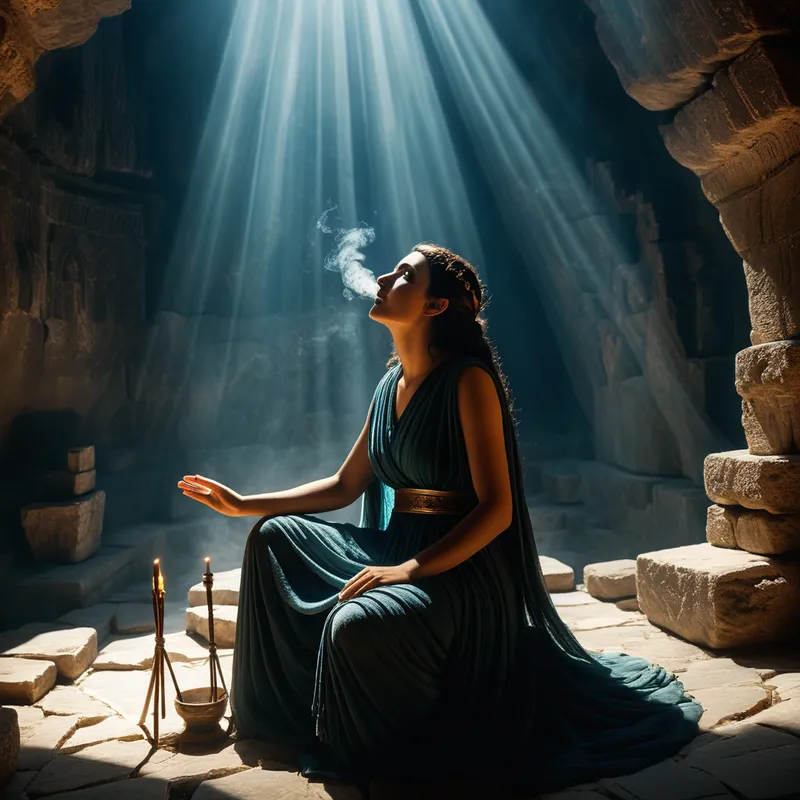
From that day, the cleft in the rock, the chasma, exhaled a strange and sweet vapor, the pneuma, the breath of the slain Python now sanctified by Apollo. To channel this breath, a vessel was needed. She was chosen from the women of Delphi, a simple peasant, often of mature years. On the seventh day of each month, sacred to Apollo, she would descend into the adyton, the forbidden inner chamber of the god’s magnificent temple. There, after ritual purification at the Castalian Spring, she would seat herself upon a three-legged stool, the tripod, placed directly over the fissure.
She would chew leaves of the sacred laurel, Apollo’s tree, and drink water from the spring of Cassotis. Then, the earth’s breath would rise. It would fill her lungs, not with poison, but with a divine madness, the enthusiasmos—the god entering within. Her body would tremble. Her eyes would lose focus, seeing not the dark chamber but the woven threads of fate. Her voice, when it came, was not her own. It was raw, guttural, often fragmented, a torrent of sound from a place beyond language. The god spoke through her, in riddles and echoes.
Before her stood the supplicant—a king fearing war, a colonist seeking a new home, a man accused of murder. They asked their questions of the priests, who then presented them to the shuddering vessel on the tripod. The sounds that issued forth were taken by the attending Hosioi, who would translate the divine gibberish into the elegant, hexameter verses that would shape destinies. “Know thyself,” the temple walls whispered, and “Nothing in excess.” But from the Pythia’s lips came the fateful, ambiguous commands: “You will find a empire when a mule sits on the throne of Media.” Or the chilling warning to a king: “A great empire will fall.” The seeker would depart, bearing not an answer, but a seed—a cryptic utterance to be unraveled by their own lives, for the Oracle revealed fate, but never robbed humanity of its terrible, glorious freedom to meet it.

Cultural Origins & Context
The Oracle of Delphi was not merely a religious institution; it was the geopolitical and psychological nerve center of the ancient Greek world for nearly a millennium. Its origins are prehistoric, rooted in a Mycenaean (c. 1600-1100 BCE) shrine to an Earth Goddess, before Apollo’s mythic arrival superimposed the Olympian order. By the 8th century BCE, it was firmly established as the preeminent oracular site of Hellenism.
Its societal function was multifaceted. It was a supreme court of divine law, consulted on matters of colonization, war, legislation, and personal piety. City-states would seek its blessing before founding new colonies, making the Oracle a central player in the spread of Greek culture across the Mediterranean. It was also a bank of a sort, as wealthy dedications and tributes from across the world filled its treasuries, turning Delphi into a neutral, pan-Hellenic sanctuary. The myth of its founding by Apollo served to legitimize its authority, transitioning the site’s power from the old, chthonic order of Gaia to the new, celestial order of Olympus, while ingeniously incorporating the former’s potency. The prophecies were passed down orally and in inscriptions, becoming part of the historical record, poetry, and tragedy, told and retold by everyone from Herodotus to the tragic playwrights, who often used the motif of the misunderstood oracle to drive their plots.
Symbolic Architecture
At its core, the Delphic myth is a profound map of consciousness. The site itself, called the omphalos, represents the axis mundi—the center of the world where heaven, earth, and underworld connect. It symbolizes the Self in Jungian terms, the central organizing principle of the psyche around which all complexes revolve.
The tripod is the unstable, trembling point of balance where the human ego surrenders to the transpersonal voice of the unconscious.
The Pythia is the ultimate symbol of the anima media natura—the soul as mediator. She represents the ego’s necessary submission to a greater wisdom. Her possession by Apollo (light, logos, clarity) through the vapors of Python (the dark, chthonic, unconscious) illustrates the alchemical conjunction of opposites. True prophecy—or true insight—does not come from pure light or pure darkness, but from their sacred, terrifying marriage in the human vessel. The cryptic, poetic form of the oracles is crucial. It represents the language of the unconscious itself: symbolic, multi-valent, requiring active interpretation (hermeneia). It refuses the literal, forcing the seeker into a participatory relationship with their own fate.
The Dreamer's Resonance
When this mythic pattern stirs in the modern dreamer, it signals a profound encounter with inner authority. Dreaming of seeking an oracle, or of being in a cavernous, resonant place awaiting a message, points to a psyche at a crossroads, yearning for guidance that the conscious mind cannot provide.
Somatically, this may manifest as a feeling of pressure in the chest or diaphragm—the “breath of the god” seeking entry. Psychologically, it is the process of preparing to “consult the depths.” The dreamer may be struggling with a decision where all logical options seem equal or flawed. The Oracle archetype emerges when the ego must acknowledge its limits and listen for the often-disturbing, non-rational intelligence of the Self. If one dreams of being the Oracle, it can indicate a terrifying but potent inflation—a brush with numinous knowledge that the fragile ego structure may not yet be able to healthily integrate, leading to feelings of alienation or a “burden of truth.”

Alchemical Translation
The journey to Delphi models the individuation process perfectly. First, the pilgrimage (nigredo): the seeker must leave their ordinary life, ascending the difficult path to the sacred precinct, representing the conscious decision to engage with the unconscious. Second, the payment and question (albedo): one must offer a sacrifice (the pelanos cake) and formulate a question. This is the clarification of one’s intention, the burning away of trivial concerns to isolate the pure, burning core of one’s existential dilemma.
The climax is the descent into the adyton and the possession (coniunctio): This is the sacred marriage in the depths. The ego (the Pythia) descends into the temple’s womb, sits upon the unstable tripod (surrenders control), and is invaded by the transcendent function (Apollo-Python). This is a voluntary psychotic episode, a creative illness where the old personality is dissolved to make way for a new insight.
The final, crucial stage is not the utterance, but the return and interpretation (rubedo). The raw, often frightening content from the depths must be brought back into the light of day and translated by the “priests”—the integrative capacities of the conscious mind. The cryptic prophecy must be lived into. The seeker doesn’t get a solution; they get a symbolic seed they must nurture with their own actions and reflections. Thus, the Oracle does not solve life’s problems; it initiates a more profound, engaged, and symbolic relationship with them. The goal is not a clear answer, but the creation of a conscious individual capable of holding the tension of the ambiguous, and in doing so, fulfilling their unique fate.
Associated Symbols
Explore related symbols from the CaleaDream lexicon: