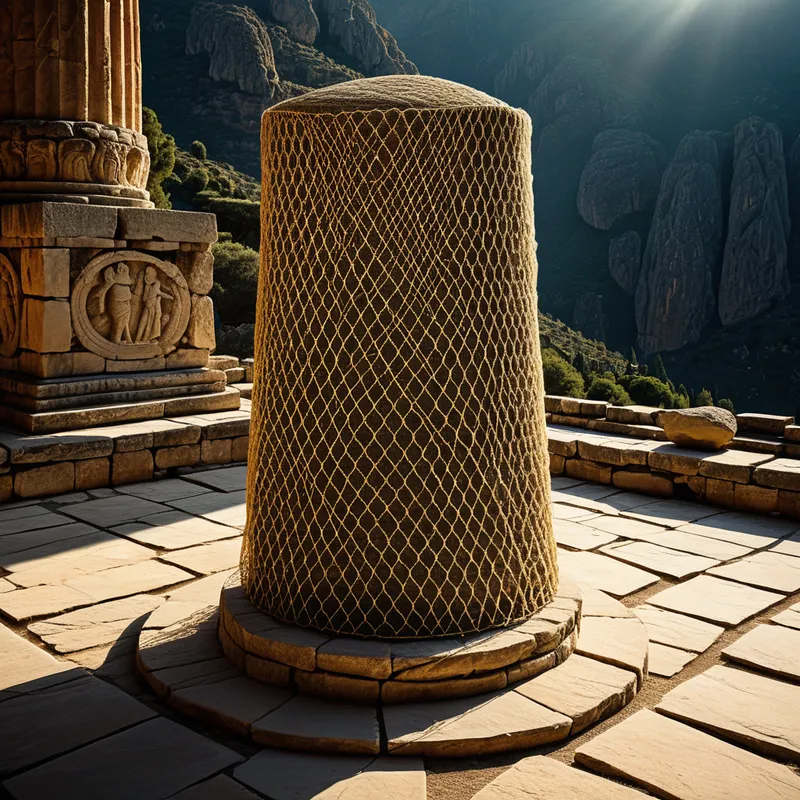
The Omphalos stone at Delphi Myth Meaning & Symbolism
The stone marking the world's center, where two eagles met, establishing Delphi as the sacred axis of prophecy and divine connection.
The Tale of The Omphalos stone at Delphi
In the beginning, when the world was still a map of chaos, the great god Zeus desired to find the true heart of the earth. He released two eagles, creatures of his own sovereign sight, from the opposite ends of the flat disc of the world. One he sent flying from the far eastern rim, where the sun is born each morning in a cradle of fire. The other he launched from the uttermost west, where the sun drowns each night in the wine-dark sea.
The eagles flew with the unwavering certainty of divine purpose, their wings beating a rhythm that measured the breadth of creation. They crossed trackless oceans, soared over the jagged spines of unknown mountains, and passed above the green whispers of endless forests. All the while, the earth held its breath. The winds stilled. The rivers paused in their courses, listening for the moment of meeting.
And meet they did. Not over a mighty city or a towering peak of obvious glory, but over a rugged, wooded slope of Mount Parnassus. With a cry that split the silence of the ages, the two eagles crossed paths, their shadows merging into one upon a particular, unremarkable patch of ground. At the very spot where their shadows became one, a stone fell from the sky—or perhaps rose from the earth. It was the Omphalos.
This was no ordinary rock. It was anointed, a belly-button of the world itself, proof that this place was the mesomphalos, the middle-navel. Here, the powers of the earth gathered thick as honey. Here, the chthonic breath of the ancient goddess Gaia still whispered from a crack in the rock, a vaporous wisdom older than the Olympians. And here, the radiant god Apollo would come, slaying the great serpent Python to claim the oracle for his own. He placed the Omphalos in the innermost sanctuary, the adyton, where it sat, swaddled in a woolen net, upon a sacred tripod. It became the fixed point, the axis. Around it, the world turned. Towards it, kings and beggars alike journeyed, seeking the fragmented voice of the god that now spoke through the Pythia, who sat beside the navel-stone, breathing in the sacred pneuma from the earth, her own body becoming a vessel for the center.

Cultural Origins & Context
The myth of the Omphalos is quintessentially Greek, emerging from the complex religious and geopolitical landscape of the Archaic and Classical periods (8th to 4th centuries BCE). Delphi was not just a shrine; it was the preeminent Panhellenic sanctuary, a neutral ground where city-states fierce rivals elsewhere could meet under a sacred truce. The story of Zeus’s eagles served a profound societal function: it provided a divine, immutable justification for Delphi’s unique authority. Its centrality was not chosen by men, but decreed by the king of gods, making its oracular pronouncements and its role as an international mediator legitimate beyond question.
The myth was passed down through poets, priests, and the countless pilgrims who visited the site. It was physically embodied in the stone itself (multiple symbolic Omphaloi stones have been found at the site), woven into the rituals, and echoed in the words of tragedians like Aeschylus and Euripides. To consult the Oracle was to journey to the center of the known world, to stand at the point where heaven, earth, and the underworld met—a concept mirrored in the Delphic maxims “Know thyself” and “Nothing in excess,” which called for a centering of the human soul.
Symbolic Architecture
The Omphalos is the ultimate symbol of the axis mundi—the world axis, the still point around which the chaos of existence rotates. It represents the concept of a sacred center, a place where communication between the divine, the human, and the chthonic realms is possible. Psychologically, it maps directly onto the need for an internal center of gravity, a core Self around which the complexities of the psyche can organize.
The center is not a place of simplicity, but of maximum tension and connection; it is where opposites are held together, not where they are eliminated.
The two eagles represent the polarities of existence: east and west, sunrise and sunset, beginning and end, conscious and unconscious. Their meeting signifies the reconciliation of these opposites, the moment where duality collapses into a point of singularity and meaning. The stone that marks this spot is thus a symbol of the transcendent function—the psychic artifact that emerges from the confrontation and synthesis of opposing forces within the individual. The woolen net that often swathes it in depictions suggests the interconnectedness of all things, the great web of fate (Moira) that is spun from and anchored at this central point.
The Dreamer's Resonance
When the image of the Omphalos or its thematic pattern appears in modern dreams, it signals a profound process of psychic re-centering. The dreamer may be lost in life’s peripheries, pulled apart by conflicting duties, identities, or desires. The dream is an imperative from the unconscious to find one’s own axis.
Somatically, this can feel like a deep, gravitational pull toward the core, a nausea of disorientation giving way to the solidity of a long-forgotten foundation. Psychologically, it is the process of locating one’s own authentic voice amidst the cacophony of internal and external expectations—the modern equivalent of seeking one’s own oracle. Dreaming of a central stone, a meeting of birds from opposite directions, or a place of powerful, ambiguous speech often accompanies life transitions, where old certainties have dissolved and a new, more integrated center must be established. It is the psyche’s way of conducting its own theoria (sacred journey) to the navel of the world.

Alchemical Translation
The myth models the alchemical process of individuation—the journey toward psychic wholeness—with stunning clarity. The initial state is one of unconscious unity with the Great Mother, Gaia, represented by the chthonic, serpent-guarded oracle. The first stage of the work (nigredo) is the confrontation with the Python, the chaotic, possessive, undifferentiated aspect of the unconscious that must be overcome for consciousness (Apollo) to establish a foothold.
The release of the eagles is the separatio, the active differentiation of opposites (conscious/unconscious, spirit/instinct, east/west) within the psyche. The long flight is the arduous work of analysis, exploration, and endurance. The critical moment of the eagles’ meeting is the coniunctio oppositorum—the sacred marriage of opposites. This is not a battle with a winner, but a convergence that creates a third thing.
The Omphalos is that third thing: the Self, the philosopher’s stone of the psyche, forged in the tension of opposites and placed at the center of one’s being.
For the modern individual, the “alchemical translation” is the lifelong work of building this inner Omphalos. It is the process of holding one’s contradictions at a point of tension until they generate a new, centered understanding. It is finding that still, small point of truth within from which one can speak—or listen to—one’s own oracle, no longer projected onto external authorities, but recognized as the sacred center of one’s own world. The tripod upon which the stone rests is the stable, triangular structure of a life built around this hard-won center: a life of balance, insight, and connection to the deep, vaporous wisdom that rises from within.
Associated Symbols
Explore related symbols from the CaleaDream lexicon: